
Introduction
Chrismukkah, the joyful portmanteau blending Christmas and Hanukkah, represents a harmonious fusion of traditions in an increasingly interconnected world. Celebrated by interfaith families and communities, it symbolises the spirit of inclusivity and shared festivity during the holiday season. Yet, this blended observance also serves as a poignant reminder of the diverse cultural streams that have nourished Western civilisation.
Despite such lived realities, public discourse often simplifies history into single-cause narratives. Recent statements by figures such as Australian Senator Ralph Babet, who has argued that Christianity is the singular bedrock of Western civilisation and that removing it would cause that civilisation to collapse, exemplify an influential and persistent tendency to attribute the entirety of Western development to one religious tradition. Assertions like this carry rhetorical force because Christianity has indeed played a major role across many centuries in Europe and the wider West. Yet to reduce Western civilisation to a monolithic Christian inheritance is to misread the evidence of centuries of cross-cultural exchange, synthesis, and adaptation.
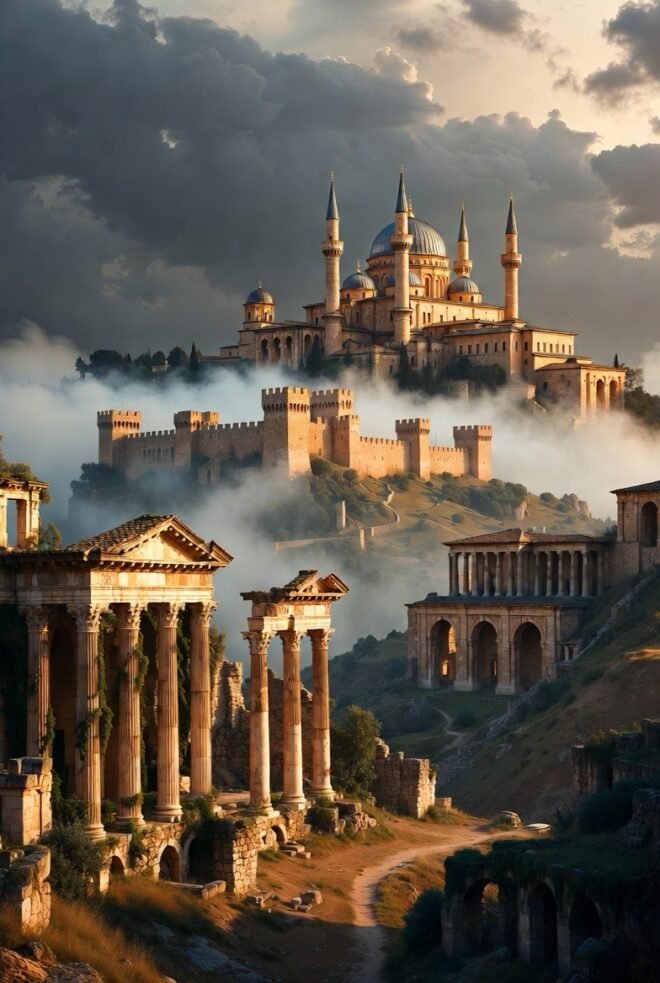
This post advances a different view: Western civilisation is a multilayered, dynamic construct formed by a succession and mingling of contributions from multiple cultures and intellectual traditions. Jewish ethical and legal concepts, Greek literary and philosophical achievements, Roman engineering and legal codifications, Islamic preservation and innovation in science and learning, and other contributions from Celtic, Germanic, African, and Asian sources have all combined over time. Christianity is an influential layer within this mosaic – sometimes enabling progress, sometimes constraining it – but not the exclusive origin of the West’s institutions, arts, and values. To understand the West as a living, composite tradition is to defend a conception of cultural identity that is both truthful and resilient, and better equipped to respond to contemporary challenges posed by exclusionary ideologies.
Jewish Culture: The Ethical and Legal Bedrock
Long before the rise of Christianity and in ways that would later permeate Western legal consciousness, Jewish thought established a framework of moral responsibility and legal ordering that seeded important Western concepts. The Hebrew Bible articulated durable moral injunctions – prohibitions against murder, theft, and false witness; principles of justice and equitable judgment; and the idea that rulers are accountable to laws higher than themselves. These elements provided resources that later juridical and philosophical systems could draw upon.
The Mosaic legal corpus introduced procedures and norms that resonate with modern legal principles: emphasis on evidence, the notion of impartial judgment, protections for property, and duties toward vulnerable community members. Jewish legal reasoning – halakha – did not treat law and morality as wholly separate; instead, it represented an integrated system governing both private conduct and communal life. That integrated approach influenced medieval jurists and provided examples of how law might serve social cohesion rather than mere sovereign command.
Beyond specific rules, the Jewish idea of covenant – a binding agreement between God and people that includes mutual responsibilities and rights – contributed to a contractual conceptual vocabulary that would later be reinterpreted in political thought. Social-contract theories in early modern Europe do not trace directly to Jewish texts in any simple lineage, but the resonance between covenantal language and later formulations of civic obligation and legitimate authority is evident. Thinkers who shaped Enlightenment political philosophy often repurposed and reinterpreted scriptural imagery and logic in framing arguments about rights, duties, and the just constitution of governments.
Jewish intellectual life also influenced Christian and secular thinkers indirectly through medieval exchanges. Jewish philosophers and legalists, most notably Maimonides (Rambam), engaged deeply with Aristotelian philosophy and produced works that circulated in Latin translations in medieval Europe. Christian scholastics such as Thomas Aquinas interacted with these sources – sometimes in agreement, often in debate – synthesising and contesting ideas about natural law, ethics, and reason. Jewish communities also served as conduits for learning and commerce across medieval Europe, creating contact points where ideas and legal practices could travel, even under conditions of discrimination and periodic violence.
In more recent history, Jewish thought continued to influence legal and ethical debates in the West. The Talmudic method of case-based reasoning, attention to precedents, and moral balancing has been cited by jurists and judges as a useful analogue to deliberative legal methods in secular courts. Figures such as U.S. Supreme Court Justice Louis Brandeis explicitly drew on Jewish moral emphases in shaping arguments about social welfare and the role of law in advancing justice. While some scholars argue that Greco-Roman institutions were more direct progenitors of Western law, the combined evidence suggests that Jewish ethical and juridical ideas provided indispensable conceptual tools that merged with these other legacies to shape Western legal consciousness.
Ancient Greece: The Cradle of Literature and the Arts
When we consider the forms of intellectual inquiry, literary aesthetics, and artistic expression that have so profoundly shaped Western sensibilities, Ancient Greece demands central attention. Greek achievements in philosophy, drama, poetry, and the visual arts established enduring templates for how societies understand reason, beauty, and narrative.
Epic poetry – epitomised by Homer’s Iliad and Odyssey – supplied narrative structures and thematic preoccupations that traverse the centuries: the interplay of fate and agency, the pursuit of honour, the complexity of human character under pressure. Greek drama, through the tragedies of Aeschylus, Sophocles, and Euripides and the comedies of Aristophanes, forged drama as a public art that examined ethical dilemmas, social norms, and political life. The structural elements of drama – dialogue, staged conflict, chorus, catharsis – informed later theatrical traditions, from Renaissance stages to modern cinemas.
Philosophically, Plato and Aristotle laid the groundwork for dialectical inquiry and systematic thought. Plato’s dialogues explored questions of justice, epistemology, and the ideal polis, while Aristotle’s examinations of ethics, poetics, politics, and natural science developed methods of classification and argument that would become central to Western learning. Aristotle’s Poetics, with its analysis of tragedy, mimesis, and catharsis, shaped how literary critics and creators conceived the arts for millennia.
In the visual arts and architecture, Greek pursuits of proportion, harmony, and human-centred representation produced canons that were revived and reinterpreted during the Renaissance and later neoclassical movements. Sculpture, with its progression from stylised Archaic forms to the idealised yet lifelike Classical sculptures, highlighted a humanism that celebrated the capacities, frailties, and beauty of the human figure. These aesthetic ideals powered later artistic revolutions and informed public architecture across the modern West – from civic buildings to museums.
Crucially, Greek intellectual modes also introduced habits of public reasoned debate and a conception of civic participation exemplified, in partial realities, by Athenian democracy. Though Athenian democracy was limited in its inclusivity, the institutional invention of deliberative assemblies and a culture of rhetorical persuasion seeded concepts later reimagined in broader democratic frameworks. The Socratic method – persistent questioning to reveal assumptions and seek clearer definitions – remains a pedagogical cornerstone in Western education and legal argumentation.
Ancient Greece’s contributions thus encompass not only discrete cultural artefacts, but also modes of thought: critical inquiry, aesthetic standards, and civic languages that have been adapted and reinterpreted to fit successive historical contexts.
Ancient Rome: Engineering the Framework of Expansion
If Greece furnished a civilisation’s imaginative and philosophical architecture, Rome built much of its practical and institutional infrastructure. Roman contributions span public works, engineering, administration, and law – areas that facilitated the long-term consolidation and expansion of Mediterranean and European societies.
Technological achievements such as aqueducts solved complex urban problems by transporting fresh water across difficult terrain; the remains of Roman aqueducts continue to astonish modern engineers for their precision and scale. Road networks like the Appian Way enabled efficient military logistics and trade across great distances, knitting disparate communities into a functioning imperial economy. Roman concrete and innovations in vaulting and dome construction empowered architects to conceive spaces of monumental scale – structures that would be emulated in public religious architecture and civic buildings in later European history.
The Roman legal tradition – most famously embodied in Justinian’s Corpus Juris Civilis – provided systematic codifications of laws and legal reasoning that would be foundational to continental European legal systems and influence global legal developments through later transmissions. Concepts like the binding nature of contracts, procedural rules, and principles of property and obligations were refined in Roman jurisprudence and later shaped medieval commentators and modern codifiers.
Administratively, Rome developed systems of provincial governance, taxation, urban planning, and public works that supplied templates for political organisation. Municipal institutions, census-taking, standardised currency, and engineering projects together created a level of administrative coherence that made long-distance commerce and cultural exchange viable. Military engineering and fortifications did not only serve conquest; they also underpinned the stability necessary for markets and towns to grow.
Rome’s legacy is therefore both material and institutional: it gave the West technologies for living at scale and legal tools for regulating complex societies. The imprint of Roman law and infrastructure can be traced through medieval Europe into modernity, even while Roman systems were continually adapted by subsequent cultural and political forces.
Islamic Scholarship: Guardians and Innovators of Knowledge
In the centuries commonly described in European histories as the “Dark Ages,” a vibrant intellectual world flourished across the Islamic Middle East, North Africa, and parts of Iberia. Rather than being a mere repository, the Islamic scholarly tradition actively preserved, critiqued, and extended Greco-Roman learning and made original contributions in mathematics, medicine, optics, astronomy, and philosophy.
Centres like the House of Wisdom in Baghdad organised translations of Greek, Persian, and Indian works into Arabic, thereby preserving texts that might otherwise have been lost. Yet the translators and commentators did not simply copy; they corrected errors, synthesised disparate sources, and advanced new methods. Al-Khwarizmi’s algebraic formulations and the propagation of the Hindu-Arabic numeral system dramatically transformed computation and bookkeeping; these developments eased commercial exchange and scientific calculation throughout the Mediterranean world.
Ibn al-Haytham’s work on optics exemplifies how Islamic scholars combined empirical observation with theoretical insight, prefiguring later methodological shifts in natural philosophy. The medical compendia of Avicenna (Ibn Sina) consolidated Greco-Arabic knowledge into systematic treatments that guided practitioners in Europe for centuries. Astronomical instruments and mathematical techniques developed in the Islamic world supported navigation and timekeeping, contributing indirectly to the Age of Exploration.
Philosophically, figures such as Averroes (Ibn Rushd) engaged Aristotle in ways that forced medieval European scholastics to confront questions about reason and faith. These exchanges shaped intellectual debates in medieval universities and contributed to the development of modern critical methods. The transmission of Islamic learning into Europe – notably through centres in Toledo and Sicily where Christian, Jewish, and Muslim scholars interacted – catalysed the intellectual revitalisation that led into the Renaissance.
To minimise Islamic contributions is both historically inaccurate and conceptually limiting. The Islamic world’s dynamic engagement with classical materials and its own innovations were essential links in the chain that led to the modern Western intellectual order.
Christianity: An Influential Layer Amid Diversity – Balanced Perspectives
Christianity has been central to Western history, shaping institutions, moral discourses, artistic expression, and political life in ways that are undeniable. Monastic communities preserved and copied manuscripts, missionary efforts established educational institutions, and Christian charitable practices helped evolve concepts of care for the poor and the sick. Christian thinkers articulated ethical doctrines that inspired movements for human dignity and social reform, and Christian imagery and ritual have saturated Western art, music, and literature.
Yet a fair historical assessment requires nuance. Christianity’s role was often integrative and constructive, but it was also complex and at times repressive. The medieval Church exercised significant political authority; that authority sometimes protected learning and sometimes curtailed it. Events such as inquisitorial persecutions, censorship, and the persecution of dissenters remind us that religious institutions can impede intellectual and social progress. At the same time, many key figures within Christian traditions pushed for reform, translation of texts into vernacular languages, and broader access to education.
The history of the West is thus not a linear outgrowth of a single theological source but a palimpsest in which Christian ideas interact with preexisting legal concepts, with Greek philosophical methodologies, and with knowledge recovered and enhanced from the Islamic world. The abolitionist movement, for example, drew on Christian moral claims about the equal worth of persons but also on secular legal arguments, Enlightenment ideals, and economic and political forces. To treat Christianity as the sole origin of Western values obscures the dialectical processes of synthesis, contestation, and borrowing that characterize the West’s historical development.
The Enlightenment: Synthesising Diversity and Championing Reason
The Enlightenment represents a pivotal moment in which many of the strands described above were consciously recombined into political and intellectual programs that championed reason, tolerance, and rights. Enlightenment thinkers engaged with ancient Greek rationalism, Roman legal thought, Jewish ethical monotheism, and scientific techniques being rediscovered and refined after centuries of inter-cultural transmission.
Philosophers such as John Locke, Montesquieu, Voltaire, and Kant articulated conceptions of government, rights, and ethics that reconfigured political life. Locke’s ideas about consent and natural rights, while not reducible to any single antecedent, drew upon various intellectual currents that included biblical covenants and classical republicanism. Enlightenment dissemination of scientific knowledge and the development of public spheres – salons, coffeehouses, periodicals, and encyclopaedias – broadened participation in debate and critical inquiry.
The Enlightenment’s influence on modern constitutions, on the separation of church and state, and on the valorisation of individual rights is profound. At the same time, Enlightenment projects were not free of contradiction: some Enlightenment figures supported colonial expansion and racial hierarchies even as they championed universal reason. As with other layers of Western formation, the Enlightenment is best understood as complex and contested – a turning point that both advanced human autonomy and transmitted older prejudices into new institutional forms.
The Hijacking by Fundamentalism and the Hard Right
Over the last century, strands of religious fundamentalism and hard-right political movements have sought to claim exclusive ownership of Western heritage, often framing it as primarily or solely Christian and as under existential threat from pluralism and modernity. This rhetorical strategy aims to construct a unified identity by invoking a selective historical narrative that privileges one tradition over others.
Such movements vary widely across contexts, but common features include a literalist reading of sacred texts, scepticism toward scientific consensus when it conflicts with theological interpretations, and an emphasis on cultural homogeneity. When these tendencies align with hard-right political agendas, the result can be policies that restrict pluralism, stigmatize minorities, and distort historical understanding in service of nationalist projects.
It is important to distinguish between mainstream religious perspectives and fundamentalist movements. Many Christian denominations and communities embrace pluralism, support democratic institutions, and engage constructively with science and modern culture. The critique here is targeted at ideological currents that weaponise historical narratives and religious identity to resist change, marginalise “others,” and undermine civic norms.
Recognising the plurality of the West’s foundations is thereby a defence not only of historical truth but of healthy civic life. An exclusive and ahistorical claim that the West derives solely from Christian roots tends to erase contributions from Jewish, Greek, Roman, Islamic, African, and Asian sources, producing a brittle cultural imagination prone to reactionary capture.
Embracing the Multicultural Tapestry
If Western civilisation is a composite of multiple, interacting legacies, then cultivating an accurate and generous historical consciousness has practical benefits. It encourages societies to draw on a wider range of resources when addressing contemporary challenges – from public health to technological innovation, from legal reform to education policy. Acknowledging contributions from diverse cultures undermines divisive narratives that treat “outsiders” as threats to an imagined purity.
Consider the practical examples: the numeral system used in global commerce today arrived via exchanges involving Indian mathematicians and Persian and Arab scholars; medicines and surgical techniques owe debts to ancient Greek physicians, Islamic wizards of the clinic, and later European refinements; architectural forms that shape civic spaces combine Roman engineering with later aesthetic revivals that themselves drew on multiple antecedents. Even linguistic and conceptual frameworks in law and governance – such as the idea of a written code, contractual obligations, and citizen rights – emerged through long chains of borrowing, reinterpretation, and synthesis.
Embracing this tapestry does not mean flattening differences or denying conflict. Rather, it means recognising that the West’s resilience stems from its history of adaptation: ideas travel, get translated, and transform. Multicultural sourcing has been a strength, not a weakness.
Practical Implications for Policy and Culture
Understanding the West’s multilayered origins should inform contemporary policy and civic education. School curricula that honestly present the multiplicity of historical influences better equip students to think critically and to understand how institutions evolved. Public commemorations and cultural institutions can highlight intercultural exchanges rather than privileging a single narrative. In politics, leaders who acknowledge plural heritages are less likely to instrumentals identity for exclusionary ends.
At a cultural level, celebrating hybrid traditions like Chrismukkah becomes a symbolic act of refusing purity myths. Such celebrations exemplify the creative possibilities of cultural exchange and help foster mutual respect. Artistic production, film, literature, and public scholarship that explore the West’s composite history contribute to a more inclusive civic imagination.
Conclusion
Reducing Western civilisation to a single origin story – however rhetorically compelling – does not withstand historical scrutiny. The West is a layered civilisation: Jewish law and ethics, Greek literary and philosophical methods, Roman engineering and legal codification, Islamic scholarship and scientific innovation, and many other contributions each provided essential ingredients. Christianity is a powerful and influential layer within this complex mixture, but it is not the exclusive source.
Recognising the West as a multicultural, adaptive tradition protects it from brittle and exclusionary appropriations. It creates room for more honest public conversations about history: conversations that can acknowledge wrongdoing and complicity, that can celebrate cross-cultural creativity, and that can imagine a shared future built on plural roots. When we honour the complexity of the past, we strengthen our capacity to craft institutions and communities capable of facing present and future challenges. Celebrations like Chrismukkah, and the broader willingness to embrace hybridity, remind us that civilisation flourishes through exchange, adaptation, and the constant reweaving of cultural threads.