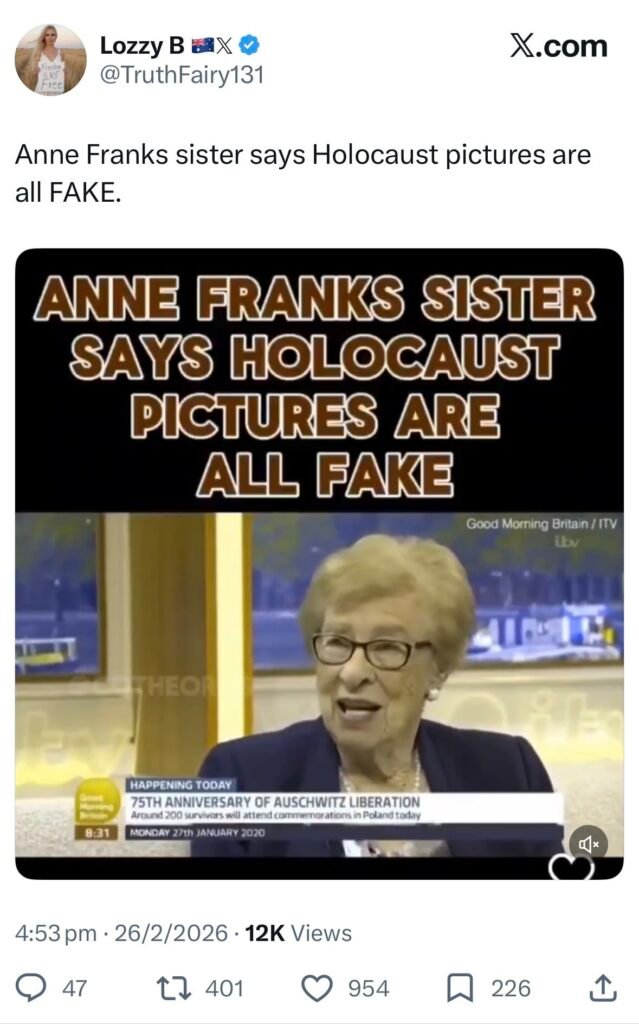
On February 26, 2026, a post on X from the account @TruthFairy131 – an Australian user with a large following – suggested, in a truncated and inflammatory headline, that “Anne Frank’s sister says Holocaust pictures are all FAKE.” The message, bolstered by a short video clip, spread quickly, attracting thousands of views and a torrent of engagement. For anyone descended from those who suffered under the Nazi regime, this was not merely an irritating inaccuracy. It was an affront, a twisting of memory and testimony into a weapon of denial, and a reminder that even a single, sensationalised social-media item can erode public understanding of events that are among the most painstakingly documented in modern history.
This essay will, in careful detail and with respect for survivors and the dead, dismantle the claim, explain how and why such distortions circulate and spread, explore the historical record that makes any suggestion of wholesale fabrication absurd, and argue for pragmatic responses – educational, technological, and, in appropriate cases, legal. My aim is to correct the public record, honour the testimony of survivors, and make clear why truth matters when the memory of genocide is at stake.
I. Correcting the Record: Who Could Not Have Said What Was Attributed
The first and simplest refutation is biographical and incontrovertible. Anne Frank had one biological sister: Margot Betti Frank, born February 16, 1926. Both girls were arrested with their family in August 1944, deported first to Auschwitz, and later transferred to Bergen-Belsen. Historical records and survivor testimony place Margot’s death from typhus in late February or early March 1945. Anne also succumbed to typhus in March 1945, and both sisters were dead before liberation in April 1945. No biological sister of Anne could possibly have made any statement in 2020 or 2026 – Margot Frank died seven decades earlier.
The video excerpt circulated on social media does not feature Margot Frank. It instead features Eva Schloss, Anne’s posthumous stepsister by virtue of her mother Elfriede’s later marriage to Otto Frank. Eva Schloss – born in 1929 – survived Auschwitz and the death marches and spent decades as an educator, chronicler, and witness. She devoted her life to telling the truth about what she saw and experienced and to urging future generations to resist bigotry and hatred.
To conflate Margot and Eva, to call Eva “Anne Frank’s sister” in the misleading biological sense, and to compound that error by adding the blanket assertion that “pictures are all FAKE” is not merely sloppy. It transforms testimony into a falsehood and weaponises that falsehood to cast doubt on the Holocaust itself.
II. What the Video Actually Shows: Context Matters
The clip that circulated in that post is an edited excerpt of a January 2020 interview with Eva Schloss on a morning television program marking the 75th anniversary of Auschwitz’s liberation. In that interview, Schloss reacted to certain photographs and film footage associated with the liberation, making specific observations grounded in memory: she recalled deep snow on the day she was liberated, she commented on the clothing and appearance of people in certain images, and she relayed an anecdote about how some early Soviet images were taken days after the first entry or were staged for documentation or propaganda reasons.
These are narrow, contextual points. They do not equate to denying that Auschwitz existed, that mass murder occurred there, or that millions perished in the Holocaust. Indeed, Schloss’s life and testimony stand squarely against denial. She spoke often of selections, forced labour, the death of family members in camps, and the horrors of liberation. To extract a handful of sentences about photographic provenance and republish them as an assertion that “pictures are all FAKE” is an act of misquotation and intentional misrepresentation. It strips nuance from lived testimony and replaces it with a meme-ready provocation.
III. Why Small Inaccuracies are Weaponised by Denialists
Holocaust denial is not an accidental misreading of history. Decades of scholarship, legal action, and public debate have shown that denialism follows repeatable patterns: cherry-picking anomalies, spotlighting archival inconsistencies, elevating hypothetical “experts” who contradict mainstream historians, and recasting methodological debates as existential disputes over whether the Holocaust happened at all. As Deborah Lipstadt and others have detailed, deniers take real or imagined gaps in documentation and amplify them, implying that isolated irregularities undermine the entire, vast web of convergent evidence.
The misrepresented 2020 interview is a textbook example. Observers have long noted that some liberation images were taken days after the initial entry by liberators, that certain Soviet images were staged for documentary purposes, and that mistakes in labelling have occurred (e.g., a photograph from one camp mistakenly attributed to another). None of this changes the fundamental fact: documentary records, survivor testimony, Nazi bureaucratic orders and reports, forensic remains, Allied and Axis communications, and the enormous consistency of independent sources together establish the systematic nature and scale of the Holocaust.
Deniers exploit the normal and expected complexities of historical documentation – variations in image provenance, later photo shoots to document conditions, and translation errors in captions – and convert them into a narrative of total fabrication. The goal is not historical clarity but to seed confusion and to provide a veneer of “scepticism” which, when repeated enough times across social media, begins to appear plausible to those without the background to evaluate primary sources.
IV. The Mountain of Evidence for What Happened
To understand why casual assertions of “all pictures are fake” are not simply wrong but absurd, one must appreciate the breadth and depth of the evidentiary base for the Holocaust.
• Nazi documentation: German bureaucracy generated mountains of records. Deportation lists, camp registries, correspondence between officials, the Korherr Report, the Höfle Telegram, and many other documents provide administrative continuity to genocide. These are not isolated anecdotes but systematic records of deportation schedules, resource allocations, and death counts.
• Survivor testimony: Tens of thousands of eyewitness accounts, oral histories, memoirs, and depositions – recorded across decades and preserved by institutions such as the USC Shoah Foundation and Yad Vashem – provide consistent, detailed descriptions of processes: selections, gas chambers, forced labour, starvation, and executions.
• Perpetrator testimony: At the Nuremberg Trials and in subsequent interrogations, many perpetrators, officers, and camp personnel described the mechanisms of murder and their roles in them.
• Forensic evidence: Archaeological excavations, mass grave exhumations in some cases, the physical remains of crematoria and gas chambers, and laboratory traces (e.g., Zyklon B residues documented in studies) corroborate documentary and testimonial evidence.
• Allied and Axis accounts: Military reports, liberation photographs (numerous and from multiple nations), and the testimony of liberators align with survivor and perpetrator accounts.
A critique focused on the provenance of a handful of images does nothing to unsettle this convergence. The Holocaust is not a claim dependent on a single photograph. To suggest otherwise is to mischaracterise the nature of historical proof.
V. The Human Cost: Why These Lies Matter Personally and Socially
For individuals like myself who have family histories tied to the Holocaust, misrepresentations are not academic. They are a violation of memory and an emotional injury. Families were torn apart; entire communities erased. Survivors and descendants carry intergenerational trauma that manifests in anxiety, mistrust, and sorrow. When public figures or influential accounts propagate content that casts doubt on the reality of this suffering, they reopen wounds and contribute to a social environment in which antisemitism can flourish.
There is also a broader social cost. Denial and distortion normalise a casual relationship with truth. If the public begins to accept that well-documented tragedies can be dismissed through clickbait and viral misinformation, scepticism metastasises from specific conspiracies to a general disbelief in institutions, expertise, and common facts. That distrust fuels polarisation, breeds resentment, and undermines civic life.
VI. How Algorithms Amplify Falsehoods
The rapid spread of the February 26 post was assisted by social-media mechanics that privilege engagement over accuracy. Short, provocative headlines and clips are formatted for rapid consumption; they trigger emotional responses that increase likes, shares, and comments; and algorithmic curation then promotes them further. An edited video that distils a multifaceted interview into a striking but misleading sentence occupies less attention than the full testimony and often outruns any corrective content.
This is not solely a technical problem; it is a design choice of modern platforms. Many platforms have taken steps to label or remove Holocaust denial content or to add contextual fact-checks. The problem is inconsistent enforcement, the global diversity of legal standards, and, in some platforms’ cases, philosophical commitments to unfettered speech that privilege distribution of content without contextual guardrails. The net effect is a public square where lies can be sown quickly and where the truth requires effort and care to reclaim.
VII. Legal and Ethical Remedies: Where Law Intersects with Memory
Different democracies approach denial differently. Several European countries made Holocaust denial a criminal offence after World War II, seeing denial as an extension of the same ideologies that led to genocide. Legal instruments in Germany, France, Austria, Israel, and others reflect a judgment that public denial and trivialisation of genocide can be an incitement to hatred and is therefore subject to penalty.
Other countries, most notably the United States, take a more speech-protective view, relying on counter-speech and education rather than criminal sanction. Australia and the United Kingdom offer a middle path: laws that primarily target hate speech, incitement, and vilification rather than denial per se, but which can in practice be used to challenge organised campaigns of denial that target protected groups.
Legal remedies can be appropriate in cases of sustained, malicious denial that targets groups and incites hatred. But law is not the only answer. Education, robust public history programs, and the preservation and amplification of survivor testimony are essential. Platforms should be accountable for how their design choices enable harm and ought to adopt transparent, independent processes for labelling and removing content that deliberately misleads about genocide.
VIII. Practical Steps to Combat Distortion
• Education at scale: Curricula must teach not just the facts of the Holocaust but how historians establish facts, how to evaluate primary sources, and why evidence convergence matters. Programs that connect students to survivor testimony, museums, and careful scholarship build resilience against simplistic revisionism.
• Institutional archiving: Continued digitisation of testimony, documents, registers, and photographs – with rigorous metadata that records provenance and context – reduces the likelihood that misattributed images can be used to mislead.
• Platform interventions: Social networks should improve prompt contextual labelling, make expert-reviewed clarifications visible adjacent to viral content, and make enforcement policies consistent and transparent. Algorithmic ranking systems should be adapted to prevent deliberate misinformation from receiving disproportionate reach.
• Public fact-checking and responsive journalism: Fact-checking organisations and responsible media must act quickly and visibly to correct false claims, explaining nuance without amplifying the lie’s rhetorical power.
• Legal options when warranted: Where content crosses into organised hate, targeted harassment, or systematic denial designed to incite violence, legal remedies should be pursued within the bounds of domestic law and international human-rights frameworks.
• Individual responsibility: Users can refuse to spread unverified clips, seek original sources, and amplify full testimony and reputable historical work rather than bite-sized provocations.
IX. On the Ethics of Speech and the Limits of Tolerance
There is an important ethical debate underlying responses to denialist content. Free expression is a foundational liberal value, but it is not absolute. Democracies have long recognised limits on speech that incites violence, threatens public safety, or violates the rights of others. Denialism that is demonstrably designed to rehabilitate genocidal ideologies or to humiliate the memory of victims falls into a morally distinct category from academic scepticism.
At the same time, there is a difference between rigorous, well-evidenced revisionism – the kind that contributes to historical understanding – and the opportunistic, selective quoting and misattribution that social-media denialists practice. We must protect intellectual inquiry while resisting the perversion of that inquiry into tools of hate.
X. Honouring Survivors: The Case of Eva Schloss and Anne Frank’s Legacy
It is especially shameful to exploit the words of a survivor like Eva Schloss. Her life’s work was the antithesis of denial: to witness, to teach, and to ensure that future generations understand the human cost of hatred. Using her statements out of context to imply a broader falsification of history is not only factually false; it is an ethical violation against the dignity of survivors.
Likewise, invoking Anne Frank’s name to amplify a claim that a biological sister said something she could not possibly have said is a distortion of personal memory tied to millions of lives lost. The diary Anne kept remains one of the most important personal documents of the Holocaust era, humanising atrocity for generations of readers. We dishonour that legacy when we twist language and context to spread confusion.
XI. A Call to Vigilance and to Truth
The February 26 post we have examined is a microcosm of a larger danger. It shows how a single edited snippet, amplified by a well-followed account, can feed a broader strategy to sow doubt about a documented genocide. Combating this requires multiple tools: legal where appropriate, technological where necessary, educational where foundational, and, above all, moral where the memory of millions is at stake.
I close with a personal note. To those whose families were taken – those who were gassed, shot, starved, or worked to death – words matter. Testimony matters. Memory matters. The impulse to reduce history to a soundbite or to indulge a viral falsehood is not a neutral failing; it is a small, corrosive act that chips away at collective responsibility. Countering that corrosion is a shared duty: of platforms that design our public square, of institutions that educate, of journalists and scholars who care for evidence, and of individuals who refuse to let truth be sacrificed for clicks.
History is not merely an archive of facts. It is the ledger of human experience, suffering, and resilience. We honour those who suffered by insisting that the ledger remains accurate, by calling out distortions with care and evidence, and by ensuring that the next generation sees the past as it was – with its horrors, its victims, and the moral lessons they compel us to learn.
Let this essay serve both as a correction of a specific misrepresentation and as a broader argument: that truth must prevail over distortion, that the testimony of survivors must be protected from manipulation, and that society must take active steps to prevent denialist lies from gaining traction. In a world where a single post can travel farther than a library, our vigilance is the last defence the dead have against being erased by the living.