In the wake of the Bondi terrorist attack, Australia has found itself hostage to a battle over freedom of thought and speech that is tearing society apart. The horrific events just two weeks prior to Christmas on the first night Hannukah have emboldened conservative voices intent upon leveraging the pain for political gain. The actors are many – politicians past and present, professionals (but notably, not café shop owners) and lobby groups. Two announcements this week have demonstrated the depth of division in this country – the decision by the Prime Minster Anthony Albanese to conduct a Royal Commission into the Bondi attack, and a separate decision by the Board of the Adelaide Writer’s Festival to deplatform Palestinian speaker Randa Abdel-Fattah from a planned engagement in its three week program scheduled to commence in six weeks.
Whilst the festival acknowledges the Traditional Owners on its website, it seems that the Board has no issue with demonstrating its racism toward a Palestinian. The Board’s statement indicates that Abdel-Fatah’s past statements make her a culturally insensitive speaker in the wake of the Bondi attack. Her statements have included in 2023 arguing that the Israeli Government is conducting a Palestinian holocaust in Gaza. She subsequently was investigated and exonerated for misuse of research funds by the Australian Research Council (ARC), the decision announced on 24 December, just ten days after the Bondi attack.
Born and raised in Australia, Randa is of Palestinian-Egyptian heritage and has both represented and written for Islamic people through her roles at the Islamic Council of Victoria. A practicing lawyer, her PhD, “Islamophobia and Everyday Multiculturalism in Australia” was completed in 2016, which has placed her well to stand as patron for the Racial Justice Centre. It can be strongly argued that she is well placed to assert that the published decision of the Adelaide Writers Festival Board is racist.
The Board has also stated that it has appointed a sub-committee to “… oversee the ongoing Board-led review, and guide decisions about Adelaide Writers’ Week in the near and longer terms. This includes ongoing engagement with relevant Government agencies and the appointment and/or advice of external experts.” Yet, the Board has jettisoned one highly qualified and experienced expert because of “cultural sensitivities”. Further in establishing it’s review, the Board undermines the role of Louise Adler, Director of the Adelaide Writers’ Week. A strident supporter of Palestinian rights, Louise has hot shied away from the difficult conversations that threatens to engulf the country in which she lives, and the communities in which she has grown. As much as Randa Abdel-Fatah is a voice for human rights, so is Louise Adler.
The Board statement further states that, “This suite of decisions has been taken with the genuine view that they provide the best opportunity for the success and support of the Adelaide Festival, for Adelaide Writers’ Week and the communities we seek to serve and engage.” It is clear from their actions that the communities they are seeking to engage exclude Palestinians.
We are yet to see what action Randa Abdel Fattah takes in response, beyond her statement online; given her background and expertise, it is unlikely that she will let this matter quietly subside. And nor should she. But the backlash is already being felt, as was the case with the Bendigo Writers Festival in August last year. A slew of writers scheduled to appear at the Adelaide Festival, including Karen Wyld, Peter Greste, Michelle de Krester and Jane Caro to name a few, have notified organisers that they will boycott the event, as has the Australia Institute which is withdrawing its support.
Political interference in the decision by the Board needs to be considered, given that South Australian Premier Peter Malinauskas indicated his lack of support for Abdel-Fatah being included in the Festival. Whilst the Festival receives state funding, the politicisation of such an event is an act of censorship that will haunt the event in years to come. It is also clear that the success that the Board so earnestly believes requires the exclusion of the Palestinian voice will be judged by the attendance at this event, but the ever growing list of writers choosing to withdraw from, one must ask whose agenda they are seeking to appease.
With the concurrent announcement by the Prime Minster that he will establish a Royal Commission into antisemitism, it is ironic that Islamophobia is simultaneously politically endorsed. It is a divisive, vindictive and destructive route that allows derision based upon ethnicity and it being blatantly and deliberately endorsed by those in power. We’ve been saying saying since the very first post at BlakandBlack. This country still has a lot of learn about inclusivity and welcome, rather than bending to the marginalising voices in the wings. Whether it is the IHRA definition of antisemitism being enforced upon speakers, the exclusion of a those critical of our regimes or the tokenism of acknowledging Traditional Owners when they practice such obvious racism, festivals, be they writers or any other form of art, do not deserve public support or funding, and leaders who politicise them need to be held to account.
It’s a shameful decision by the Board of the Adelaide Writers Festival, however difficult they intimate it may have been. We can only hope that after the spate of such instances in the past year that other events are conscious of their own biases, the pressures of individuals and lobby groups and have the integrity to behave in a genuinely inclusive manner. If they do not, we will see the narrowing of opinions and acceptable speech to privilege certain voices over others and risk tearing the social cohesion that makes our multicultural nation unique.
We close this post with one of Bakchos’ poems, a reflection on decisions of that have allowed cultural erasure and the cruelties they allow.
To Erase a People
Strike at the names that echo old olive groves –
scrub them clean from road-signs, shelves, the whisper of curriculum;
snatch away keffiyeh threads and stories soft as childhood.
The effort, enormous, is the stripes of paint
across a mural, the whiteout stammering over ink,
the cold click of a mouse deleting a nation.
Australia, do you stand taller for this?
Does the red earth pulse more purely, untroubled
by the footprints you refuse to remember?
You grit your teeth against the music of their vowels,
turning your back, arrogant, as if the world’s memory
were fragile enough to be swept away
like sand from a welcome mat.
To erase is not to heal, not to build:
erasure is a shallow grave, a monument
to your own fear – of difference, of justice, of the reflection
not seen, but burning, in every blacked-out word.
You do not rid history of pain by denying its voice.
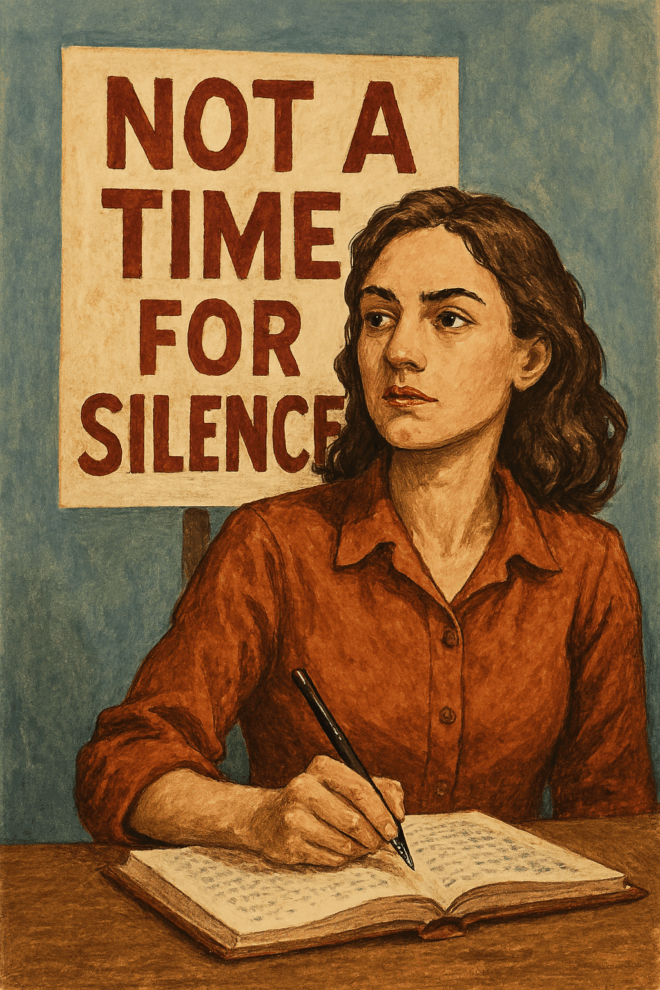
You do not make peace by commanding silence.
Look at the empty shelf, the vanished book,
the hollow classroom where stories might have grown.
This is not a society confident in its own spirit –
it is a mirror, cracked with smallness,
petty cruelties glinting at every edge.
Erasing Palestinians from sight proves nothing
but the ferocity of intolerance,
the banality of a racism clothed as order.
But you cannot unmake a people with censorship,
nor kill a culture by decree. Every filtered photograph,
every cancelled speaker, every banned flag
is seen, remembered, recorded – not as triumph,
but as the measure of cowardice,
and the tally of wounds not easily forgiven.
History keeps its own account.
What you erase is always rewritten
in the hearts of those who refuse to vanish,
whose names find root, again and again,
even as you turn the soil.
Know this: Justice, though exiled,
is patient – and will not be erased.
by Bakchos