On 26 January 2026, a bomb was thrown into the Invasion Day Rally in Perth. The bomb failed to detonate, possibly due to incompetence of the attacker. Nonetheless, the attack has been verified as the second terrorist incident in as many months in Australia, but has been the subject of far less publicity and political posturing, and much more reserved response by police than the events at Bondi despite the fact they recognised the device as a bomb from the outset. Even more concerning is the muted response of police to an actual attack on Indigenous people compared with the bogus Dural caravan-bomb 12 months ago. Such disparate responses between events a matter of six weeks apart raises concerns about the inequality of policing and law enforcement between communities and the bias displayed among leaders across the country.
Defining terrorism
No consistent definition of terrorism exists – one man’s terrorist is another’s freedom fighter. Following the Munich Olympics the United Nations met resistance from African, Asian and Middle Eastern nations when seeking agreement upon a definition, which would then assist in enabling international cooperation to prevent terrorism. But politics and national agenda rarely align cleanly, particularly when the incumbent government sees that aims of a particular group designated as terrorists as aligned with their own political and/or national interests. Labels could carry consequences for West and East alike. The UN’s International Convention for the Suppression of Terrorist Bombings, enforced by international Treaty since May 2001, lacks a definition of terrorism
What does seem consistent is that terrorists are presumed to represent a minority within a society, possibly one perceived to be growing in number and hence strength. Concepts of violence, coercion and intimidation of a non-combative populace and/or its government, justified by an underlying ideology, are expected and reflected by both academics and legislators. Terrorism is not accepted to be accidental and has an impact that reaches far beyond those within the line of direct harm, with disruptive social and psychological effects, from panic to sympathy, all included as part of the terrorists’ intent. Some researchers also argue that terrorism is directed at symbolic targets.
It’s not hard to see why defining terrorism has been elusive. The actions of a particular nation against another, directly or indirectly, may create an incident requiring an international response with far greater implications than simply a breach of a national or criminal code. It could also trigger international arrest warrants, limiting movement of bureaucrats and heads of state. We see this already, without an agreed definition of terrorism due to existing international agreements.
Law enforcement and terrorism
Policing generally focuses on the actions of presumed offenders and their applicability to the criminal code; motivations and thought processes are not determinants for investigation or arrest. An actual act of terrorism triggers a more immediate response than a threat of violence. Freedom of speech and association are core tenets of a democracy and whilst what is said and, in whose company, may be unnerving, it’s not always a crime.
In the pall of the Bondi attack, Australians are seeing the long arm of political correctness taken to an extreme that equates criticism with hate speech and hence, perceived threat. The community fear generated by genuine acts of terrorism can be further inflamed by opportunistic lobby groups and legislators to enact laws that constrain civil liberties, including legitimate criticism of individuals, national and international bodies.
The microcosms of society cleaving our country
Terrorism must be prevented, but it cannot come at the cost of silencing the voices of those who simply express a contrary opinion. The slippery slope to authoritarianism through the chilling effect of laws that were enacted in haste, leveraged by fear, has the real possibility of limiting political expression and curtailing the very processes that underpin democracy. When the word of a Muslim is disregarded because of his faith, when the actions of a white person are lessened because of his colour, when the targeted group is ignored because they are Indigenous, we empower those who would seek greater control. History is very clear about where that may lead a society.
In Australia, colour has a firm hold on community relations. There’s a spectrum from white to black. The white person is generally perceived to be raised as a Christian and has a relatively privileged existence compared with the blackfulla, still viewed by some as stone age relics incapable of independent thought or action to better their own lives, Christian or not. Between these extremes are a range of others. With greatest proximity to Indigenous people are the Muslims and due to the acts of extremist and fundamentalist organisations, the entire community is often portrayed as violent, disinterested in engaging or interacting positively with the rest of society. Following some distance along the spectrum are Asians, distrusted for their focus on educational advancement, many see them as a threat who seek to control corporations and property. The rhetoric around Chinese goods, property purchase and corporate acquisition is viewed with far more distrust by Western nations that that of the United States. Notably, Western culture is primarily assumed to be Christian and white. In more recent times, Zionism has been accepted at the white end of the spectrum.
The overt willingness with which media bias toward black or brown people is directed can be read daily in any media. A terrorist attack in Quebec in 2017 was initially reported in a Fox News tweet to be violence instigated by a Moroccan-born man. It was in fact a Canadian-born white supremacist who was the murderer, the Moroccan man was the one who called the police. Correction of the assertion required the intervention of the Canadian Prime Minister Justin Trudeau. So biased are attitudes to foreigners that the hero of the Bondi attack who disarmed one of the terrorists, Ahmed al Ahmed, was initially identified as Edward Crabtree, before corrections were published.
Most concerningly, the attack on the Invasion Day Protest two weeks ago by a radicalised white man was downplayed for two weeks before police finally conceded that the aggressor’s actions constituted a terrorist event. The Western Australia Police Commissioner is quoted as saying:
“All of us in this room, all of us in our community, would have seen a bomb being thrown into a crowd on Australia Day at an Invasion Day rally as an act of terror … But to charge someone with a terrorism offence, we need to prove motivation and the ideology of that person.”
So was it the that the perpetrator was white or that the rally was led by Indigenous people that made the Commissioner hedge? The act itself was intended to instigate fear and to harm a group of people who had gathered to express a shared opinion. The NSW Police Commissioner declared the Bondi attacks an act of terrorism the same night. The differences? The aggressors at Bondi were brown, Muslim and people were killed.
We have no means of determining the religious faith of the man charged with the offences at the Perth Invasion Day rally. Whilst his identity has been suppressed for his safety, the limited vision online shows a clearly white man and his actions clearly targeted a gathering of people with a common ideal, namely Indigenous recognition and mourning. The attacker constructed a homemade bomb, “filled with ball bearings and screws” that would become projectiles causing the most horrific battlefield-type injuries that would overwhelm emergency services and hospitals, cause fear and engender sympathy among neo-Nazis.
In the days prior to Australia Day, NSW Police acknowledged that they were investigating a letter sent to the Lakemba Mosque threatening a range of people including Middle Easteners, Aboriginal and Torres Strait Islanders and political figures with kidnap and being beaten to death. So when a bomb was thrown into the event in Perth three days later, why would the WA Police hedge on calling it a terrorist event? Would it have mattered if people had actually died? Would they still have hedged for two weeks if Indigenous people were carrying out Sorry Business and non-Indigenous supporters were also conducting funeral rites?
It don’t matter if you’re black or white … only it does
The politicians and wannabes have been far less strident in their denunciation of the attack on the Invasion Day rally in Perth than they were for Bondi. Quick to denounce the act of hatred against the Jewish population, a necessary and right reaction, they have ignored the Indigenous people of this country. I ask again – would it have mattered if the bomb had actually exploded? Would we be seeing an Indigenous envoy called forward to consult on everything from university curricula to speaking engagements? Would we see a voice implemented that would have direct access to the parliament?
Parliament needed to be recalled from the summer break to make official statements about the events in Bondi, but that did not stop the politicians from climbing on their soapboxes to expound their opinions and support for the terrified and heartbroken Jewish community immediately. Where has been the same outrage for the terrified and heartbroken people in the Indigenous community? When did Albanese visit Perth to meet with Indigenous leaders to listen and reassure them that the government would ensure that a full and thorough investigation would be conducted? Where is the acknowledgement of anti-Aboriginal racism?
Pauline Hanson, so quick to capitalise upon the Bondi attack has been entirely silent about Perth. The former and possible future politician Josh Frydenberg, so sanctimonious in his rage following Bondi, seems to have exhausted his supply of righteousness when it comes to the Indigenous community. A notable exception to the conservative politicians who have been vocal about the attack at Bondi and who has also spoken up for Indigenous people is Allegra Spender, whose unequivocal and detailed condemnation of the attack must be acknowledged.
Israeli President Issac Herzog is currently in Australia at the invitation of the Australian Prime Minister, Anthony Albanese and the Governor-General Sam Mostyn. Both the Prime Minster and the NSW Premier Chris Minns have referred to the Israeli President as the Head of State for Jewish people who may not be Israelis citizens. There are many proud Jewish people in Australia. There are many proud Muslims, Asians and Indigenous people as well. It is an afront to every other culture to acknowledge one group and place the sovereignty of another country over your own within the borders of your own nation. The insult is to every Australian, including the vastly ignored and racially abused Indigenous people, the First People of the land we now call Australia.
Minns’ derogatory comments suggesting that Muslim’s on their knees praying at the Sydney protest against Herzog’s visit may have been a farce was also offensive and could be considered Islamophobic. Minns, Albanese and Mostyn kowtow to the Israeli President at the expense of their own citizens whilst turning a blind eye to the International Criminal Court proceedings against Israel. The entire Israeli leadership, including Herzog, are under scrutiny for the breach of human rights against the Palestinians of Gaza. Australians marched in the tens of thousands during the March for Humanity in August 2025. It was a peaceful, welcoming and heartwarming event that expressed to Australia’s leaders and those overseas that the disproportionate decimation of an entire people, especially children, in response to the events of 7 October 2023, is unacceptable. And just as they marched for the Gazans, they gathered to mourn for those lost and injured at Bondi … they mourned for themselves and the naivety that was lost.
Terrorism in Australia
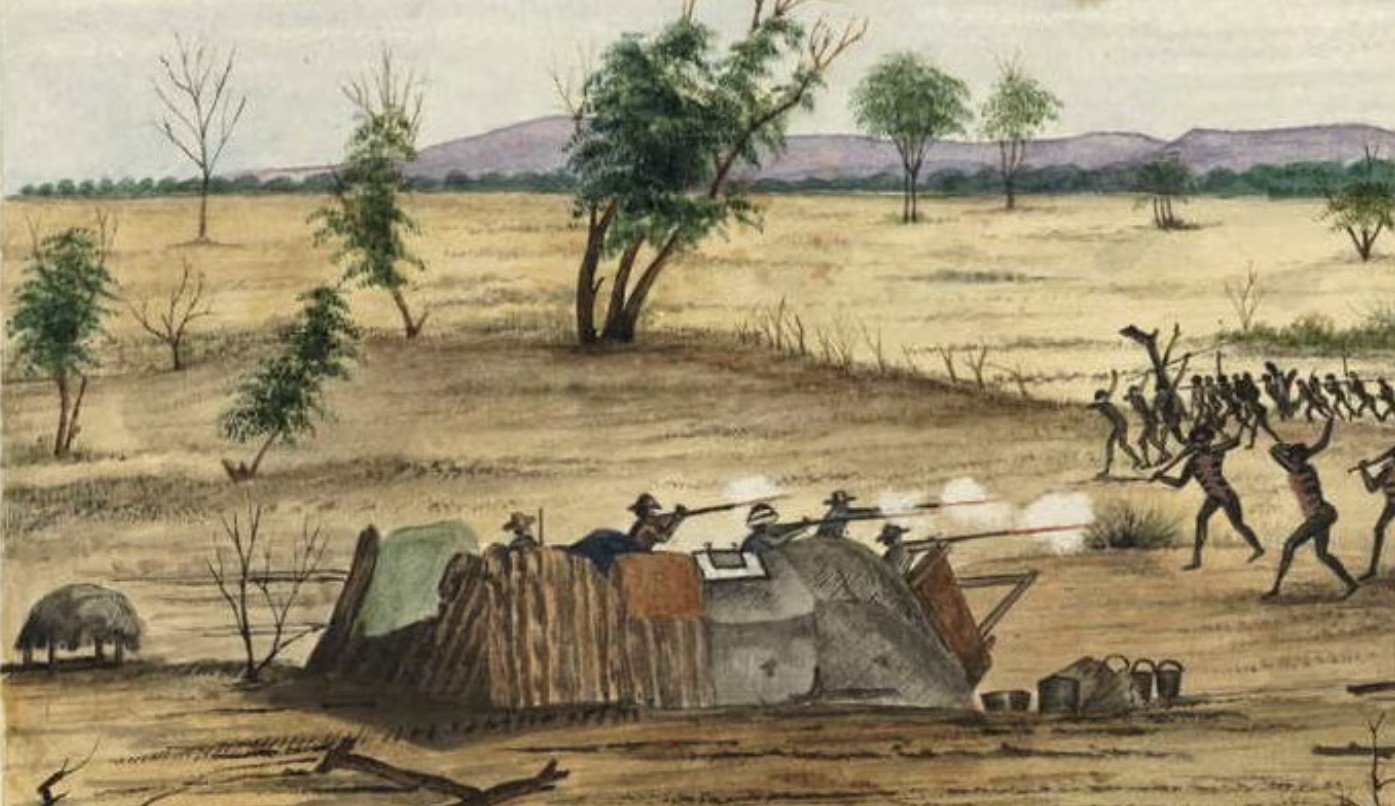
Compared to many other Western nations, Australia has had a very sheltered existence. Genuine terrorist attacks are rare, shootings are rare, there’s no military carrying weapons on the streets or in airports. Police carry guns, but they are used infrequently. Australians really have been quite blessed and the relative peace is one of the attractions for foreigners who seek to immigrate. But this country has not been entirely immune. Since 1970, 106 terrorist events have been declared in Australia resulting in 47 deaths and 143 injuries. Bondi has by far been the worst of those recognised as such. But the perpetual racism experienced by Indigenous people in Australia and the lack of acknowledgement or enduring efforts to address the underlying causes remains the most egregious and shameful chapter of sagas in this nation’s history. Since settlement, Indigenous communities have been terrorised by non-Indigenous people. We can call it what we like, but the kidnaps of the Stolen Generations, the poisoning, the theft were all acts of terrorism, we just call it something else – colonisation, nation-building, settlement.
The Indigenous people of Western Australia and supporters in attendance at this year’s Invasion Day Rally are right to be upset, they have every right to be indignant. The delay in declaring the attack on Invasion Day a terrorist event and the WA Police Commissioner’s choice of words comes across as a begrudging acknowledgement. In the past few months we have seen attacks on the Camp Sovereignty in Kings Park, an act that was intended to case fear, do harm and was driven by the political ideology of neo-Nazis.
And then there’s the protected status of the 31-year old attacker, name and personal details suppressed. The gutless soul may be shown in CCTV footage wearing a mask when he threw his bomb, but why is his identity more precious than that of the surviving brown murderer from Bondi? Why is he simply not placed in maximum security for his own protection? Double standards never look good when it comes to law enforcement.
Hope springs …
Indigenous Australians have watched the responses to the events of Bondi and wondered at how they can continue to be so overlooked. The most enduring and longest surviving people by far on this land, they have watched everyone else advance and be protected bar themselves. It seems that everyone has a direct line to parliament and the Prime Minister except Indigenous people. The lack of understanding among the broader community of the sense of betrayal at the failed Voice to Parliament Referendum and the subsequent appointment of envoys has gouged a deep wound into the Indigenous psyche. A generation of effort and hope that they would finally have a means to engage and work with Australia’s leaders directly, to be heard firsthand, evaporated like so many of their dreams. Without the direct voice or a body or envoy, Indigenous people are yet again ignored and response to the racism they experience daily remains glacially slow. There is no equality, no safety, no societal balance when we continue to leave the most marginalised and racially vilified people in Australia behind.
Australia’s leaders worry more about the perceptions of leaders overseas than the people who they represent. As the Prime Minister and state Premiers fawn over a foreign dignitary, the attack by the Perth terrorist is drowned out, just another attack in the 238 years since colonisation to add to the list for the most racially vilified sub-group in the country.
Ignoring Indigenous people speaks far more to the ethics of those who have arrived since settlement than it does to First Nations People. A Royal Commission that investigates racism against a limited section of the community will not address the broader problems facing the cohesion necessary to make everyone feel safe. The manoeuvrings and self-serving politicking of those in Parliament more concerned with keeping their seats or expanding their power won’t restore the peace so many seek. We must include those with the smallest and least supported voice, extend our arms around those who have arrived since settlement and reach to the most recent arrivals who call this place home. We must work together to protect each other, to respect differing points of view without marginalising anyone. We must cherish this place we call Australia and unite, regardless of our backgrounds, to ensure everyone who lives here is safe, supported and welcomed at home. It’s the only way we will control and treat the negativity that is festering below the surface.