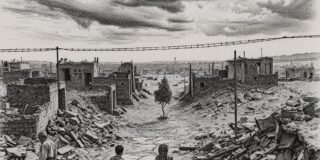

Imagine a world where hatred isn’t learned, but lurks in our DNA, a primal spark waiting for the right tinder to ignite into inferno. Are we, as humans, hardwired for hostility, our brains etched with ancient survival codes that pit “us” against “them”? This chilling question strikes at the core of our existence, blending evolutionary whispers of tribal defence with the harsh realities of cultural indoctrination. Picture early ancestors huddling in caves, eyeing strangers with suspicion to protect scarce resources, fast-forward millennia, and those instincts morph into modern massacres, fuelled by power plays and propaganda. Yet, hope flickers: if prejudice is partly programmed, can empathy be rewired? Delving into harrowing chapters of history and headlines, from Tulsa’s scorched streets to Gaza’s relentless bombardments and Rohingya’s desperate flights, we dissect these patterns of division, challenging whether breaking the cycle is within our grasp or doomed to repetition.
Reflecting on historical atrocities provides a framework for scrutinising present-day conflicts, exposing recurring strategies that societies employ to sidestep responsibility for large-scale harm. The 1921 events in Tulsa, Oklahoma, exemplify orchestrated devastation aimed at a vulnerable group, driven by financial jealousy, ethnic hostility, and unrestrained group aggression leading to extensive ruin. Greenwood, dubbed Black Wall Street, symbolised African American achievement in the initial decades of the 20th century. Business owners established flourishing enterprises, encompassing lodging establishments, performance venues, and food markets, cultivating an independent hub within the constraints of segregationist regulations. This accomplishment stirred bitterness among white inhabitants, perceiving it as a challenge to their supremacy. The catalyst ignited on May 30, 1921, when Dick Rowland, a youthful Black footwear polisher, faced allegations of attacking Sarah Page, a white lift attendant, inside a central structure. Although specifics stay unclear, certain narratives indicate a mere misstep, the occurrence amplified inflammatory press titles, provoking whispers of an imminent execution by hanging.
By the following morning, a white crowd assembled at the judicial building, insisting on Rowland’s surrender. Equipped Black ex-soldiers, numerous having served in the global conflict, converged to safeguard him, resulting in a clash. Shots rang out, and the turmoil intensified swiftly. White throngs, expanding to multitudes, penetrated Greenwood, plundering and incinerating edifices methodically. Officials worsened the disorder: Tulsa law enforcement authorised hundreds of white individuals, equipping them as auxiliary officers to participate in the onslaught. The state militia, summoned, chiefly confined Black citizens instead of stopping the aggressors. More alarmingly, civilian aircraft, some allegedly releasing flammable projectiles, hovered above, assaulting the area from the skies in what certain chroniclers label as the inaugural airborne strike on U.S. territory. Fires consumed more than 35 city segments, obliterating over 1,200 dwellings, 191 commercial sites, religious centres, educational institutions, and a medical facility. The loss of life proved disastrous: formal documents referenced 36 fatalities, yet period aid organisation approximations climbed to 300, with observers describing communal burial sites and corpses discarded into the nearby waterway to hide the proof. Thousands found themselves without shelter, corralled into detention areas under surveillance, their asset demands subsequently rejected by coverage providers who categorised the incident as an uprising provoked by Blacks.
The consequences amplified the injury. No white instigators encountered legal action; rather, fault transferred to those harmed, with investigative panels blaming Black inhabitants for equipping themselves vigorously. Regional publications enforced a silence, erasing archives and dissuading those who endured from voicing experiences. Across eras, the slaughter receded from collective recollection, excluded from state learning resources until the closing years of the 1900s. Those who survived, such as Viola Fletcher, who reached 107 years and addressed lawmakers in 2021, portrayed enduring distress– vanished occupations, fragmented households, and ongoing deprivation. Compensation initiatives, encompassing a 2001 governmental body’s suggestions for disbursements and educational grants, faltered among judicial disputes. In 2024, the state’s highest tribunal rejected a claim by surviving individuals pursuing restitution, referencing time limits, additionally solidifying the rejection. This obliteration not solely sustained financial inequalities but also strengthened institutional bias, permitting the account of reciprocal disturbance to eclipse calculated terror. Tulsa’s chronicle demonstrates how authority frameworks can coordinate brutality, subsequently alter records to exonerate themselves, leaving offspring to excavate concealed realities via digs for collective tombs and verbal legacies maintained in hushed tones.
This occurrence highlights how organised influence can sustain obliteration, converting a deliberate assault into a marginal note. Advancing to the persistent situation in Gaza, comparable mechanisms of relocation, shelling, and account management surface within the Israel-Hamas dispute that heightened following October 7, 2023. What commenced as Hamas’s penetration, causing roughly 1,200 Israeli losses and abductions, elicited a reaction that worldwide monitors have depicted as excessive and structured. By November 2025, the fatalities in Gaza exceeded 43,000, with most non-combatants, encompassing over 17,000 youths, per wellness authority data verified by assistance entities. Foundations crumbled: more than 60% of residences ruined or impaired, whole districts flattened, and vital provisions like hydration, power, and health services paralysed by recurrent assaults and restrictions. Medical centres, formerly refuges, turned into objectives–Al-Shifa and Al-Aqsa installations withstood blockades and explosions, with healthcare workers recounting compelled departures amid combat. Learning facilities, assigned as protections, endured analogous outcomes, with international organisation sites struck despite shared locations for security.
Global entities have elevated their evaluations. In September 2025, the UN autonomous worldwide investigative body determined that Israeli measures formed extermination, referencing proof of purpose to eradicate Palestinians as a collective via immediate slayings, enforcement of perilous circumstances, and refusal of relief supplies. The document outlined configurations: extensive deployment of potent detonators in thickly inhabited zones, yielding unselective damage; limitations on nourishment, fluid, and remedies that propelled Gaza toward scarcity, with undernourishment levels escalating among young ones; and declarations from Israeli authorities implying dehumanisation, such as allusions to Palestinians as beast-like or summons to obliterate Gaza. A following October 2025 document by the UN designated reporter on the seized Palestinian regions bolstered this, designating the condition a group offence entailing external nations’ involvement via weaponry provisions and political shielding. Amnesty International and Human Rights Watch supported, recording compelled movements of over 1.9 million individuals, almost Gaza’s full populace, into contracting secure areas that demonstrated otherwise, as bombardments persisted without pause.
Nevertheless, these conclusions encounter opposition. Israeli leaders assert that activities aim at Hamas foundations, encompassing subterranean passages and projectile locations integrated into non-military zones, portraying losses as lamentable yet inevitable in metropolitan combat. They reference alerts distributed through pamphlets and communications, although detractors contend these prove inadequate or deceptive, directing crowds into lethal sectors. The global judicial tribunal, seeking detention orders for commanders on both factions since 2021, heightened examination in 2024 with claims of combat offences like deprivation as a tactic. Similarities to Tulsa proliferate: just as Greenwood’s affluence prompted resentment and demolition, Gaza’s endurance beneath years of enclosure, enforced since Hamas’s 2007 dominance, has encountered sequences of intensification. The 1921 skyward explosions resonate with contemporary unmanned and aerial campaigns, where accuracy assertions contradict broad wreckage. In Tulsa, officials armed crowds; in Gaza, claims endure of synchronisation between armed forces and coloniser clusters in neighbouring West Bank regions, although Gaza’s emphasis stays on enclosure implementation. Harm-attribution echoes as well: Tulsa’s disturbance designation suggested Black hostility, paralleling Gaza accounts of protective barriers that assign non-combatant deaths to Hamas methods, possibly diverting from balance infringements under worldwide regulations.
The mental and communal repercussions reflect one another deeply. Tulsa survivors narrated visions of blazes and weaponry discharges, leading to scattered kin and weakened group connections. In Gaza, reiterated injuries–from the 2008-2009 initiative to the 2021 heightening, accumulate with the present stage, where youths display intense stress disorders, involuntary releases, and hostility. Inherited consequences threaten: just as Tulsa’s progeny confront prosperity disparities linked to vanished holdings, Gaza’s adolescents acquire a terrain of shortage, with learning interrupted for over 625,000 learners and joblessness lingering at 80%. Ecological deterioration contributes dimensions, waste overflows from harmed installations pollute liquids, promoting illness eruptions like a disease eliminated in other places. This lacks a precise comparison; Tulsa arose from internal ethnic structures, Gaza from territorial strains involving control and opposition. But both reveal how aggression against confined groups can target elimination, requiring detailed responsibility via orbital visuals, observer accounts, and judicial examinations to oppose denial.
To deepen this exploration of patterned devastation, examine the Rohingya crisis in Myanmar, a parallel modern ordeal where ethnic and religious targeting has spawned genocide allegations, weaving additional threads of resemblance and distinction with Tulsa and Gaza. The Rohingya, a Muslim minority in predominantly Buddhist Myanmar, have endured centuries of marginalisation, stripped of citizenship under a 1982 law that deems them Bengali interlopers despite deep roots in Rakhine State. Tensions simmered through discriminatory policies, confining them to villages resembling open-air prisons, denying access to education, healthcare, and mobility. The crisis erupted catastrophically in 2017, when military operations, triggered by attacks from Rohingya militants, unleashed a scorched-earth campaign. Soldiers, alongside local mobs, razed villages, committed mass rapes, executions, and infanticides, forcing over 700,000 to flee across the border to Bangladesh in a matter of months. UN investigators labelled these acts as genocide, citing intent to destroy the group through killings, serious bodily harm, and conditions calculated to bring about physical destruction. Estimates suggest up to 25,000 deaths, with satellite imagery revealing over 392 villages burned, echoing Tulsa’s systematic arson and Gaza’s aerial bombardments.
By November 2025, the situation remains dire, with ethnic Rohingya facing the most severe threats since 2017, amid Myanmar’s broader civil war following the 2021 military coup. Clashes between the junta, Arakan Army insurgents, and other factions have displaced additional thousands, with Rohingya caught in crossfire, subjected to forced recruitment, and arbitrary arrests. Humanitarian access dwindles, compounded by natural disasters like March 2025 earthquakes that ravaged camps and infrastructure. In Bangladesh’s Cox’s Bazar, the world’s largest refugee settlement houses nearly a million Rohingya, grappling with overcrowding, cyclones, and dwindling aid, fostering cycles of despair akin to Gaza’s blockade-induced scarcity. Repatriation efforts falter, as Myanmar’s upcoming December 2025 elections, dismissed by observers as authoritarian facade, offer no genuine inclusion or safety guarantees. International calls for accountability persist: The Gambia filed a genocide case at the International Court of Justice in 2019, with provisional measures ordering Myanmar to prevent further harm, though compliance lags. The UN General Assembly in September 2025 urged protection and justice, while U.S. lawmakers in November pressed for stronger sanctions amid warnings of escalating unrest.
Parallels to Tulsa and Gaza emerge vividly in the mechanics of erasure. Like Greenwood’s targeted prosperity inviting backlash, Rohingya communities, once sustaining through farming and trade, faced envy-fuelled pogroms, with villages torched to prevent return, mirroring Gaza’s levelled neighbourhoods and Tulsa’s incinerated blocks. Narrative manipulation unites them: Myanmar’s military propagates tales of Rohingya terrorism to justify crackdowns, akin to Gaza’s “human shields” rhetoric or Tulsa’s “riot” rebranding that pinned blame on victims. Denial persists – Myanmar rejects genocide labels, blocks investigators, and erases evidence through mass graves and digital censorship, much as Tulsa’s records vanished and Gaza’s casualty counts are disputed. Displacement scales comparably: Tulsa’s thousands interned, Gaza’s millions shuffled into unsafe zones, Rohingya’s exodus creating stateless limbo. Psychological scars bind these: Rohingya survivors recount nightmares of flames and flights, intergenerational trauma manifesting in refugee camp violence and mental health crises, echoing Gaza’s youth distress and Tulsa’s lingering poverty.
Yet distinctions sharpen the analysis. Tulsa unfolded as domestic racial terror in a democratic facade, resolved, albeit belatedly, through internal commissions. Gaza involves asymmetric international conflict, with occupation and resistance intertwined, drawing global alliances and arms flows. The Rohingya crisis, internal yet spilling borders, highlights statelessness in a military dictatorship, where Buddhist nationalism fuses with state identity, portraying Rohingya as existential threats to Burmese purity. This ideological blending parallels Zionism’s entanglement with Judaism: Myanmar’s leaders invoke Theravada Buddhism to sanctify exclusion, conflating criticism with anti-Buddhist sentiment, stifling dissent through blasphemy laws or sedition charges. International response varies, Rohingya garnered swift UN probes but sluggish enforcement, Gaza faces veto-blocked resolutions, Tulsa awaited domestic reckoning. Complicity layers differ: external powers arm Israel, Myanmar relies on regional trade, Tulsa involved local complicity without foreign aid.
These overlaps underscore how regimes weaponize identity to perpetrate and obscure harm, demanding vigilant disentanglement. In Myanmar, decoupling nationalism from Buddhism could amplify moderate voices advocating coexistence, similar to Jewish anti-Zionists challenging state actions.
Transitioning to conceptual aspects, a central strand in these examinations concerns the merging of governmental patriotism with spiritual essence. Zionism surfaced in the latter 1800s via personalities like Theodor Herzl, who imagined a Jewish domain in reaction to continental hostilities and massacres. It pursued non-religious nationhood, incorporating collective, progressive, and adjustment-oriented branches, peaking in Israel’s 1948 formation amid division and strife. Judaism, oppositely, extends over 3,000 years as a belief, tradition, and lineage, incorporating sacred text examination, moral directives like world mending, and varied branches from adaptive to strictly traditional. The blending occurs when Zionism is depicted as identical to Jewish essence, suggesting disapproval of Israeli strategies amounts to dismissing Judaism outright. This approach, detractors maintain, protects expansionary deeds, such as colony expansion in the West Bank, displacing locals, by evoking past injuries like the mass extermination, where six million Jews vanished under authoritarian elimination.
Jewish opponents contest this combination strenuously. Associations like Jewish Voice for Peace promote local entitlements, perceiving Zionism’s ethnic patriotism as contrary to Judaism’s equity-focused doctrines. They reference seers like Isaiah, who stressed empathy over domination. Anti-Zionist traditional communities, such as Neturei Karta, decipher holy writings as forbidding a Jewish domain prior to the saviour period, viewing Zionism as a worldly imposition that jeopardises inner sanctity. Past instances abound: initial Zionists like Herzl confronted resistance from spiritual leaders who dreaded it would incite hostilities or weaken devout adherence. Modern expressions, including thinkers like Noam Chomsky and Judith Butler, condemn the blending as a type of refreshed hostility dialogue that mutes discussion. The worldwide remembrance alliance’s operational description, embraced by numerous administrations, encompasses instances like rejecting Jewish autonomy as possibly hostile, which has been utilised to probe scholars or campaigners disapproving Israel. For example, academic gatherings debating avoidance movements encounter terminations, marked as animosity expression.
Advocates retort that anti-Zionism frequently conceals profound bias, particularly when it concentrates on Israel while disregarding rights violations elsewhere, like in certain Middle Eastern or Asian lands. They contend Zionism confirms Jewish initiative after dispersal, and dismantling it would subject Jews to renewed fragility. Yet, this discussion divides Jewish groups: polls indicate younger individuals in certain nations progressively separating from Israeli strategies, favouring universal principles over absolute backing. Digital platforms magnify strains – networks modify calculations to identify Zionist as an insult substitute, possibly exceeding into valid exchange. This merger not only estranges supporters but endangers sustaining generalisations, as when Zionist entities advocate for rules equating strategy disapproval with intolerance, recalling suppression eras.
In Australia, this blending crosses with regulatory structures, elevating worries about expression liberty on regional matters. While no overt prohibition on examining Israeli deeds persists, roundabout systems can suppress articulation. The nation embraced the remembrance description in 2021, affecting anti-bias rules under the ethnic distinction statute. This has prompted investigations where anti-Zionist declarations are inspected as defaming Jews as a whole. For instance, demonstrations in certain cities chanting regional phrases, understood by some as demanding elimination, by others as yearning for fairness, have activated law enforcement intercessions and institutional penalties. In 2024, educational bodies confronted criticism for halting learners over expressions considered hostile, despite their aim to illuminate control injustices.
Australia’s external approach contributes intricacy: as a tight associate of certain powers, it supplies armed elements like aircraft components, possibly employed in Gaza activities, attracting involvement claims. A 2024 submission of the head executive to the global tribunal for accessory to elimination via weaponry transfers diminished, but it underscored internal splits. Rights promoters, including the national commission, caution that expanding animosity expression rules–such as suggested measures penalising deliberate blockage of devotion locations or learning sites – could unevenly aim at Gaza unity deeds, like gatherings near religious centres. Detractors indicate 2023 detentions during assemblies, where accusations of provocation originated from observed anti-regional rhetoric. The local Jewish progressive association resists, maintaining such steps exploit safety concerns to mute combat offences examinations, like alleged group penalty in Gaza.
Legislative probes in 2025 assessed increasing hostilities after October 2023, but documents noted blending dangers, proposing detailed directives to differentiate valid disapproval from animosity. Yet, advocacy by pro-regional entities has shaped media and governance, with channels framing Gaza reporting through protection perspectives, sidelining local viewpoints. This setting encourages self-restraint: reporters and scholars report reluctance to investigate subjects like coloniser aggression or enclosure effects, fearing professional fallout. Comparable situations, like stricter rules in other nations banning avoidance summons as bias, predict possible Australian alterations, though communal opposition, clear in sizeable 2024 gatherings, opposes excess.
Broadening this scrutiny, Tulsa’s heritage instructs that postponed equity multiplies agony. The 2001 body revealed concealed papers, proposing compensations like endurance resources and tributes, yet execution delays, with 2024 judicial decisions favouring procedural details over ethical correction. Digging endeavours persist, unearthing remnants for recognition, representing postponed admission. Likewise, Gaza’s settlement requires unbiased systems: the global tribunal’s continuing matter, strengthened by a nation’s 2023 elimination request, assembles proof from collective tomb accounts and relief group assaults. The Rohingya parallel reinforces this – Gambia’s ICJ suit and UN rapporteur reports demand similar transparency, yet Myanmar’s junta evades through isolation. Separating Zionism from Judaism could cultivate encompassing conversations, boosting Jewish anti-control expressions without disloyalty claims, much as challenging Myanmar’s Buddhist nationalism might empower reformist monks advocating inclusion.
In Australia, polishing legislation to shield articulation while tackling authentic animosity, via learning rather than pursuit, might protect debate on worldwide compassionate rule breaches, extending to critiques of Myanmar’s actions without conflating them with anti-Buddhist bias.
These strands, past aggression, essence governance, regulatory tactics, interlace, pressing continuous examination to prevent reiteration. Extracting from Tulsa’s hidden actualities, Rohingya’s ongoing exile, and Gaza’s besieged resilience, worldwide initiatives can advocate clarity, detach belief from domain commands, and maintain accessible arenas in lands like Australia. This pursuit, although demanding, sustains collective human worth amid separation.