
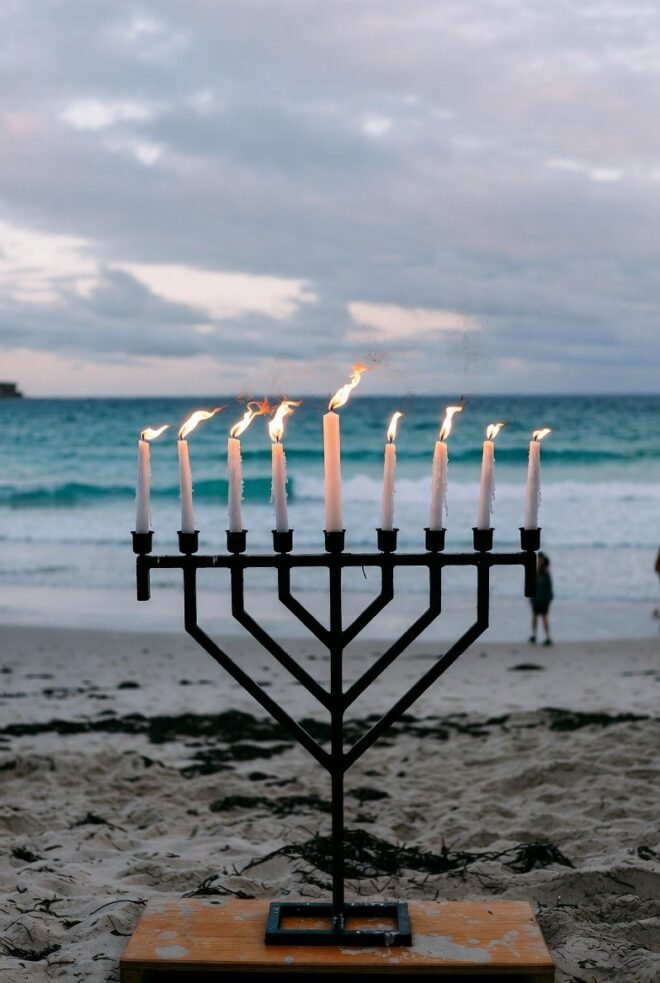
Bondi has always been a place of light for me – the sea’s steady breath, the gulls’ persistent cries, the slow, consoling rhythm of waves that has read people in and out of joy and sorrow for generations. It is a public heart, an open-air sanctuary where families gather, where festivals and faiths mingle on the sand, and where ordinary days can become extraordinary with sunsets that seem to promise that everything will be all right. On December 14, 2025, that promise was brutally ruptured.
On that night, during a Hanukkah celebration meant to be a refuge of warmth and light, the world we thought we knew folded into a new and terrible shape. At least twelve people were killed and twenty-nine wounded as gunmen stormed a gathering of worshippers and friends. Amid sirens and screams, strangers became protectors – some tackling an assailant with nothing but raw courage and instinct. The death toll included one of the shooters. Names and details have been reported and repeated in the hours since: a 24-year-old identified as Naveed Akram among them. Whether we follow the news closely or keep our distance, the images remain lodged in the tender parts of the mind: candles guttering under a sudden wind of violence, the bright joy of a holiday hollowed by fear, the bright faces of people who will never return to their loved ones.
I write this with a weight in my chest that words struggle to carry. I cannot unsee the faces of those who lost their lives. I cannot unhear the imagined cries of those who survived. What happened on that sand is not simply a news item or a statistic. It is a rupture, a tearing of the social fabric that binds communities together. It is a wound inflicted on the better angels of our nature. It is an attack on our shared capacity for simple, ordinary kindness.
Grief is public and private at once. In the quiet hours after learning of Bondi, I think about the mothers who will wake and find an empty place at breakfast. I think of fathers whose steady hands will never fold another child’s shirt. I think of siblings who will count missed calls and realise they will never hear the voice again. Grief multiplies: it radiates outward to friends, to co-workers, to strangers who read the news and find that a part of their day is forever altered by learning that people they do not know were made to die in a place where we gather for celebration. These are not abstract victims; they were people with small, ordinary urgencies – school runs, work deadlines, medical appointments – whose lives were cut short by ideology and hate.
There is also fury. That fury is rightly aimed not only at those who pulled triggers but at the systems, cultures and narratives that enable such acts. Hatred does not appear in a vacuum. It grows in the shadow of careless language, of inflammatory rhetoric, of online echo chambers that teach people to distrust each other and to name their neighbours as enemies. For every violent act there are a thousand smaller acts of cruelty and indifference that prepared the soil for that violence. A “joke” that dehumanises, a social media post that amplifies division, a charismatic figure who builds influence by creating an enemy – these all accumulate until a person who is already fractured or malleable is given both permission and purpose to commit an atrocity.
This is not an abstract assertion. I carry a memory from years ago that refuses to let me simplify the pattern. I remember walking through the centre of town with a dear friend – a female Wiradjuri banker whose life had been built on dignity and service – only to be accosted by the blunt hatred of strangers who could not see us as human. We were violently assaulted for our skin, our heritage. The police’s tepid response felt like a further injury: an institution that should have protected the vulnerable instead looked away. That day, the simple pleasure of an afternoon turned into a lesson about how easy it is for society to allow cruelty to go unchallenged. The emotional scars did not heal overnight. They mutated into a caution that saw every new instance of hatred, no matter how small, as a possible prelude to something more terrible.
Bondi is that “more terrible” for many of us now. To watch a gathering of people who had come for sacred ritual and communal warmth become a target is to confront the naked face of bigotry. Anti-Semitism has a long and ugly history, and it adapts, finding new forms in new media, new dialogues, and new political contexts. The perpetrators of violence in Bondi will be rightly condemned and prosecuted. But the prosecutors and courts cannot alone cure the culture that produced such carnage. We must ask ourselves, as a community and as individuals: How did we allow this to grow? What did we not see? What did we say – or fail to say – that made the hatred seem legitimate?
Denial has always been an ally to cruelty. I remember another private conversation that shaped my understanding of human evil: someone I once loved confided in me about a rape she had endured. The sheer intimacy of her confession made me acutely aware of how easily society minimises suffering. People who cannot imagine such acts often deny their existence or discount their severity, and that denial is a kind of violence in itself. It protects perpetrators by silencing victims. The logic is the same with communal hatred: when we say “those things don’t happen here” or “we don’t have that problem,” we close our eyes to the small injustices that presage larger ones. That complacency becomes complicity.
So how do we respond to Bondi, as a community and as moral beings? Silence is not an option. Waiting for others to act is not an option. There are immediate things we can do to honour the victims and to stem the river of hate that fed this attack, and there are longer-term commitments we must make to ensure that such a tragedy does not become a pattern.
First, we must honour the victims with memory and with concrete support. That means amplifying their stories beyond the momentary news cycle. Names matter. Lives matter. Funerals matter. Community vigils and memorials can be ways of acknowledging grief, but they must be accompanied by tangible acts: fundraising for medical bills and counselling, establishing scholarships or community programmes in the victims’ names, and ensuring long-term support for survivors who will carry the psychological scars of that night for the rest of their lives. Grief left unattended calcifies into anger and division. Compassion, properly directed, becomes a balm.
Second, we must protect public assemblies – places of worship, festivals, community centres – from being easy targets. I do not mean that we should surrender the warmth and openness that make our public spaces precious. Security should never transform communion into a fortress. But sensible, community-led measures – volunteer marshals trained in de-escalation, clear channels for reporting threats, partnerships between congregations and local police – can make gatherings safer without turning them into gated islands. The heroism we saw in Bondi – the bystander who tackled an attacker – reminds us that ordinary people are often the first line of defence. Let us invest in training and support for those who stand in harm’s way.
Third, we must challenge the narratives that make an “other” into a target. Education is not a soft gesture in this moment; it is a frontline strategy. Schools, universities, community groups, and religious institutions should all commit to curricula and programmes that teach critical media literacy, empathy, and the history of persecution in ways that are honest and unflinching. When younger generations learn to distinguish between a justified critique of policy and the dehumanisation of a people, we reduce the chance that ideological arguments will mutate into lethal violence.
Fourth, we must demand accountability from those who have the platforms to shape public discourse. Social media companies, broadcasters, and politicians all share in the responsibility to not monetise or amplify hate. When misinformation and vitriol are allowed to flourish unchecked, they radicalise and demoralise. This does not mean policing thought; it means refusing to normalise hate. Calling out demagogues who profit from division is not the same as silencing dissenting voices. It is an insistence that public life be anchored by decency and truth.
Fifth, we must care for the survivors. Trauma is an invisible wound that changes the architecture of a life. Survivors of mass violence often contend with PTSD, chronic pain, and a shattered sense of safety. We should push governments and health services to prioritise long-term psychological care, to make counselling accessible and ongoing, and to ensure that survivors do not become invisible once the news cycle moves on. Community networks – faith groups, neighbourhood associations, schools – must also sustain active and compassionate outreach.
Sixth, we must build bridges across communities. Interfaith work is not an optional luxury; it is a necessity. When Jewish congregations, Muslim communities, Christian churches, Indigenous elders, and secular groups build relationships, they create social architecture that resists atomisation. The simple acts of shared meals, joint vigils, cooperative educational events, and visible solidarity can blunt the power of divisive rhetoric. We must make the routines of civic life an antidote to isolation and alienation.
I do not want to romanticise unity. Real social repair is messy and painful. It requires confession and accountability and a willingness to face how our institutions may have failed members of our communities. In my own life, recognising that I was protected by privileges I did not earn forced uncomfortable conversations. But discomfort is a necessary part of growth. We honour the dead not only by lighting candles, but by asking how our communities may have been lenient toward the small aggressions that, compounded over time, lead to tragedy.
There are policy responses worth discussing in good faith – measures to control the flow of weapons, to improve intelligence and threat-sharing between local and national agencies, to strengthen hate-crime legislation and ensure it is enforced equitably. Policy matters because policy shapes behaviour. But policy without cultural change is an incomplete remedy. The law can punish, but it cannot alone transform hearts and minds. For the latter, we need a patient, sustained cultural campaign to re-establish empathy as our default posture.
I want also to name the human heroism that occurred that night, the kind that stubbornly resists despair. In the chaos of terror, people performed acts of such bravery that they restored some small measure of faith. A bystander who overcame terror to tackle an assailant; neighbours who opened their doors to the wounded; hospital staff who worked through exhaustion – all these deeds are the raw material from which community resilience is built. The narrative of victimhood can slip into one of passivity, but the counter-narrative, the one where people choose life and love in the face of death, must be told loudly and often. We owe those heroes our thanks, and we owe them support if they are themselves injured or traumatised by what they witnessed.
If we are to move forward honestly, we must name the venom that produced Bondi: an ideology that allows people to be reduced to caricatures, to be blamed for distant events they had nothing to do with, to be made into convenient scapegoats. Such ideologies are nurtured by rage and ignorance in equal measure. They are fed by the news cycle that prizes outrage over understanding, by online platforms that reward extremity, and by a politics that sees advantage in scapegoating. We cannot defeat this poison with a single speech or a single law. We must be relentless, patient, and principled.
Finally, let us remember to mourn with dignity. Public grief can sometimes be co-opted into counterproductive displays – politicised outrage that substitutes posturing for meaningful change. Mourners deserve better. The families of the dead deserve our sustained attention, our offers of help, our invitations to sit with their sorrow without trying to fix it with platitudes. Loss is not an invitation to triumphalism about “lessons learned”; it is a solemn charge to do the work of repair with humility and persistence.
To those who ask what they can do today: show up. Attend a vigil. Donate to verified funds that help victims and survivors. Reach out to members of communities that may be targeted by hate and listen before speaking. Support local organisations that promote interfaith understanding. If you run social accounts, use your reach to amplify voices of care and to challenge dehumanising content. Vote for leaders who demonstrate a commitment to unity and the rule of law, and hold them accountable when they veer into opportunistic division.
Bondi’s sand still remembers. It will remember the holiday candles and the prayers, and it will also remember the day violence tried to overwrite what those candles stood for. But remembrance need not be a permanent marking of defeat. We can, and must, transform this sorrow into renewed purpose. Let the grief be fertile. Let it feed our resolve to teach better, to act more kindly, to govern more justly, and to hold one another close.
To the fallen: we promise to remember you beyond the headlines. Your lives were not collateral. Your laughter, your work, your love, your promises – they mattered. We will continue to speak your names and to name the wrongs that took you from us.
To the wounded and the traumatised: you are not alone. Your survival is a story of courage that will inspire healing if we have the humility to walk beside you, to offer help without judgment, and to insist on compassionate care.
To those predisposed to hate: understand that violence never answers hate. It only begets more. If you have been seduced by rhetoric that isolates and dehumanises, step back. Seek conversation. Let yourself be transformed by human voices rather than by screens that flatter your worst impulses.
And to everyone who believes in the possibility of a different world: we can build it. The task is enormous, but it is not impossible. It begins with small acts: checking our own biases, intervening when we see cruelty, educating our children in empathy, and sustaining institutions that hold communal life together. It requires policy, yes – sensible controls, better safety measures, and resources for mental health – but it also requires a culture that prizes human dignity above spectacle.
Tonight, as candles are lit in memory and in hope, let us hold the light not as a fragile thing but as a challenge. Let it be a challenge to name the sources of hatred, to dismantle them, and to build in their place institutions and relationships that resist division. Let our cries of sorrow be joined to the steady work of repair. Let us never again be complacent about the small cruelties that, if left unchecked, transform ordinary life into tragedy.
No more hate. Not in our conversations, not in our feeds, not in our politics, and not on our beaches. Let Bondi be the site of our grieving and the birthplace of our resolve. Let memory become a call to action, and let action be guided by love.
We mourn. We remember. We act.