
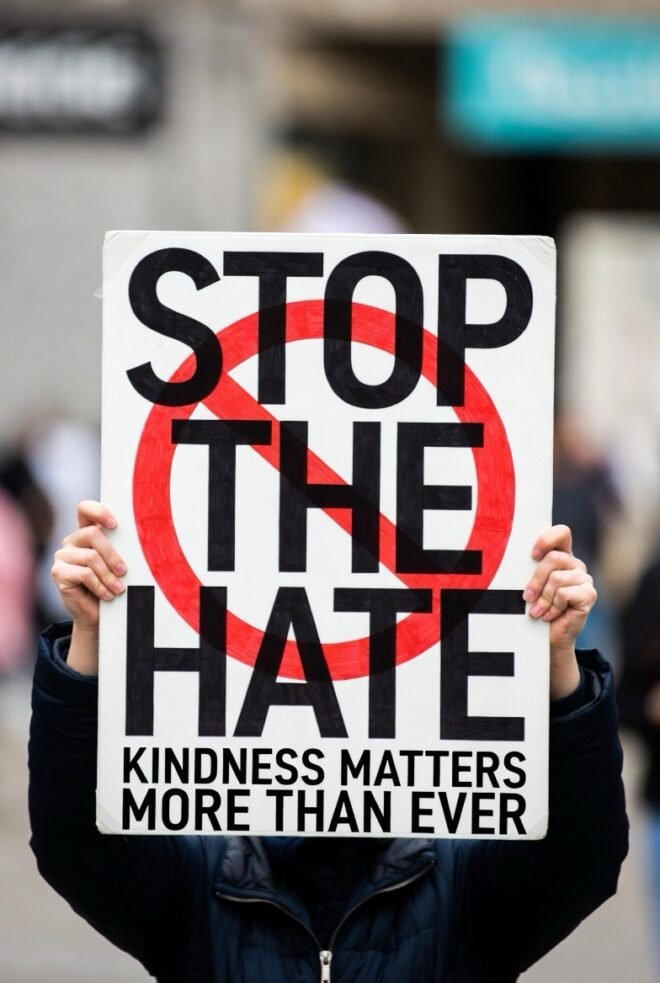
Hate is a corrosive force. It strips people of dignity, fractures families, and corrodes the social bonds that make communities possible. It can be institutional – law, policy, propaganda – or personal: a slur shouted in the street, a jealous rumour, a hand that pushes another to the ground. My own life has been shaped by encounters with hate in multiple forms: family stories of the Holocaust, hands-on activism at the Aboriginal Tent Embassy, and the trauma of contemporary terrorist attacks that turn celebrations into scenes of mourning. These experiences have forced me to ask hard questions about faith, reason, and how communities respond when fear becomes legislated or normalised.
This piece is part memoir, part analysis. I want to trace how Islamophobia developed as a modern political and cultural phenomenon, link it to older patterns of dehumanisation such as antisemitism and colonial racism, and explore how the illogic of certain religious claims – and the philosophical problems those claims raise – can be twisted to justify exclusion and violence. My aim is practical as well as intellectual: to show why confronting prejudice requires both clear ideas and collective action.
Personal roots: family history and early awakenings
Some of my earliest encounters with hate arrived second-hand through my family’s stories of the Holocaust. Relatives hid in attics, fled across borders, and still lost siblings to gas chambers. These narratives taught me early that hatred is learned and cultivated. I became determined to understand how ordinary people can be persuaded to accept monstrous doctrines.
In my twenties I read Mein Kampf in English. It was a rambling mixture of pseudo-science, mystical racism and spiteful grievance – the kind of incoherence that nonetheless proved dangerous when it found an audience. Later, as my German improved, I read Hitler’s words in the original and found the same vulgar rhetorical tricks, the same appeal to simplistic narratives of superiority and victimhood. That experience hardened my suspicion that grand narratives of superiority are not proof but propaganda – and that they can be terrifyingly effective.
My abstract education in hatred became concrete in the late 1990s when my cousin Aunty Isobel Coe, a foundational figure in the Aboriginal Tent Embassy movement, invited me to Canberra. There I saw racism as a lived, institutional reality. Protesters at the Embassy faced slurs, police harassment, and bureaucratic indifference – the same pattern of dehumanisation and displacement that underpinned colonialism. Aunty Isobel’s courage taught me something crucial: confronting hate requires both intellectual critique and collective, sustained action.
More recently, the Bondi Beach attack during a Hanukkah celebration brought the past into the present: joyous community rituals turned into scenes of death and grief. Whether perpetrators are lone actors, state proxies, or ideologues, the consequence is the same – lives stolen, futures curtailed, and communities fearing each other. Such incidents reverberate beyond their immediate victims, stoking generalised suspicion toward whole groups and feeding cycles of retaliation and scapegoating.
Islamophobia: history, definitions, and mechanisms
The term “Islamophobia” entered mainstream policy conversations with the 1997 Runnymede Trust report, Islamophobia: A Challenge for Us All. The report helped crystallise what many of us had been witnessing: an unfounded hostility toward Islam that leads to discrimination against Muslims. Runnymede described a set of “closed views” that reduce a plural faith to a monolith of threat – claims that Islam is static, incompatible with Western values, intrinsically violent, or a political ideology masquerading as religion. In response, the report promoted “open views” that recognise Islam’s internal diversity, its shared ethical foundations with other traditions, and its historical contributions to knowledge and culture.
Runnymede’s framework remains useful because it exposes the rhetorical shortcuts that make prejudice plausible. Stereotyping a billion people – with different histories, cultures and theologies – into a single caricature of menace both simplifies and sanitises exclusion. It allows politicians, media outlets and interest groups to scapegoat, distract and mobilise support for policies that target whole communities.
This dynamic is not new. Anti-Muslim prejudice borrows patterns from older forms of radicalisation and religious hatred. The anti-Jewish stereotypes that fed the Holocaust were built on centuries of myth, pseudo-science and scapegoating – the same toolkit used today by those who portray Muslims as a monolithic threat. Likewise, the colonial narratives that justified dispossession and assimilation of Indigenous peoples rested on depictions of “primitive” otherness. The Aboriginal Tent Embassy resisted exactly those tropes, reminding us that narratives are tools of power.
From Runnymede to post-9/11 politics
The framework Runnymede outlined was already under strain by the time of 9/11. The terrorist attacks on the United States in 2001 were, in the short term, decisive in shaping modern Islamophobia. Public fear skyrocketed, and hate crimes against Muslim communities surged in many countries. Political rhetoric – “the War on Terror,” the language of civilisational conflict and existential threat – validated and amplified cultural anxieties. Policies that prioritised security over civil liberties, surveillance over community engagement, added to the feeling of alienation and suspicion directed at Muslim citizens.
Over the following decades, moments of terror – Madrid, London, Paris, Sydney – were followed by moral panics about Muslim communities. Public debates over mosques, burqas, refugee settlement and “integration” were often framed in terms that suggested Muslim difference posed a risk to national identity. These debates were amplified by emerging media ecosystems and gave rise to an “Islamophobia industry” of pundits, think tanks and bloggers who trafficked in stories of “no-go zones,” “Sharia creep” and cultural takeover.
This pattern reached grotesque extremes in several episodes: the Cronulla riots in Australia, the rhetoric around the proposed “Ground Zero mosque” in the United States, and the 2019 Christchurch mosque shootings in New Zealand. In Christchurch a white supremacist invoked conspiracy theories about “replacement” to justify mass murder. The shooter’s manifesto borrowed freely from racist literatures and online subcultures which depict demographic change as an existential threat. That attack made painfully clear how online radicalization and enacted violence are connected: dehumanising rhetoric circulates cheaply, and in contexts of real grievances it can inspire atrocities.
The illogic of faith and the problem of evil
My rejection of organised religion is not a rejection of GD. I believe in a transcendent presence – a source of awe and moral aspiration that I would call GD. But the historical record shows that organised religions have often been instrumentally used to justify violence, oppression and exclusion. If one accepts the premise that GD is perfectly good and omnipotent, the existence of massive and apparently gratuitous suffering creates an unavoidable philosophical problem. How can such a being permit genocides, child suffering, earthquakes and pandemics?
Philosophers have wrestled with the “problem of evil” for millennia. Ancient voices like Epicurus posed the paradox in blunt terms. Later theologians offered theodicies – explanations meant to reconcile divine goodness and the reality of suffering. The free will defence argues that moral evil results from human freedom, a valuable good that God would not override. Soul-making theodicies suggest that suffering can cultivate virtues such as compassion or resilience. Leibniz famously argued that our world might be the “best of all possible worlds,” where some evil is necessary for certain goods.
Each response reveals a tension. Free will appeals to our intuitions about moral responsibility, but it struggles to account for natural evils like tsunamis or for massive, apparently pointless suffering such as the Holocaust. Soul-making sounds noble, but it does not adequately explain the suffering of beings who cannot develop moral virtue, such as animals or small children, and it can seem a poor justification for atrocity. Sceptical theism – the claim that human beings are not in a position to judge God’s reasons – may be internally consistent, but it risks turning religious belief into an invitation to agnosticism about any moral claim: if GD’s reasons are always inscrutable, then what grounds are left for trusting claims about GD’s moral character?
For many, these tensions reveal religion’s intellectual fragility. Critics argue that to preserve belief in an omnipotent, benevolent deity, some believers appeal to unfalsifiable claims or redefine divine attributes in ad hoc ways. If one insists that GD’s ways are mysterious whenever they confront a moral problem, then faith loses explanatory power and becomes insulated from criticism. That insulation may protect believers from doubt, but it also provides cover for those who would deploy religious language to justify harmful actions.
Psychology explains a great deal about why faith persists despite intellectual objections. Religion offers comfort in the face of mortality, meaning in chaotic circumstances, and community bonds that meet deep social needs. Cognitive biases – confirmation bias, motivated reasoning, deference to authority – help maintain beliefs once they become embedded in identity. The upshot is that religion is not simply a failure of intellect; it is embedded in human psychology and social life in ways that make it resilient.
Pascal’s Wager: pragmatism, fear, and the ethics of belief
One classic response to religious uncertainty is Pascal’s Wager, a pragmatic argument that treats belief in GD as a rational bet under uncertainty. Pascal’s point is simple: if there is any non-zero probability that GD exists and if the consequences of belief entail infinite reward (heaven) while disbelief risks infinite loss (hell), then it is rational to believe – or at least to live as if one believes – because the expected value of belief is infinitely greater.
Pascal’s strategy sidesteps many metaphysical debates by appealing to decision theory and risk aversion. Yet it has long inspired criticism. The “many-gods” objection points out that Pascal’s calculation presumes a particular conception of God and afterlife. If multiple religious options exist – each with different prescriptions and consequences – the Wager loses its decisive force. Even at a personal level, it has an ethical awkwardness: it seems to encourage belief born of fear and calculation rather than conviction or moral insight. Is a belief motivated chiefly by hedging really genuine faith? And if someone accepts Pascal’s calculus, does that justify religious coercion or exploit people’s fear?
These critiques echo my broader worry that faith is sometimes mobilised as a tool of control. If a religion’s promise of reward or threat of punishment can be used to justify exclusion or violence, we should be sceptical of claims that divine authority unequivocally sanctions social hierarchies or punitive injustices.
Islamophobia in the 21st century: politics, technology, and scapegoating
The last two decades have shown how rapidly prejudice can be institutionalised and amplified. Populist politicians built platforms on anti-Muslim sentiment: calls for travel bans, rhetoric about “radicalisation,” and laws that single out religious clothing or prayer practices. At the same time, the rise of social media accelerated the spread of conspiracy theories and decontextualised images. Algorithms favour outrage and simplification; tribal content spreads. The result is an environment in which fear becomes profitable, and nuance is expensive.
Events like the 2015 European terror attacks, the 2019 Christchurch shootings, and the repeated cycles of violence in the Middle East feed into a constant feedback loop. Extremists on both sides make claims about existential threats, and political entrepreneurs exploit those fears to pass restrictive laws, close borders, or scapegoat minorities. Media coverage matters enormously: disproportionate focus on crimes committed by Muslims, sensationalist headlines and uncritical repetition of official narratives all reinforce stereotyped associations between Islam and violence.
But for every example of inhumanity, there are also counterexamples that suggest a better human response. During the Bondi attack, bystanders risked their lives to stop the violence. In Christchurch survivors and wider communities responded with solidarity. Muslim organisations mobilise to defend civil liberties; interfaith groups organise vigils; grassroots campaigns teach media literacy and fight for fairer representation. These responses remind us that hate is not inevitable: institutions, stories and public norms shape how communities respond to fear.
Intersecting oppressions and the limits of identity politics
Islamophobia does not exist in a vacuum. It intersects with misogyny, ableism, homophobia and class oppressions in complex ways. Muslim women who wear observable religious dress face double discrimination: for some they are hypervisible targets for harassment, for others they become symbols in debates about liberalism and secularism. LGBT Muslims confront exclusion from both conservative communities and secular spaces that fail to accommodate religious difference. Disabled Muslims face barriers to participation in religious life. A politics that addresses Islamophobia must therefore be intersectional: it must attend to the ways multiple forms of exclusion compound one another.
Organised religions are not uniform in how they treat difference. Within any tradition there are voices that promote inclusion and others that promote exclusion. My critique is aimed not at the people of faith but at the institutional tendencies that entrench dogma as a pretext for exclusion. True spiritual life ought to bind communities together, not justify hatred or violence.
Paths forward: policy, education, media, and grassroots action
If hate thrives on simplification and anonymity, our responses must cultivate complexity and human connection. Here are practical steps that can make a difference:
• Legal protections: Strengthen hate crime laws and enforcement mechanisms so targeted communities have recourse. Classify serious forms of anti-Muslim attacks appropriately and ensure victims have access to justice.
• Education: Integrate curriculum that teaches the histories of Jewish, Muslim and Indigenous peoples, not as abstraction but as lived stories. Holocaust education, Indigenous histories and modules on contemporary Islamophobia can reduce ignorance and humanise “the other.”
• Media literacy and responsible reporting: Promote guidelines for balanced coverage of terror and crime that avoid collective blame. Support local journalism that highlights everyday lives and civic contributions of minority communities.
• Tech regulation and platform responsibility: Hold social media platforms to higher standards for algorithmic transparency and content moderation. Incentivise measures that reduce the spread of decontextualised violent content and false conspiracies.
• Community dialogue and interfaith work: Create sustained spaces where neighbours can meet, share meals and discuss common concerns. Storytelling converts statistics into human narratives that resist abstraction.
• Support for grassroots activism: Fund and protect organisations that work in communities to foster inclusion, monitor incidents and provide legal and social support.
• Intersectional policy design: Ensure anti-Islamophobia work includes strategies for gender equity, disability access and LGBT inclusion within targeted communities.
A personal resolution
Confronting hate has been, for me, a lifelong commitment. From reading hateful screeds to listening to survivors of genocide to marching beside Aunty Isobel at the Tent Embassy, I have learned that understanding hate begins with refusing to be indifferent. I still believe in God – in an eternal presence that calls us to compassion – but I cannot accept organised doctrines that are used to justify murder, exclusion or dehumanisation. No faith I know of could coherently claim divine sanction for murder of innocents; any theology that does should be rejected as a distortion of the sacred.
The problem of evil and the philosophical critiques of religion do not automatically lead to cynicism. Instead, they invite humility: humility about our certainties, and responsibility about our actions. Philosophy shows us that some theological positions are difficult to defend intellectually. Psychology shows us why people cling to them anyway. Politics shows us how dangerous they can be when harnessed by demagogues. But together these disciplines also point to remedies: better institutions, better education, and social forms that promote empathy over suspicion.
Conclusion: choosing understanding over fear
Hate prospers when we allow complexity to be replaced by caricature. Islamophobia is not an isolated pathology; it is the modern expression of older habits of othering, subject to the same mechanisms that produced antisemitism, colonial racism and xenophobia. To fight it we need more than slogans. We need laws that protect, education that humanises, media that contextualises, platforms that dampen outrage economies, and communities that practice solidarity.
We must also be willing to critique our own traditions honestly. Faith can be a source of deep meaning and moral courage, but it is not immune to being misused. Rejecting the illogic of doctrines that sanction hatred is compatible with believing in a benevolent divine presence. In fact, such rejection may be essential to reclaiming the spiritual core of compassion that many traditions profess.
Hate can be learned – and so it can be unlearned. The work is long and often thankless, requiring the steady application of reason, courage and empathy. But my experience, from family history to activism, convinces me that the alternative – tolerating the slow drift toward normalised prejudice – is worse. Let us choose instead to make community of our differences: to commemorate the past honestly, to defend the vulnerable now, and to build social institutions that refuse to let fear alone set our civic agenda. That choice, more than any argument about heaven or hell, will determine the kind of world our children inherit.