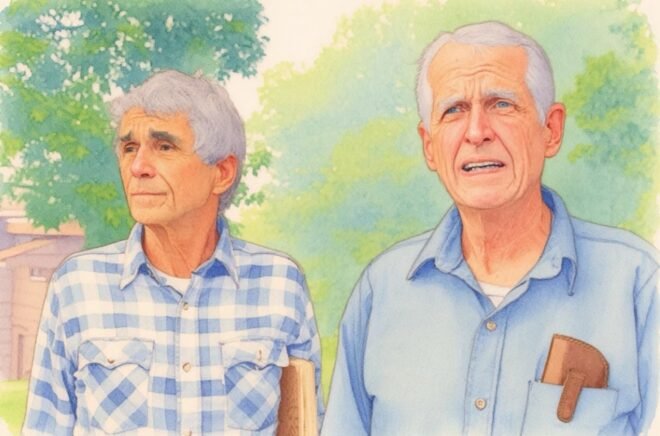
In the convulsive decades of the 20th century – when the United States was convulsed by civil rights struggles at home and an increasingly unpopular war abroad – two Catholic priests stepped beyond the conventional boundaries of clerical conduct and became, to many Americans, both scandalous and saintly. Daniel and Philip Berrigan were brothers in blood and brothers in faith; they were also brothers in rebellious conscience. For a time, their names were splashed across headlines as “holy outlaws”: clergy who put their bodies and livelihoods on the line to oppose what they understood as systemic injustice and brutal state violence. Both men would wind up on the FBI’s Ten Most Wanted list, not for bank robbery or organised crime, but for acts of symbolic, prophetic civil disobedience meant to wake a nation from moral complacency.
This extended post revisits the Berrigan brothers’ lives and work in full: their formative years, the religious convictions that animated them, the defining protests that catapulted them into national infamy, the legal and spiritual costs of their resistance, and the legacy they left behind. My aim is not merely to recount events, but to explore the ethical logic that made their actions coherent to them, to situate these actions within broader movements for peace and justice, and to draw out lessons for our own era of perpetual conflict and looming nuclear threat. Their story is as much theological and poetic as it is political: the Berrigans made of protest a sacrament – an embodied speech-act that sought to reconcile faith with the imperative to oppose violence.
Early formation: family, faith, and literary impulse
Daniel Joseph Berrigan was born in 1921 in Virginia, Minnesota, into a large, devout Irish-German Catholic family. The household was shaped by both the warm religiosity of his mother and the fiery unionist politics of his father, Thomas, a railroad engineer whose socialist sympathies and stern discipline left a deep imprint. The Berrigan family eventually settled near Syracuse, New York, where farming, prayer, and the rigours of working-class life were daily realities. Daniel’s childhood was marked by material scarcity, but also by an early intimacy with language and the natural world – both resources he would later deploy in priestly ministry and in poetry.
At eighteen, Daniel entered the Jesuit order, drawn to its intellectual rigour. His studies in philosophy and theology culminated in ordination in 1952; yet he did not fit the stereotypical mold of the cloistered academic. He taught at Jesuit schools, founded an International House to foster intercultural exchange, and began to publish poetry that married biblical imagination with contemporary anguish. His early recognition – winning the Lamont Poetry Prize – announced that Daniel would be as much a man of letters as of liturgy. The poetic sensibility would later shape the aesthetics of his protest: image, symbol, and ritual were essential to his method.
Philip Francis Berrigan, two years Daniel’s junior, shared the same household origins, but emerged from a different crucible. Drafted into the U.S. Army during World War II, Philip served in Europe and witnessed the brutalities of combat and the humiliations of racial segregation in the armed services. Those experiences did something definitive to his moral compass: a deep-seated aversion to violence fused with an acute consciousness of injustice. After the war Philip completed an English degree and was drawn to the Josephite order, whose mission among African American communities introduced him to grassroots struggle against Jim Crow. Ordained in 1955, he rapidly became involved in civil rights work – practically and prophetically – organising interracial prayer groups and participating in direct action.
The brothers’ divergence in temperament – Daniel the poet and philosopher, Philip the activist and organiser – proved complementary. Both were steeped in Catholic social teaching and inspired by contemporary figures such as Dorothy Day and the Catholic Worker movement. Together they began to perceive a throughline connecting segregation at home, imperial war abroad, and the systemic violences of state power. Their vocation, they argued, demanded a public, embodied response.
From civil rights witness to antiwar resistance
The 1950s and ’60s were rich with movements that remodelled American public life. For the Berrigans, the struggle against racial oppression was the first theatre of Christian dissent. Philip’s ministry in the South brought him into the thick of the civil rights movement; Daniel, too, became a presence at Selma and other protests. These encounters with nonviolent resistance were formative: marching with Martin Luther King Jr. and standing in the same struggles taught the brothers that spirituality and social action could not be kept in separate compartments.
As the Vietnam War escalated, a new focus took precedence. The Berrigans perceived Vietnam as an intensification of a moral failure that had already been exposed within the United States: if Christians could not oppose racism and state-sanctioned violence at home, they could hardly remain silent about an unjust foreign war. In the mid-1960s they helped organise Catholic efforts against the draft and imperial war-making: Daniel worked with Clergy and Laymen Concerned About Vietnam (CALCAV) while Philip co-founded the Catholic Peace Fellowship. Their circle included influential intellectuals and spiritual figures such as Thomas Merton and Howard Zinn; this interfaith confederation framed resistance in moral and theological terms, not merely political ones.
The Baltimore Four: sacramental protest
One of Philip’s earliest and most theatrical protests was the Baltimore Four action in 1967. With three collaborators – Tom Lewis, David Eberhardt, and Rev. James Mengel – Philip entered the Baltimore Customs House and poured their own blood (mixed with animal blood to produce a more vivid effect) onto Selective Service draft records. The act was intentionally sacramental and scriptural in tone: the blood symbolized the human cost of war and the tangible consequences of state policy. Arrested and later sentenced, Philip viewed the legal penalties as part of the moral theatre of witness; in refusing to separate sacrament from civil disobedience, he redefined how clergy might act in the public square.
Daniel’s involvement in antiwar work intensified after he travelled to Hanoi in early 1968 with Howard Zinn and others to escort released POWs back to the United States. That visit exposed him firsthand to the suffering the war had caused and radicalised his view of what constituted pastoral ministry. What followed was a series of increasingly daring acts that culminated in Catonsville.
Catonsville Nine: symbolic arson as prophetic indictment
On May 17, 1968, Daniel and Philip Berrigan, with seven accomplices, carried out what remains their most famous action: the Catonsville Nine protest. Entering the Selective Service office in Catonsville, Maryland, the group seized hundreds of draft files and burned them with homemade napalm in the parking lot. They prayed as the paper turned to flame and issued a searing indictment of the institutional silence of major faith bodies: “We confront the Catholic Church, other Christian bodies, and the synagogues of America with their silence and cowardice in the face of our country’s crimes.”
Catonsville worked on multiple levels. Practically, it disrupted draft administration in one office and aimed to free men from the machinery of conscription. Symbolically, the use of napalm – an incendiary weapon widely used in Vietnam – meant the protesters turned the weapon of war back onto the bureaucratic machinery that sustained it. The act was both prophetic and theatrical: an attempt to shock public conscience into moral awareness.
The trial that followed was itself a public stage. Defended by radical civil liberties attorney William Kunstler, the Catonsville Nine used the courtroom as a platform to denounce the war and expose its moral bankruptcy. Daniel dramatised the trial in his later writing and in a play that brought the event into artistic discourse. Convictions were secured, and prison sentences imposed; yet the action’s resonance extended far beyond the penalties incurred. Catonsville became a template for sanctified civil disobedience, an image that divided the nation but also galvanised antiwar sentiment.
The fugitive phase: priest as hunted prophet
In 1970, after a series of legal entanglements and convictions, Daniel went underground and spent several months evading the FBI. The decision to go into hiding was controversial within and beyond the Church. For supporters, it underscored the depth of his convictions and symbolized a willingness to sacrifice personal liberty for the integrity of conscience. For critics, it appeared as an abdication of responsibility. Either way, Daniel’s months on the run achieved a kind of mythic status: interviews shot clandestinely, appearances at protests followed by disappearance, and even an appearance in a public television documentary that humanised the fugitive priest.
The government’s pursuit of the Berrigans highlighted the intensifying polarisation of the era. Their evasion embarrassed political authorities and raised questions about proportionality and the use of state power against dissenters. Once captured, both brothers faced additional legal exposure – but they and their allies treated these prosecutions as further material for moral argument. Prison itself became a domain of pastoral ministry and literary production.
Trials, conspiracy charges, and prison ministry
The legal reprisals against the Berrigans were not limited to the Catonsville convictions. Philip was later charged in the Harrisburg Seven conspiracy case, accused – with several others including Elizabeth McAlister (who would later become his partner) – of plotting violent acts. The government relied on informants and surveillance, and the trial brought to light questionable investigative practices. Ultimately, the most serious charges did not stick; the prosecution was hampered by legal missteps and sceptical jurors. These episodes underscored the thin line that the state sometimes sought to draw between dissent and criminality.
Prison, for both men, was not solely punishment. Behind bars they conducted Bible studies, ministered to fellow inmates, and continued to write and publish. Daniel’s prison poems and reflections reveal a minister finding pastoral purpose in constrained circumstances; for both brothers, the jail cell was a place to model a different way of life – one focused on healing, repentance, and radical accountability. Their years of incarceration, totalling many cumulative years across different actions, did not break them; rather, imprisonment refined their witness and deepened their moral credibility among supporters.
From napalm to hammers: the Plowshares turn against the nuclear state
With the Vietnam era waning, the Berrigans turned to what they perceived as the central moral problem of the late 20th century: nuclear weapons. If Vietnam revealed the destructiveness of conventional war, nuclear arms revealed an existential threat to humanity. To confront that scale, they embraced a new set of symbolic tactics.
In 1980, the Plowshares Movement was born in a direct action led by Daniel and several co-conspirators; the action became known as the Plowshares Eight. Invading a General Electric plant that produced components for nuclear warheads, the activists hammered on missile parts, poured blood on documents, and offered prayer in the factory floor. They invoked Isaiah’s prophetic injunction to “beat swords into Plowshares,” turning the image into an act of disarmament. Like Catonsville, the Plowshares actions were performative and sacramental: the activists deliberately accepted arrest and legal consequences as part of a prophetic witness.
The Plowshares approach spread: over the subsequent decades, hundreds of similar actions were staged at missile bases, nuclear laboratories, and military installations around the world. The movement reframed nonviolence as not simply passive resistance, but as an active sacrament of repair – an embodied plea for conversion at the level of state policy. Though these actions resulted in repeated arrests and prison time, they produced a durable network of activist communities and a moral vocabulary for anti-nuclear protest.
Communities of resistance: Jonah House and the practice of countercultural witness
The Berrigans did not conceive of dissent in isolation. They sought to sustain communities that would practice and teach the disciplines of nonviolent resistance. Jonah House, founded in 1973 in Baltimore, became one such centre – a residential community dedicated to living lives of witness that combined prayer, hospitality, and direct action. Jonah House was both refuge and training ground, a place where families and activists could learn the crafts of civil disobedience, nonviolent tactics, and communal discernment.
The community model was significant for two reasons. First, it provided the moral and emotional infrastructure needed to sustain repeated confrontations with state power. Second, it offered a countercultural alternative to the individualism of mainstream American life: here, solidarity and shared risk replaced private comfort. For a generation of activists, Jonah House and similar communities were laboratories of persistent dissent, producing a continuity of commitment across decades.
Personal lives, loves, and ecclesial consequences
The Berrigans’ lives were not only public acts of protest; they were also marked by intimate, sometimes controversial personal choices. Philip’s relationship with Elizabeth McAlister, a Sacred Heart nun he married after both had left the formal structures of their religious vows, generated ecclesial and public controversy. Their marriage – initially secret and later publicly formalised – resulted in temporary excommunication for McAlister under Church law. The couple bore children and continued their activism through Jonah House and other networks. They endured long periods of imprisonment, yet remained committed to a shared project of peace-making.
Daniel’s trajectory was different: he remained a celibate priest, continuing to teach, write, and advocate. His ministry extended beyond antiwar politics to embrace AIDS ministry, support for marginalised communities, and outreach to LGBTQ persons – positions that sometimes placed him at odds with conservative elements within the Church. In both brothers, then, private life and public witness were deeply entangled: personal choices were inseparable from broader moral commitments.
A long arc of protest and a final testament
By the late 20th and early 21st centuries, the Berrigans had become elder statesmen of the peace movement. They opposed U.S. interventions in Central America during the 1980s, protested the Gulf War in 1991, and opposed subsequent wars in Afghanistan and Iraq. They also embraced a “consistent life ethic,” which framed opposition to abortion, capital punishment, and war as part of a single moral commitment to the sanctity of human life. This ethic did not sit comfortably on a neat ideological spectrum; it demanded moral coherence over political convenience.
Philip died in 2002 at Jonah House, still fierce in his denunciation of nuclear arms. Daniel lived until 2016, passing away at ninety-four. In his later years he continued to write poetry, preach, and mentor younger activists and theologians. Their deaths marked the end of an era, but their influence lives on in contemporary movements: Plowshares-inspired actions continued, including the high-profile Kings Bay Plowshares action in 2018, and their writings and images circulate widely in activist and theological circles.
What the Berrigans teach us: conscience, risk, and the grammar of prophetic action
Several lessons emerge from a life of such extraordinary moral risk:
• Embodied dissent matters. The Berrigans believed that moral truth must be enacted, not merely articulated. Their aesthetic of protest – ritualized, symbolic, sacramental – sought to transform public perception by staging moral drama in visible forms. This is not merely theatrical; it is pedagogical, teaching the public to see otherwise.
• Conscience can conflict with law. Their actions challenge the tidy assumption that legality and morality coincide. Civil disobedience, when grounded in conscientious objection, makes demand of political communities for moral reasoning beyond mere compliance.
• Consequences are part of witness. The Berrigans accepted imprisonment as part of the prophetic package. Taking responsibility for the legal fallout of direct action was itself an ethical statement about accountability and the costs of dissent.
• Community sustains resistance. Jonah House and similar formations show that resistance is not a solo vocation; it requires community support, spiritual practices, and collective disciplines to persist across decades.
• Nonviolence is active, not passive. Their vision of nonviolence was not a refusal to act but a commitment to creative, non-destructive disruption aimed at exposing and dismantling systems of violence.
Contemporary relevance and contested legacies
In an age of remote drone warfare, mass incarceration, environmental collapse, and renewed nuclear brinksmanship, the Berrigan story remains urgent. Their insistence that faith must lead to confrontation with state-sponsored violence has a renewed resonance for activists who face complex moral terrains. At the same time, their tactics continue to be contested. Critics argue that acting outside the law, especially by clergy, risks politicising religious vocation or undermining democratic procedures. Supporters reply that when institutions fail to correct moral wrongs, prophetic witness becomes not only justified but necessary.
The pluralistic movements that draw on the Berrigans’ legacy – peace activists, religious dissidents, anti-nuclear campaigners – illustrate the enduring appeal of a faith that refuses to be privatised. Whether one agrees with every tactic or not, the core question they pose is unavoidable: if moral conscience demands action, what are you prepared to risk?
Concluding reflections: the cost and promise of holy outlawry
The story of Daniel and Philip Berrigan complicates simple narratives about clergy, politics, and patriotism. They were not mavericks in the margins but deeply formed religious actors who believed their ministry required public resistance to institutional evils. Their life-work shows both the heartbreak and the hope of prophetic action: heartbreak in the cost – imprisonments, ecclesial sanctions, personal sacrifices – and hope in the capacity of a relatively small, determined group to keep moral questions alive in public debate.
Daniel’s line – “The good is to be done because it is good, not because it goes somewhere” – invites us to practice integrity without utilitarian calculation. Philip’s blunt observation – “War doesn’t determine who’s right, only who’s left” – forces us to look soberly at the human toll of political decisions. Together, they remind us that conscience is a lived practice, that language without sacrifice risks becoming mere rhetoric, and that the spiritual and the political are not separate spheres but mutually constitutive.
If the Berrigans were, in some sense, “holy outlaws,” it was because they reimagined the priestly vocation as necessarily public, and because they insisted that religious truth must be lived out, even at the cost of freedom. For those who take seriously the demand that faith must oppose injustice, their lives remain a provocative challenge and a luminous example: a testament to the power of conscience, the necessity of communal resistance, and the radical imagination required to envision peace in a world still making war.