
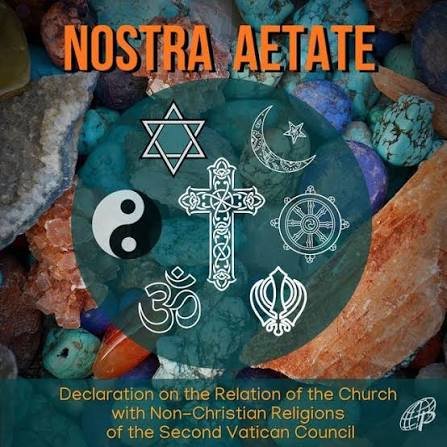
Nostra Aetate, the brief but seismic declaration issued by the Second Vatican Council in 1965, remains one of the most consequential ecclesial texts of the modern era. Framed in a few concise paragraphs yet pregnant with theological and moral significance, it reconfigured the Roman Catholic Church’s posture toward other religions and, above all, recalibrated its relationship with Judaism. To examine Nostra Aetate is to trace a moment of institutional self-examination and public repentance, to survey a doctrinal reorientation, and to consider the ongoing life of a document whose moral clarity continues to reverberate beyond ecclesiastical boundaries. This essay undertakes such an examination: it situates the declaration within its historical matrix, parses its substantive content, explores its theological implications, surveys its reception and contested legacy, and reflects on its continuing relevance in a world still riven by religious prejudice and violence.
The historical moment that produced Nostra Aetate was one of shock, moral reckoning, and theological self-questioning. The mid-twentieth century carried the trauma of the Holocaust into the conscience of Europe and beyond in a way that rendered previous patterns of Christian-Jewish relations morally and historically indefensible. Centuries of theological formulations, liturgical tropes, and popular iconography had often cast Jews as spiritually culpable or, at minimum, as the residual other to Christian identity. The charge of deicide – an invocation that the Jewish people as a whole bore responsibility for the death of Jesus – had been, implicitly or explicitly, a common motif in preaching, art, and catechesis. Such representations acquired a new and ruinous force when interwoven with modern antisemitism and political movements of extermination.
Against this painful backdrop, the Second Vatican Council set out a program of aggiornamento, a renewal intended to engage the Church with the modern world in ways that were both pastoral and doctrinal. Initially focused on liturgical reform and ecclesiology, the Council’s scope gradually extended to the Church’s relations with non-Christian religions. This expansion was neither inevitable nor uncontested. It emerged out of theological scholarship, diplomatic pressures, pastoral experience, and the moral imperative to address the religious and cultural ferment of the age. The drafting of what would become Nostra Aetate involved a contested and delicate negotiation among theologians, bishops, advisors, and representatives of affected communities. The resulting declaration, promulgated by Pope Paul VI on October 28, 1965, is notable for its brevity; that concision, however, contains a series of decisive moves whose implications far outstrip the text’s nominal length.
At the outset, the document establishes a posture of respect toward non-Christian religions. Its opening affirmation – rejection of nothing true and holy in other religious traditions – signals a profound theological humility. Religions other than Christianity are not dismissed as mere error or superstition but are to be approached as responses to the perennial human search for meaning, transcendence, and moral order. Such a stance challenges triumphalist attitudes that reduce religious others to targets of conversionist rhetoric or cultural contempt. At the same time, the declaration remains rooted in Christian conviction; it does not abandon the uniqueness of the Christian claim that Christ is the fullness of revelation. Rather, it frames such uniqueness within a dialogical posture that recognizes “rays of truth” in other traditions while maintaining fidelity to Christian identity.
The section on Judaism constitutes the most ethically and theologically decisive component of Nostra Aetate. Its rejection of the notion that all Jews – whether those “then alive” or those of subsequent generations – bear collective responsibility for the death of Christ represents a rare and explicit ecclesial repudiation of a theological motif that had been used, often tacitly, to justify discriminatory and violent treatment of Jews over centuries. By acknowledging the historical complexity of the passion narrative – that certain Jewish authorities and followers participated in events that led to the crucifixion while imperial Roman authorities executed the sentence – the declaration disaggregates individual historical actors from an entire people and their descendants. The moral and doctrinal significance of this move is considerable: it cuts the conceptual tether between the narrative of Christ’s passion and the theological legitimisation of anti-Jewish contempt.
Beyond the direct repudiation of the deicide charge, Nostra Aetate reasserts the Jewish roots of Christianity in a way that fosters continuity rather than replacement. The Church’s debt to the Old Testament, its awareness of the patriarchs, prophets, and the law, and its recognition of being grafted into an established religious history all serve to problematise supersessionist theologies that claim an absolute negation of Israel’s covenantal role. Such a reorientation opens space for a rethinking of the covenants, divine election, and the integrity of the Jewish people’s ongoing relationship with God. The Pauline imagery of grafting, invoked implicitly by the declaration, evokes a theological imagination in which Christian particularity and Jewish continuance are not necessarily oppositional but can be read as overlapping narratives within the economy of divine engagement with humanity.
The declaration’s treatment of other major world religions likewise signals a dramatic shift. Islam is recognised for its worship of the one God, its reverence for many biblical figures, and its serious moral and devotional practices. Hinduism and Buddhism are acknowledged for their spiritual insights, ethical disciplines, and contemplative traditions. The text’s tone toward these faiths is neither neutral nor merely courteous; it expresses a genuine esteem for their contributions to humanity’s spiritual heritage, and it frames interreligious engagement as a morally and intellectually serious enterprise. This reception, in turn, invites theological reflection on the nature of truth, revelation, and the possibility of partial truths distributed among different religious formulations.
The theological implications of these moves deserve sustained reflection because they touch at the core of religious identity, mission, and doctrine. Nostra Aetate does not dissolve doctrinal distinctives into a bland relativism. It affirms the particular claims of Christianity while concurrently acknowledging that truth is not wholly monopolised by a single religious institution. The document thus presents a tension – productive and unresolved – between the particularity of Christian revelation and the universality of certain spiritual insights. Theologically, this tension points to questions about the nature of salvation, the possibility of truth outside explicit Christian confession, and the hermeneutical lenses through which Christians read shared scriptures and religious histories.
Reception of Nostra Aetate was a complex, variegated process. For many Jewish leaders and communities, the declaration represented a watershed – a formal recognition by the largest Christian body that centuries-old theological misreadings needed correction. The immediate aftermath saw the initiation of formal dialogues, the reassessment of catechetical materials, and public gestures of reconciliation. Papal actions in subsequent decades amplified and extended the spirit of Nostra Aetate. Pope John Paul II’s liturgical, diplomatic, and rhetorical gestures – his visit to the Roman synagogue, his repeated references to Jews as “our elder brothers,” and the establishment of formal diplomatic relations with the State of Israel – constituted high-profile embodiments of the Council’s ethos. Later pontificates continued to affirm and build upon these foundations, contributing to an evolving pattern of Catholic-Jewish encounter.
Yet the implementation of Nostra Aetate has been neither smooth nor uniform. Institutional inertia, entrenched cultural patterns, and theological resistance in certain quarters limited the extent of immediate change. In some parishes and religious formations, older narratives persisted in catechesis and popular devotion. Liturgical remnants and exegetical practices that had previously fostered a negative view of Jews took time to be excised or reinterpreted. The text’s measured language, while deliberate, permitted a range of readings: to some it offered a decisive break with supersessionism; to others it left open the continuity of certain doctrinal claims about the Church’s unique role. The result was a tapestry of reception in which progress and persistence of prior attitudes intermingled.
Critiques and tensions surrounding Nostra Aetate have emerged from multiple vantage points. Within Catholicism, conservative critics have sometimes perceived the declaration as a capitulation to modernist or relativist pressures – an unwarranted concession that could dilute the Church’s missionary impetus or undermine its doctrinal confidence. Others have argued that the document did not go far enough to address structural and institutional manifestations of anti-Jewish sentiment embedded in centuries of Christian teaching. From Jewish interlocutors, initial welcome often coexisted with caution: words, however noble, required translation into concrete changes in education, liturgy, and institutional practice before trust could be fully built. The scepticism on both sides underlines the difference between declarative moral theology and the slow, messy work of cultural and institutional transformation.
Beyond internal ecclesial debates, the world into which Nostra Aetate was sent has continued to present formidable moral challenges. Antisemitism, rather than disappearing, has reappeared in new and sometimes old guises: political movements have instrumentalized anti-Jewish prejudice; conspiracy theories and racially tinged ideologies have found renewed audiences; acts of violence and intimidation persist in various locales. The internet and global communications have facilitated the rapid dissemination of hate, complicating efforts to address it. Simultaneously, the realities of globalisation – mass migrations, diasporic identities, and religious pluralism – have created contexts in which religious communities repeatedly meet and contest one another’s claims in public life. In such a landscape, Nostra Aetate’s insistence on mutual esteem and the repudiation of hatred retains a pressing moral valence.
Theologically, the declaration has stimulated an extensive scholarly literature. Questions have proliferated regarding the proper relationship between particularity and universality, the status of covenantal promises, and the ecclesiological implications of recognising truths in other religions. If Christian mission is no longer to be construed predominantly as triumphal displacement, how then is it to be defined? How does one articulate a Christian conviction about the uniqueness of Christ without lapsing into denigration of those who adhere to other religious paths? These philosophical and doctrinal puzzles have animated decades of theological reflection, producing a body of work that probes the boundaries of orthodoxy, the ethics of interreligious encounter, and the methodological tools necessary for genuine dialogue.
A significant element of Nostra Aetate’s legacy is the liturgical and catechetical reconsideration it prompted. The theological reframing encouraged re-examination of scriptural interpretations that had been used to legitimate anti-Jewish attitudes. Homiletic language and devotional practices were subject to scrutiny. In academic and pastoral institutions, curricula evolved to incorporate a more historically sensitive and theologically nuanced account of Christian origins and Jewish-Christian relations. Seminarians, theologians, and lay ministers increasingly encountered pedagogical emphases on the shared scriptural heritage of Christians and Jews. The implications of such curricular shifts have been cultural as well as intellectual: they bear upon how communities imagine their history and conceive of their neighbours.
Symbolic acts of reconciliation and public testimony have also played a role in the document’s afterlife. Public visits by pontiffs to synagogues, joint commemorations, and interreligious councils have created occasions for mutual recognition and visibility. These acts function as signposts of institutional intent and as catalysts for more personal encounters. At the same time, their symbolic resonance has raised questions about performative gestures absent structural change: whether public acts of solidarity can be sustained by deep, institutional commitments to anti-discrimination in education and pastoral practice.
One of the more subtle and enduring challenges lies in theological hermeneutics: how to read shared scriptures in a manner that honours the interpretive communities to which they belong. The Hebrew Bible, for Christians an essential foundation of revelation, also remains the living canonical text for Jewish communities with their own interpretive traditions. The interplay between Christian typological readings and Jewish exegetical continuity has been a recurring area of friction and creative engagement. Narrative readings that locate fulfilled prophecy in Christ can readily come into tension with Jewish claims of ongoing covenantal fidelity. The task of navigating such tensions without reducing one tradition to the interpretive schema of another continues to be a matter of careful theological work.
Moreover, the document’s implicit challenge to supersessionism has prompted reassessments of soteriology and ecclesiology. If the Church affirms the ongoing covenantal relationship between God and the Jewish people, the theological map of salvation history requires nuanced articulation. Questions about the scope of salvific possibility, the nature of election, and the destiny of particular religious communities become theological frontiers demanding both fidelity to tradition and openness to reinterpretation. These are delicate tasks that engage Scripture, patristic sources, magisterial teaching, and contemporary theological methodologies.
The ambits of interreligious dialogue, as imagined in the wake of Nostra Aetate, extend well beyond theological conversation. They implicate moral imagination, civic life, and the ethics of public discourse. The recognition of shared moral goods and common human vulnerabilities invites forms of encounter that are simultaneously spiritual and social. Yet such encounters have themselves proven to be sites of contestation: the boundary lines between dialogue and relativism, between hospitality and assimilation, between respect and indifferentism have been repeatedly contested. It is precisely in these contested spaces that the deeper intellectual and moral work of the post-conciliar era has taken place.
The continuing relevance of Nostra Aetate rests partly in its capacity to recalibrate theological categories and partly in its moral witness against hatred. That witness, as a public theological act, resonates not only within ecclesiastical corridors but in plural public spheres where religious language intersects with political and cultural rhetoric. The document’s denunciation of antisemitism, its affirmation of Jewish continuity, and its respectful engagement with other faiths constitute a declaration that religion must not be a vector of exclusion but can be an instrument of shared human concern.
It is also important to attend to the ways in which Nostra Aetate became a locus for broader reflection on the nature of modern identity. The twentieth century’s upheavals – wars, genocides, displacements – raised questions about belonging, memory, and responsibility. The Council’s engagement with other religions, exemplified by this declaration, formed part of a larger grappling with how communities remember past wrongs and how institutions confess and transform. Theologies of repentance and reconciliation, long associated with intra-ecclesial reform, here took on inter-religious dimensions with significant cultural import.
Finally, the moral seriousness of Nostra Aetate invites ongoing critical attention to the intersection of theology and historical conscience. The text’s insistence that certain theological readings had contributed to a climate of intolerance points toward a broader theological humility: that theological systems themselves must be accountable to history and to the lived consequences of doctrinal articulation. This accountability opens a reflective posture in which doctrine and practice are mutually formative rather than isolated spheres. Such a posture challenges religious communities to consider not only what they teach but how teaching shapes social imagination and political possibilities.
Nostra Aetate’s contribution to the religious landscape of the modern world is thus multifaceted: it is at once a corrective to old prejudices, a theological reorientation, a moral witness, and a site of ongoing debate. Its concise language belies its expansive implications; its procedural modesty has nevertheless produced substantive shifts in theological reflection and public ecclesial behaviour. The text’s enduring power derives from its ability to articulate respect for the religious other without surrendering the distinctiveness of religious convictions, to confront the moral failures of the past without allowing despair to foreclose hope, and to place the practice of dialogue within a theological framework that takes both truth and dignity seriously.
In surveying the history, content, theological reverberations, and contested reception of Nostra Aetate, one encounters a document that operates on multiple registers. It is at once ecclesial pronouncement and moral manifesto, theological proposition and cultural intervention. Its legacy is neither univocal nor finished; it continues to provoke reflection, contestation, and transformation within Christian communities and in broader civic life. As an artefact of a particular historical moment, it spoke of repentance; as a theological text, it opened new avenues of inquiry; as a public act, it signalled a commitment to lift religious discourse above the level of scapegoating and into the realm of mutual recognition.
The story of Nostra Aetate is therefore not merely the story of a single Council declaration but part of a larger narrative about how religious institutions confront their histories, recalibrate their doctrines, and engage plural societies. Its significance lies in the ways it reframed relationships among traditions and in how those reframings have continued to shape theological conversation and public life. What remains clear is that the declaration has functioned as an important point of departure – one that continues to challenge religious communities to reflect on the moral and theological consequences of their teaching, on the historical responsibilities inherent in doctrinal formulations, and on the complex work of living in a world of religious plurality.