
Preamble
It’s almost Australia Day again, I’m not interested in engaging in the divisive Australia Day versus Invasion Day debate. Instead I’m going to delve into Indigenous spirituality. Indigenous spirituality, though different from settler spirituality, is no less valid.
Introduction
The Wandjina – also rendered Wandjina or Ounjina in various transliterations – stand among the most distinctive and enduring figures in the spiritual and cultural landscape of Aboriginal Australia. Revered primarily by the Worrora, Wunumbal and Ngarinyin peoples of the Kimberley in northwestern Australia, these sacred creation spirits embody a complex intertwining of cosmology, law, environmental stewardship and artistic practice. Unlike purely mythic or allegorical beings, the Wandjina exist as living presences within a network of sacred places, oral traditions, ceremonial responsibilities and visual expressions. They are cloud and rain spirits, originators of landforms and life, and custodians of the social and ecological regulations that constitute the lifeways of the peoples who are their custodians. To treat the Wandjina as mere relics of the past is to misunderstand a system of knowledge that actively shapes identity, land management, legal claims and cultural continuity in contemporary Australia.
This essay offers a comprehensive, formal treatment of the Wandjina: their historical and geographical contexts in the Kimberley; the primary narratives and creation myths that situate them within Dreamtime cosmology; the clan-specific figures and mythic episodes that articulate law and morality; the artistic traditions through which they are depicted and maintained; and the modern challenges surrounding cultural appropriation, legal protection and environmental change. To situate the Wandjina within the wider spectrum of Indigenous Australian spirituality, the essay also provides a comparative analysis with the Rainbow Serpent – arguably the most widespread pan-Australian creator figure – tracing both convergences and contrasts across symbolism, scale, regional variants and practical implications for law and land care. Throughout, attention is paid to the ways in which Wandjina stories and practices encode ecological knowledge, kinship structures and custodial obligations, and how these persist and adapt amid colonial disruption and contemporary legal regimes.
Historical and Geographical Context
The Kimberley is a distinctive and ancient landscape that frames Wandjina cosmology. Stretching across more than 420,000 square kilometres in the far northwest of Australia, it presents a topography of sandstone escarpments, deep gorges, tidal estuaries, mangrove-lined river mouths and monsoon-influenced savannas. The climatic rhythm – marked by a pronounced wet season, driven by monsoonal incursions between November and April, and a drier cool season – shapes ecological productivity and human patterns of movement. It is precisely this pattern of seasonal renewal that anchors many Wandjina narratives: the spirits are intimately associated with cloud, rain and the life-giving inundations that transform the Kimberley landscape each year.
Archaeological and rock-art evidence attest to Aboriginal occupation of the Kimberley for tens of thousands of years. Rock art sequences in the region reveal layered stylistic traditions: the ancient Gwion Gwion (Bradshaw) figures, characterised by elegant, elongated human forms, predate the appearance of Wandjina imagery by many millennia. Wandjina paintings, some scholars suggest, began to appear in their recognisable form roughly four thousand years ago, a time when climatic shifts brought increased monsoonal influence to the region. This environmental transition is often read as one factor that catalysed the reconfiguration of cosmological emphases toward rain and water – subjects of existential importance in a landscape where seasonal rainfall governs subsistence, mobility and social timing.
Culturally, the Worrora, Wunumbal and Ngarinyin peoples – among others grouped within the Wandjina Wunggurr cultural bloc – occupy contiguous territories within the “Wandjina Belt,” a corridor of rock shelters and painted caves where Wandjina imagery abounds. Although each group maintains distinct languages and clan structures, they share overlapping ritual responsibilities and songlines that traverse the landscape, reflecting historical patterns of exchange, intermarriage and ceremonial collaboration. Clans claim custodial rights to specific Wandjina sites; those rights carry responsibilities to repaint and otherwise maintain the images, perform associated ceremonies, and transmit the knowledge through initiatory instruction and everyday practice. These custodial practices are embedded within kinship and moiety systems that prescribe marriage rules, ceremonial roles and reciprocal obligations – systems that the Wandjina themselves are said to have established.
The arrival of Europeans in the 19th century disrupted these systems through dispossession, missionary settlement, disease and forced relocation. Mission stations such as Kalumburu and Mowanjum became focal points in colonial histories that restructured Indigenous lifeways. Yet despite displacement and pressure, many Wandjina traditions persisted – through oral performance, the movement of people to mission settlements, and the continuation of painting and ritual cycles. In the late twentieth and early twenty-first centuries, Indigenous communities have mobilised art, legal claims, cultural institutions and education to reassert custodial authority, protect sites and ensure intergenerational transmission. These community-led initiatives are contemporary expressions of an ancient custodial ethic, brought into new legal and political frameworks such as Native Title and international cultural-rights instruments.
Mythology and Creation Narratives
At the core of Wandjina belief is a cosmological account of creation – what Indigenous Australians commonly refer to as Dreamtime or the Dreaming. These narratives operate across multiple temporal scales: as primordial events when ancestral beings formed the land and established law; as cyclical processes of renewal enacted through seasonal phenomena; and as ongoing obligations that must be reactivated by ritual and art to maintain balance. Central characters include Idjair, often conceived as the father or primal source residing in the Milky Way; Wallungunder (also rendered Wallanganda or by variant names), who travels the landscape forming rivers, waterholes and the first human prototypes; and a host of site- and clan-specific Wandjina – Namarali, Wodjin/Wanalirri, Rimijmarra and others – whose attributes, personalities and duties reflect the diversity of custodial relations.
A foundational myth recounts how Idjair summons his son Wallungunder from the stars to shape the earth. Wallungunder molds rivers, carves out gorges and forms sacred waterholes – sites imbued with creative potency called wunggud. At some of these pools he fashions figures in mud, which later become the first people, known in several traditions as the Gyorn Gyorn. These first humans are made “same-like” to the Wandjina – bearing their essence and bound to the sites that birthed them. In some tellings, spirit-children from these waterholes enter human wombs, reinforcing cycles of spiritual continuity and custodial responsibility.
A recurrent thematic strand is the role of the Wandjina as both benefactors and enforcers. They are the source of life and fertility – bringing monsoonal rains that nourish yams, freshwater species, and myriad terrestrial resources – but they are also guardian-judges who can unleash retributive weather. Stories of floods and storm-driven catastrophes frequently function as moral parables. The tale of Dumby the Owl and the Wandjina Wojin provides a paradigmatic example: mischief and cruelty inflicted on the young Dumby provoke his father Wojin’s wrath and a council of Wandjina, leading to a deluge that resets the social order. Such narratives articulate norms of care, restraint and respect: transgressions against kinship and social obligations risk cosmic redress.
Clan-specific Wandjina figures personalise cosmology and map moral jurisdictions onto the landscape. Each clan’s Wandjina may be associated with particular features – coastal reefs, mangrove systems, inland waterholes, or mountain outcrops – and the custodial rights to paint and maintain the corresponding images are carefully regulated. These affiliations link the metaphysical authority of the spirits to human social order: rights of access, ceremonial responsibilities and rules governing marriage and inheritance all find their genealogical anchoring in Wandjina narratives.
The symbolically mouthless face of the Wandjina figures deserves comment. Widely remarked in scholarly and popular accounts, the absence of a mouth signifies restraint – speech, if uttered by a Wandjina, could unleash boundless rain and thus uncontrollable destruction. The lack of a mouth conveys solemnity and omnipotence: the spirits are present, seeing and judging, but their power is manifest through weather and ecological cycles rather than vocal decree. This iconographic choice reinforces the idea that law is enforced through the material world – through storms, floods, droughts and abundant rains – rather than through the type of discursive sanction familiar in Western legal orders.
Closer analysis of the myths reveals adaptive sequence and narrative negotiation over time. Early ethnographic accounts (for example, the work of A.P. Elkin and contemporaries) interpreted the Wandjina chiefly as rain-making ancestors. Subsequent scholarship has emphasised the dynamism of these traditions: the Wandjina narratives are not fixed catechisms but evolving repertoires that incorporate landscape change, social realignment and intergroup exchange. The overlay of Wandjina images on earlier Gwion Gwion figures in rock shelters is a striking material symptom of such cultural layering: new mythic emphases do not entirely erase older cosmologies, but rather reinscribe them in ways that assert new forms of authority.
Specific Myths and Their Social Implications
The diversity of Wandjina narratives reflects their granular role in social regulation. Beyond the foundational Idjair-Wallungunder account and the flood tale of Dumby and Wojin, numerous localised myths recount how particular Wandjina instituted marriage laws, parcelled out territories among lineage groups, or set down rules for resource use. The Namarali story, associated with the Worrora, is one such example, where the Wandjina are said to have divided people into totemic groups, each tied to animals, plants or landscape features. These divisions underpin exogamous marriage systems that prevent incestuous unions and promote inter-clan alliances. Similar narratives associated with Rimijmarra (Wunumbal) or Wodjin/Wanalirri (Ngarinyin) speak to the establishment of clan territories, custodial ritual duties and obligations to minister to waterholes through repainting and ceremony.
One recurrent motif is the theme of regeneration following destruction. Flood narratives, in which large sectors of the population are drowned and new progenitors repopulate the land, function both as warnings and as origin tales that justify certain patrimonial arrangements. The survival of a few individuals – sometimes the very transgressors who precipitated the disaster – can explain the establishment of particular totems or taboo restrictions, the location of sacred tracks and the creation of new songlines. These stories provide teleologies for present-day social arrangements: they are not simply aetiologies of natural phenomena but narratives that justify and perpetuate contemporary kinship, custodial and ritual regimes.
Theological nuance also appears in the interrelation between Wandjina and Wunggurr (or Wunngurr) – a local manifestation of the Rainbow Serpent. Wunggurr sometimes functions as a diffuse life-force, a serpent that undergirds the creative potency of waterholes, while Wandjina are more personified agents who enact specific acts of law and weather-making. In some myths, Wunggurr and Wandjina cooperate: the Serpent provides the animating essence while the Wandjina perform the structuring act. This complementary arrangement symbolically reconciles the serpentine and anthropomorphic registers of creation, allowing for both personalised juridical beings and impersonal life-forces to inform cosmology and practice.
Artistic Representations and Ritual Maintenance
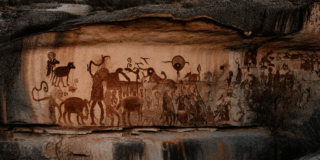
Wandjina art is as much ritual technology as it is aesthetic expression. Caves and rock shelters throughout the Wandjina Belt host numerous Wandjina panels, many of them layered through successive re-paintings – a practice that treats the images as living entities requiring periodic renewal. Repainting is not performed as mere conservation; it is an act of ritual maintenance believed to reinvoke the spirits’ potency and ensure seasonal rains. Elders and initiated custodians hold the authority to repaint, and the timing, colour palettes and compositional choices are governed by inherited protocols. Repainting seasons often coincide with the onset of the wet season, with ritual cycles orchestrated to align spiritual rejuvenation and ecological renewal.
Iconographically, Wandjina figures are instantly recognisable: large, round, pale faces (often rendered with white pigments), dark concentric eyes, absence of mouths and radiating halos that evoke clouds and lightning. Red ochre is frequently used to outline the head or to add radiating marks that signal storm activity. Dots and lines may indicate rain or the connectivity between sites. While a degree of stylistic standardisation exists, local variations appear in proportions, headdress ornamentation, and the inclusion of accompanying motifs – serpents, animal tracks or abstract designs – that carry clan-specific meanings.
The transition of Wandjina imagery from rock to bark, canvas and institutional art forms illustrates both continuity and adaptation. From the mid-twentieth century onward, Indigenous artists began producing Wandjina works on portable media for sale and exhibition, particularly through mission communities and later through galleries and cultural centres. Artists such as Alec Mingelmanganu and others have been instrumental in bringing Wandjina iconography to national and international audiences. Yet this modern dissemination raises intricate questions about authority and appropriation. Traditional custodians emphasise that Wandjina images belong to specified clans and cannot be indiscriminately reproduced; unauthorized depictions risk spiritual offence and cultural infringement. As a result, contemporary art markets increasingly recognise and uphold protocols of permission, attribution and custodial rights.
The performative aspects of Wandjina ritual extend beyond repainting to include dance, song and ceremonial regalia. Headdresses, body painting and choreographed movements may invoke lightning, thunder or rain. Ceremonies function to recall and re-enact cosmological episodes, reinforcing communal memory and social cohesion. These ritual performances are educational, serving to transmit mythic narratives, custodial responsibilities and ecological knowledge to younger generations in a context that blends religious reverence with practical stewardship.
Comparative Analysis: Wandjina and the Rainbow Serpent
Comparing the Wandjina with the Rainbow Serpent (by names varying across the continent: Ngalyod, Witij, Wanampi, Wagyl, Yurlunggur and many others) illuminates convergences and divergences in Australian Indigenous cosmologies. Both are water-associated creator figures with authority over fertility, landforms and weather; both operate as enforcers of social and ecological law. Yet they diverge in geographic scope, iconography, gendered associations and social deployment.
Geographic and Cultural Distribution
Wandjina are regionally specific, central to the Wandjina Wunggurr cultural bloc of the Kimberley. Their presence is materially concentrated along the Wandjina Belt and their custodial rights are tightly linked to discrete clans and sites. The Rainbow Serpent, by contrast, is pan-Australian in its diffusion. Variants of the Serpent appear in over two hundred Indigenous language groups, with stories adapted to the ecological realities of rainforests, savannas, deserts and coastal zones. This broad distribution suggests the Serpent functions as a unifying archetype, flexible enough to take on local inflections without losing its essential association with water and life-force.
Iconographic and Gendered Variations
Wandjina are primarily portrayed as anthropomorphic cloud-spirits with mouthless faces and halo-like headpieces. The Rainbow Serpent is typically sinuous and reptilian, often represented as a multicoloured, scale-covered being whose body carves the land. Gender presentations of the Serpent are variable: in some traditions it is male, in others female, and in still others androgynous or beyond gender. This mutability allows the Serpent to occupy roles in fertility, initiation and kinship narratives that emphasise transformation and reproductive cycles. In contrast, Wandjina narratives, while not monolithically masculine, often present a pantheon of named figures with discrete roles and a hierarchical organisation that aligns with clan-based custodial prerogatives.
Symbolic Focus and Social Function
Both types of beings regulate moral order through the material consequences of their agency – rain, drought, flood – but their social functions differ in emphasis. Wandjina narratives frequently articulate explicit clan jurisdictions, marriage laws, and the rituals necessary to sustain yorro yorro (continuous creation). The Rainbow Serpent’s myths more widely address themes of primal transformation, the origins of totems and languages, and the establishment of more continentally diffused taboos, particularly around waterholes. In many desert contexts the Serpent closely guards scarce water resources and determines territorial rights, while in the monsoonal north it controls tidal and riverine dynamics.
Regional Interplay: Wunggurr and Wandjina
In the Kimberley, the local Serpent – Wunggurr or Wunngurr – interacts with Wandjina traditions in complex ways. Sometimes Wunggurr is conceived as the animating life-force present in waterholes, with Wandjina acting as personified regulatory spirits. In rock art compositions one often finds serpentine motifs associated with or subsumed beneath anthropomorphic Wandjina figures, indicating an integrated cosmology where lifeforce and law are co-present. This syncretism highlights the capacity of Aboriginal belief systems to accommodate multiple metaphysical registers, allowing different figures to assume complementary functions in both ritual and landscape.
Variants of the Rainbow Serpent: A Concise Catalogue
The Rainbow Serpent’s many regional variants – Ngalyod and Witij in Arnhem Land, Wanampi and the Aranda Water Snake in central deserts, Wagyl in the southwest, Julunggul among the Yolngu as a fertility-associated figure – demonstrate the motif’s adaptability. Northern variants often align with cyclonic and monsoonal phenomena and may emphasise androgynous regenerative power; desert variants stress subterranean water management and territorial custodianship. Eastern and southeastern variants incorporate local topographies and social structures, shaping moral prescriptions appropriate to particular ecological circumstances. Across these variants, commonalities persist: the Serpent as both benefactor and punisher, the association with life-giving waters, and the role in establishing human social order.
Cultural Laws, Kinship and Obligations to Country
Wandjina cosmology is juridical as much as it is cosmological. The spirits are invoked as the originators of life-regulating laws: rules concerning marriage (particularly exogamous moiety divisions), kinship categories that delineate responsibilities and rights, and obligations to country that mandate stewardship and ritual upkeep. These laws are practical: they regulate resource use, seasonal movements, and the timing of ceremonial cycles. They also preserve spiritual balance by insisting that humans acknowledge the presence and authority of ancestral entities through respectful conduct, avoidance of taboo actions, and active maintenance of sacred sites.
Kinship systems grounded in Wandjina narratives prescribe marriageable partners, affinal obligations and intergenerational duties. In a socio-legal environment where land and identity are co-constituted, compliance with these rules is not merely a matter of personal morality but a form of land care: secure custodial relationships ensure that waterholes, rock art panels and songlines receive appropriate ritual attention. This is why the repainting of Wandjina images has practical as well as spiritual significance: failure to repaint may be read as neglecting custodial duties, which, within the cosmology, can precipitate ecological failure.
Modern Challenges: Appropriation, Legal Battles and Environmental Threats
The persistence of Wandjina traditions does not render them immune to contemporary pressures. Cultural appropriation – through unauthorised reproduction of Wandjina motifs in commercial products, unauthorised art projects, or tourism promotions – has been a persistent issue. Such acts raise deep concerns among custodians: in addition to aesthetic misrepresentation, unauthorised reproduction can entail violation of sacred protocols or spiritual harm. Judicial and extrajudicial efforts to address misuse have taken various forms, from community-based cultural licensing schemes to legal claims grounded in intellectual property, moral rights and, in some cases, native title assertions.
Environmental challenges pose another suite of threats. Climate change, with its potential to alter monsoon patterns, sea levels and ecosystem dynamics, has direct implications for the material conditions that Wandjina narratives encode. Shifts in rainfall timing and intensity could undermine traditional seasonal calendars, affect resource availability and complicate ritual cycles tied to predictable ecological markers. Mining, uncontrolled tourism, and other extractive practices threaten the physical integrity of rock art sites, waterholes and the landscapes upon which custodial claims rest. Indigenous communities and their allies have increasingly turned to multi-modal strategies to protect heritage: documentation projects, digital archiving, community education programs, co-management arrangements with government bodies, and strategic litigation.
Institutional and legal tools have both supported and complicated Indigenous custodial practices. Native Title recognition has empowered some groups to assert legal rights over land and resource management, but statutory frameworks often operate in tension with customary law – especially when it comes to sacred knowledge that traditional practice restricts from non-initiated audiences. Global instruments such as UNESCO conventions and UN declarations on Indigenous rights provide moral support and international visibility, yet the practical translation of such protections into site-level conservation and economic sustainability remains uneven.
Community-Led Preservation and Cultural Revitalisation
Indigenous-led initiatives exemplify the most effective and culturally consonant approaches to Wandjina preservation. Communities such as Mowanjum maintain cultural centres, run art programs that respectfully regulate who may depict Wandjina imagery, and engage in cultural education that transmits both visible and invisible aspects of tradition to younger generations. Corporate entities established by Indigenous groups have been used to manage intellectual property and to negotiate commercial licences that align with custodial values. Such arrangements seek to balance the economic potential of art and cultural tourism with the imperative to protect spiritual integrity and to ensure that benefits accrue to rightful custodians.
Documentation initiatives – sound recording, photographic archives, mapping of songlines and rock art panels – offer resources for both scholarship and community memory. Yet many custodians emphasise that documentation cannot replace ritual practice; repainting, ceremony and oral transmission remain necessary to sustain the spirits’ potency. Digital archiving can play a role in supporting these practices by providing accessible repositories for authorised use, by supporting remote communities in legal claims and by serving educational purposes for both Indigenous and non-Indigenous audiences.
Sensitive collaboration with researchers and conservation professionals has proven productive in some cases, provided that protocols of permission, benefit-sharing and cultural respect are scrupulously observed. Co-management of national parks and cultural heritage sites offers a model whereby Indigenous custodians retain primary ritual authority while state agencies provide resources for monitoring, infrastructure and scientific assessment of environmental threats. These partnerships have demonstrated that Indigenous ecological knowledge – encoded in Wandjina stories, seasonal prescriptions and fire regimes – can contribute to effective land management, biodiversity conservation and climate adaptation.
Ethical Considerations in Representation and Scholarship
Any public or scholarly discussion of the Wandjina must attend to ethical responsibilities. Many aspects of Wandjina tradition are culturally restricted: certain stories, ritual details and iconographic variants are the domain of initiated custodians and are not appropriate for general dissemination. Even publicly-known motifs may have meaning or uses that only custodians can authorise. Responsible scholarship therefore foregrounds custodial permission, community involvement and reflexivity about the limits of outsider interpretation.
This ethical orientation extends to artistic engagement: museums, galleries and commercial enterprises that wish to display or reproduce Wandjina imagery are increasingly expected to seek community consent, to provide accurate attribution, and to respect conditions against publicising sacred or secret imagery. Failure to do so risks cultural harm and perpetuates colonial patterns of extraction. Conversely, where Indigenous artists and institutions control representation, Wandjina art can be a powerful vehicle for cultural pride, education and economic empowerment.
Contemporary Relevance: Identity, Land Rights and Ecological Stewardship
Beyond its spiritual and artistic significance, Wandjina cosmology provides a framework for contemporary Indigenous political action and environmental advocacy. The narratives and custodial practices embed legalities of ownership, stewardship and intergenerational responsibility that can be mobilised in negotiations over native title, land management and heritage protection. Wandjina-based claims not only assert rights to physical sites but also assert the continuity of a living system of law and obligation. In an era marked by environmental uncertainty, Wandjina-informed stewardship practices – such as seasonally timed burning, taboos on over-harvesting, and careful maintenance of waterholes – offer adaptive strategies grounded in centuries of local knowledge.
Moreover, Wandjina imagery and the broader Wandjina Wunggurr discourse function as potent markers of identity. In contexts where colonial processes attempted to erase Indigenous languages, ceremonies and land-based practices, the public maintenance and celebration of Wandjina art and songlines serve as acts of cultural resilience. They reinforce intergenerational ties, link urban and remote community members, and provide a narrative through which contemporary issues – health, education, governance and environmental management – may be approached with cultural coherence.
Conclusion
The Wandjina are more than mythic figures or artistic motifs; they are operative agents within a living cultural system that integrates cosmology, law, stewardship and identity. Rooted in the unique ecologies of the Kimberley and sustained across centuries through oral transmission and ritual practice, Wandjina traditions articulate a worldview in which humans, spirits and the landscape are reciprocally constituted. The Wandjina teach that lawful living is inseparable from respectful care for country: marriage laws, kinship obligations and ceremonial maintenance all function to preserve the reciprocal relationships that sustain life.
Understanding the Wandjina requires attention to their historical emergence, their mythic narratives, their ritual and artistic technologies of maintenance, and the contemporary challenges and opportunities that shape their continuation. Comparative engagement with the Rainbow Serpent underscores both the distinctive regional character of Wandjina belief and the shared thematic threads that animate Australian Indigenous cosmologies – water as life, transformation as moral pedagogy, and the ethical regulation of human behaviour through consequences enacted in the natural world.
In an age of accelerating environmental change and ongoing struggles over cultural sovereignty, Wandjina traditions offer relevant insights. They exemplify how cosmology and law can be integrative, how art can function as ritual practice, and how custodial obligations can inform pragmatic land care. Protecting Wandjina heritage therefore requires more than static preservation; it requires supporting the living practices – repainting, ceremony, education, and custodial governance – that maintain the spirits’ potency and ensure the continuation of a culturally embedded ethic of stewardship. For custodians and their communities, and for the broader public that engages respectfully with this heritage, the Wandjina remain a profound reminder that culture, law and ecology are bound together in the ongoing work of creation.