Note to readers:
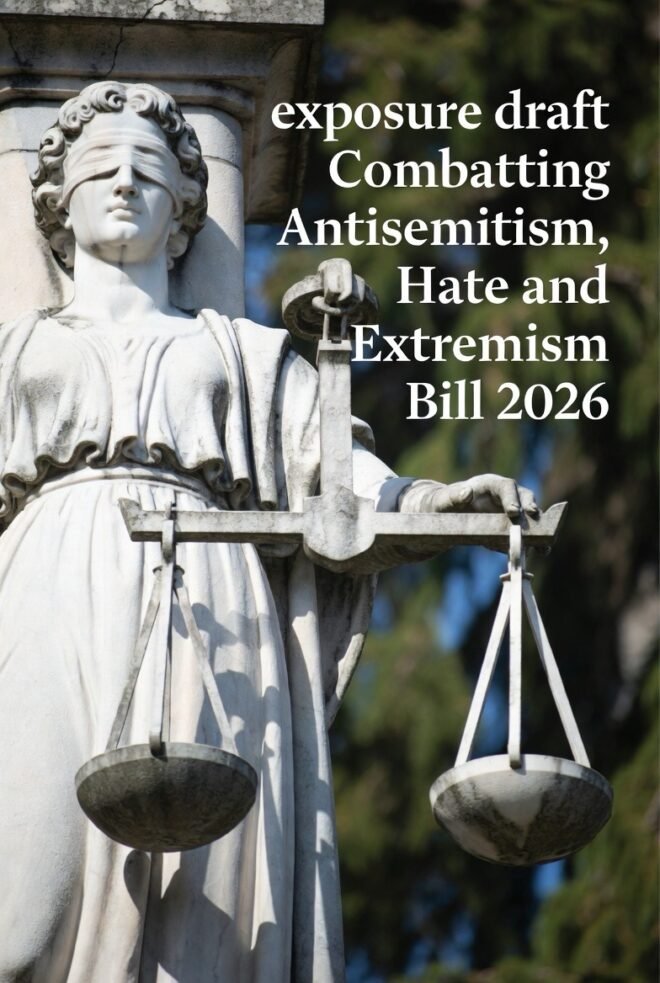
The following essay is a comprehensive, formal analysis of the Australian Labor Party’s exposure draft Combatting Antisemitism, Hate and Extremism Bill 2026 (the Bill), first released on 13 January 2026. It examines the Bill’s background and principal provisions, sets out the principal legal and democratic objections advanced by critics, canvasses the arguments put forward in support of the Bill, situates the measure within comparative and international legal contexts, and concludes with practical recommendations for reform. The objective is to offer a measured, evidence-based assessment of whether and how the Bill, as originally drafted, risked corroding rule-of-law principles – and how those risks might be mitigated while addressing genuine public safety concerns.
Introduction and context
In December 2025, Australia experienced a horrific act of violence in Bondi that re-animated longstanding social anxieties about terrorism, violent extremism, and targeted hate. The political reaction was swift and intense. Within weeks, on 13 January 2026, the federal government published an exposure draft of the Combatting Antisemitism, Hate and Extremism Bill 2026. The Bill proposed a suite of robust criminal and regulatory measures: new criminal offences for publicly promoting or inciting racial hatred with significant custodial penalties; aggravated penalties targeted at religious or political “hate preachers”; ministerial powers to designate and proscribe “hate groups” and associated symbolic bans; expanded immigration powers to refuse or cancel visas of those deemed to pose extremist risks; and a national firearms buyback scheme.
The government framed the Bill as filling gaps in Australia’s legal architecture, deterring violent radicalisation, and protecting vulnerable communities – including Jewish Australians, women, LGBTQIA+ people and others – from escalating harms. Opponents – ranging from civil liberties organisations, legal scholars, faith leaders, to opposition political parties – argued the Bill was rushed, vague, and contained instruments that risked arbitrary enforcement, reversed critical legal presumptions, chilled legitimate speech, and concentrated power in the executive with inadequate procedural safeguards. By 17 January 2026, intense public debate and more than 7,000 submissions had been registered, and the political landscape suggested that the Bill would undergo substantial revision before any final vote.
This essay does not take a partisan position for or against the authorship party. Rather, it asks a narrower, jurisprudential question: would the Bill, if enacted in the form circulated as an exposure draft, have been corrosive to the rule of law. Answering that question requires first identifying the rule-of-law principles at stake, describing the Bill’s main instruments and how they operate, and then testing the Bill against those principles. The essay will also examine the Bill’s policy rationale, its potential efficacy in combating extremism, and possible reforms that can preserve both public safety and the rule of law.
Rule of law: core principles to guide analysis
The term “rule of law” is used in many registers – political, philosophical and legal – but for purposes of statutory and constitutional design a set of core principles is typically invoked. International instruments and comparative jurisprudence commonly identify the following as essential elements:
• Legality and certainty: laws must be clear, accessible, and formulated with sufficient precision that individuals can foresee the consequences of their conduct.
• Non-arbitrariness and the separation of powers: powers should not be exercised in an arbitrary manner; significant coercive authorities ought to be subject to meaningful checks and balances and allocation of roles consistent with separation of powers.
• Procedural fairness and due process: decision-making that affects life, liberty, reputation or membership must, where appropriate, be accompanied by fair procedures, notice, reasons, and opportunity to be heard, and decisions affecting criminal liability must respect presumption of innocence and burden of proof principles.
• Proportionality: restrictions on rights and imposition of criminal penalties must be proportionate to the legitimate aims pursued; penalties should be calibrated to the harm and culpability involved.
• Equality before the law and non-discrimination: laws must be applied consistently and not used to target or privilege particular groups unjustly.
• Protection of fundamental freedoms: particularly freedoms of expression, association, religion, assembly and political communication; limitations on these freedoms must meet prescribed standards (e.g., legality, necessity, proportionality).
Testing the Bill against these principles is the analytical frame used below.
Overview of the Bill’s principal measures
The exposure draft advanced several interlocking measures. The following is a concise description of the Bill’s core elements (as circulated):
• New criminal offence of “racial vilification” (drafted as Section 80.2BF or equivalent): public promotion or incitement of hatred against a person or group on protected grounds would be criminalised. The threshold incorporated a “reasonable person” test – prosecution would not need to prove actual harm, but that the conduct could reasonably be expected to cause members of the protected group to fear physical or psychological harm, or to be harassed or intimidated. Penalties of up to five years’ imprisonment were proposed where the conduct could reasonably cause fear.
• Aggravated penalties for “hate preaching” by persons who, in positions of influence (including religious leaders), publicly advocate violence or hatred: heavier maximum penalties were proposed (up to 12 years’ imprisonment), and the offence contemplated enhanced sentences where conduct was directed at youth or vulnerable persons.
• Proscription of “hate groups” and criminalisation of membership or support: the Home Affairs Minister would have power to designate organisations as “prohibited hate groups” on the basis of intelligence or security assessments – principally, advice from ASIO (the Australian Security Intelligence Organisation). Criminal penalties for membership, support, promotion, or attendance at prohibited organisations were substantial (drafted at up to 15 years’ imprisonment for certain offences).
• Bans on symbols associated with proscribed organisations: use, display, or promotion of certain symbols could attract criminal penalties unless the defendant could prove a “good faith” purpose (e.g., for journalism, education, art, or academic inquiry).
• Expanded immigration controls: administrators would have broader powers to refuse visas or cancel existing visas of non-citizens assessed to pose a risk due to extremist views or links.
• National firearms buyback scheme: a program to facilitate the surrender and destruction of certain classes of firearms, accompanied by legislative strengthening of gun-control enforcement.
• Fast-tracked parliamentary and executive timetable: the government proposed accelerated consideration, with sittings recalled for 19–20 January after a short inquiry by the Parliamentary Joint Committee on Intelligence and Security, and a constrained period (c. 72 hours) for public submissions on the exposure draft.
Stakeholders thus saw a package that combined criminal law, administrative controls, symbolic regulation, immigration powers, and gun policy – bundled into expedited legislative processing.
Arguments that the Bill is corrosive to the rule of law
Vagueness and overbreadth
One of the principal criticisms mounted by legal scholars and civil liberties groups concerns the Bill’s terminology. Criminal offences are expected to satisfy the principle of legality: they must be formulated with sufficient precision for individuals to regulate their conduct. The Bill’s central “racial vilification” offence extended criminal liability to public speech that “promotes or incites” hatred where a “reasonable person” in a protected class might fear violence or harassment. That combination of indeterminate standards – “promote”, “incite”, “reasonable person”, and “fear” of harms that need not be actualised – was widely described as legally vague and overbroad.
Vagueness risks two distinct harms. First, individuals may be unable to foresee whether ordinary political argument, robust advocacy, or controversial but widely accepted expressive conduct could fall within the offence, thereby chilling speech out of risk aversion. Second, police, prosecutors or ministers could exercise discretion unevenly because the statutory markers leave too much room for subjective interpretation. Examples debated publicly – such as whether slogans like “from the river to the sea” or calls for “globalise the intifada” would be captured – illustrated the difficulty even for government officials to commit to clear enforcement boundaries. Where criminal sanctions attach, these uncertainties are particularly troubling from a rule-of-law perspective.
Reversal of presumption of innocence and shift in burden of proof
A further concern relates to evidential burdens. Several provisions in the exposure draft placed the burden on defendants to establish that their conduct engaged an exempted “good faith” purpose (for instance for artworks, academic discussion, or religious teaching), rather than requiring the prosecution to prove all elements of the offence beyond reasonable doubt. Reverse onus provisions are sometimes sustained by legislatures for legitimate purposes, but they attract strict scrutiny because they trench upon the presumption of innocence – an essential element of fair criminal procedure.
Similarly, the proscription power for “prohibited hate groups” did not, in the draft, require a judicial determination prior to the imposition of criminal sanctions on members or supporters. Ministerial designation, based principally on executive intelligence assessments, therefore risked creating circumstances in which individuals were criminalised by association without the procedural safeguards that accompany judicial findings. Combined with a reverse onus for justifying symbol use, these features were said to undermine basic due process protections.
Concentration of executive power and inadequate checks
The Bill’s architecture vested significant decision-making power in the Home Affairs Minister and executive agencies. Ministerial designations of organisations and decisions to cancel visas on the basis of “risk” assessments were central instruments. Where such powers are unconstrained, the risk of arbitrary or politically motivated exercise rises. Effective rule-of-law design ordinarily requires meaningful checks – prior judicial review where possible, independent merits review or robust parliamentary oversight, procedural fairness for affected parties, and independent reasons for decisions that can be publicly scrutinised.
Critics were especially alarmed that the Bill’s process provisions did not appear to provide for prompt and effective judicial review, nor to require publication of reasons or provision of material on which decisions were based. Because intelligence assessments often involve classified sources, the Bill ought to have set out a careful regime for special advocates, closed-material procedures or other mechanisms to balance national security with procedural fairness. The exposure draft’s apparent failure to provide such safeguards was a key reason why figures across the legal and faith sectors urged substantial reworking.
Chilling effect on free speech, religious freedom and political communication
Restriction of speech – particularly political and religious speech – lies at the heart of controversy. The Bill’s aggravated offences targeted “hate preachers” and contemplated influence-based enhancements where the speaker is a religious leader or possesses a platform. While protecting communities from violent radicalisation is a legitimate aim, the statutory text as proposed risked entangling legitimate religious instruction, scriptural exegesis, or contentious political advocacy in criminal culpability.
Faith leaders from diverse communities warned that placing the onus on a religious speaker to prove “good faith” exposition could force courts into theological adjudications and create incentives for religious leaders to self-censor. Political organisations and activists – on both the left and the right – expressed concern that the Bill’s broad definitions could be used to criminalise protest speech or solidarity campaigns (for instance, demonstrations around national day events or pro-Palestine activism), thereby skewing the democratic public square.
Rushed legislative process and democratic legitimacy
The Bill’s expedited timetable – 72 hours for public submissions on an exposure draft and a two-day parliamentary debate window – provoked criticism of procedural shortcuts. Law-making that significantly alters the balance between liberty and security generally benefits from deliberative processes: extended public consultation, detailed parliamentary committee scrutiny, time for stakeholders to propose amendments, and opportunities for comparative law study. Rushing such a complex and liberty-implicating instrument undermined public confidence and reduced the likelihood that technical defects would be identified and remedied prior to vote.
Unequal application and potential for selective enforcement
The Bill’s combination of broad speech offences and discretion in agency and ministerial action creates risk that laws will be applied unevenly. Critics warned that minorities, activists, and political dissidents could be disproportionately affected, whether because of ordinary law-enforcement bias or because political expediency drives selective targeting. Indigenous groups raised the prospect that protest actions (for example, demonstrations concerning Australia Day) might be recast as criminalised behaviour under a reading of “incitement” or “symbolic” prohibition, thereby impacting civic participation and exacerbating historic inequalities.
Arguments that the Bill could strengthen the rule of law
Addressing legal lacunae and responding to real harms
Proponents argued the Bill corrected identifiable gaps in the legal framework. Australia’s criminal law contains provisions on incitement, terrorism and hate speech, but critics within government and some legal circles contended those provisions were not calibrated to emerging modes of violent radicalisation or modern forms of organised hate. The Bill’s supporters maintained that targeted criminal offences – especially where tailored to public advocacy that reasonably risks provoking violence – would deter conduct that catalyses harm. In that sense, the Bill aimed to protect the rule of law by preventing abuses that undermine social cohesion and security.
Proportionality of new measures (as claimed by backers)
The government emphasised the inclusion of exemptions and “good faith” defences for journalism, academic work and religious instruction, suggesting a design that sought proportionality: heavy penalties were reserved for the most culpable conduct (for instance public calls for violence or the organisation of extremist groups), while safeguards were built in to protect legitimate activity. Supporters argued that refusing visas to non-citizens who pose security risks and confiscating extremist material are conventional, proportionate responses found in many liberal democracies.
Targeting of organisational structures rather than private belief
Defenders of proscription argued that the primary focus is organisational behaviour – structural mobilisation of violence or the promotion of violent extremism – rather than private beliefs themselves. The Bill’s supporters compared its approach to counter-terrorism frameworks that proscribe criminal organisations, arguing that group proscription and symbolic bans help break the cycle of recruitment and normalisation that can precede violent acts.
Comparative and international perspectives
Comparative legal experience is instructive. Democracies have calibrated hate-speech and extremist-organising laws in different ways:
• Germany criminalises the public use and display of Nazi symbols and has robust proscription powers against extremist organisations. These measures are enacted in the shadow of historical atrocities and are defended as necessary to prevent renewal of totalitarian ideologies. Germany’s legal system, however, couples proscription with a strong rule-of-law framework, independent courts, and detailed statutory definitions.
• The United Kingdom criminalises stirring up racial hatred and has proscription powers for terrorist organisations. Debate in the UK has long contrasted criminal sanctions for incitement to violence with considerations about free speech, with courts and Parliament often refining the contours of offences.
• Canada’s criminal code contains hate propagation offences and legal provisions governing the distribution of hate literature, but Canadian jurisprudence has repeatedly debated the proper balance between freedom of expression in the Charter and protection from hatred.
• The United States, by contrast, affords maximal protection to speech under the First Amendment and would likely resist criminalising broad categories of provocative speech absent direct incitement to imminent lawless action (Brandenburg standard).
Taken together, comparative models indicate that proscription and symbol bans are not unknown in liberal democracies, but these laws tend to be accompanied by narrow definitions, careful procedural protections, and high thresholds for criminal liability. The risk of overreach is consistently the central concern across jurisdictions.
Testing the Bill against rule-of-law norms: an integrated assessment
Applying the rule-of-law principles identified earlier, the exposure draft as released raised legitimate rule-of-law concerns in multiple respects.
Certainty and clarity: The statutory language’s indeterminacy – unfocused terms like “promote,” “incite,” “reasonable person,” and the absence of a clear mens rea standard (intent vs recklessness vs negligence) – would make it difficult for ordinary speakers to know when criminal liability attached. Because speech can be contextually sensitive, precision is essential to prevent criminalisation of controversial yet non-violent advocacy.
Non-arbitrariness and separation of powers: Vesting decisive designation power in the executive without robust judicial checks invites the risk of arbitrary exercise. Where criminal penalties flow from executive decision, procedural safeguards (notification, reasons, access to impartial adjudication, prompt review) are essential to ensure decisions respect the rule of law.
Due process: Reverse onus clauses and evidentiary presumptions that shift burdens to accused persons heighten the risk that individuals will be deprived of liberty without rigorous procedural protections. Criminal law should ordinarily require the prosecution to prove every element beyond reasonable doubt, unless an exceptionally compelling justification is provided and proportional safeguards are embedded.
Proportionality and equality: Heavy sentences up to 15 years for association with proscribed organisations raise proportionality questions, particularly where membership may be ambiguous (e.g., transient association, familial ties). Equal application requires careful statutory metrics to distinguish between culpable active organisational conduct and mere presence, association, or passive attendance.
Freedom of expression and association: The Bill’s reach into symbols, protest speech and religious discourse risks chilling democratic participation. A hallmark of rule-of-law societies is that the remedy to offensive speech is typically counter-speech or limited civil regulation, except where speech is intentionally and directly connected to imminent violence. Criminalising broad categories of vilification without precise mens rea and connection to harm moves away from this norm.
Procedural legitimacy: The expedited process in which the Bill was advanced undermined deliberative legitimacy. Democratic law-making that affects fundamental rights benefits from measured processes: time for stakeholders to present alternatives, parliamentary committees to examine the legal drafting, and experts to propose concrete amendments.
Does the Bill’s public-safety purpose justify its intrusions?
Clear and weighty public purposes can justify restrictions on rights in the name of public safety. However, such justification demands narrow tailoring. Even where a proportionate link to preventing imminent violence exists, the law must tread carefully to avoid catch-all wording that ensnares legitimate activity. The exposure draft’s central defects were not necessarily its stated objectives – protecting communities from violent extremism and antisemitism are legitimate ends – but its means were too blunt and its safeguards too thin, thereby threatening to undercut the rule of law.
Practical risks: chilling, overreach and social fragmentation
Beyond abstract legal principles, the Bill carried practical risks. If citizens, journalists, religious leaders and community organisers feared criminal sanction for controversial speech, public debate could be muted. That chilling effect can be particularly pernicious in multicultural democracies where contested narratives are part of political life. There is also the risk of enforcement bias: selective prosecutions could further erode trust between communities and state authorities, undermining the social cohesion the Bill purported to protect.
Recommendations for reform: preserving security while upholding the rule of law
If the policy objective of combating antisemitism, hate and violent extremism is accepted as legitimate, the legal architecture must reflect precise drafting and robust safeguards. The following reforms would materially reduce rule-of-law concerns while preserving legitimate public-safety aims:
1. Narrow and precise statutory definitions
• Define prohibited conduct with mens rea thresholds – a requirement of intent to incite imminent lawless action or a high standard of recklessness – so that mere offence or affront does not trigger criminal liability.
• Limit the “reasonable person” test by specifying contextual factors and by clarifying the threshold of likely harm (e.g., a substantial risk of imminent violent conduct), rather than the possibility that some members could be fearful.
2. Preserve the presumption of innocence
• Avoid reverse onus provisions in criminal sections. If a qualified defence is necessary (e.g., for journalistic or academic uses), frame it as an evidential burden on the accused to adduce some supporting evidence, but require the prosecution to disprove the defence beyond reasonable doubt.
3. Require prior judicial involvement for proscription or create a robust merits review mechanism
• Instead of unilateral ministerial proscription based solely on executive advice, require an initial application to a court (or an independent tribunal) where classified information can be heard in closed session with special advocates if necessary, allowing judicial determination of whether the organisation meets a statutory test (e.g., engages in, advocates for or organises violent activity).
• At minimum, ensure an independent merits review avenue and prompt access to judicial review of any designation decisions, with a statutory obligation on the minister to publish reasons consistent with national security constraints.
4. Tailor penalties and distinguish levels of culpability
• Calibrate maximum penalties to reflect differences between active leadership or operational involvement in extremist conduct and passive association or attendance.
• Clarify that symbolic offences apply only when the symbol is used in a context reasonably likely to incite imminent violence or recruitment to violent causes.
5. Strengthen procedural safeguards in immigration and intelligence-based actions
• Provide non-citizens subject to visa cancellation with a meaningful right to be heard and a mechanism for reviewing classified material that informs decisions (special advocates, closed material procedures).
• Ensure intelligence assessments that underpin criminal or proscription decisions are subject to independent oversight (Inspector-General of Intelligence and Security, parliamentary intelligence committees).
6. Sunset clauses and periodic review
• Include a parliamentary sunset clause requiring re-authorisation after a defined period (e.g., three or five years) and a statutory requirement for an independent review of the legislation’s effects on rights, enforcement patterns and community trust.
7. Wider consultation and staged legislative approach
• Recommit to an extended consultation process with legal experts, civil society, faith communities and affected groups, and break the package into separate legislative instruments (e.g., hate-speech and symbol provisions, organisational proscription, immigration measures, and gun reform), allowing distinct scrutiny and cross-bench negotiation.
8. Investment in non-legislative prevention measures
• Complement criminal law with funding for community-led prevention and deradicalisation programs, education initiatives, social-media counter-speech strategies, and support services for at-risk youth and affected communities.
Concluding reflections
The exposure draft of the Combatting Antisemitism, Hate and Extremism Bill 2026 exemplifies the perennial tension democracies face: how to protect communities from real and present dangers while preserving the constitutional and legal norms that enable free politics and civic life. The Bill’s objectives reflected urgent and legitimate concerns about rising antisemitism, extremist mobilisation and the risk of violence. Yet the shape of the machinery proposed – in particular its imprecision, heavy penalties, reverse burdens of proof, and concentration of executive designation power – posed significant risks to core rule-of-law principles: legal certainty, due process, non-arbitrariness, proportionality and protection of fundamental freedoms.
Law can and should be used to prevent and punish genuinely dangerous conduct. But the success of laws that regulate speech, association and symbolic expression depends on careful drafting, rigorous procedural safeguards, and transparent, deliberative law-making. To be defensible in a polity that values both security and liberty, measures must be narrowly tailored, subject to independent review, and embedded in a broader strategy that invests as much in prevention, education and community resilience as in punitive responses.
The public debate that followed the exposure draft – thousands of submissions, sustained engagement from legal and civic groups, and the apparent political willingness to split the package and rework problematic provisions – illustrates democratic responsiveness. That process is itself a guardrail of the rule of law: contested proposals must be corrected, amended, or discarded if they infringe the legal principles that underpin the legitimacy of governmental authority.
If a final Bill is to be both effective and lawful, legislators must heed the lessons of rule-of-law scrutiny: clarity in language, proportionality in sanctions, procedural safeguards against arbitrary or political decision-making, and avenues for independent redress. Only then can the twin goals of protecting communities from hate and preserving the liberties that define liberal democracy be advanced in durable and lawful ways.