
Introduction
The rules-based international order was constructed in the ruins of the Second World War with an explicit, solemn promise: to save succeeding generations from the scourge of war. The United Nations Charter, the Geneva Conventions and later instruments such as the Rome Statute of the International Criminal Court (ICC) were built on that moral and legal commitment. Yet across the last eight decades the limits of those instruments have been repeatedly exposed. Powerful states have shaped, strained and sometimes outright ignored the rules when it suited strategic interests. The result is an international legal architecture that often looks fine in theory but constricted and porous in practice.
The images that have come out of Gaza over the last two-plus years – skeletal children, flattened neighbourhoods, hospitals emptied or destroyed, queues for aid attacked, whole communities uprooted – are not merely photographs. They are living testimony to how those legal protections are being tested, and in many cases, breached. Allegations from major human rights organisations, inquiries by the United Nations, and investigations at the ICC point to patterns of conduct in Gaza that, if proven in a court of competent jurisdiction, would constitute serious breaches of international humanitarian law and, according to some determinations and submissions, possibly crimes against humanity or even genocide.
Against that background, the decision by Australia’s government to host Israeli President Isaac Herzog for an official visit in early 2026 is not a neutral diplomatic event. It carries symbolic weight. In inviting a head of state whose country is accused by multiple international bodies and civil society organisations of grave violations, Australia risks signalling something far more consequential than a mere diplomatic courtesy. It risks eroding Australia’s own credibility on international law, exposing domestic social fractures, and contributing to an environment in which impunity becomes normalised.
This essay argues – from historical, legal and moral standpoints – that it was inappropriate for Australia to host Isaac Herzog while the devastation in Gaza continued. It traces how the rules on war crimes and humanitarian protections have been weakened in practice, surveys the documented allegations of systematic destruction in Gaza, examines the specific role played by the Israeli presidency and statements attributed to Isaac Herzog, and assesses Australia’s shifting policy and the contradictions embedded in the invitation. The purpose is not to provide a one-sided polemic; it is to explain why, in the words of the founders of the post-1945 order, law and moral leadership should constrain state behaviour, and why a decision to host must be judged against those obligations.
Historical Context: The Fragility of International Humanitarian Law
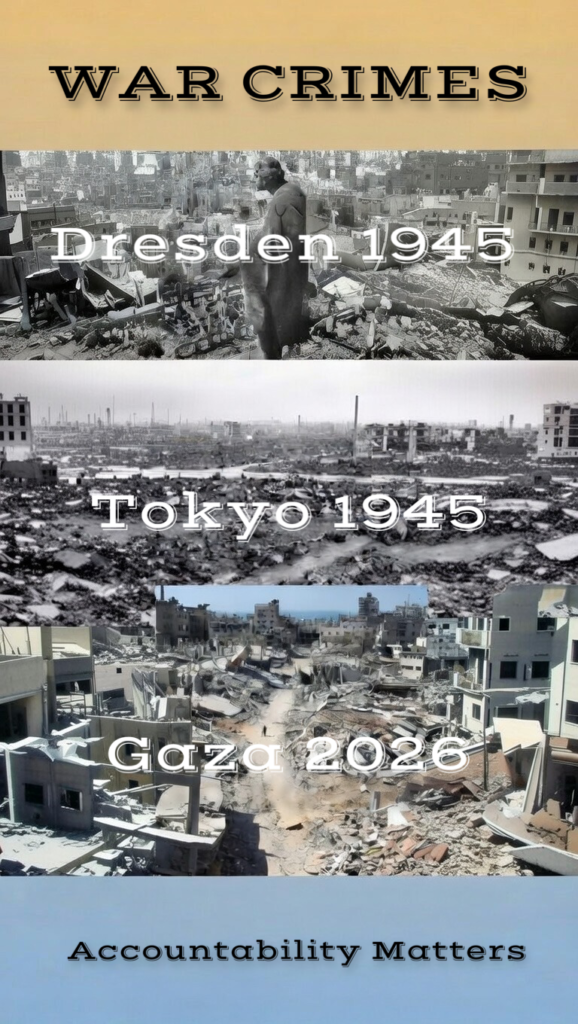
International humanitarian law – the laws of war – was born out of accumulated outrage at the excesses of past conflicts and an aspiration to limit the suffering those conflicts cause. After World War II, tribunals in Nuremberg and Tokyo prosecuted leaders of the Axis powers. Yet those very tribunals were imbued with paradox. The Allied strategic bombing campaigns that had razed Dresden and Tokyo, and caused tens of thousands of civilian deaths, were not prosecuted with similar zeal. Allied leaders were uncomfortable opening themselves to “tu quoque” defences; the result was a selective application of justice. That selectivity set a precedent that has echoed through subsequent decades.
Over time law-makers attempted to close loopholes. The 1949 Geneva Conventions, the 1977 Additional Protocols, and the 1998 Rome Statute expanded protections and defined new international crimes. Nonetheless, the principle of “military necessity” and the concept of proportionate collateral damage leave substantial room for interpretation. States may argue that strikes on populated areas are justified by military objectives; distinguishing between combatants and civilians remains hard where insurgents and irregular forces operate within civilian populations.
The post?1945 architecture has been further weakened by politics. Permanent members of the UN Security Council wield veto powers; great powers remain outside the jurisdiction of the ICC or have powerful domestic legal and political tools to resist accountability. Nuclear states have been able to shield aspects of their conduct from international censure. The paradox is stark: the legal texts enshrine norms that, in moments of geopolitical pressure, are often subordinated to national interests.
These structural weaknesses matter because they create what many commentators have called “wriggle room.” When a state can credibly argue self-defence, military necessity, or the lack of proof of intent, then accountability mechanisms are constrained. Over time this fosters a culture where some actors calculate that they can act with impunity or with limited consequences. The tragic result is that laws meant to constrain violence sometimes appear to function as rhetorical devices rather than binding limits.
Israel and Gaza: Patterns and Allegations of Systematic Destruction
Since October 2023, the Israel–Gaza conflict has unfolded not as a short, localised military action but as a prolonged, widescale campaign marked by repeated escalations, sieges, and ground operations. International organisations, human rights groups and UN bodies have documented patterns of conduct that raise grave legal and moral questions.
Scope and scale of civilian harm
Reports from the United Nations, Human Rights Watch, Amnesty International, and other bodies describe extraordinarily high civilian casualty rates. Tens of thousands of Palestinians have been killed, a significant proportion of them women and children. Schools, mosques, universities, hospitals and refugee camps – settings that are protected under international humanitarian law – have been struck repeatedly. These attacks have not only caused immediate civilian deaths but have decimated the medical and humanitarian infrastructure Gaza depends upon, increasing indirect mortality from disease, malnutrition and lack of medical care.
Displacement and the destruction of homes
Forced displacement on a mass scale has been central to the pattern. Evacuation orders, demolition of neighbourhoods to create “buffer zones,” and destruction of residences have left the vast majority of Gaza’s population displaced at least once, many multiple times. The scale of demolition – by some accounts hundreds of thousands of homes damaged or destroyed – amounts to what some experts and UN committees have termed “domicide,” the systematic destruction of homes that contributes to long-term dispossession.
Starvation and siege tactics
A critical and particularly grave allegation is the use of starvation as a weapon of war. The cutting off of fuel, water, electricity and humanitarian supplies – at times coinciding with intensive military operations – has created famine conditions in parts of Gaza. The United Nations and numerous human rights organisations warned early on that barring or limiting lifesaving aid to a trapped civilian population constitutes collective punishment and can amount to a war crime. The ICJ’s provisional measures in cases brought before it called on Israel to prevent genocidal acts and to allow unimpeded humanitarian assistance; compliance has been contested and partial, at best.
Targeting of protected facilities and personnel
Hospitals and medical facilities were repeatedly hit, many taken out of operation for prolonged periods. Medical personnel were killed or detained, and patients were left without care. Attacks on clearly marked UN facilities and aid convoys have further restricted humanitarian access. The bombing of civilian infrastructure, where there is no clear or lawful military nexus, falls into the realm of indiscriminate or disproportionate attacks – categories that international humanitarian law forbids.
Actions that implicate genocidal intent
Beyond individual attacks, some international bodies and legal scholars have assessed the cumulative effects of policies and operations and suggested that elements of conduct – causing serious bodily or mental harm, deliberately inflicting conditions of life calculated to bring about physical destruction, and imposing measures intended to prevent births – might meet elements of the Genocide Convention if intent can be established. Intent is the critical legal threshold for genocide; it is notoriously difficult to prove, but numerous UN investigations and human rights organisations have catalogued acts that meet several of the Convention’s structural elements.
Accountability efforts and the limits of enforcement
The ICC, domestic legal initiatives, and the ICJ have all moved, to varying degrees, towards adjudication or determination. In 2024 the ICC issued arrest warrants against senior Israeli figures for allegations related to starvation as a weapon, and the ICJ has entertained proceedings brought by states. But enforcement – the physical arrest of suspects, or effective multinational sanctions – remains problematic. The political shield afforded by powerful allies and the reality that several major states are not fully subject to ICC jurisdiction or will use Security Council vetoes to block enforcement mean that legal processes, however credible, can be slow and incomplete.
It is in this context that questions about the hospitality extended to Israeli leaders must be understood. When a state is credibly accused of systematic and ongoing violations of international law, receiving its leaders with the trappings of normal diplomatic recognition carries consequences beyond optics: it normalizes, it confers legitimacy, and it can be read as a denial of the suffering those allegations describe.
Isaac Herzog: Statements, Symbolism, and Responsibility
Isaac Herzog serves as Israel’s president, a role that is constitutionally and ceremonially significant. In democratic systems, even ceremonial presidents embody the state’s image abroad. During the course of the conflict, statements attributed to President Herzog have been highly controversial. Phrases such as “there are no uninvolved civilians in Gaza” (as reported widely), and public denials of famine despite visual and documented evidence to the contrary, have been read by many observers and by a UN commission as dehumanising, inflammatory, and potentially constitutive of incitement.
It is important to distinguish between the legal theories of individual responsibility (criminal liability) and political accountability (moral/political responsibility). Legally, heads of state enjoy certain immunities under international law, and accountability mechanisms like the ICC face complex jurisdictional and enforcement dilemmas. Politically, however, public statements by heads of state that suggest the delegitimisation of an entire civilian population contribute to an environment in which atrocities are more likely to be tolerated or rationalised.
Allegations of incitement or endorsement of policies that allow for collective punishment require serious scrutiny. Accusations that a leader’s rhetoric has been used to justify indiscriminate targeting elevate the stakes of state visits. If an international commission names a leader among those whose rhetoric meets thresholds of incitement, hosting that leader risks contradicting the hosting state’s commitments to human rights and international law.
Australia’s Decision to Invite: Context and Contradiction
Australia’s foreign policy stance on Israel and Palestine has been in flux for decades. Historically, Australia supported the UN Partition Plan in 1947 and has often balanced strategic ties with Israel against commitments to international law and multilateralism. The domestic political landscape, public opinion, and international alignments – including relationships with the United States, European partners, and regional states – all shape Canberra’s approach.
In September 2025 Australia took the significant step of formally recognising the State of Palestine, part of a broader shift in several Western capitals aimed at reinvigorating the prospect of a two?state solution. That recognition was accompanied by public statements criticising settlement expansion and calling for concrete steps toward conflict resolution. Against that background, inviting Israel’s president for a ceremonial state visit – especially when that presidency sits over a country under intense scrutiny for its conduct in Gaza – appears inconsistent at best and hypocritical at worst.
Proponents of the invitation argue that the visit was intended to heal divisions within Australia following a horrific antisemitic attack in December 2025 (the Bondi massacre), to show solidarity with the Jewish community, and to affirm condemnation of antisemitism. Those are legitimate concerns. States have obligations to protect religious and ethnic minorities, to speak against hate, and to foster social cohesion.
But these legitimate aims do not automatically justify a state visit that risks normalising or whitewashing ongoing allegations of atrocity. Diplomacy is an exercise in symbolic communication. Hosting a leader accused – by UN bodies, human rights NGOs, and prosecutors at the ICC – of statements or policies that contributed to grave harm sends signals beyond the immediate domestic context. It may be read internationally as a softening of Australia’s stance on the protection of civilians, on upholding legal obligations under the Geneva Conventions and other instruments, and on the seriousness of allegations raised in global fora.
The domestic backlash predicted (and observed) in response to the invitation also illustrates a tangible cost. Grassroots protests, legal submissions urging refusal or arrest, and divisions among communities show that the visit did not achieve the unifying purpose argued by its proponents. Instead, it intensified debates about whether healing and solidarity require unconditional gestures toward one side of a foreign conflict.
Why Hosting Accused Leaders Undermines International Law and Moral Leadership
Hosting leaders accused of war crimes or crimes against humanity is not a mere diplomatic nicety; it carries legal and moral weight. Several interlocking reasons explain why states ought to think carefully before providing the full honours of a state visit to such leaders.
1) It weakens the normative force of international law
International legal norms derive force not only from treaties and courts but from states’ consistent practice and the coherence of their actions. When countries of standing receive leaders under credible indictment – or during an ongoing legal process or credible inquiry – they undermine the global message that violations have consequences. Diplomatic courtesy unaccompanied by serious insistence on accountability can be misread as endorsement.
2) It normalises impunity
International justice mechanisms depend on states to assist with investigations and arrests, to cooperate with international prosecutors, and to apply universal jurisdiction principles where appropriate. Hosting an accused leader creates practical and symbolic barriers to those processes. It bolsters a culture in which the powerful expect to travel freely despite serious allegations.
3) It dishonours victims
Victims of alleged atrocities and their families often look to the international community for recognition and redress. When states hold out the welcome mat to leaders accused of ordering or enabling such atrocities, they risk marginalizing victims and dismissing their suffering.
4) It creates domestic tensions and security risks
As seen in other cases (e.g., when Sudan’s Omar al?Bashir visited South Africa in 2015 despite ICC warrants), the presence of accused figures can prompt domestic legal challenges, protests, and social division. Governments must weigh the potential for civil unrest and the demand for transparent legal processes when making diplomatic choices.
Historical parallels teach that hosting such leaders often backfires. When South Africa failed to arrest Omar al?Bashir at an AU summit in 2015, it suffered a deep reputational blow and a prolonged domestic legal contest. Similarly, the reception of leaders accused or suspected of serious violations at international summits has catalysed legal and political debates rather than quieted them.
Legal pathways exist that states can use as alternatives to uncritical hospitality: invoking immigration or national security laws to refuse entry where there is reasonable suspicion of international crimes; conditioning visits on cooperation with international investigations; or using diplomatic channels to press for accountability while maintaining channels of communication that are strictly necessary. None of these are simple or risk-free, but they indicate that states have options besides an unconditional state welcome.
The Particular Case of Australia: Policy, Principle, and Practical Politics
Australia has important interests in projecting itself as a principled middle power that supports multilateralism and international law. Its recognition of Palestine in 2025 was an attempt to recalibrate its posture in line with those values. That recognition, however, must be matched by consistent conduct. Inviting President Herzog while the devastation in Gaza continued and while international investigations were ongoing created an impression of inconsistency.
There is also the domestic dimension: Australia’s Jewish community, many of whom understandably fear antisemitism and insecurity, sought recognition and solidarity after the Bondi massacre. But a compassionate response aimed at healing must be calibrated so that it does not simultaneously silence or discount the suffering of Palestinians or signal apathy toward calls for accountability. A successful bridging strategy would require transparent criteria – expressed in terms of international law and human rights – for any official receptions of foreign leaders accused of serious crimes, and meaningful engagement with affected communities to avoid the perception of selective empathy.
The Australian legal framework also provides mechanisms to act. National laws, such as migration and anti?incitement statutes, can be invoked to deny entry where there is clear risk of harm or incitement. While these mechanisms require careful legal justification and will invite political blowback, their considered use in exceptional circumstances reinforces the idea that states do not host leaders in a moral vacuum.
Practical Alternatives and a Roadmap for Principled Diplomacy
If Australia (or any state) wishes to balance a commitment to domestic communal safety with an equally firm commitment to international norms, there are constructive alternatives to an unconditional state visit:
• Use diplomatic channels to convey concern: Hosts can insist on publicly articulated terms that the leader must address, including commitments to comply with international investigations, assurances of humanitarian access, and commitments to protect civilians.
• Condition visits on cooperation: A leader’s entry could be conditioned on demonstrable steps, such as facilitating independent investigations or allowing humanitarian corridors, subject to transparent monitoring.
• Employ middle?power convening: Australia can use its diplomatic capital to convene panels or dialogues that include representatives from affected communities, independent legal experts, and UN agencies to press for accountability and relief.
• Support robust independent inquiry: If evidence suggests crimes may have been committed, Australia should support investigatory mechanisms – both within international bodies and independent commissions – and consider measures to enhance the prospect of enforcement (e.g., targeted sanctions, arms embargoes, or diplomatic censure tied to legal benchmarks).
• Uphold legal obligations at home: Accept and adjudicate legal requests consistent with universal jurisdiction principles where appropriate, and ensure domestic laws can support arrest or extradition in compliance with international obligations.
These alternatives preserve channels for constructive engagement while signalling that diplomacy does not provide a shield from accountability.
Conclusion: Restoring Credibility Through Consistency
The founders of the post-1945 order intended a world in which states would be bound by legal and moral constraints when waging war. That aspiration has been compromised not only by the ambivalence of great powers but also by the cumulative effect of selective enforcement, diplomatic inconsistency, and the normalisation of impunity.
Australia – as a middle power with a long?standing commitment to multilateralism – has a unique capacity to shape norms by its example. Hosting a head of state under credible allegations of facilitating or inciting grave violations in Gaza, while those allegations are the subject of international investigation, undermines that capacity. The invitation to Isaac Herzog, coming after Australia’s formal recognition of Palestine and in the shadow of a domestic terrorist attack, exemplifies the uncomfortable trade-offs nations make between short?term domestic political aims and longer?term commitments to international law.
Refusing to host – or at least conditioning any hospitality on concrete steps toward accountability and humanitarian relief – is not an act of hostility toward a people or a religion; it is an assertion that states must be held to norms that protect civilians everywhere. Such a stance reinforces the credibility of the legal order and sends a powerful message that moral leadership requires more than ceremonial courtesies. It requires consistency between words and actions.
If the world is to avoid descending repeatedly into the moral depths recorded in history – from the bombed cities of the Second World War to the flattened districts of contemporary conflicts – then states must align their diplomatic practice with the legal and human rights principles they profess. Australia’s decision to invite Israel’s president at a time when Gaza remains devastated tested that alignment. Re-establishing humanity, as those earlier legal framers urged, means that countries must be willing to refuse normalizing gestures toward leaders whose policies or rhetoric contribute to mass suffering. Only then can the promise embedded in 1945 be given renewed force, and only then can international law move beyond rhetoric to a living constraint on the abuse of power.