
Introduction
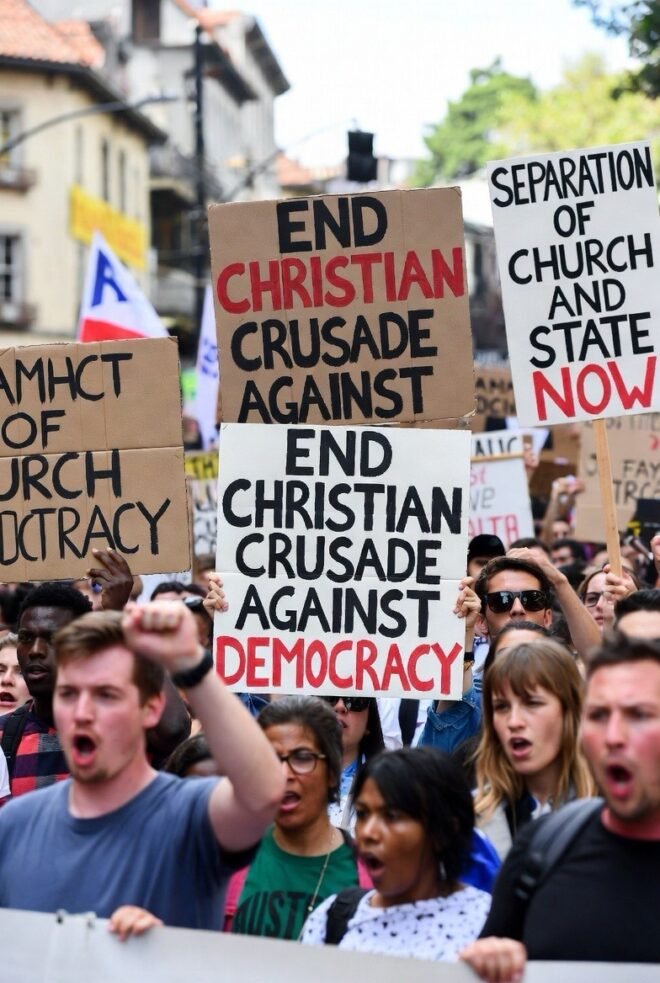
Christian nationalism denotes a particular fusion of religious conviction and national identity in which the political order, cultural norms, and public policy are conceived as expressions of a nation’s supposed Christian foundations. Its adherents typically argue that the moral and legal framework of the state ought to reflect Christian principles, and they often view secularism, multiculturalism and religious pluralism as corrosive to a shared national character. While scholarly and public debate about Christian nationalism has largely centred on the United States, comparable phenomena have emerged in Australia. In the Australian context, Christian nationalism has adapted to local histories, institutions and demographics; its expression is frequently more cultural than explicitly theocratic, and it tends to align with right-wing populism, restrictive immigration politics, and campaigns that portray Islam as a fundamental challenge to national cohesion.
This essay examines the rise and consolidation of Christian nationalism in Australia, focusing on two prominent vehicles for its articulation: Pauline Hanson’s One Nation party and conservative advocacy organisations such as Advance Australia. Through historical tracing, analysis of contemporary dynamics, and consideration of the strategic targeting of Islam, the essay seeks to illuminate how this strand of political culture operates and what consequences it poses for a pluriform democratic society. Central questions include: how has Christian nationalism been framed and mobilised in the Australian setting; in what ways do actors like One Nation and Advance deploy anti-Islam rhetoric; what motivates such targeting; and what implications follow for Australian democracy, social cohesion and minority communities?
Historical Roots and Contemporary Resurgence
Understanding Christian nationalism in Australia requires attention to the long arc of national formation. The British colonial project that established European settlement in Australia carried with it Anglican and broader Protestant cultural assumptions. Christian institutions, missionary activity and legal frameworks deeply influenced the colonial management of land, Indigenous peoples and social morality. Throughout the nineteenth century, sectarian tensions – primarily between Protestant and Catholic communities – shaped civic associations and political movements, and organisations such as the Australian Natives’ Association advanced a notion of national identity bound to white, European and often Protestant norms.
At federation in 1901, Australia adopted a constitutional framework that enshrined secular principles in key respects, most notably through a prohibition on establishing a state religion (section 116). Over the twentieth century, processes of migration and policy evolution – especially following the dismantling of the White Australia Policy – transformed Australia into a more plural and diverse society. Multiculturalism acquired official and cultural currency from the latter twentieth century onwards, and religious affiliation began to change: survey data show a decline in the proportion of Australians identifying as Christian and a rise in those declaring no religion. These demographic shifts have not eliminated religious influence, but they have altered the socio-religious landscape in which political actors operate.
Christian nationalism in recent Australian politics emerges against this background of secular institutions and pluralising demographics. Two broad dynamics explain its resurgence. First, socioeconomic dislocation associated with globalisation and deindustrialisation has produced cultural and economic anxieties, particularly in regional and working-class communities. Politicians and movements that promise restoration of a recognisable social order – often coded as a return to “traditional” or “family” values – can thus find receptive constituencies. Second, international events and transnational political currents, from Islamist terrorism after 2001 to the rise of populist figures such as Donald Trump, have normalised more confrontational rhetoric toward religious minorities and energized transnational networks of conservative activists and intellectuals.
Post-9/11 security politics and episodes of domestic violence attributed to individuals claiming Islamist motives have had particular salience. High-profile incidents amplify fears and become readily politicised. Media coverage, political rhetoric and social media dynamics often amplify exceptional events into broader narratives about cultural compatibility and national survival. In this environment, claims that Australia’s “Judeo-Christian” heritage is under threat gain traction among sectors of the electorate predisposed to view social change as loss.
One Nation: Populism, Identity and Implicit Christian Tones
Pauline Hanson’s One Nation party provides a salient case study of how cultural Christianity and nationalism can be combined into a durable political formation in Australia. Since Hanson’s emergence in the mid-1990s, the party has articulated an explicitly anti-establishment, populist politics framed around concerns about immigration, multiculturalism, economic dislocation and perceived elite aloofness. Hanson herself identifies as Christian but seldom advances theological arguments in their own right; rather, One Nation’s politics often draw on cultural Christian tropes – appeals to an imagined moral order, stress on family and community, and the valorisation of an ancestral Anglo-Celtic past – as legitimating motifs for exclusionary policies.
One Nation’s rhetoric has evolved over time from earlier anti-Asian themes to a more pronounced focus on Islam. The party’s public statements and policy proposals commonly portray Muslim immigration and the presence of Muslim communities as threats to social cohesion, positing dangers such as “Sharia creep,” the importation of illiberal practices and cultural withdrawal by certain Muslim communities. Hanson’s parliamentary gestures – most notably wearing a burqa into the chamber as a form of protest – have functioned as dramatic symbolism, designed to crystallise public anxieties about cultural difference and to present the party as a defender of women’s rights and liberal Western mores. Such moves are designed, rhetorically, to align the party with a familiar liberal defence of women while simultaneously constructing Islam as incompatible with Australian norms.
Electorally, One Nation attracts support among voters who feel economically and culturally sidelined. Survey data indicate that its base includes disproportionately high shares of rural voters, lower-income households, and socially conservative Christians. One Nation’s policy mix – combining protectionist economic propositions with tough stances on immigration and law and order – has had periodic electoral resonance. Importantly, the party’s appeal rests as much on affective messaging and identity politics as on granular policy platforms. The invocation of a declining Christian heritage operates symbolically to naturalise exclusionary claims: the party suggests that defending “Australian” ways of life necessitates curtailing immigration from particular regions and resisting multicultural policies that give space to religious minorities.
The party’s critics charge that this rhetorical strategy masks xenophobic impulses and sometimes drifts into explicit racism. International watchdogs and domestic civil society organisations have documented ties between One Nation figures and extremist networks or individuals, evidence that underscores concerns about the party’s boundaries. Supporters reject these charges and frame their agenda as patriotic, aimed at preserving civil liberties and national security rather than targeting faith communities per se.
Advance Australia: Advocacy, Strategy and the Targeting of Islam
Advance Australia (commonly stylised as Advance) exemplifies a newer form of conservative political activism that blends professionalised advocacy, modern digital campaigning and policy research to influence public debate. Modelled rhetorically as a defender of mainstream values against progressive encroachments, Advance has engaged in campaigns on issues ranging from energy policy to national security and multiculturalism. Funded by private donations and staffed by professional consultants, the group operates in the political marketplace in a manner akin to well-resourced lobby groups on the left, but with conservative aims.
Advance’s campaigns sometimes foreground anti-Islam themes, painting Muslim immigration and particular expressions of Muslim practice as risks to social cohesion. Messaging includes references to the need for vigilance about radicalisation, claims about cultural incompatibility, and critiques of policies perceived to privilege religious accommodation over majority norms. The organisation’s tactics – targeted digital advertising, social media amplification, and support for like-minded candidates – are geared toward shaping narratives that put security and cultural continuity at the centre of political debate.
The strategic choice to emphasise Islam arises from several calculations. Practically, Islam functions as a politically salient foil: public worries about terrorism, gender inequality and cultural separatism can be harnessed to mobilise conservative constituencies. Narratives that present Islam as a civilisational competitor allow groups like Advance to delineate a clear enemy, simplifying complex social dynamics into digestible political messaging. This approach also intersects with broader geopolitical affiliations and donor networks, some of which have their own concerns about Islamist politics and regional security.
Critics argue that such targeting is both ethically problematic and politically counterproductive. Framing an entire religious tradition as inherently problematic risks stigmatising peaceful communities, fuelling discrimination, and legitimising illiberal policies that erode civil liberties. Empirically, stigmatisation can alienate minority communities and undermine efforts to foster civic integration and cooperation – ironically producing some of the conditions that radicalisers exploit. Moreover, critics highlight the selective nature of such campaigns: while focusing intensely on the behaviour of a small minority, they often downplay socio-economic determinants of radicalisation, domestic drivers of crime, or extremist tendencies in other ideological milieus.
Motivations for Targeting Islam: Security, Identity and Political Opportunity
A nuanced understanding of why Islam has become a central target for conservative nationalists requires considering multiple overlapping drivers:
• Security narratives: High-profile terrorist attacks, domestic acts of violence attributed to Islamist motives, and global media coverage of extremist organisations have all contributed to public perceptions of Islam as a security concern. These anxieties can be exaggerated by deliberate political framing that conflates radical fringe actors with broader communities.
• Demographic and cultural anxieties: Even where Muslim populations are numerically small, changing patterns of immigration and cultural visibility can trigger fears among some groups about loss of cultural dominance. The rhetoric of “replacement” or “takeover,” although unfounded in quantitative terms, resonates emotionally with those who understand national membership in cultural and historical terms.
• Political opportunism: Anti-Islam rhetoric can be an effective mobiliser for conservative parties and advocacy groups seeking to differentiate themselves from centrist competitors. It is often simpler politically to identify an external or internal “other” rather than offer complex policy solutions to economic and social discontent.
• Transnational influence: Networks of right-wing activists, think tanks and media outlets circulate frames and strategies across borders. Australian actors have not been immune to these currents; the rhetorical strategies and policy prescriptions often echo those seen in the United States and Europe.
• Cultural Christianity: For some adherents, the defence of national identity is explicitly tied to Christian symbolism and moral claims. Even when not articulated in theological language, appeals to a supposed Judeo-Christian heritage provide normative buttressing for policies that privilege the cultural majority.
Countervailing Perspectives and Internal Christian Dissent
It is important to note that not all Christian groups or religious leaders in Australia endorse the fusion of Christianity and exclusionary nationalism. Many mainstream and progressive Christian denominations – such as the Uniting Church and significant elements of Catholic and Anglican communities – advocate for inclusion, social justice and interfaith engagement. Theologically, many Christian leaders argue that their faith calls for hospitality, care for the stranger and protection of the marginalised, and they reject policies and rhetoric that stigmatise Muslims or other minorities.
Muslim communities and Islamic organisations in Australia have consistently condemned extremist violence and engaged in interfaith initiatives, civic participation, and public education. They have also demanded fairer media representation and stronger protections against discrimination. Academics and civil liberties advocates point out that securitised, culturally essentialist approaches often produce counterproductive outcomes – marginalising communities, undermining trust in state institutions, and weakening the social bonds necessary for effective counter-extremism.
Broader implications emerge when one considers that scapegoating a minority for complex social problems simplifies public debate and narrows the policy menu. Addressing economic insecurity, educational disadvantage, social exclusion and mental health requires nuanced, evidence-based interventions, not simplistic cultural antagonisms. Moreover, the legal and constitutional protections Australia maintains – separation of religion and state, protections for freedom of religion and expression – are challenged when public policy begins to prioritise one faith tradition over others.
Implications for Democracy and Social Cohesion
The ascendancy of Christian nationalism, when translated into political influence through parties like One Nation and advocacy bodies such as Advance, carries several implications for Australia’s democratic and social fabric:
• Polarisation: The rhetoric of existential threat can deepen social polarisation, hardening attitudes and making compromise more difficult. When political identity becomes tightly interwoven with cultural or religious identity, public discourse tends to shrink into antagonistic camps.
• Erosion of pluralism: Policies that privilege a particular religiously inflected conception of national identity risk undermining the pluralist settlement that has been central to Australia’s post-war social contract. This can take subtle forms – such as privileging religious exemptions for certain groups – or more overt manifestations, like discriminatory restrictions on religious practice.
• Impact on minorities: Stigmatisation can translate into tangible harms: discrimination in employment and housing, verbal and physical attacks, and barriers to civic participation. These effects can be most severe for visible minorities who are already disadvantaged by socioeconomic factors.
• Institutional trust: Persistent narratives about foreign or internal enemies can erode trust in institutions – media, judiciary, law enforcement – especially if those institutions are portrayed as complicit in enabling change or as instruments of a distant elite.
• Policy distortion: A politics fixated on cultural threat may divert attention from structural policy challenges (housing affordability, climate change, appropriate economic reform) and produce policy responses that are disproportionate to the actual risks involved.
Nonetheless, the contest over national identity also stimulates important public conversations. Debates provoked by Christian nationalist arguments force a rearticulation of what Australian values mean, who gets to define them and how they should be expressed in law and public life. This reflexive process can strengthen democratic deliberation if it encourages inclusive engagement and robust defence of civil liberties.
Recommendations for a Cohesive Approach
Policy responses and civic strategies to address the challenges posed by Christian nationalism and anti-Islam campaigns should navigate the twin imperatives of protecting security and preserving pluralism. Possible directions include:
• Strengthening civic education: Enhancing public understanding of democratic rights, religious diversity and the historical foundations of Australian pluralism can reduce susceptibility to simplistic cultural narratives.
• Investing in community resilience: Supporting grassroots interfaith initiatives, local civic organisations and community leaders can build trust and cooperation across divides.
• Evidence-based counter-extremism: Programs that focus on social inclusion, mental health and community development are more effective in the long term than securitised approaches that stigmatise entire communities.
• Legal protections and accountability: Enforcing anti-discrimination laws, holding public actors accountable for inflammatory rhetoric, and ensuring transparent funding disclosures for advocacy groups can mitigate harms.
• Promoting balanced media: Media literacy initiatives and responsible journalistic standards can reduce sensationalism and give voice to a plurality of perspectives.
Conclusion
Christian nationalism in Australia has emerged as a significant force within contemporary politics, articulated through parties like One Nation and amplified by advocacy groups such as Advance. Its appeal rests on the mobilisation of cultural anxieties, economic grievances and security fears, often refracted through symbolic claims about a lost Christian national heritage. The strategic targeting of Islam – framed alternately as a security threat, a challenge to liberal values, or a cultural rival – has been an effective mobilising tactic for some actors, but it carries considerable social and democratic costs.
If Australia is to preserve its pluralist commitments and social cohesion, responses must be neither complacent about the genuine anxieties of citizens nor indulgent of narratives that legitimate discrimination. Robust public debate, principled political leadership, and community engagement that emphasise inclusion and shared citizenship are essential. Ultimately, the task is to construct an inclusive national identity that affirms the rights and dignity of all Australians, while addressing legitimate social and economic concerns through policies grounded in evidence rather than cultural scapegoating. Only through such an approach can Australia navigate the tensions of a diverse, secular democracy without succumbing to the exclusionary impulses that Christian nationalism, when weaponised, can produce.