
Introduction
For much of its modern history, Australia’s national story has been told through an appealing shorthand: egalitarianism, mateship, and the promise of a fair go. These ideas – rehearsed in novels, films, political speeches and school lessons – have long shaped how Australians imagine themselves and how the world imagines Australia. But identity is not static. Demography shifts, migration remakes communities, religious adherence changes, and economic structures reconfigure opportunity. Over the past half-century, the picture of Australia as a predominantly white, comfortably Christian, and essentially classless society has been challenged on every front. That challenge is not merely an academic exercise; it has concrete implications for social cohesion, public policy and how we live together.
This essay traces that evolution. Beginning with the legacies of colonial settler society and the apparatus of the White Australia Policy, it moves through the postwar migration decades that diversified the country, examines the secularisation of public life and the decline of institutional Christianity, interrogates the persistent myth of classlessness, and considers how religion and race interact in current political discourse – especially through the rise of Islamophobia and reactionary forms of nationalism. It also articulates a set of practical commitments for how Australia might honour its Christian heritage without imposing it on others, and how embracing pluralism can be an active, policy-led project rather than a passive state of affairs.
My aim is not to celebrate change uncritically nor to paint a picture of inevitable decline. Rather, the goal is to take stock honestly: to acknowledge the gains and promise of a multicultural, secular nation while confronting the inequalities, resentments and exclusionary politics that threaten to corrode social trust. If Australia is to live up to the “fair go” it prizes, that ideal must be extended to everyone – Indigenous peoples, migrants, religious minorities, and those left behind by the economy.
Australia’s shifting racial and ethnic landscape: beyond a “white nation”
The story of Australia’s demography begins, necessarily, with colonisation. British settlement in 1788 established legal and cultural institutions premised on British norms and a racial hierarchy that devalued Aboriginal and Torres Strait Islander peoples. For more than a century, national policy reflected a conscious project to secure and maintain a European, predominantly Anglo-Celtic society. The Immigration Restriction Act of 1901 and subsequent policies that became known collectively as the White Australia Policy placed explicit barriers on non-European immigration and shaped public attitudes about who belonged.
That historical framework began to unravel in the mid-20th century. Economic imperatives after World War II, humanitarian commitments, and the changing international environment pushed successive governments to broaden immigration. The formal dismantling of racially exclusionary immigration law in the 1970s marked the start of a large-scale demographic transformation: substantial flows of migrants from southern and eastern Europe in the postwar decades, followed more recently by steady immigration from across Asia, the Middle East and Africa.
Census data and social research make the picture clear. While people reporting Anglo-Celtic ancestries remain substantial, the proportion of Australians born overseas and the number of households where languages other than English are spoken have both risen markedly. The 2021 census showed a record share of people identifying with “no religion” and a continuing increase in ancestries and languages that reflect Asia-Pacific migration. Cities such as Sydney and Melbourne now host residents from hundreds of ancestry backgrounds and speak scores of languages – local suburbs that, a generation ago, were overwhelmingly Anglo now reflect vibrant diasporic communities, with businesses, media, festivals and cultural life that reshape civic and commercial spaces.
This transformation has tangible benefits. Migrants contribute to labour supply, entrepreneurship and innovation; diaspora networks sustain trade and cultural linkages across the region; and urban cultural life has been enriched by food, music, festivals and religious practice. Economists and migration researchers have repeatedly shown that immigration has been a contributor to GDP growth and to filling skill shortages over recent decades.
Yet neither change nor richness come without friction. Public debate about immigration levels and composition periodically spikes during political cycles and international crises. Media narratives sometimes sensationalise crime or other social problems and tie them to nationality or ethnicity, stoking fear rather than offering context. Indigenous Australians complicate the neat categories of a multicultural success story. Their status as the First Peoples – sovereign, enduring and subject to dispossession – places them outside the immigrant narrative entirely. Persistent disadvantage in health, education, employment and incarceration rates underscores how migration-led diversity has not automatically guaranteed inclusion for everyone who lives here.
Another layer of complexity is intergenerational. More than half of younger Australians now have at least one parent born overseas, and the cultural repertoires of Australian identity have expanded as a result. For the next generation, being Australian will more likely mean navigating multiple heritages and languages; institutions – schools, legal systems, media and workplaces – will need to adapt. That adaptation can be messy, contested and political, but the alternative – attempting to freeze identity in a nostalgic past – would be both unrealistic and socially costly.
The decline of Christianity: a nation no longer defined by faith
While the Australian story has long been interwoven with Christian institutions – churches as providers of education, hospitals, charity and moral discourse – religious affiliation and practice have shifted markedly in recent decades. The most visible sign of change is the growth of the “no religion” category in national censuses: a steady, sharp rise in people who report no religious affiliation, paralleled by declines across a range of Christian denominations.
This is not simply an actuarial change; it reflects broader cultural and social transformations. Rising education levels, urbanisation, the diversification of moral and intellectual influences available through media and travel, and the exposure to multiple religious traditions all play a role. Institutional scandals that came to public view over the last two decades – including egregious cases of abuse in some church settings – have also eroded trust in religious institutions and contributed to disaffiliation.
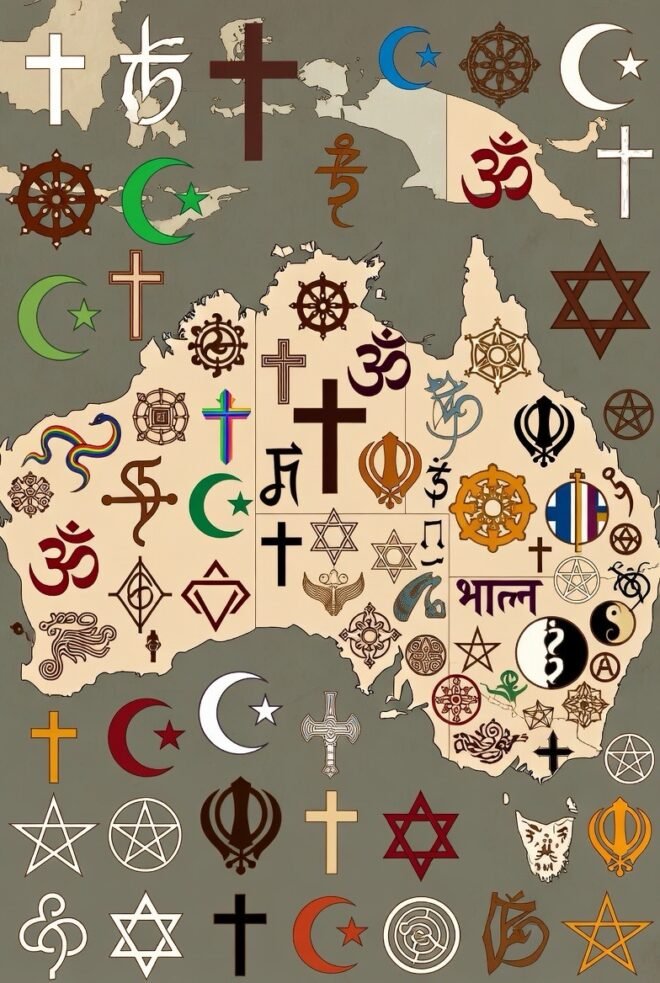
Decline in affiliation does not mean the disappearance of spiritual life. Many Australians who report “no religion” nonetheless observe cultural forms tied to Christianity – celebrating Christmas as a social holiday, for instance – or pursue private spiritualities and community involvement outside formal religious structures. At the same time, non-Christian faiths have grown in absolute and relative terms, reflecting migration trends. Islam, Hinduism, Buddhism, Sikhism and others are now a visible part of the religious landscape, bringing their own institutions, festivals, charitable activity and public voices.
The public settlement of religion in Australia has long been framed by a constitutional commitment to secularism: the law prohibits the establishment of a state religion and ensures freedom of religious practice. That legal architecture has allowed religion to operate as a private and communal force rather than a formal organ of government. Yet that balance is constantly subject to political strain. Debates about faith-based schooling, exemptions where religious doctrines conflict with anti-discrimination laws, and the role of religious lobbying in public policy have underscored the tensions between religious conviction and the rights of others in a plural society.
The trajectory of secularisation also suggests a generational effect. Younger cohorts are more likely to report no religious affiliation, which indicates that the proportion of non-religious Australians will grow over time. How the state and civic institutions respond to that trend – by ensuring no faith is privileged while respecting freedom of belief – will be central to how social cohesion is maintained.
The myth of classlessness: inequality in the “Lucky Country”
Australia’s reputation as a relatively equal society – one where hard work, not accident of birth, determines life outcomes – has been part of the national myth. Phraseology such as “a fair go” and social institutions that once provided broad-based prosperity supported that self-conception. But closer sociological and economic scrutiny reveals deep and widening fault lines.
Measures of income and wealth inequality show a concentration at the top that is not captured by simple anecdotes about equal opportunity. Home ownership, for many Australians, is the primary route to wealth accumulation; where property values have skyrocketed in major cities, those who owned housing benefited enormously while younger and less affluent households have been increasingly locked out. The composition and returns to labour have changed as well: contingent work, casualisation, and the decline of certain stable blue-collar careers have produced precariousness for many, while professionals in finance, tech and related sectors have seen substantial gains.
Class in Australia is not only an economic indicator but also cultural and social: networks, educational attainment, accent and school background can open or close doors in employment and civic life. Research into social mobility shows that while there is some movement between classes, parental background remains a strong predictor of educational and occupational outcomes. Indigenous Australians, people from refugee backgrounds, and some migrant communities face further barriers to upward mobility, producing layered forms of disadvantage.
The COVID-19 pandemic provided a lens on inequality: some workers – white-collar professionals – were able to work remotely and largely retain incomes, whereas hospitality, retail and other service workers suffered job and income losses. Government supports mitigated some immediate harms but did not alter structural dynamics. Superannuation and retirement savings, too, show disparities: lifetime accumulation is strongly influenced by career interruptions, part-time work and wage levels – factors that disproportionately affect women and carers.
Addressing class disparities is not merely a matter of rhetoric. It requires deliberate policy choices: progressive taxation; targeted investments in early childhood education, schools in disadvantaged areas and vocational pathways; affordable housing initiatives; and industrial relations that protect low-paid workers. Recognising class – and naming it – undermines a comfortable illusion but opens the possibility of actionable reform.
Christian tradition without imposition: balancing heritage and pluralism
Australia’s Christian heritage is a fact of history and a living presence: churches run hospitals, congregations staff food banks and volunteer programs, and religious narratives continue to shape some aspects of civic discourse. The challenge for a plural, democratic nation is to honour that heritage without allowing it to translate into coercive power over others.
There are several practical principles that can guide this balance. First, public institutions should remain neutral in matters of religion: schools, courts and government agencies must serve citizens regardless of faith. Second, faith-based organisations should be free to operate and to express their beliefs, so long as their activities do not contravene rights and protections that apply to everyone. Third, exemptions from anti-discrimination laws, where granted, should be narrowly tailored and justified by clear and compelling reasons, to avoid creating broad licences for exclusion.
A healthy civic culture will also cultivate religious literacy: understanding the historical role of Christianity in Australia, the diversity within Christian traditions, and the place of other faiths and non-religion in public life. Interfaith initiatives, dialogues and community collaboration can help bridge differences and defuse tensions when competing values come into public debate. Importantly, acknowledging Christian contributions to civil society does not require privileging Christian doctrine in law or public policy.
In short, heritage is not identical with entitlement. The public sphere should be a shared space where people of many convictions can coexist; securing that requires clear legal boundaries, generous civic norms and robust debate about how to harmonise freedoms and protections.
Islamophobia as the Trojan horse of reactionary nationalism
One of the most fraught fault lines in contemporary Australian public life is the intersection of race, religion and security. Anti-Muslim prejudice has been a persistent problem, periodically intensifying in the aftermath of terror attacks overseas or domestic episodes of violence. The discourse around Islam often blends legitimate public concerns – security, integration policies – with sweeping generalisations and stereotypes that stigmatise entire communities.
A particular danger is the way Islamophobia can function as a Trojan horse for a broader politics of exclusion. Narratives that treat Islam as incompatible with “Australian values” or that portray Muslim communities as inherently suspect can be used to justify restrictive immigration measures, intrusive surveillance, or the marginalisation of civil liberties for particular groups. Such narratives sometimes overlap with strands of Christian nationalism that invoke a putative Judeo-Christian heritage as the defining marker of national belonging.
Media framing, political rhetoric and the activity of far-right groups have amplified these dynamics. Sensationalist coverage of isolated criminal incidents or the use of emotive language around cultural threat can entrench fear and support punitive policies. In addition, social media allows rapid spread of disinformation and amplifies echo chambers where conspiracy theories and hostility flourish.
The effects on targeted communities are real and measurable: reduced sense of belonging, increased anxiety and fear, and economic and social exclusion. These harms weaken social cohesion and create resentments that can make communities less resilient and more susceptible to radicalisation or withdrawal from civic life.
Countering Islamophobia requires a multi-pronged response. Stronger hate-speech and anti-discrimination protections are necessary, but not sufficient. Public institutions – schools, police forces, media outlets – must adopt practices that avoid stereotyping and that foster dialogue. Political leaders bear responsibility for rhetoric that either calms or inflames public sentiment; measured, fact-based discussion is crucial. Civil society, including faith leaders from diverse traditions, has a role in building trust and demonstrating shared values around civic responsibility and mutual respect.
These measures are not only about moral principle; they are pragmatic. Inclusion reduces social friction and supports economic participation. A society that marginalises or surveils certain communities pays a political and social price: wasted human potential, fractious public debate, and the erosion of democratic norms.
Towards a fair go for all: policy and cultural prescriptions
If the trajectory of Australian identity is towards greater diversity – in ancestry, language, belief and class – policy must be forward-looking rather than defensive. Some priorities flow directly from the challenges explored above:
• Education and civic literacy: School curricula should teach Australian history in ways that include Indigenous perspectives, the history of migration and the principles of secular, plural democracy. Programs that teach media literacy and critical thinking help inoculate against disinformation.
• Economic inclusion: Policies that improve access to quality early childhood education, support vocational and tertiary pathways for disadvantaged youth, invest in affordable housing and recalibrate tax and transfer systems to reduce entrenched inequality will make “fair go” more than a slogan.
• Anti-discrimination and inclusion measures: Robust anti-discrimination frameworks, combined with targeted programs to reduce workplace bias and increase representation of minorities across media, public service and corporate leadership, will help ensure that diversity is reflected in decision-making.
• Faith and public life: Maintain legal protections that ensure freedom of religion and belief while limiting exemptions that enable discrimination. Encourage interfaith and secular dialogues that build networks of trust.
• Media and public rhetoric: Public broadcasters, major media outlets and social platforms should commit to higher standards of contextual reporting on issues that involve race, religion and crime. Public debate needs to be de-escalatory rather than sensational.
• Community resilience and mental health: Investment in community-led programs that provide social supports for newly arrived communities, and culturally competent mental health services for those who experience discrimination, is essential.
These are policy directions, but culture matters too. National narratives are powerful: how we tell the Australian story in museums, textbooks, ceremonies and civic rituals shapes how newcomers and established residents see themselves. Telling a more inclusive story – one that recognises dispossession, celebrates multiple heritages, and speaks honestly about inequality – will not erase difficult memories but can reframe them in ways that sustain democratic pluralism.
Conclusion
Australia stands at a moment of real choice. Demographic, religious and economic changes have already transformed the nation; those transformations will only deepen in the decades ahead. The options are to resist, to romanticise a past that no longer exists, or to adapt constructively, shaping institutions so that diversity is an asset rather than a source of division.
Honouring Christian tradition while upholding secular equality, confronting the structural realities of class and disadvantage, and pushing back against Islamophobia and other forms of radicalised exclusion are not mutually exclusive tasks. They are components of a single effort to make the promise of the “fair go” universal. That effort will require policy courage, civic leadership and a patient readiness among everyday Australians to engage across difference.
If Australia succeeds, its evolving identity will be a model of pluralism in a region where difference is the rule rather than the exception. If it fails, the consequences will be felt not only in the lives of those excluded but in the erosion of democratic norms that protect all citizens. The imperative is clear: a future worth having depends on acknowledging where we have come from, understanding who we are now, and committing – to institutions, discourse and practice – to the kind of inclusive nation we wish to become.