
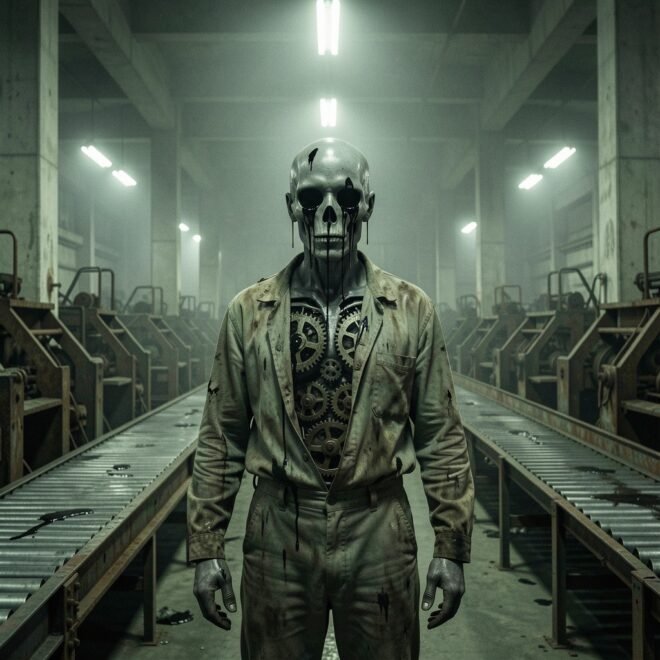
Capitalism doesn’t pretend to care.
It doesn’t bother with illusions.
It presents you with a fact:
you exist to be used.
Your value is measured by how efficiently you can be drained
without collapsing in a way that causes inconvenience.
You’re not a person in this structure.
You’re a resource.
A consumable.
A temporary asset that costs more to replace than to exploit.
The system’s brilliance is that it convinces you
this degradation is normal –
even respectable.
Every institution you interact with
is designed to keep you obedient through exhaustion.
Jobs that demand loyalty and offer nothing in return.
Leases that strip you of dignity.
Hospitals that bill you for surviving.
You learn quickly that pain is not a glitch in the system –
it’s the operating principle.
The profit motive has no conscience.
It rewards whoever can monetise your desperation most efficiently.
It admires the landlord who raises rent because he can.
It celebrates the corporation that cuts wages to “increase value.”
It treats human breakdown as an excellent business model –
a predictable revenue stream.
If you suffer, the system shrugs.
If you beg, it looks away.
If you collapse, it steps over you.
And then it replaces you with someone hungrier,
someone more afraid,
someone willing to tolerate even less.
People talk about “hard work”
as if the system has ever cared about effort.
It cares only about output –
and how cheaply it can be extracted.
Your dreams, your family, your body, your sanity
are all acceptable collateral damage.
And here’s the part that makes it truly vicious:
capitalism doesn’t just expect you to endure this.
It expects you to smile while doing it.
To broadcast your productivity.
To disguise your exploitation as ambition.
To post about your grind
as though you chose it freely.
Any tenderness that survives inside this machine
survives “despite” the system,
not because of it.
Compassion is a malfunction.
Empathy is inefficiency.
Care is a threat to productivity.
The system would eliminate all three
if it could function without them –
but it can’t.
It needs people to quietly cushion its brutality,
patch the wounds it inflicts,
and keep each other alive
just enough to keep the economy running.
Capitalism is a parasite
that humiliates the host
and then demands thanks for the privilege.
It thrives by draining the humanity
it claims is irrelevant.
It destroys the very people
who keep it afloat.
And the most brutal truth of all:
if everyone suddenly mirrored the system’s logic –
if everyone took as much as possible
and cared as little as possible –
the entire structure would collapse
within a single generation.
It survives only because
the people it exploits
are still more human
than the system deserves.
by Bakchos

We exist only to work, bleed and die to the benefit of the billionaire class.
We’re not free, very few of us are genuinely free, we’re slaves to the 1%, this has to change!
Powerful poem Bakchos. Sadly it’s one hundred percent true.
You’ve named something most people only feel in their bodies — that low, persistent hum of being used. And you’re right that the cruelest trick isn’t the exploitation itself, but the rebranding of it. Suffering repackaged as hustle. Exhaustion sold as identity. The grind worshipped because worshipping it is cheaper than escaping it.
But I want to sit with your final lines, because they carry something the rest of the poem almost buries under its fury. The system survives because the people inside it remain stubbornly, inconveniently human. They still show up for each other. Still share food, time, warmth — none of which appears on any balance sheet.
That’s not naivety. That’s the actual counter-evidence.
Capitalism is a powerful poem about power. But power isn’t the whole story, and you know it — otherwise you wouldn’t have written this. You wouldn’t have bothered making something that asks to be felt rather than monetised.
The tenderness that survives despite the machine isn’t a footnote. It’s the argument.
The fact that you wrote this, and that someone will read it and feel less alone — that’s not a malfunction.
That’s everything the system can’t account for.
Communist rubbish??
You’re obviously from a deep red state, probably Florida. Do you even know what communism is?
The poem is a sharp, unflinching blade aimed at capitalism’s heart, strong in its emotional and thematic force but weakened by oversimplification and repetition. It serves as a rallying cry rather than a subtle exploration, earning admiration for its boldness while inviting criticism for its lack of balance. For readers weary of systemic inequities, it’s a cathartic read; for others, a reminder of poetry’s power to provoke, even if it doesn’t fully persuade.
“Engine of Extraction” is undeniably effective as protest poetry, channeling rage into a coherent, compelling narrative that resonates in an era of inequality and gig-economy precarity. Its accessibility—clear language, no esoteric references—makes it shareable and potent for social commentary, potentially inspiring activism or self-reflection among disillusioned readers. The poem’s greatest triumph is its exposure of capitalism’s performative demands: not just endurance, but smiling complicity via social media “grinds.”
That said, its polemical edge undermines broader appeal. By refusing nuance, it preaches to the converted while alienating those who might see capitalism as reformable rather than irredeemable. As art, it prioritizes message over aesthetic innovation, which may limit its longevity compared to more ambiguous works like those of Bertolt Brecht or Adrienne Rich, who balance critique with complexity.
That poem reads like a manifesto. It’s a powerful protest poem, it has power which should see it outlive its writer.