
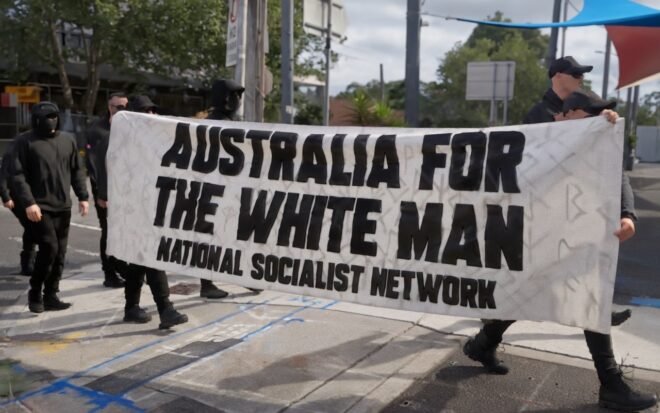
There is a passage in Christopher Browning’s Ordinary Men that ought to haunt every liberal democracy: a reminder that mass atrocity does not require monsters. It requires, instead, an environment in which a targeted group has been so thoroughly dehumanised, so consistently framed as a menace to the social order, that violence against them comes to seem not merely permissible but logical. What the Holocaust engaged, as historians of perpetrator motivation have established, was the energies and enthusiasm of ordinary people nurtured in a culture that had made hatred of Jews feel like plain common sense. The lesson is not that Australia is Nazi Germany. The lesson is that the cultural machinery which makes organised persecution possible – the slow normalisation of contempt, the withdrawal of moral consideration, the framing of a minority as an existential threat – is neither exotic nor archaic. It is available, in degraded but recognisable form, in the media ecosystems and political cultures of twenty-first century liberal democracies. Australia is not immune.
This essay examines the risks that the unaccountable vilification of Muslim Australians by far-right commentators poses to Australian society. Those risks are not abstract. They are measurable in the psychology of targeted communities, traceable in the political mainstreaming of eliminationist language, and legible in the historical record of what happens when democracies permit the sustained demonisation of minorities to proceed without meaningful sanction. The argument proceeds in four movements: first, the character and reach of far-right Islamophobic discourse in Australia; second, the documented harms to Muslim Australian communities; third, the structural risks to democratic culture and social cohesion; and fourth, the question of accountability – what it means that this speech proceeds largely without consequence, and what a democratic society owes to itself and its members when it allows that to continue.
I. THE ANATOMY OF AUSTRALIAN ISLAMOPHOBIA
The far-right commentariat in Australia is not a fringe curiosity. It commands audiences of hundreds of thousands across television, radio, and digital platforms. Its leading figures hold parliamentary seats, appear on primetime news programs as credentialled opinion-formers, and are quoted approvingly in government press releases. Their rhetoric concerning Muslim Australians follows a template refined over two decades: the conflation of Islam with terrorism, the insistence that Muslim cultural and religious practices are fundamentally incompatible with Australian values, the representation of Muslim immigration as a form of civilisational conquest, and the suggestion – rarely stated with precision, always present by implication – that Muslim Australians cannot be fully trusted as citizens.
The intensity of this rhetoric escalated sharply in the years following September 11, 2001, found fresh ammunition in the European migration debates of the 2010s, and has been further energised by the globalisation of far-right networks through social media platforms that reward outrage and punish nuance. What distinguishes the contemporary Australian moment is not the novelty of the prejudice – Islamophobia has deep roots in Western cultural history – but the degree to which it has been institutionalised. When a senator pours out a bag of pork rinds as a commentary on halal certification, or when a broadcaster with a national audience describes the building of mosques as a symptom of invasion, these are not isolated performances. They are nodes in a system of meaning-making that systematically positions Muslim Australians as alien, threatening, and undeserving of the protections afforded to other citizens.
The discourse operates through a series of rhetorical moves that are worth naming precisely because their effectiveness depends on their invisibility. The first is the move of generalisation: the actions or statements of individuals, or of fringe groups, are attributed to Islam as a whole, and by extension to every Muslim Australian. The second is the move of essentialism: Islam is treated not as a diverse and contested tradition spanning fourteen centuries and encompassing over a billion people, but as a fixed and malevolent essence, immune to historical context. The third is the move of threat inflation: statistics are cherry-picked, incidents are decontextualised, and the ordinary life of ordinary people – prayer, dietary observance, modest dress, communal association – is reframed as evidence of a creeping parallel society intent on displacement. The cumulative effect is to make Muslim Australians permanently legible as suspects.
II. DOCUMENTED HARMS: THE COST TO MUSLIM AUSTRALIANS
The claim that hateful speech is merely speech – that words, however vicious, cause no material harm – is one of the enduring sophistries of contemporary liberal discourse. The evidence against it is substantial, and much of it concerns the specific harms inflicted on communities subjected to sustained vilification. The Islamophobia Register Australia, which has documented anti-Muslim incidents since 2014, records a consistent pattern of physical assaults, verbal abuse, property damage, and workplace discrimination, with spikes closely correlated to moments of intensified media attention. The Register’s data reveals what researchers of racism have long argued: that the relationship between elite-level rhetoric and street-level violence is not metaphorical. It is causal.
Women who wear the hijab or niqab bear a disproportionate share of this violence. They are the most visible markers of Muslim identity in public space, and they pay for that visibility with routine harassment, spitting, physical assault, and the constant management of fear in places – public transport, shopping centres, school gates – that the rest of Australian society navigates without calculation. Children in Islamic schools have received bomb threats. Mosques have been vandalised, defaced, and in some cases firebombed. In the years following the Christchurch mosque massacre of March 2019 – in which a young man radicalised in the swamps of online far-right culture murdered fifty-one people at Friday prayers in New Zealand – Australian Islamic communities reported a significant intensification of threatening behaviour. The geographic and cultural proximity of that atrocity was not incidental: the perpetrator had lived in Australia, had absorbed Australian far-right content, and had framed his act in terms drawn directly from the replacement theory rhetoric that circulates, barely disguised, through mainstream Australian commentary.
The psychological toll is less visible but equally significant. Research on the mental health of Australian Muslims documents elevated rates of anxiety, depression, and what clinicians have termed minority stress – the chronic, low-grade activation of threat responses produced by the knowledge that one is perceived as dangerous. This is not a condition produced by a single incident but by the cumulative experience of living in a society whose public culture regularly signals that your presence is unwelcome and your loyalty suspect. It is the experience of hearing, each time a new commentary cycle begins, that the problem with Australia is people like you. To grow up as a Muslim Australian child and encounter your community’s faith represented in the national media as a synonym for violence is to receive, day by day, an education in your own disposability.
III. THE DEMOCRATIC STAKES: WHAT UNACCOUNTABLE HATRED DOES TO A SOCIETY
The harms to Muslim Australians are grave and sufficient by themselves to justify concern. But the risks of unaccountable Islamophobia extend beyond the targeted community. They reach into the structural integrity of Australian democracy itself. A democracy is not simply a set of formal institutions – elections, parliaments, courts. It is a culture of reciprocal recognition, a shared commitment to the proposition that all citizens are entitled to equal standing in the life of the polity. When that culture of recognition is systematically eroded for one group – when a substantial portion of the citizenry is made to understand that their belonging is conditional, their loyalty permanently on trial, their humanity in regular dispute – the damage is not merely to those people. It is to the democratic culture as a whole.
Hannah Arendt, writing in the aftermath of the European catastrophe, observed that totalitarianism becomes possible only after a long prior process in which the targeted group is first rendered stateless in the moral imagination of the majority – stripped of the attributes that make their suffering legible as injustice. This process does not require formal legislation. It can be accomplished through the steady work of public rhetoric, the repeated inscription of a group as alien, threatening, and expendable. Australia is not on the threshold of totalitarianism. But it is not exempt from the dynamics Arendt identified. A society in which a religious and ethnic minority can be routinely dehumanised without institutional consequence is a society in which the moral reflexes necessary for democratic self-defence have been allowed to atrophy.
There is also the question of what unaccountable vilification does to political culture more broadly. The mainstreaming of far-right Islamophobic rhetoric has proceeded, in Australia as elsewhere, through a process of Overton Window capture: what was once unsayable becomes edgy, what was edgy becomes provocative, what was provocative becomes a matter of legitimate debate. Each iteration of this process expands the space of permissible contempt, not merely toward Muslims but toward the principle of equal civic standing as such. The politician who builds a career on Muslim-baiting does not confine the logic of exclusion to Muslims. The commentator who makes a platform from civilisational threat narratives is not developing a toolkit with a single application. What is normalised in discourse about one group is available, at lower cost, for deployment against the next. The history of scapegoating in democratic societies is not a history of targeted precision; it is a history of escalating generalisation.
The radicalisation pipeline – the pathway by which individuals move from ambient cultural prejudice to organised extremist commitment to the willingness to commit violence – is not a phenomenon that begins in mosques or on dark web forums. It begins in the mainstream. The young man who murders strangers at Friday prayers is not an anomaly who arrived at his convictions from nowhere. He is the product of a cultural environment that told him, with sufficient repetition and with the authority of broadcast media and parliamentary platforms, that the people he murdered were an existential threat to his civilisation. The relationship between the mainstream commentator and the terrorist is not one of direct incitement. It is one of cultural permission – the gradual construction of a moral framework in which certain people are so thoroughly othered that violence against them becomes thinkable.
IV. THE QUESTION OF ACCOUNTABILITY
What the Law Permits and What It Fails to Prohibit
Australia’s legal framework for addressing hate speech is, by the standards of comparable democracies, notably permissive. The Racial Discrimination Act 1975, in its Section 18C, prohibits conduct that is reasonably likely to offend, insult, humiliate, or intimidate a person on the basis of race or ethnicity. But the provision has proven difficult to enforce, its scope has been repeatedly contested by those with the largest platform to abuse it, and the exemptions in Section 18D – for artistic, academic, journalistic, and political expression – are wide enough to accommodate almost any commentary that claims the mantle of public debate. More fundamentally, 18C addresses race and ethnicity, not religion. Australian law provides no equivalent protection against vilification on the basis of religious identity at the federal level. Muslim Australians are, in this respect, less protected than many other groups, a legal asymmetry that reflects and reinforces their political vulnerability.
The argument against stronger accountability mechanisms is always framed as a defence of free speech. It is worth examining this framing with some rigour. The freedom of speech worth defending in a democracy is not the freedom to say anything to anyone with no regard for consequence. It is the freedom necessary for democratic self-governance: the freedom to criticise power, to contest orthodoxy, to hold authority to account, to participate in the formation of collective decisions. None of this requires the freedom to vilify minorities without accountability. A commentator who describes Muslim Australians as an invasive civilisational force is not exercising the freedom of democratic speech. They are exercising power over a minority community – the power to shape how that community is perceived by the majority, to influence the conditions of their civic life, to narrow the space of their belonging. That is not an exercise of freedom that a democratic society is obliged to protect. It is an exercise of domination that a democratic society has every reason to restrain.
The Responsibilities of Platforms, Institutions and Elites
If the legal framework is inadequate, the question of accountability does not disappear. It relocates to other institutions. Media organisations that platform far-right Islamophobic content are making editorial choices. They are deciding, for reasons that are ultimately commercial, that the revenue generated by outrage is worth the cost to the communities targeted and to the health of democratic culture. That calculation is not neutral, and it should not be treated as such. The argument that media organisations are merely reflecting pre-existing public sentiment gets the causation backwards: they are substantially producing the sentiment they claim to reflect. The normalisation of Islamophobic rhetoric is not a given of Australian public life that media must navigate. It is, to a considerable degree, an artefact of media choices.
Political parties and leaders bear a related responsibility. When elected officials repeat or amplify far-right Islamophobic talking points – when they treat the manufactured anxieties of the commentariat as legitimate grievances requiring legislative response – they are not managing public sentiment. They are manufacturing it, lending the authority of democratic office to the project of Muslim-baiting. The complicity of centre-right politicians in this project, their calculation that outflanking the far right on Islam is safer than contesting it, has been one of the most consequential features of Australian political culture over the past two decades. It is a calculation that trades the civil standing of Muslim Australians for short-term electoral advantage, and it is a calculation whose costs are borne not by those who make it but by those it targets.
Civil society, too, has a role that it has not always discharged with clarity. The organisations nominally committed to multicultural Australia, to human rights, to democratic culture, have at times retreated from the defence of Muslim Australians – either from a misguided fear of association with a politically toxic community, or from a liberal discomfort with religious identity that mirrors, in attenuated form, the secular chauvinism of the far right. Solidarity is not a commodity to be distributed on the basis of cultural affinity. It is a practice that must be extended most urgently to those who are most comprehensively excluded.
V. CONCLUSION: THE SOCIETY WE ARE BUILDING
In 1996, the Australian political commentariat largely treated Pauline Hanson’s maiden parliamentary speech – with its claims that Asians were swamping Australia and that multiculturalism was tearing the country apart – as an embarrassment to be managed rather than a danger to be confronted. What followed was the partial normalisation of those arguments, their uptake by mainstream parties under the rubric of community concern, and their eventual institutionalisation in policies of deterrence, mandatory detention, and the treatment of asylum seekers as a security problem rather than a humanitarian one. The lesson was not learned. A decade later, the same logic of managed mainstreaming was applied to Islam, with similar results: a rhetoric initially confined to the fringes of political life progressively colonised the centre, and the Muslim minority paid, and continues to pay, the price of its normalisation.
The question facing Australia is not whether far-right commentary on Islam should be the subject of philosophical debate. It is whether a society that permits the sustained, unaccountable dehumanisation of one of its constituent communities can be said to be serious about the values it professes. The values in question – democratic equality, civic inclusion, the equal dignity of persons – are not ornamental. They are the foundation on which the legitimacy of democratic governance rests. A democracy that extends those values selectively, that makes them available to some citizens and withholds them from others on the basis of religious identity, is not a democracy with a problem. It is a democracy in the process of abandoning its own premises.
What the Holocaust demonstrated, with a clarity that history has not been permitted to soften, is that the most efficient precondition for organised atrocity is not the arrival of evil men but the prior departure of moral seriousness – the long, slow, culturally-produced withdrawal of full humanity from the targeted group, accomplished through rhetoric, through repetition, through the complicity of institutions that knew better and chose profit or convenience instead. No one who pays attention to the history of the twentieth century can look at the sustained, commercially-driven, politically-amplified vilification of Muslim Australians and regard it as a merely rhetorical problem with no structural consequences. It is the construction, brick by brick, of a moral environment in which the next act of organised hatred becomes easier to perform and easier to excuse.
The time to interrupt that construction is not after the consequences have become undeniable. It is now, while the choice still exists, while the institutions capable of making different choices retain the authority and the legitimacy to do so. What is required is not censorship but accountability: the application to powerful voices of the same standards of civic responsibility that are demanded of citizens who wield far less power. A commentator who reaches millions bears a responsibility proportionate to that reach. A political party that exploits communal anxiety bears a responsibility proportionate to its power. A media organisation that profits from contempt bears a responsibility proportionate to its profit. Australia has the tools to hold these actors to account. The question is whether it has the will.
Hate is a powerful emotion, when politicians weaponise that emotion for political gain anything becomes possible and it often happens. Democratise that allow hate against a group to go unpunished are playing with fire.
The normalisation of hate against any group is a dangerous path for a democracy to tread. Hate cannot be tolerated in a democracy. It needs to be rooted out and dealt with. Anti hate laws have to be enforced against everyone who spreads hate.