
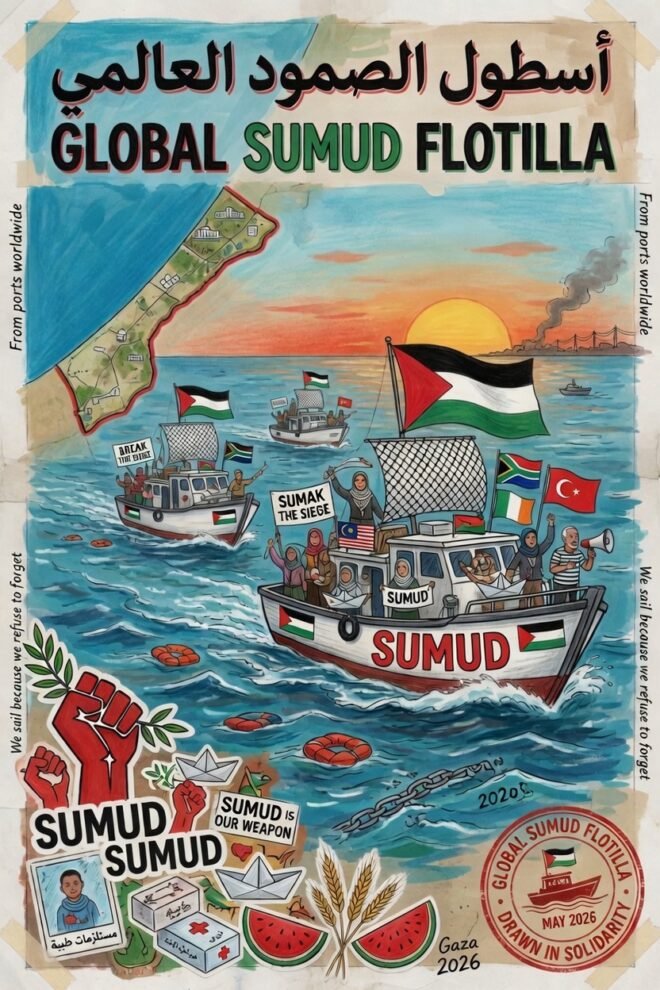
There are moments in the life of a nation when its government must choose between the comfortable silence of diplomatic hedging and the uncomfortable clarity of principle. The interception of the Global Sumud Flotilla by Israeli naval forces in international waters in May 2026, and the documented allegations of violence, humiliation, and sexual crimes inflicted upon its passengers – including Australian citizens – constitutes precisely such a moment.
This essay does not pretend that every question raised by the flotilla is simple. Some are not. The legal status of Israel’s naval blockade is a matter of genuine scholarly debate, and the flotilla participants themselves made a deliberate and knowing choice to challenge a blockade that has been in place, in some form, since 2007. These facts deserve honest acknowledgment. But there is a difference between contested questions that legal scholars reasonably dispute and questions that are not seriously in contest. The absolute prohibition on torture and sexual violence in detention is not debated in international law. The obligation of any government to take seriously an allegation that one of its citizens was raped in foreign custody is not ambiguous. And the question of whether a government that claims to defend human rights universally can apply different standards to allies and adversaries is a moral question that admits of only one honest answer.
This paper proceeds from a commitment to that kind of honesty. It acknowledges where the law is uncertain. It states plainly where it is not. And it asks what Australia’s Prime Minister is obliged, in law and in conscience, to do.
I. The Flotilla and the Law of the Sea: A Genuine Legal Debate
On 18–20 May 2026, Israeli naval forces intercepted a fleet of vessels associated with the Freedom Flotilla Coalition and the broader Global Sumud Flotilla network in the Mediterranean Sea, approximately 250 nautical miles from the coast of Gaza, within the Cyprus Search and Rescue (SAR) zone. This was the second interception in a matter of weeks: approximately a fortnight earlier, Israeli forces had boarded and detained 181 participants across 21 civilian vessels off the coast of Crete, over 650 nautical miles from Gaza and within the Greek SAR zone. Among those detained across these operations were at least eleven Australian nationals. The interceptions followed earlier operations in June and October 2025, in which hundreds of activists from more than forty countries – including prominent figures such as Greta Thunberg, Nelson Mandela’s grandson Mandla Mandela, and several European parliamentarians – were detained and transported to Israeli custody. The flotilla participants were not passive victims of circumstance. They had openly declared their intention to challenge the blockade and understood that interception was a probable outcome of their mission.
The central legal question is whether Israel’s blockade of Gaza is lawful, and whether, if it is, that lawfulness extends to the interception of civilian vessels on the high seas. This is a question on which serious international lawyers disagree, and intellectual honesty requires that both sides of that disagreement be presented.
Israel’s position, and that of international lawyers who support it, rests primarily on the San Remo Manual on International Law Applicable to Armed Conflicts at Sea (1994) – a widely cited restatement of customary law of naval warfare. Under the San Remo Manual, a belligerent may impose a naval blockade provided certain conditions are met: the blockade must be declared and notified to all parties; applied impartially to all states; effective; and must not have the purpose of starving the civilian population.
Israel declared its blockade in 2009, notified all parties, and applies it without national distinction. The Australian Israel and Jewish Affairs Council, the Algemeiner, and other pro-Israel legal commentators argue that these requirements are met, and that Article 67 of the San Remo Manual allows merchant vessels to be stopped on the high seas if they are on reasonable grounds believed to be breaching a legal blockade. The UN Palmer Report of 2011, which examined the Mavi Marmara incident, found that the naval blockade was “imposed as a legitimate security measure in order to prevent weapons from entering Gaza by sea,” and that its implementation “complied with the requirements of international law.” Israel points further to the 2023 Newport Manual, a successor document produced by leading scholars from Australia, Germany, the United Kingdom, the United States and others, as further support.
“A blockade may be used in wartime, but only if five legal conditions are met – including that it must not have the sole purpose of starving the civilian population or denying it objects essential to its survival.” – San Remo Manual on International Law Applicable to Armed Conflicts at Sea (1994), the central contested document in this debate
The critics of Israel’s position – and they are numerous and distinguished – advance several arguments. First, and perhaps most technically compelling, is the question of whether a blockade can lawfully be imposed on a territory that is itself under the blockading state’s occupation or control. As Assistant Professor Mustafa Tuncer of Turkey’s Naval War College has argued, neither the San Remo Manual nor the Newport Manual positively authorise a blockade of occupied coastline. The German military manual of 2006, the Australian military manual of 2006, and the US Commander’s Handbook explicitly confine blockades to ‘ports or coastal areas belonging to, occupied by, or under the control of an enemy State.’ If Gaza is under Israeli occupation – a proposition most international lawyers accept – Israel cannot blockade it as if it were enemy foreign territory.
Second, and on humanitarian grounds, the fifth condition of the San Remo Manual is critical. A blockade that has the effect – even if not the declared sole purpose – of depriving a civilian population of objects essential to its survival is unlawful. The humanitarian situation in Gaza is not disputed by neutral observers. The International Court of Justice, in its provisional measures orders, found that Palestinians faced conditions that could constitute genocide and ordered Israel to facilitate urgently needed humanitarian assistance – orders Israel has not fully complied with. Against this backdrop, the argument that the blockade satisfies the proportionality and humanitarian access conditions of the San Remo Manual is, to put it with appropriate scholarly restraint, difficult to sustain. The Conversation’s legal analysis concludes that “the flotilla is entitled to sail unimpeded in the Mediterranean Sea” and that “any harassment or stopping of the flotilla within the Mediterranean’s international waters is a clear violation of international law.”
This paper takes the view that the weight of international legal opinion, properly applied to the specific factual circumstances of Gaza in 2025–2026 – an occupied territory experiencing a humanitarian emergency acknowledged by the UN’s own judicial organs – supports the conclusion that the blockade, as currently enforced, does not satisfy the conditions required for legality under the San Remo Manual’s own terms. But this is honestly a contested conclusion. What is not contested is what happened to the people on those vessels once they were detained.
II. The Treatment of Detainees: Allegations of Abuse and Established Facts
It is important, at the outset of this section, to distinguish between that which is documented and publicly established and that which remains, in the technical legal sense, alleged and awaiting independent investigation. Israel’s Foreign Ministry has characterised some claims as “brazen lies.” Ben-Gvir has contested the characterisation of the conditions at Ketziot Prison while simultaneously boasting about them. The proper response to this uncertainty is not to suspend all judgment; it is to separate what is visible and verified from what is claimed by parties with conflicting interests.
What is visible and verified: Ben-Gvir himself posted to social media a video of detained flotilla activists bound, kneeling on concrete at Ashdod port, surrounded by armed personnel, while he moved among them. He confirmed his presence. He confirmed his pride in the treatment. Israel’s own Foreign Minister, Gideon Sa’ar – not a critic of the interception, and not a friend of the flotilla – publicly rebuked Ben-Gvir, writing that he had “deliberately damaged the state with this shameful display.” France, Spain, Ireland, Poland, South Korea, and the United States all formally condemned the footage. The US administration, not given to casual criticism of Israel, called Ben-Gvir’s conduct “despicable.” This is not activist testimony. It is the documented response of governments to footage that Ben-Gvir himself disseminated.
What is alleged by multiple independent sources and corroborated in significant part by legal documentation: The Palestinian legal aid organisation Adalah attended Ashdod port and collected testimony from hundreds of detainees. It documented dozens of participants with suspected rib fractures and breathing difficulties; widespread use of tasers during the boarding of vessels; use of rubber bullets; and the systematic use of stress positions during transfer. Three people were hospitalised. These findings were compiled by a legal team of lawyers acting professionally, not by activists. Australian activist Juliet Lamont said on returning home that the Australian contingent was the last nationality released from Ketziot Prison and described being denied food and medication.
US activist David Adler, in a detailed audio account provided to Al Jazeera, described five days of “serial and systematic violations” of basic rights, including being “kidnapped, stripped, zip-tied, blindfolded,” and transported to a prison camp where riot troops raided cells with attack dogs at night. Greta Thunberg, after her release, told Swedish media that activists had been beaten, kicked, threatened with being gassed, denied adequate food and water, and developed skin rashes from bedbugs. She said she had been “dragged on the ground” and “forced to kiss the Israeli flag.” Israel’s Foreign Ministry denied these specific claims. It should be noted that neither Thunberg nor Adler are the most disinterested of witnesses – both are committed activists with strong political views. But the consistency of accounts across dozens of detained nationals from different countries, combined with independent legal documentation from Adalah and the reports of multiple consular officials from European governments, provides a basis for treating the allegations as serious and credible, not as simple propaganda.
The legal standard is clear regardless of the political controversy. The International Covenant on Civil and Political Rights, to which Israel is a party, prohibits torture and cruel, inhuman, or degrading treatment in absolute terms under Article 7. No security justification, no characterisation of detainees as “terrorism supporters,” and no ministerial pride in the conditions of detention alters that prohibition. If the conditions described by Adalah’s legal team and corroborated by consular accounts are accurate – and a credible independent investigation would be required to make that determination definitively – they constitute violations of Israel’s own treaty obligations. That investigation has not occurred. Its absence is itself a problem.
III. Allegations of Rape and Sexual Violence: Gravity Without Prejudgment
Among the most gravely serious matters to emerge from the flotilla interceptions are formal allegations of rape and sexual violence against detainees by Israeli security forces. These allegations require careful statement. They are serious. They are formally made. They are corroborated in limited respects by independent accounts. And they have not been subject to independent investigation. They remain, in the strict legal sense, allegations – and they must be treated with the gravity that entails, in both directions: gravity that takes the claims seriously, and gravity that does not prejudge their ultimate determination.
On 21 December 2025, German journalist Anna Liedtke, who had been aboard the flotilla vessel Conscience during the October 2025 interception, publicly disclosed for the first time that she had been raped by Israeli personnel after resisting a forced strip search by female officers. She made this disclosure at an international conference in solidarity with political prisoners. The Freedom Flotilla Coalition confirmed her account in a formal statement published in January 2026, and announced that others had come forward with similar allegations: Italian journalist Vincenzo Fullone, also aboard the Conscience, alleged repeated sexual violations amounting to rape while in unlawful detention. Australian activist Surya McEwen made a comparable allegation.
Australian activist Surya McEwen has formally alleged rape by Israeli security forces during detention following the October 2025 interception. These are allegations that have not been independently investigated. They are also allegations of a crime committed against an Australian citizen by agents of a foreign state – and they demand a response commensurate with that gravity.
Israel has denied the allegations. Its Foreign Ministry has described mistreatment claims as “brazen lies.” Ben-Gvir, while boasting about harsh conditions generally, has contested specific claims of sexual violence. The Freedom Flotilla Coalition, for its part, is an advocacy organisation with institutional interests in the prominence of these allegations. These competing interests are noted. They do not, however, determine the outcome: only an independent investigation can do that. And the fact of competing interests on both sides is precisely why an independent investigation is essential.
What is clear, regardless of the ultimate findings of such an investigation, is the applicable legal framework. Rape in detention constitutes torture under international law. This is not a contested proposition. The International Criminal Tribunal for the former Yugoslavia established it in the Akayesu and subsequent cases. The Rome Statute of the International Criminal Court categorises rape as both a war crime and a potential crime against humanity when committed in particular contexts. The UN Committee Against Torture has consistently held that sexual violence by state agents in detention constitutes torture for the purposes of the Convention Against Torture. Israel is a signatory. If the allegations concerning Surya McEwen, Anna Liedtke, and Vincenzo Fullone are established through proper process, they would constitute, under settled international law, acts of torture committed by state agents. The Freedom Flotilla Coalition has called for an independent international investigation. That call is reasonable and should be supported.
The broader context of alleged sexual abuse is not limited to these individual accounts. The Adalah legal team’s documentation of “sexual humiliation and psychological abuse” during the transfer of detainees at Ashdod port, and earlier accounts from the 2025 interceptions, suggest a pattern. Patterns of this kind in detention contexts do not arise spontaneously. They arise from cultures of impunity. And cultures of impunity are sustained by the absence of accountability. In this sense, the question of how Australia responds to the allegation concerning Surya McEwen is not merely a question about one person. It is a question about whether the international accountability mechanisms that exist on paper will be activated in practice.
IV. Australia’s Legal Obligations: What the Law Requires
The question of what the Australian Prime Minister is legally obliged to do is more tractable than the legal controversies canvassed above. Australia’s obligations are grounded in well-established principles that do not depend on the resolution of the blockade debate.
Australia is a party to the Vienna Convention on Consular Relations (VCCR), which obliges the detaining state to inform detained foreign nationals of their right to consular assistance without delay, and to notify the relevant consular post if the detained national so requests. Multiple Australian detainees reported inadequate and delayed consular access. The Australian Centre for International Justice, acting for Australian nationals Helen O’Sullivan and Violet CoCo, wrote to the government on several occasions, warning that Australia’s approach treated the detention as a routine consular matter rather than what it was: the consequence of an internationally disputed act of force against civilians at sea. This characterisation was confirmed by detained Australian activist Juliet Lamont, who, on release, stated that the Australian contingent was the last national group to be freed and described the Australian government’s response as “shameful.”
Beyond consular obligations, Australia has the right and the responsibility to exercise diplomatic protection for its nationals subjected to internationally wrongful acts. The International Law Commission’s 2006 Draft Articles on Diplomatic Protection codify a principle of customary international law: a state may espouse the claim of its national against a foreign state that has committed an internationally wrongful act causing harm to that national. Where Australian citizens have been detained pursuant to an interception that this paper, and the weight of international legal opinion, characterises as unlawful; subjected to conditions that credible legal documentation suggests amounted to cruel and inhuman treatment; and where one Australian has formally alleged rape – the conditions for the exercise of diplomatic protection are met. The question is not whether Australia has the right to act. It is whether it has the will.
Foreign Minister Penny Wong has taken some steps. She condemned the footage of detainee mistreatment. She summoned Israel’s ambassador. She noted that Australia had already sanctioned Ben-Gvir. These actions are on the record. The Australian Centre for International Justice has described them, correctly, as necessary but insufficient. The ACIJ has called on the government to make clear that this is not merely a consular matter, to demand reparations, and to reject the legal validity of the blockade as applied. That call has not yet received a full governmental response.
V. Australia’s Moral Obligation: The Question of Consistency
The legal obligations are the floor. The moral obligations are higher.
Australia has been consistent and vocal in its condemnation of international law violations committed by states it regards as adversaries or competitors. It has spoken with clarity on Russian war crimes in Ukraine. It has advocated within UN bodies for accountability in Myanmar and China. It has contributed to the international legal processes designed to hold governments to account for the mistreatment of civilians. This is a record of which any democratic government should be proud.
But a commitment to international law that is applied selectively – that speaks clearly when the violator is an adversary and hedges when the violator is an ally – is not a commitment to international law. It is a commitment to the national interest dressed in the vocabulary of universal principle. And that distinction is perceived, and felt, by the communities most affected. Palestinian-Australians, Muslim Australians, and all Australians who watched footage of their compatriots kneeling on concrete while a sanctioned foreign minister celebrated their degradation are entitled to ask whether their government’s commitment to human rights extends to them.
There is a specific and pointed question to be asked about the consistency of Australia’s response to sexual violence committed by state actors. Australia has been, rightly, an active supporter of international efforts to hold to account those who commit rape as a tool of state violence in conflict contexts. It has contributed to international tribunals, supported UN investigations, and advocated for survivor-centred approaches to accountability. The logical corollary of those commitments is that when an Australian citizen alleges rape by agents of a foreign state while in unlawful detention, the Australian government responds with the same institutional energy it brings to comparable cases involving state actors it has fewer reasons to accommodate.
This is not an argument that Israel must be presumed guilty. It is an argument that the allegation concerning Surya McEwen must receive a response commensurate with what the allegation is – which is a claim that an Australian was raped by foreign state agents while detained pursuant to an internationally disputed act. That response must be independent of diplomatic convenience.
“The Australian Government and all governments must condemn Israel for the illegal interception, unlawful detention and abuse being directed at flotilla participants. At minimum, they must demand reparations and accountability.” – Australian Centre for International Justice, May 2026
The moral case is reinforced by the specific character of Ben-Gvir’s conduct. This is a man who was convicted in Israel of supporting a terrorist organisation. Who was excluded from the Israeli bar for racism. Who has displayed in his home a portrait of the mass murderer Baruch Goldstein. Who publicly declared himself proud of the harsh treatment of detained civilians, and who characterised humanitarian activists as terrorists deserving of whatever conditions they endured. The argument that Australia’s sanctioning of Ben-Gvir is an adequate response to his continued exercise of authority over the conditions of detention of Australian citizens – including a citizen who has alleged rape on his watch – does not withstand examination.
VI. The Pattern of Impunity and the 2010 Precedent
This is not a new situation. In May 2010, Israeli forces stormed the Mavi Marmara in international waters and killed ten people, including a Turkish-American citizen. The UN Palmer Report found that Israel’s actions in boarding the vessel were “excessive and unreasonable.” No criminal accountability followed. The pattern established in 2010 – interception, violence, international condemnation, Israeli internal inquiry, no accountability, no change in conduct – has been replicated through every subsequent flotilla operation.
The Freedom Flotilla Coalition has documented that volunteers in 2025 were subjected to violence, humiliating treatment, and sexual assault. The escalation documented in 2025–2026, including formal rape allegations involving a German journalist, an Italian journalist, and an Australian activist, represents a deepening of that pattern. In contexts of state violence, the absence of accountability for lesser violations predictably enables greater ones. The failure of the international community to impose meaningful consequences for the Mavi Marmara killings in 2010 created the conditions under which the treatment of flotilla detainees in 2025 and 2026 became possible. That is a lesson about impunity that Australia, which likes to describe itself as a defender of the rules-based international order, should be equipped to understand.
VII. What Accountability Requires
What follows from the foregoing is not a simple list of demands but a framework of proportionate response – one calibrated to the distinction between what is established, what is credibly alleged, and what remains genuinely contested.
On the blockade: Australia need not take a definitive position in the ongoing scholarly debate about the legality of Israel’s blockade in the abstract. But it should, as the Australian Centre for International Justice has recommended, make clear that it does not accept that the blockade, as currently enforced against a civilian population experiencing a humanitarian emergency, satisfies the conditions required by the San Remo Manual. This is a principled position grounded in the weight of international legal opinion, and it does not require Australia to adjudicate every contested question.
On the treatment of detainees: Australia should formally invoke the doctrine of diplomatic protection on behalf of all Australian nationals subjected to internationally unlawful conditions of detention, and should demand both an independent investigation and reparations for those found to have suffered internationally wrongful acts. The summoning of Israel’s ambassador was a necessary step. It is not a sufficient one.
On the rape allegation: Australia must demand a full, independent, and international investigation into the allegation made by Australian activist Surya McEwen. This investigation must not be delegated to Israeli domestic processes. It must be survivor-led in its approach and free from political interference by either party. Australia should make clear that it regards the allegation as one that, if established, would constitute an internationally cognisable act of torture, and that it will pursue accountability through every available legal and diplomatic channel if the allegation is confirmed.
On consistency: Prime Minister Albanese should make a personal and unambiguous public statement affirming that Australia’s commitment to international law is not conditional on the identity of the alleged violator. This is not a partisan demand. It is the minimum that credible advocacy for the international rules-based order requires.
Conclusion: The Weight of Silence
This paper has tried to be honest about what is uncertain. The legal status of the blockade is genuinely contested among serious scholars. The full facts of what occurred in detention have not been independently established. Flotilla participants made a knowing choice to challenge a long-standing enforcement regime and understood the consequences. None of that complexity disappears. Nor should it be elided in the interests of a cleaner political argument.
But complexity does not dissolve obligation. When an Australian citizen has formally alleged rape by agents of a foreign state while in detention following an internationally disputed interception; when video evidence confirms that a sanctioned foreign minister publicly celebrated the degradation of Australian detainees; when a legal team documented suspected rib fractures, the use of tasers, and stress positions among those detained; and when Australia’s own detained citizens described their government’s response as “shameful” – the weight of those facts does not become lighter because the legal background is complicated.
The test of any commitment to human rights is its application in the hardest cases: the cases where the violator is powerful, where the relationship is valued, where the political cost of clarity is real. Australia has chosen, on the record, to be a defender of the international rules-based order. That choice has consequences. It means that when an ally behaves in ways that the international legal order does not sanction, the response must be proportionate to the act, not calibrated to the relationship.
An Australian was detained at sea pursuant to an internationally contested act of force. She was held in conditions that credible legal documentation suggests were cruel and inhuman. She has alleged rape. She was the last to be released from a foreign prison, in part because her government was the slowest to act.
The question for Prime Minister Albanese is not whether these facts are contested. Some of them are. The question is what kind of country Australia intends to be when the answers are hard.
— — —
A note on sourcing: This paper draws on reporting and analysis from The Conversation, Al Jazeera, the Times of Israel, the Australian Centre for International Justice, the Freedom Flotilla Coalition, the Middle East Monitor, the Jerusalem Post, SBS News, PBS NewsHour, the Australian Israel and Jewish Affairs Council, the Algemeiner, and the International Law Blog. Where legal arguments are contested, the paper has attempted to represent both sides before identifying the weight of scholarly opinion. Allegations of abuse and sexual violence are characterised as allegations throughout, reflecting their unverified status pending independent investigation.
© Bakchos, May 2026
Bakchos is the founder and principal writer of Blak and Black, an Australian media and advocacy platform established in 2010. He writes from the intersecting perspectives of Wiradjuri heritage, Jewish identity, and humanism.



This is the minimum that Albanese must do:
“ Prime Minister Albanese should make a personal and unambiguous public statement affirming that Australia’s commitment to international law is not conditional on the identity of the alleged violator. This is not a partisan demand. It is the minimum that credible advocacy for the international rules-based order requires.”
The “most moral army in the world” dehumanises and brutalises detainees with a fervour and impunity that mimics many other conflicts. That they expect Hamas to be held accountable, but not Israeli troops speaks to the hypocrisy of their claims of morality.
.
I read the May 11 NYT article on the rapes of Palestinians. The riot by right-wingers when nine reservists were charged, resulting in all charges being dropped and the accused subsequently returning to their roles, shows who is influencing the narrative in the population and directing the values of the nation. Those values extend to anyone who shines the light on the hypocrisy of Zionism. In failing to address the allegations and the disgusting behaviour of such a prominent politician as Itamar Ben-Gvir and his cronies, the Nation of Israel shows us what its threshold of acceptability.
.
The Global Sumud Flotilla knew their action would be dangerous. In 2010, nine people were killed in a similar activity. It’s a wonder that no one was killed this time. As for Australia’s response, Albanese and Wong have clearly abandoned their beliefs. They left their countrymen adrift. That is unforgivable of any leaders.
I’ve said this multiple times before, Albanese is spineless, he wouldn’t know genuine leadership if he fell over it in the street.
Enough is enough, Israel has to be accountable for its actions.