
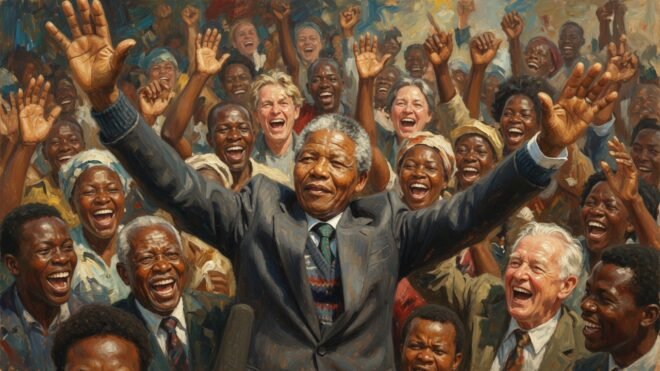
Few lives in the modern era compress so much suffering, discipline, and grace into a single arc as that of Nelson Rolihlahla Mandela. He travelled from a cattle-herding childhood in the Transkei to twenty-seven years behind bars, and from there to the presidency of the nation that had imprisoned him. It is tempting, in retrospect, to smooth this journey into a fable of inevitable triumph. The historical record resists that temptation.
Mandela was not born a saint, and he did not become one in Robben Island’s lime quarry. He was radicalised by decades of accumulated humiliation, he made a considered and dangerous decision to take up armed sabotage, and he emerged from prison not merely unbroken but strategically transformed, choosing reconciliation not out of naivety but out of a hard-headed reading of what his country actually needed to survive.
What follows is an attempt to hold both halves of that record at once: sympathy for the brutal conditions that shaped him, and a clear-eyed account of the choices he made in response to them. It draws on Mandela’s own testimony – his address from the dock at the Rivonia Trial, his autobiography, his presidential speeches – while resisting the urge to flatten a complicated man into an icon.
A Childhood Under Colonial Rule
Mandela was born on 18 July 1918 in the village of Mvezo, in what was then the Transkei. His Xhosa name carried an unintentionally prophetic edge – it is often rendered as “troublemaker” – and after his father’s early death he was raised within the Thembu royal household, absorbing both the customary authority of tribal leadership and the daily indignities of colonial subjecthood. A schoolteacher later gave him the English name by which the world would come to know him.
It was in Johannesburg, where he went to study law, that the abstract fact of racial discrimination became a lived and grinding reality. In 1944 he joined the African National Congress Youth League with contemporaries who would remain central to his life, among them Walter Sisulu and Oliver Tambo. Four years later the National Party’s victory formalised apartheid, converting informal prejudice into a comprehensive legal architecture that stripped Black South Africans of land rights, political voice, and basic civic dignity.
Mandela was insistent, later in life, that his politicisation was not the product of a single dramatic event, but of a slow accretion of grievance – thousands of small humiliations that, compounded over years, produced in him a rebelliousness he had not been born with. That account matters, because it locates the origin of his militancy not in temperament but in circumstance. It was this accumulated anger, rather than any innate appetite for confrontation, that carried him first into the 1952 Defiance Campaign, a programme of non-violent civil disobedience modelled loosely on the example of Gandhi. Mandela believed in that method. He abandoned it only when the state made clear that peaceful defiance would be met with escalating force rather than negotiation.
It is worth pausing on what apartheid actually meant in practical terms, because the word can flatten into an abstraction if it is not anchored in specifics. The Population Registration Act classified every South African by race. The Group Areas Act determined where a person was permitted to live. The Bantu Education Act deliberately constructed an inferior schooling system for Black children, designed by its own architects to prepare them for subordinate labour rather than intellectual or professional advancement. Pass laws required Black South Africans to carry documents authorising their presence in areas designated for white use, and the violation of those laws was itself criminalised. Mandela’s activism was not a response to abstract injustice; it was a response to a legal machine built, article by article, to enforce racial hierarchy in every domain of daily life, from where a person could sleep to which door of a building they could use.
It is also worth noting that Mandela’s ANC did not represent the only current of Black South African political thought, and was not free of internal critique from within the wider liberation movement. The Black Consciousness tradition associated with Steve Biko, which rose to prominence particularly among students in the late 1960s and 1970s while Mandela was already imprisoned, argued for a psychological and cultural decolonisation that some of its adherents saw as more fundamental than the ANC’s constitutional, multiracial framework. It was frequently sceptical of the ANC’s willingness to negotiate with white liberals and, later, the apartheid state itself. Biko’s death in police custody in 1977 became its own galvanising symbol of the struggle. Mandela’s later politics of reconciliation, forged in a different generation and shaped by his particular imprisonment and negotiation, was not the only vision available to Black South Africans of how liberation should be pursued or what it should look like once achieved. Situating him against that alternative tradition sharpens rather than diminishes the specific choices he made.
Sabotage and the Dock at Rivonia
The Sharpeville massacre of March 1960, in which police killed sixty-nine unarmed demonstrators, marked the point at which Mandela and his colleagues concluded that non-violent resistance alone could not dislodge a regime willing to answer protest with gunfire. The government banned the ANC outright. In 1961 Mandela helped found Umkhonto we Sizwe – “Spear of the Nation” – the movement’s armed wing, deliberately confined in its early years to sabotage of infrastructure rather than attacks on people.
This is the point at which any honest account of Mandela must resist hagiography. The decision to build an armed organisation was not forced upon him by circumstance alone; it was a choice, made with full awareness of its moral weight and its legal consequences. Arrested and tried, Mandela used his statement from the dock at the Rivonia Trial in April 1964 not to plead for leniency but to lay out, calmly and at length, the reasoning behind that choice. He described the shift to sabotage as the product of a sober assessment of a political situation created by years of tyranny and exploitation, not of recklessness or any love of violence.
The same statement contained the passage that would come to define his public identity for the rest of his life – a declaration that he had fought against domination by whites and by Black South Africans alike, that he cherished the ideal of a free and democratic society in which all people lived together in harmony, and that this was an ideal for which, if necessary, he was prepared to die. The court did not test that willingness rhetorically. It sentenced him, along with his co-accused, to life imprisonment.
Objectively, the turn to sabotage invited the label of terrorism that the apartheid state and its allies would use against Mandela for decades. It is worth stating plainly that this was a real strategic and moral risk, not a footnote. But it is equally worth stating what the historical record shows: that Umkhonto we Sizwe under Mandela’s direction targeted infrastructure rather than civilians, and that Mandela himself always described armed struggle as a last resort forced by the closure of every peaceful avenue, not as an end in itself.
That distinction, however, should not be allowed to settle the matter for the whole of MK’s history. Mandela himself was arrested in August 1962, barely a year into the organisation’s existence, and had no operational role in what followed. The Truth and Reconciliation Commission’s later findings complicate the record for MK as a movement over its full three decades: a majority of those killed in its operations were in fact civilians, including people classified by the ANC as collaborators – councillors, informers, and others deemed to have compromised the struggle. Acknowledging this does not retroactively implicate Mandela in operations he did not direct and could not have directed from a prison cell.
An honest account of MK’s record therefore cannot rest solely on the infrastructure-focused doctrine of its earliest phase.
The Rivonia sentence did not end the struggle outside the prison walls; if anything it globalised it. Through the 1970s and 1980s, an international anti-apartheid movement grew around demands for economic sanctions, sporting and cultural boycotts, and divestment from companies operating in South Africa. Universities, pension funds, and eventually national governments faced sustained pressure to sever financial ties with Pretoria. The United Nations General Assembly had already declared apartheid a crime against humanity in 1973, and by the mid-1980s the United States Congress passed sanctions legislation over a presidential veto – a measure of how far the moral consensus against the regime had hardened, even as Mandela himself remained invisible to the public, his image legally banned from publication inside South Africa. He became, paradoxically, one of the most famous people on earth without the South African public being permitted to see his face.
Twenty-Seven Years
Mandela served eighteen of his twenty-seven years of imprisonment on Robben Island, under conditions designed to break both body and spirit. He performed hard labour in a lime quarry that permanently damaged his eyesight. Family contact was rationed to a single letter and a single visit every six months in the early years. Surveillance was constant, privacy non-existent.
He wrote later of solitary confinement as the aspect of prison life he found hardest to bear, describing the experience as one without beginning or end, in which the mind itself begins to turn against its occupant. Yet it was in this same period that Mandela articulated the philosophical position that would anchor his later politics: that a man who deprives another of freedom is himself a prisoner of hatred, and that oppressor and oppressed are equally robbed of their humanity by the relationship between them. This was not a comforting abstraction offered from safety. It was formulated inside a cell, by a man with every immediate reason to hate the people holding him there.
He also insisted, repeatedly, on a kind of disciplined optimism – describing himself as fundamentally hopeful by nature, and framing that hope not as blind faith but as a deliberate orientation, a decision to keep moving forward even through the darkest periods when his confidence in humanity was most severely tested. The personal cost behind this discipline should not be understated: Mandela was separated from his wife Winnie and their children for the better part of three decades, and he lost his mother and his eldest son while still behind bars. He emerged from Robben Island not merely intact but more disciplined than when he entered it, having spent the intervening years in sustained study and in argument with fellow prisoners over the shape a future South Africa should take.
Negotiation and the Politics of the Handshake
Mandela walked free from Victor Verster Prison on 11 February 1990, hand in hand with Winnie, after a campaign of international pressure and domestic unrest had made his continued imprisonment untenable for the apartheid government. What followed was not an immediate handover of power but four years of difficult negotiation with President F. W. de Klerk, encompassing the unbanning of the ANC, the release of remaining political prisoners, and the constitutional groundwork for a non-racial democracy.
Mandela’s guiding principle in these negotiations was neither naive forgiveness nor tactical capitulation. He held, and said plainly, that making peace with an enemy requires working with that enemy, at which point the enemy becomes a partner. This was a calculated judgment about what South Africa’s transition actually required: an alternative to the cycle of retribution that had consumed other post-colonial societies emerging from prolonged racial or ethnic conflict. In 1993 Mandela and de Klerk jointly received the Nobel Peace Prize, an acknowledgment less of personal friendship between the two men than of the fact that their negotiated settlement had avoided a widely predicted civil war.
The years between Mandela’s release and his inauguration were far from a smooth glide toward democracy. Political violence, some of it orchestrated by elements within the security establishment seeking to derail the transition, killed thousands of South Africans between 1990 and 1994, much of it concentrated in conflict between the ANC and the Inkatha Freedom Party in KwaZulu-Natal.
Mandela’s own household was not exempt from the period’s turbulence, though the story here is not simply one of a personal cost borne alongside his public struggle. Winnie Madikizela-Mandela was a major political figure in her own right, not merely a spouse who waited. Subjected to years of banning orders, extended solitary detention, and internal exile during his imprisonment, she became for much of that period the most visible face of the resistance inside South Africa, sustaining the ANC’s profile domestically at moments when the organisation’s exiled and imprisoned leadership could not speak for itself. That same prominence, and the militancy she came to embody, put her on a collision course with the negotiated, conciliatory politics Mandela pursued after 1990. Their marriage unravelled amid serious allegations of violence linked to her associates, including her conviction in connection with the killing of the teenager Stompie Seipei, and the couple separated in 1992. An honest account of Mandela’s negotiated transition has to include this – that the same years in which he was constructing a language of national reconciliation were also years of serious, sometimes lethal, instability, and that the political costs of the struggle did not spare his own family, or leave his former wife’s legacy free of comparable complexity to his own.
The Presidency and the Work of Reconciliation
South Africa’s first fully democratic election, held on 27 April 1994, delivered the ANC a decisive victory, and on 10 May 1994 Mandela was inaugurated as the country’s first Black president, at the age of seventy-five, at the head of a Government of National Unity.
His presidency was organised around reconciliation rather than retribution, most visibly through the Truth and Reconciliation Commission chaired by Archbishop Desmond Tutu, which allowed victims of apartheid-era abuses to testify publicly while offering perpetrators amnesty in exchange for full disclosure. The Commission was, and remains, a genuinely contested instrument: critics on the side of victims argued it traded justice for peace too cheaply, while others credited it with preventing a descent into civil conflict. Both positions have merit, and neither cancels the other.
Mandela’s personal symbolism reinforced the institutional work. He appeared at the 1995 Rugby World Cup final wearing the Springbok jersey, a garment that had functioned for decades as a symbol of Afrikaner nationalism, and in doing so converted a symbol of exclusion into a moment of shared national identity. He met, separately, with the widow of Hendrik Verwoerd, one of the principal architects of apartheid. These were not empty gestures; they were calculated acts of statecraft dressed in the language of grace.
Economic policy remains one of the sharper points of contention among historians of Mandela’s presidency. Early redistributive ambitions, set out in the Reconstruction and Development Programme, gave way by 1996 to the more fiscally orthodox Growth, Employment and Redistribution strategy – a shift that satisfied investors and stabilised the currency, but which critics on the left have long argued sacrificed the pace of material transformation for macroeconomic caution.
On HIV and AIDS, Mandela’s own record is mixed and became a subject of later regret: the disease’s exponential spread through the 1990s was met with a response from his government that many public health specialists considered too slow and too quiet, a criticism Mandela himself effectively accepted in his post-presidential years by campaigning far more visibly on the issue than he had while in office, including at the memorial for his own son Makgatho, who died of an AIDS-related illness in 2005. The picture is complicated, though not resolved, by what followed him: the most severe phase of state AIDS denialism, in which President Thabo Mbeki’s government publicly questioned the causal link between HIV and AIDS and delayed the rollout of antiretroviral treatment, occurred after Mandela had already left office. This does not erase the case for criticising Mandela’s comparative quiet on the issue during his own presidency, but it does mean that the catastrophic policy failure most associated with South Africa’s AIDS crisis belongs principally to his successor rather than to him.
None of this should obscure the genuine limits of his presidency. Unemployment, entrenched inequality, rising crime, and the early stages of the HIV/AIDS epidemic all persisted and in some respects worsened during his term, and Mandela himself acknowledged that political liberation had not been matched by anything like economic equality. He stepped down after a single term in 1999, a decision that stands in sharp contrast to the pattern of post-liberation leaders elsewhere on the continent who clung to office indefinitely, and which itself forms part of his legacy of restraint.
Throughout his public life Mandela returned repeatedly to education as the decisive lever of social transformation, describing it as the most powerful instrument available for changing the world, and observing that it was precisely through education that the daughter of a labourer could become a doctor, or the child of a farmworker could rise to lead the nation.
Final Years and an Unfinished Legacy
After leaving office Mandela devoted himself to the Nelson Mandela Foundation and the Nelson Mandela Children’s Fund, campaigning on education, children’s welfare, and peace, and he married Graça Machel in 1998. He made his final major public appearance at the 2010 FIFA World Cup, hosted in South Africa, and died on 5 December 2013 at the age of ninety-five, mourned across the world as one of the defining moral figures of the twentieth century.
It is instructive to set Mandela’s exit from power against the regional pattern he departed from. Elsewhere on the continent, the generation that had won independence or liberation struggles frequently converted that moral authority into indefinite rule, amending constitutions or suspending elections to stay in office for decades. Mandela’s decision to serve a single term and hand power to Thabo Mbeki in 1999 was not constitutionally required – he could have sought and almost certainly won a second term – which is what makes it notable as a deliberate act of institution-building rather than mere formality. He seemed to grasp, in a way many liberation leaders elsewhere did not, that a democracy’s durability depends on showing that power can change hands without catastrophe, and that his own continued presence risked becoming a substitute for functioning institutions rather than a support for them.
His legacy resists any single verdict. He is credited, with justice, for averting the bloodbath that so many observers considered the near-inevitable outcome of apartheid’s collapse, and for modelling a form of political grace that has few precedents among leaders who have suffered comparably at the hands of a state. At the same time, the South Africa he left behind continues to struggle with the inequality, corruption, and social division that outlast any individual leader’s tenure, and serious critics have questioned both the pace of the country’s economic transformation and specific choices made during the transition. Both of these things are true simultaneously, and an honest reckoning with Mandela’s life requires holding them together rather than resolving the tension in either direction.
Mandela described his own life, near its close, as a long road on which he had tried not to falter despite genuine missteps, and on which each hill climbed only revealed further hills beyond it – a journey that permitted rest but not an end, because freedom brings with it obligations that cannot be set down. He held, too, to the conviction that hatred is not innate but learned, and that what can be taught can equally be untaught, since love comes more naturally to human beings than its opposite.
Mandela did not achieve a perfect transition, and he would have been the first to reject any account that claimed he had. What he achieved instead was rarer and in some ways harder: he helped a deeply wounded nation imagine, and begin to build, a future that was not simply a mirror image of its past cruelties. That project remains unfinished. It is also, on the evidence of the life recounted here, still possible – which may be the most durable part of what Mandela left behind.
– – –
Bakchos is the founder of Blak and Black, an Australian media and advocacy platform established in 2010. Bakchos writes from the intersecting perspectives of Wiradjuri heritage, Jewish identity, and humanism.
© Bakchos, July 2026


We tend to remember Mandela as pure grace: the man who forgave his jailers and saved his country from civil war. That’s true, but it’s not the whole story. This piece walks through the parts that get smoothed over — the deliberate decision to take up armed struggle, the 27 years and what they actually cost him and his family, the complicated legacy of his own former wife Winnie’s political life, and the presidency’s real limits, including a slow response to the AIDS crisis that Mandela himself later regretted.
It’s a longer read, but it’s the Mandela worth knowing — not less admirable for being complicated, more so.
No great people exist without sin. Nelson Mandela was not an exception.
We tend to remember Mandela as pure grace: the man who forgave his jailers and saved his country from civil war. That’s true, but it’s not the whole story. This piece walks through the parts that get smoothed over — the deliberate decision to take up armed struggle, the 27 years and what they actually cost him and his family, the complicated legacy of his own former wife Winnie’s political life, and the presidency’s real limits, including a slow response to the AIDS crisis that Mandela himself later regretted.
Comrade Mandela was one of the greatest men of the twentieth century.
Nelson Mandela is perhaps the greatest leader and statesman of my lifetime.