
In the uneasy months after Donald Trump’s election to a second term, the United States in 2025 feels to many like a country at a crossroads. Policies are reshaping immigration enforcement, trade policy and the cultural landscape; rhetoric is more polarised than it has been in generations. People across the political spectrum ask: are we witnessing a drift toward authoritarianism, or are these merely normal partisan battles magnified by social media and history’s mnemonic shortcuts?
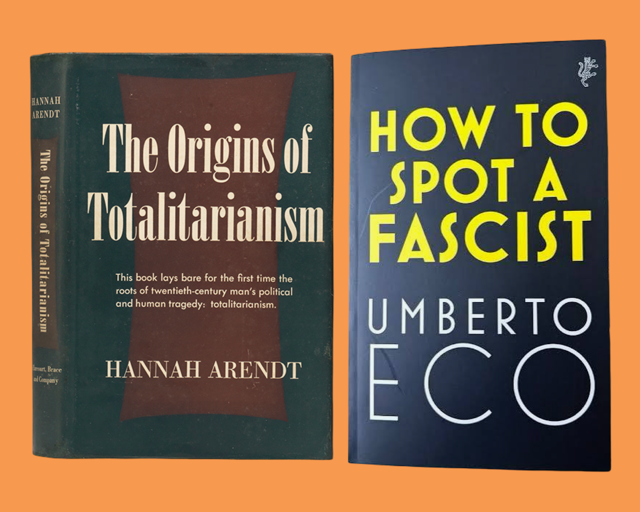
My instinct as someone who reads history and political theory the way some people read weather reports, is to look for frameworks that help us see patterns without collapsing complex phenomena into slogans. For that exercise I turn to two of the twentieth century’s most incisive thinkers on authoritarianism and totalitarianism: Umberto Eco and Hannah Arendt. Eco’s short essay “Ur-Fascism” (1995) offers a diagnostic list of recurring attitudes and cultural moves that make societies vulnerable to fascist-like thinking. Arendt’s monumental Origins of Totalitarianism (1951) supplies a systemic, institutional account of how mass movements, ideology and bureaucracy can invert politics and undermine human rights.
This post does not intend to perform a label-first diagnosis, “this is fascism” or “this is totalitarianism”, because such claims have real historical weight and legal meaning. Instead, my aim is analytic and precautionary: armed with Eco’s 14 features and Arendt’s institutional insights, what recurring tendencies in 2025 American life should alarm democrats of all stripes? Which cultural idioms and institutional habits make it easier for illiberal shifts to scale? And what practical vigilance might a civic culture adopt to preserve pluralism?
A note on structure: I’ll summarise Eco’s features and apply each, briefly and concretely, to political developments and cultural currents since 2024. Then I’ll fold in Arendt’s concepts, atomisation, the banality of evil, statelessness, ideology as total explanation, and show how they complement Eco’s cultural focus by explaining the institutional mechanics that can translate social attitudes into durable power. Finally, I’ll weigh their synergies and close with an argument for civic restoration rather than despair.
Umberto Eco’s “Ur?Fascism”: an analytic kit
Eco insisted that “Ur?Fascism” is not a checklist to prove that a specific movement equals Mussolini’s Italy or Hitler’s Germany. Rather, it’s a family of attitudes and rhetorical moves that can reappear in new guises. These are not strictly historical or doctrinal truths; they are cultural and psychological tendencies. Below I list Eco’s features and give concrete contemporary illustrations from the American scene.
1) The cult of tradition
Eco describes fascist temperaments as syncretic: they stitch together incompatible traditions into a single, sacralised past. The past becomes a revealed truth that cannot be improved upon. In today’s politics this shows up as appeals to an imagined “golden age” of America—an immobile national identity presented as the proper order. Policy proposals that aim to re?establish a mythical industrial era, paired with religious nationalism and a sanitised founding narrative, are not just nostalgia; they’re a political project that treats contested historical realities as settled dogma. When school curricula get shortened into patriotic catechisms and complex histories are dismissed as “anti?American,” you’re seeing this trait at work.
2) Rejection of modernism
Eco noted that fascism can reject the Enlightenment’s faith in reason while still embracing technology when useful. A contemporary example is the selective acceptance of innovation—like using social platforms or surveillance technology to organise but rejecting scientific consensus on climate change or public health when it clashes with a preferred narrative. The rhetorical delegitimisation of expert institutions, universities, scientific bodies, reputable journalism, turns civic respect for expertise into suspicion.
3) The cult of action for action’s sake
Eco wrote that action is beautiful in itself because thinking is “a form of emasculation.” Policy enacted for its spectacle rather than for deliberated outcomes fits this pattern: impulsive executive decisions, sudden trade measures presented as decisive victories, or dramatic enforcement actions that emphasise theatricality over administrative coherence. When governance is treated like performance, institutions meant to deliberate and balance are marginalised.
4) Disagreement is treason
A movement that treats dissent as betrayal fractures the public sphere. When political loyalty takes precedence over policy critique, and critics are branded as enemies of the nation rather than participants in democratic deliberation, civic conversation narrows. The social media age amplifies this dynamic: labelling, doxxing and coordinated harassment can make public criticism costly beyond the realm of argument.
5) Fear of difference
Fascist politics historically weaponised xenophobia and the fear of outsiders. In our context this appears in nativist rhetoric, immigration policies aimed at exclusion rather than humane management, and the politics of moral panic, where migrants, religious minorities, or sexual minorities are depicted as existential threats to a homogenous national culture. When political rhetoric traffics in metaphors of contamination, “poisoning the blood,” “replacement,” or invasion—democracy’s inclusive foundations are at risk.
6) Appeal to a frustrated middle class
Eco observed that fascists seduce people who feel humiliated by economic and cultural change. In modern America, the anxieties of communities hit by deindustrialization, rising inequality, and shrinking civic prospects can be redirected toward scapegoating and nationalist promises. Political entrepreneurs who offer simplistic external enemies and quick solutions exploit those grievances without addressing structural roots.
7) Obsession with a plot
Conspiracy thinking is a social glue in many illiberal movements: the idea that a hidden cabal, the “deep state,” “globalists,” or “elites, controls events lends moral clarity to complex politics. This habit of explaining every setback as the result of a malign design produces paranoia and delegitimises independent institutions tasked with oversight.
8) The enemy is both too strong and too weak
Eco explained fascist rhetoric often oscillates: enemies are omnipotent conspirators one day and hapless stooges the next. This shifting rhetoric keeps followers mobilised, terrified enough to demand protection, but confident enough to believe victory is feasible if they act.
9) Pacifism is trafficking with the enemy
Words such as “soft” or “weak” become political condemnation. Political life becomes framed as perpetual struggle, where compromise is moral failure. Such framing narrows the scope for negotiation and institutional restraint.
10) Contempt for the weak
Elitism—public contempt for perceived weakness—normalises cruelty and policy choices that degrade vulnerable groups. When social policy debates prioritise valour or strength over welfare and dignity, political coalitions can rationalise inequality as moral order.
11) Everybody is educated to become a hero
Movements that celebrate martyrdom, violence or unilateral heroics breed a culture where individual sacrifice for the cause is glamorised. This can translate into uneven attitudes toward protest and political violence: what is terror in one frame becomes heroism in another.
12) Machismo and weaponry
Eco’s portrait of fascism includes an ethic of masculinity, disdain for women’s rights, and the fetishisation of arms. Political aesthetics that centre masculine dominance, glorify weapons, or deride gender equality signal an illiberal cultural allergy to plurality.
13) Selective populism
The leader claims to speak for the people directly, bypassing intermediary institutions and checks. This populist posture often masks elite capture: populist rhetoric is used to centralise authority while creating a performative alignment with “the people.”
14) Newspeak
Simplified, sloganised language reduces capacity for complex thought. Repetition of short mantras, “fake news,” “drain the swamp,” “stolen election”, short-circuits scrutiny and fosters a politics where persuasion is emotional rather than factual.
Eco’s point in putting these features together is not inevitability; he wanted us to see how ordinary cultural habits can accrete into illiberalism. One or two of these traits may occur in many democratic societies at many times. The danger is the overlap: when several traits converge and institutions are weakened, the risk of systemic backsliding grows.
Hannah Arendt: structure, loneliness, and the banality of evil
Eco’s list diagnoses temperaments. Arendt explains how mass movements and administrative systems can translate temperamental shifts into durable political realities.
1) Totalitarianism as a project that transforms politics into ideology
Arendt distinguished totalitarian movements from ordinary dictatorships by their ideological ambition to explain everything and to subordinate reality to an all?encompassing doctrine. When facts are forced to fit a political myth (for instance, the myth of a stolen election as an all?explaining narrative), politics ceases to be argument about competing goods and becomes a struggle to maintain narrative coherence. The result: institutions that rely on neutral facts, courts, statistical agencies, independent journalism, are delegitimised because they contradict the ideology’s premises.
2) Loneliness and mass atomisation
Arendt emphasised how atomised, dislocated individuals are particularly susceptible to totalising movements. Modern social and economic dislocation, loss of stable employment, the fraying of civil society, isolation exacerbated by digital life, produces citizens who crave belonging. Populist rallies, online communities and conspiratorial networks provide an ersatz community. They also intensify us-versus-them thinking: belonging requires a shared enemy and a shared set of grievances. In policy terms, the failure to rebuild social infrastructure (community institutions, local economies, mental health systems) makes democratic resilience harder.
3) The banality of evil
Derived from her reporting on Adolf Eichmann’s trial, Arendt’s phrase describes how bureaucracy and thoughtless obedience can produce monstrous outcomes. People who participate in deportations, rights-restripping policies, or the enforcement of cruel administrative regimes may not act from hatred but from a professional ethic that discourages moral imagination. Arendt’s point is chilling: most atrocities require not monstrous intent but normal institutions that stop asking moral questions.
4) Statelessness and the “right to have rights”
Arendt showed that those stripped of nationality become vulnerable in a lawless space where human rights are hollow without a political community that enforces them. Policymaking that erodes citizenship protections, limits asylum rights, and reduces long-term residents into precarious legal categories creates populations who are politically vulnerable and economically exploitable. The erosion of legal protections for people on the margins is therefore not a narrow technical issue: it is a fault line along which authoritarian practices can attach.
5) Lawfulness in tyranny
Totalitarian regimes often cloak themselves in legality: they pass laws that legalise the extraordinary. When checks and balances are undercut and legal norms are reshaped to serve political ends, pardons to shield allies, reinterpretations of statutes to centralise power, the legal scaffolding of democratic constraint weakens. In a situation where legality becomes elastic and subject to political ends, institutions that once protected pluralism can be repurposed.
When Eco and Arendt meet
Eco and Arendt complement one another. Eco gives us cultural warning signs, rhetorical moves, aesthetics, affects, while Arendt describes the institutional architecture that transforms those affects into durable power. In a simplified causal model: cultural shifts that valorise tradition, demonise difference, and celebrate theatrical action create political energy. When that energy meets institutional vulnerabilities, atomised publics, legal malleability, weakened civic infrastructures, it can be pressed into policies and practices that normalise exclusion, punishment, and the delegitimisation of plurality.
Consider immigration policy and deportation campaigns: Eco helps us recognise the rhetoric, contamination metaphors, apocalyptic frames, heroisation of enforcement, that builds consent. Arendt helps us see how bureaucratic normality turns cruelty into routine: forms signed, detention centres run as administrative units, legal exceptions treated as precedents. Combined, the two analyses show how symbolic politics and administrative practice can mutually reinforce illiberal outcomes.
What the frameworks do not say (and why that matters)
Neither Eco nor Arendt provide a deterministic map where the appearance of a trait equals the end of democracy tomorrow. Democratic backsliding is a matter of degree, and it is reversible if countervailing energies are mobilised. Both thinkers, however, insist on one core truth: small cultural and institutional shifts accumulate. The trivialisation of debate, the delegitimisation of expertise, the abandonment of norms for spectacle, taken singly, are repairable. Taken together and left unaddressed, they can corrode democracy’s foundations.
A short list of practical implications
If one accepts these frameworks as illuminating, what then? Here are concrete, civic-minded responses that address the cultural and institutional vulnerabilities Eco and Arendt identify:
• Reinforce institutions of truth-telling. Invest in independent journalism, protect statistical offices and preserve academic freedom. Push back, through law and culture, against rhetorical delegitimisation of expertise.
• Rebuild social infrastructure. Strengthen local civic institutions, fund community mental health and addiction services, support labour policies that create stable employment—because atomisation is not merely emotional; it is political fuel.
• Defend rule-of-law norms. Judicial independence, transparent administrative procedures, and oversight mechanisms matter. Legal reforms that increase checks—sunset clauses for novel executive authorities, stronger whistleblower protections—help inoculate democracy.
• Normalise pluralism in education. Resist reductive curricula that turn history into catechism. Civic education should cultivate critical thinking, historical complexity and empathy.
• Protect vulnerable populations. Uphold asylum rights, prevent manufacturing of statelessness, and ensure that large enforcement actions are subject to legal review and human-rights standards.
• Cultivate public argumentation. Political leaders, religious institutions and civil-society organisations should model disagreement as an art rather than a crime. Depolarising communication, promoting formats that encourage listening and joint problem-solving, reduces the appeal of conspiratorial total explanations.
A closing thought
Eco’s warning that fascism can return “in the most innocent of disguises” and Arendt’s account of how ordinary institutions can hide atrocity are not merely theoretical ruminations; they are civic-economy manuals for what to watch for and how to act. The American moment in 2025 is contested and, like every historical moment, open to choice. The alternatives are not inevitable, political culture is a contested space, and institutions can be reinforced. If Eco gives us a checklist of cultural pathologies to resist, Arendt gives us a reminder that bureaucracy and legal form matter hugely. Democracy will not be saved by slogans or by panic. It will be preserved through slow, often boring institutional work, cultural restoration, and an ethic of citizenship that refuses to treat disagreement as treason or compassion as weakness.
We can, and should, draw on history without letting it tyrannise us. Eco and Arendt offer both diagnosis and, implicitly, a remedy: vigilance grounded in thought, solidarity rooted in institutions, and politics renewed by humility rather than theatrical domination. Democracy’s defenders must remember that the cure is ordinary: restore civic trust, defend procedural fairness, embrace complexity, and keep the public sphere hospitable to dissent. If we heed them, the echoes of twentieth?century darkness can be diminished, and American pluralism can be strengthened for the long run.