
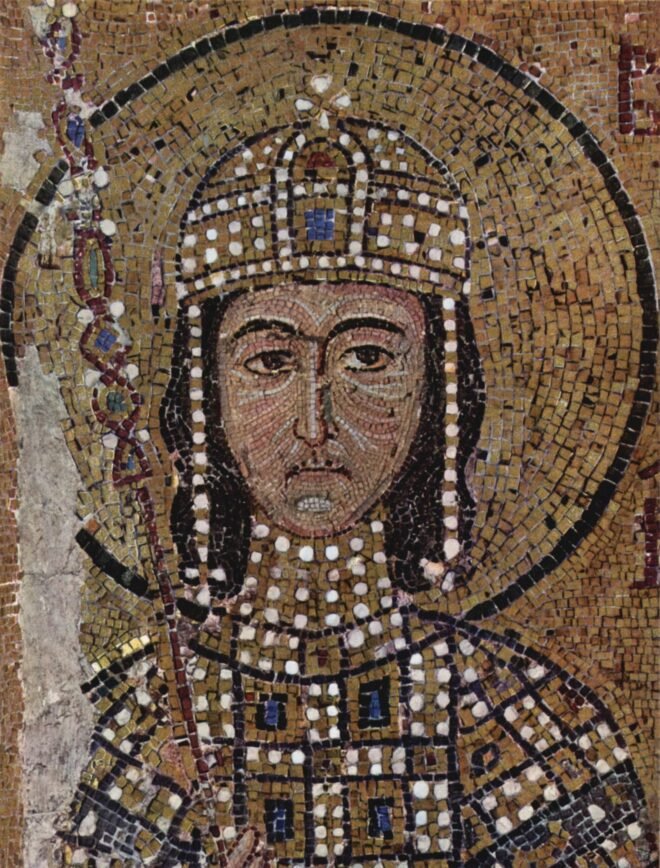
In the crowded library of medieval literature, where annals, sermons, and monastic chronicles often blend into a uniform grey, The Alexiad shines as a luminous, surprising, and deeply personal work. Composed by Anna Komnene in the mid-twelfth century, it is at once a family memorial, a piece of political advocacy, and a literary achievement. It records a pivotal age – the aftermath of Manzikert, the arrival of Western crusaders, the reassertion of imperial authority under Alexios I Komnenos – but it does so through a deliberately narrow lens: the life and reign of Anna’s father. The result is less a dispassionate chronicle than an epic biography, written in the language of classical antiquity yet suffused with the concerns of Byzantium’s medieval reality. As the first sustained history written by a European woman known to us, The Alexiad occupies a singular position in the history of historiography and in the study of Byzantine culture.
Anna Komnene: scholar, courtier, exile
To understand The Alexiad one must begin with its author. Anna Komnene was born into the purple: December 1, 1083, in the Porphyra Chamber of the Great Palace – an origin that signified imperial legitimacy and placed her within the intimate circle of court life. Her father, Alexios I Komnenos, laboured to reconstruct an empire threatened from every quarter; her mother, Irene Doukaina, belonged to one of the great aristocratic houses, and the familial ambitions and alliances that shaped Anna’s upbringing are written into the texture of her text.
The trajectory of Anna’s life – education, marriage, political disappointment, and scholarship in monastic isolation – mirrors, in many ways, the textured ambivalence of her book: learned enthusiasm tempered by thwarted expectation. She received an education rare even among princely women of Byzantium: classical Greek literature, rhetoric, theology, philosophy, mathematics, medicine, astronomy, and military tactics. Such breadth of learning enabled her to write in cultivated Attic Greek and to infuse her narrative with literary allusions and analytic arguments that demand a reader trained in classical texts.
Her marriage, at around fourteen, to Nikephoros Bryennios the Younger allied her to an accomplished general-historian and offered intellectual companionship. Yet marriage did not secure the political future she had been raised to expect. The birth of her brother John altered the line of succession; ploys to secure the throne for Bryennios and Anna failed upon Alexios’s death in 1118. The subsequent sidelining and, possibly, accusations that Anna conspired against John culminated in the loss of estates and a forced retreat to the convent of Kecharitomene – an environment that, for the paradox of exile, became the cradle for her literary undertaking. There, after Bryennios’s death, Anna completed The Alexiad, drawing on family recollections, court documents, eyewitness testimony, and her own memories.
The political and personal circumstances of composition matter. The Alexiad is not a neutral record of events; it is a deliberate act of legacy-making. In exile, barred from the corridors of power, Anna fashioned a monument – an argument that her father’s reign was the salvation of Byzantium and that the Komnenoi had restored order through intelligence, piety, and courage. But this act of filial homage is also an assertion of intellectual independence in a society that seldom foregrounded women as historical authorities. Her very presence as author complicates the medieval habit of confining women to footnotes; she makes an extended claim to public voice through literary mastery.
A beleaguered empire and its moment of reinvention
By the late eleventh century Byzantium was a state under siege. The military catastrophe of Manzikert in 1071 had torn enormous swathes of Anatolia from imperial control, enabling Turkish settlement and the emergence of new polities that threatened Byzantium’s heartland. From the west came Norman adventurers who tested imperial defences with sieges and incursions. At home, aristocratic factions and palace coups undermined the effectiveness of centralised governance. Economically and socially, the empire faced strains that called into question its resilience.
Alexios I’s accession in 1081 represented a decisive, if precarious, attempt to reconstitute imperial strength. His policies combined military reforms, administrative restructuring, and deft diplomacy. He reoriented landholding practices through mechanisms – including early forms of pronoia – and cultivated a renewed centrality of the imperial household and family network. He also faced theological and cultural challenges. The schism of 1054 loomed as a cultural and ecclesiastical cleavage between East and West even when Anna rarely dwells on it directly; ecclesiastical disputes and heretical movements such as Bogomilism tested the spiritual unity that Byzantine rulers claimed to defend.
Into this fraught landscape came the Western response to Alexios’s appeal for assistance. His request for military aid – intended to repel the Turks and protect Byzantine territory – unwittingly became the spark for the First Crusade. The arrival of massive Western contingents, their logistical demands, and their different conceptions of reward and honour injected a new centrifugal energy into Mediterranean politics. The Crusaders were both allies and competitors; their campaigns on the Near Eastern coast often intersected with Byzantine strategic priorities but also undermined imperial claims when leaders seized territory and refused to honour pledges.
Anna’s work takes place against that complicated backdrop. She compresses imperial anxieties, intercultural friction, and the juggling of alliances into a narrative that elevates her father’s political skill as the central mechanism that preserved Byzantium against collapse.
The Alexiad’s structure and literary project
Unlike grand, panoramic chronicles that trace centuries, The Alexiad is concentrated: a prologue followed by fifteen books that march chronologically through Alexios’s rise, struggles, and death, but that are thematically coherent as a sustained encomium. Anna explicitly sets out to defend and magnify her father – she promises truth, yet she frames events to display his wisdom and providence. Stylistically, she writes in an artificial Atticized Greek modelled on classical authors: Homer, Thucydides, Xenophon. This choice is significant. By echoing the diction and rhetoric of antiquity, Anna anchors her contemporary narrative in a tradition that associates the Komnenian revival with ancient glories. Her Homeric resonances – the comparison of Alexios to heroic figures, the dramatisation of battles as moral tests – serve a deliberate apologetic purpose: to present Alexios not merely as a competent ruler but as a man whose virtues transcend his epoch.
The book blends genres: biography, military history, diplomatic chronicle, theological polemic, and personal reflection. Anna employs devices – from rhetorical amplification and direct speech to vivid scene-setting – that enliven the narrative and lead readers toward the conclusion she intends. The use of eyewitness testimony and documentary evidence gives the work the trappings of historical reliability; the selective emphasis and moralising tone remind readers that The Alexiad is equally a work of persuasion.
Alexios as heroic centre: metis, piety, and authority
At the centre of The Alexiad stands a figure modelled for emulation: Alexios I Komnenos as the ideal Byzantine ruler. Anna’s portrait is multifaceted. She stresses his metis – cunning intelligence – as his defining trait, aligning him with Odyssean craft rather than purely martial prowess. Time and again, Alexios is shown outmanoeuvring enemies through strategy, diplomatic acumen, and psychological insight. These episodes underscore a Byzantine preference for flexible statecraft over frontal brutality.
Piety is another pillar of Anna’s depiction. Victories are often presented as signs of divine favour; Alexios’s piety legitimises his reign and frames political success as part of a providential plan. At the same time Anna does not reduce him to saintly passivity. He is an active, pragmatic ruler who negotiates, recompenses, and on occasion resorts to severe punishment to maintain order. This combination of the devout and the pragmatic allows Anna to present Alexios as both Christian exemplar and effective monarch.
Anna’s selective omissions and emphases reveal her purposes. She foregrounds battles and diplomatic triumphs that illustrate Alexios’s competence, while downplaying or rationalising setbacks. Defeats become opportunities to highlight courage under trial or the intervention of God. Personal details – family interactions, the atmosphere of court, Alexios’s illness and death – humanise him and encourage readers’ emotional investment. The final books, which detail his protracted illness and the final days of the emperor, function as elegy and testament: a culmination that invites sympathy and reinforces the narrative of a dignified end.
A Byzantine perspective on the First Crusade
One of The Alexiad’s most valuable contributions to medieval studies is its Byzantine-centred account of the First Crusade and its aftermath. Western narratives of the Crusade – pious rhetoric, saintly warriors, miraculous victories – are given a counterweight in Anna’s descriptions. She views the arrival of Western armies through a matrix of practical state concerns: logistics, oaths, territorial claims, and the culture clash between Greeks and Latins.
Anna emphasises the problematic character of Crusader behaviour from a Byzantine viewpoint: oaths offered in Constantinople but not honoured later; an unseemly appetite for land and wealth; cultural misunderstandings that exacerbated mistrust. Her accounts of figures such as Bohemond of Taranto frame the Norman leader as both militarily formidable and politically unreliable; the chronic dispute over Antioch – built with Byzantine interests but retained by Bohemond – illustrates the tension between solidarity against a common foe and competing claims of sovereignty.
Anna’s perspective helps modern readers appreciate the Crusade’s dual nature: both a military-religious enterprise and a geopolitical intervention with complicated, sometimes contradictory effects. Her narrative anticipates later estrangement between East and West; the seeds of the tragic rupture of 1204 find expression in her accounts of early betrayals and mutual contempt.
Literary artistry: style, allusion, and rhetoric
The Alexiad is notable not merely for its content but for its literary artistry. Written in elevated Attic Greek, Anna deliberately places herself in the line of classical masters. The effect is not mere archaism; it is a rhetorical choice that fuses antiquity with contemporary meaning. Homeric similes, Thucydidean analysis, and Xenophontic narrative rhythms intersect to produce a work that reads as both a litany of events and a crafted poem of leadership.
This style facilitates several aims. It lends authority and gravitas to the account; it creates resonance between old heroic models and the Komnenian project; and it supplies a vocabulary for praising and interpreting contemporary events in terms that educated audiences could appreciate. Anna’s rhetorical skill is especially evident in speeches, scene-setting of battles, and the deathbed portrayals that blend emotional intensity with restrained decorum.
Gender, authorship, and the presence of a woman historian
The Alexiad’s authorship elevates it from a singular historical source to a document of social and intellectual significance. Anna Komnene’s role as the first major female historian in European tradition raises questions about gender, agency, and the limits of female intellectual life in Byzantium. Her education was exceptional; her ability to claim authority through learned style and substantive argument demonstrates that women of elite status could, under certain conditions, participate in intellectual production.
Anna’s mode of self-presentation is strategically modest even as it is assertive. She adopts a tone that professes humility, even while she demonstrates mastery; she invokes sorrow in the prologue as a rhetorical device to justify both intimacy and critical distance. In depicting other women – her mother Irene, imperial women advising statecraft – Anna subtly argues for female influence within the permissible frameworks of family and court. Her work thus complicates any simple narrative of female marginalization: she was both a product of a patriarchal order and a figure who pushed its intellectual boundaries.
Biases, omissions, and the historian’s craft
No historical text is free of bias, and Anna’s project is transparently partisan. Her filial devotion is the engine of the narrative; Alexios’s virtues are amplified, his faults minimised. Rival figures – most notably her brother John – receive less sympathetic treatment; foreign opponents are often depicted as culturally inferior or morally corrupt. Such bias does not render The Alexiad useless; rather, it demands critical reading.
Anna’s use of sources blends memory, oral testimony, official materials, and perhaps earlier drafts by her husband. Memory’s fallibility and the political stakes of representation mean that dates are sometimes inaccurate and events selectively framed. Modern historians use The Alexiad in conversation with other sources – Latin chronicles, Arabic and Armenian materials, archaeology – to triangulate a fuller picture. Anna’s subjectivity, in this light, becomes itself a source about Byzantine mentalities, values, and modes of justification.
Religion, orthodoxy, and political unity
Religious motifs permeate The Alexiad. Anna frames Alexios as a defender of orthodoxy and a bulwark against heresy. The treatment of Bogomilism, a movement viewed as subversive, is telling: her descriptions fuse theological condemnation with political alarm, and she recounts trials and punitive measures as necessary to preserve unity. This conflation of spiritual and temporal authority reflects Byzantine paradigms in which the emperor played both political and quasi-sacral roles.
The work reveals how religion served as both solace and instrument. Alexios’s piety legitimises his reign; victories become signs of divine favour; punishments for heresy are represented as acts of restoration. Anna thereby frames imperial policy as a moral as well as strategic enterprise, and she exemplifies the Byzantine tendency to read political events through theological lenses.
Military detail and strategic insight
For military historians, The Alexiad is a treasure trove of operational detail. Anna’s accounts of sieges, campaigns, logistics, and battlefield stratagems offer vivid descriptions of medieval warfare. Episodes such as the siege of Dyrrhachium, the campaigns against the Pechenegs culminating at Levounion in 1091, and the intricate diplomacy with Turkish rulers reveal a military culture that combined fortification, mobile cavalry tactics, intelligence-gathering, and psychological warfare. She records innovations, uses of recon and diplomacy, and the integration of mercenary contingents – information that helps reconstruct the tactical world of late eleventh- and early twelfth-century Byzantium.
These military narratives are not merely technical; they are integral to Anna’s portrayal of Alexios as a ruler who preserves state through strategic sophistication. His victories are both physical and symbolic, restoring confidence and stabilising the imperial centre.
Legacy, reception, and modern readings
The Alexiad has enjoyed a complicated reception. Medieval Byzantine readers valued it for its polished Attic style and its depiction of a crucial era; later vernacular paraphrases indicate its readership extended beyond elite circles. Western scholars in later centuries recognised its importance for Crusader studies and Byzantine history, while modern historians have approached it with richer interpretive tools – sourcing biases, contextualising its rhetoric, and reading it through lenses such as gender studies and narrative theory.
In literary history, Anna’s achievement is often reappraised as pioneering: she reused classical forms to craft a self-conscious narrative voice that straddles the boundary between personal grief and public testament. In historiography, her text remains indispensable for its firsthand detail and its perspective on East-West relations during the Crusader period. The Alexiad is therefore both a source of raw historical information and an object of literary and cultural analysis.
Comparative perspectives: Byzantine vs. Latin narratives
One of the most instructive aspects of The Alexiad is how it sits in conversation with Latin narratives of the same events. Where Western chroniclers often frame the Crusade in transcendental terms – miracles, sanctity, divine mandate – Anna is grounded in imperial priorities: preservation of territory, diplomatic obligations, ceremonial deference, and cultural superiority. The clash of narratives is not merely factual disagreement but a clash of worldviews. Anna’s depiction of the Latins as quarrelsome, greedy, and uncultured (her repeated use of terms that translate roughly to “Celts” or “Latins” in a pejorative sense) needs to be balanced against Latin writers who emphasize piety and spiritual purpose. The comparative reading exposes how difference in identity, memory, and political stakes shaped competing historical reconstructions.
The Alexiad as source for archaeology and material culture
Archaeological findings – remains of fortifications, battlefields, and ecclesiastical structures – provide a complementary dimension to Anna’s text. When physical evidence aligns with her descriptions, it bolsters the historical plausibility of certain campaigns and siege techniques. Where material culture diverges or remains silent, it invites caution in treating The Alexiad as exhaustive. In practical terms, archaeologists and historians use Anna’s detailed descriptions as hypotheses for where to look and what to look for; her accounts have helped locate sites and interpret finds in the Balkans and Asia Minor.
Emotional texture and narrative voice
Beyond politics and military strategy, The Alexiad is remarkable for its emotional cadence. Anna’s prose alternates rhetoric with moments of candid feeling: grief for lost comrades, reverence for her father, an abiding sense of injustice at the denial of her rightful status. She practices a kind of emotional restraint that suits the genre but also allows spontaneous pathos to surface – particularly in scenes of illness, funeral, and family sorrow. This emotional labour is itself a form of historical information: it reveals aristocratic values, the dynamics of imperial family life, and the moral registers through which Byzantines interpreted suffering and success.
Modern debates: authorship, reliability, and interpretation
Scholars have debated aspects of The Alexiad since it returned into modern awareness: questions of exact authorship (its attribution to Anna is secure in most scholarship), the extent to which she drew on her husband’s incomplete work, the degree of editorialising, and how best to read her rhetorical devices. Debates also revolve around her reliability: is she a partial but broadly factual witness, or is her account too shaped by filial flattery to be trusted on matters of chronology and causation? Most modern scholars adopt a middle road: they recognize her biases and rhetorical purposes but also value the book’s substantial, often unique, information for reconstructing Byzantine responses to the great challenges of the era.
Cultural resonance and contemporary relevance
The Alexiad’s resonance goes beyond academic debates. Its core themes – the defence of civilisation against disorder, the collision of cultures, the maintenance of order through intelligence and faith – speak to perennial human concerns. In periods of heightened East-West tension, Anna’s narrative offers a cautionary tale about the costs of misunderstanding and the perils of short-term alliances. Her insistence on viewing events through the prism of state survival and moral order invites contemporary readers to consider how historical narratives are shaped by the needs of those who tell them.
Conclusion: a monument of intellect and devotion
The Alexiad stands as a testament to the intertwined powers of intellect and family devotion. Anna Komnene’s literary craft, her learned style, and her strategic framing of Alexios I’s reign produced a work that is at once historiography and elegy. In emphasising her father’s metis and piety, she recasts a tumultuous era as a sequence of trials met with perseverance and divine assistance. In doing so she also carved out a space for a woman as an authorial presence in the public discourse of her time.
Her narrative is not a transparent window onto the past but a carefully composed lens that refracts events through grief, loyalty, and a classical idiom. Read critically, The Alexiad offers scholars and general readers alike a rich portrait of Byzantine politics, culture, and self-conception at a pivotal historical junction. It brings to life the drama of an empire reinventing itself, the collision of Mediterranean worlds, and the private aches of a woman whose intellect and pen fortified a legacy that continues to instruct and fascinate.
For anyone interested in medieval history, literary craftsmanship, or the study of gendered voices in antiquity and the Middle Ages, The Alexiad remains an indispensable and rewarding read – an epic shaped by genuine love and formidable intelligence, a mirror of Byzantine grandeur and human complexity, and a work whose echoes continue to shape our understanding of the medieval Mediterranean.




That was an interesting post.