
Introduction
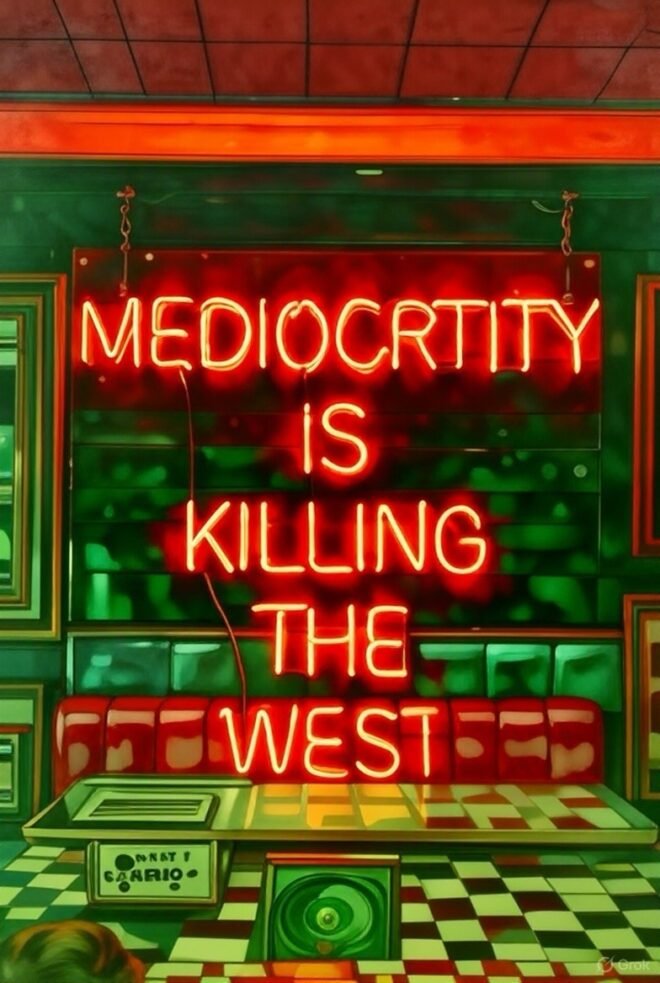
In an era where the West grapples with existential threats, from economic stagnation to cultural fragmentation, the narrative often points fingers at external forces. Immigration, globalisation, and geopolitical rivals like China are frequently blamed for the decline of Western dominance. But what if the real culprit is something far more insidious, lurking within our own systems? What if the West is not being overrun by outsiders but is instead self-sabotaging through a deliberate embrace of mediocrity over meritocracy?
This is not a new idea, but it’s one that’s gaining urgency in late 2025. As we navigate the final months of this tumultuous decade, marked by political upheavals, inflationary pressures, and a widening wealth gap, it’s clear that superficial explanations fall short. Runaway inflation, insecure employment, and the concentration of wealth in the hands of a few billionaires are symptoms, not causes. The root issue is the dumbing down of Western society, driven by the replacement of merit-based systems with ones that prioritise mediocrity. This shift undermines innovation, morality, and the rule of law – hallmarks of what made the West exemplary.
Consider the rhetoric around decline: pundits decry “overrun” borders and cultural dilution, but these distract from internal rot. Mediocrity manifests in promoting unqualified individuals to positions of power, dismissing expertise, and fostering anti-intellectualism. It’s a self-inflicted wound that erodes trust in institutions and stifles progress. In this blog post, we’ll explore this phenomenon in depth, drawing on contemporary examples, historical context, and analytical insights to argue that restoring meritocracy is essential for the West’s survival.
Why does this matter now? On November 28, 2025, with global tensions rising and domestic divisions deepening in the wake of events like the assassination of conservative activist Charlie Kirk earlier this year, understanding this internal sabotage is crucial. We’ll examine figures like Kirk, Angel Marina, and Peter Garrison as case studies, alongside broader trends such as the Australian Capital Territory’s escalating debt crisis. By the end, you’ll see that mediocrity isn’t just a buzzword, it’s a destructive force we must confront, and models like Singapore’s rigorous meritocracy offer pathways forward.
Defining Meritocracy and Mediocrity: The Core Dichotomy
To grasp how mediocrity is destroying the West, we must first define the terms. Meritocracy, a concept popularised by sociologist Michael Young in his 1958 satirical book “The Rise of the Meritocracy”, refers to a system where advancement is based on talent, effort, and achievement rather than birthright or connections. In theory, it’s egalitarian: anyone can rise through hard work and ability. However, critics like Daniel Markovits argue that modern meritocracy has morphed into a mechanism that perpetuates inequality, creating an elite class insulated by education and networks.
Mediocrity, on the other hand, is the antithesis: a state where average or subpar performance is rewarded, often at the expense of excellence. It’s not about innate ability but systemic choices that favour conformity, nepotism, or ideological alignment over competence. This leads to what commentators call “the dumbing down” of society, a deliberate simplification of discourse, education, and standards to appeal to the masses or avoid challenging hierarchies.
In the West, meritocracy was once the engine of progress. Post-World War II, institutions like universities and corporations selected based on aptitude tests and qualifications, fuelling innovations in technology, medicine, and governance. But over the last few decades, this has eroded. Anti-intellectualism, defined as scepticism or criticism of intellect and experts, has risen, dismissing science, arts, and humanities in favour of entertainment and self-righteousness. This trend is particularly pronounced in the United States, where anti-intellectual elitism mocks expertise as elitist.
The shift from merit to mediocrity isn’t accidental. It stems from a mix of populism, identity politics, and economic pressures that prioritise short-term gains over long-term excellence. For instance, in education, standardised testing has been criticised for narrowing curricula, while affirmative action debates highlight tensions between equity and merit. The result? A society where leaders are chosen for charisma or loyalty rather than capability, leading to policy failures and institutional decay.
This dichotomy plays out daily. In politics, unqualified candidates rise on viral appeal; in business, DEI initiatives sometimes overshadow skills; in academia, grade inflation dilutes standards. As we’ll see, this isn’t just theoretical, it’s evident in real-world examples that illustrate the self-sabotage at play, from the promotion of figures like Charlie Kirk to fiscal mismanagement in jurisdictions like the Australian Capital Territory.
Historical Context: The Rise and Fall of Meritocracy in the West
The West’s ascent to global pre-eminence was built on meritocratic principles, even if imperfectly applied. From the Enlightenment onward, thinkers like John Locke and Adam Smith championed reason, individual merit, and free markets over aristocratic privilege. The Industrial Revolution amplified this: inventors like James Watt and entrepreneurs like Andrew Carnegie rose through ingenuity, not lineage.
In the 20th century, meritocracy institutionalised. The GI Bill post-WWII democratised education in the US, creating a middle class fuelled by skilled labour. Europe’s welfare states combined social safety nets with rigorous education systems, producing engineers and scientists who drove the post-war boom. The Cold War era saw massive investments in STEM, epitomised by NASA’s moon landing, a triumph of merit-based collaboration.
But cracks appeared in the late 20th century. The 1960s counterculture challenged authority, sometimes equating expertise with oppression. By the 1980s, neoliberalism emphasised markets but also led to cronyism. The end of the Cold War brought complacency; without external threats, internal mediocrity festered.
The 21st century accelerated the decline. The 2008 financial crisis exposed how “experts” failed, eroding trust. Populism surged: Brexit, Trumpism, and European nationalism rejected elite consensus. Adrian Wooldridge notes that post-1968 universities shifted from merit to other goals, like diversity, diluting standards. Today, meritocracy is criticised for worsening inequality: elites hoard opportunities, leaving the working class behind.
This fall isn’t uniform. In tech, Silicon Valley still rewards merit, but even there, scandals like Theranos show how hype trumps substance. Globally, the West’s edge dulls as Asia embraces rigorous merit systems. China’s gaokao exam, for example, is brutally competitive, producing top talent while the West debates “equity” over excellence. Singapore, as we’ll discuss later, exemplifies a balanced yet stringent meritocracy that has transformed a resource-poor nation into an economic powerhouse.
The historical arc shows meritocracy as a double-edged sword: it built the West but, when corrupted, sows discontent. The embrace of mediocrity – through anti-intellectualism and lowered standards – is the self-sabotage that now threatens collapse, as seen in contemporary fiscal crises and cultural shifts.
Contemporary Examples: Mediocrity in Action
To illustrate the thesis, let’s examine relevant examples, starting with those highlighted in the discourse: Charlie Kirk, Angel Marina, and the ACT Solicitor General, Peter Garrisson. These cases show how promoting mediocre figures leads to societal dumbing down, with ripple effects on policy and culture.
First, Charlie Kirk. Born in 1993, Kirk dropped out of community college after one semester, yet became a prominent conservative activist as founder of Turning Point USA (TPUSA). He condemned higher education as “unnecessary” and leftist indoctrination, resonating with right-wing evangelicals and MAGA supporters. Kirk’s views were often inflammatory: he expressed racist sentiments, like referring to “prowling Blacks,” and misogynistic attitudes, criticising feminism and promoting traditional gender roles. His legacy is a blend of grassroots mobilisation, controversial rhetoric, and a catalyst for youth conservatism, but it’s also tainted by accusations of racism, misogyny, and anti-intellectualism, which critics argue contributed to the dumbing down of political discourse.
Kirk’s ascent began at age 18 when he founded TPUSA in 2012, aiming to counter perceived liberal bias on college campuses. The organisation grew into a multimillion-dollar entity, hosting events, producing content, and endorsing politicians aligned with Donald Trump. Kirk became a key Trump ally, speaking at rallies and advising on youth outreach. His influence peaked during the 2024 election cycle, where TPUSA mobilised young voters through social media and campus tours. However, his views often sparked outrage: he made inflammatory statements, such as derogatory remarks about Black communities and criticisms of feminism, which opponents labelled as racist and misogynistic.
Tragically, Kirk was assassinated on September 10, 2025, while speaking at Utah Valley University, shot in an incident that shocked the nation. His memorial service, attended by figures like President Donald Trump and Vice President JD Vance, drew widespread attention, with tributes emphasising his role in energising conservative youth. In the aftermath, donations flooded TPUSA, enabling expansion under his widow’s leadership as CEO. Young conservatives vowed to carry on his message, focusing on anti-woke campaigns and electoral activism.
Yet, Kirk’s legacy is fraught with controversy. His death triggered a “purge” where over 600 Americans faced firings, suspensions, or investigations in a pro-Trump crackdown, raising alarms about political retaliation. Critics, including educators, decried his anti-education stance, he often dismissed higher learning as unnecessary leftist indoctrination, which they say exemplified mediocrity’s triumph over merit. Vigils and funerals revealed a “strange loneliness,” with some noting the isolation of his polarising figure. Faith played a central role in remembrances, with supporters viewing his life as a divine assignment.
Ultimately, Kirk’s impact accelerated the right-wing evangelical and MAGA movements but also deepened societal divisions. His rise without formal credentials highlights how charisma can eclipse expertise, fuelling the dumbing down narrative. As TPUSA endures, his legacy serves as a reminder of mediocrity’s role in polarising the West. Kirk exemplifies mediocrity’s rise: without formal credentials, he gained influence through charisma and alignment with anti-intellectual populism, contributing to the dumbing down by dismissing education.
Next, Angel Marina in the Australian Capital Territory (ACT) government. Marina, a public servant in the ACT Treasury, on his own admission failed first-year accounting three times at the Canberra Institute of Technology. Lacking qualifications, he allegedly resorted to white-anting to advance, targeting colleagues and creating a toxic environment. This mediocrity has broader implications: the ACT is projected to pay nearly 30% of its tax revenue in interest on borrowings by 2029, a staggering burden for a small jurisdiction. Critics argue this fiscal woe stems from promoting unqualified individuals like Marina over the “best and brightest,” leading to poor decision-making and inefficiency.
The Australian Capital Territory (ACT), home to Australia’s capital Canberra, is facing a mounting debt crisis that exemplifies how mediocrity in governance can lead to fiscal irresponsibility and long-term economic strain. While the ACT is a small jurisdiction with a population of around 450,000, its budget woes are symptomatic of broader issues in Australian state and territorial finances, where poor decision-making and unqualified leadership contribute to unsustainable borrowing. Projections indicate that by 2029, the ACT could be dedicating a significant portion of its revenue to interest payments alone, diverting funds from essential services like healthcare, education, and infrastructure.
Recent analyses highlight the severity of the situation. The ACT’s net debt is estimated at $9.2 billion for the 2024-25 fiscal year, ballooning to $13.6 billion by 2028-29. This rapid accumulation – over $1 billion annually – has prompted credit rating downgrades. In September 2025, S&P Global downgraded the ACT to ‘AA’ from ‘AA+’, citing persistent budget deficits and escalating debt levels. The agency noted that interest costs are expected to more than double between 2024 and 2028, reaching 8.8% of operating revenue. A parliamentary inquiry into the 2025-26 Budget found that interest expenses could equate to about a quarter of taxation revenue, underscoring the burden on taxpayers.
By 2028-29, interest payments are forecasted to total $974.4 million, representing 9.5% of total expenses and over 1.25% of the territory’s Gross State Product (GSP). This trajectory aligns with warnings from former premiers and economists about a “sad eastern states” scenario, where rising debt hampers growth amid global pressures like those noted by the IMF, which projects global public debt at 123% of GDP by 2029. In the ACT, unemployment remains low, signalling a tight job market, but GSP growth is sluggish, exacerbating the debt-to-revenue ratio.
Critics attribute this crisis to mediocre leadership and wasteful spending. For instance, the promotion of unqualified officials, as seen in cases like Angel Marina’s alleged advancement despite academic failures, has led to inefficient resource allocation. The ACT’s debt surge is partly fuelled by ambitious projects and post-pandemic recovery efforts without adequate fiscal restraint. Broader Australian trends, such as Victoria’s projected $10.5 billion interest bill by 2029 on net debt reaching staggering levels, mirror this, with refinancing challenges looming between 2029 and 2034 at potentially doubled rates. In the ACT, this means future generations could face higher taxes or reduced services, perpetuating a cycle of decline. Transparency concerns raised in committee findings further highlight how mediocrity erodes accountability, allowing debt to spiral unchecked. To mitigate this, experts call for stricter budgeting, merit-based appointments, and diversification of revenue sources beyond taxation, lest the ACT become a cautionary tale of self-inflicted economic sabotage.
Another ACT example is Peter Garrisson, the Solicitor General. In 2013, the ACT government pursued a High Court case arguing for territorial same-sex marriage rights, despite clear constitutional precedent that only the Commonwealth can legislate marriages. This quixotic effort cost taxpayers around $670,000 – a waste any first-year law student could foresee. Additionally, during negotiations for the Belconnen pool contract, Garrisson struggled to comprehend what a tripartite agreement was, the financial institution concerned wanted an agreement involving the ACT government, itself, and the successful tenderer, a basic legal concept Garrisson couldn’t draft. This “mediocrity on steroids” highlights how incompetent leadership squanders resources and undermines governance.
Beyond these, broader examples abound. In the US, the rise of anti-intellectual politicians who deny climate science or promote conspiracy theories reflects societal dumbing down. In Europe, nepotism in EU bureaucracies favours connections over competence. Tech giants like Google face criticism for prioritising diversity quotas over merit, potentially stifling innovation. Education systems suffer too: grade inflation and lowered standards produce graduates ill-equipped for real-world challenges, perpetuating cycles of mediocrity.
These cases aren’t isolated; they signal a systemic issue where mediocrity is rewarded, leading to policy failures, financial waste, and cultural decline. Immigration isn’t the problem; it’s the internal promotion of the unqualified that sabotages progress.
Causes of the Shift to Mediocrity
Why is this happening? The causes are multifaceted, blending cultural, political, and economic factors.
Culturally, anti-intellectualism has deep roots in the West, particularly America. Isaac Asimov once called it a “cult of ignorance,” where opinions trump facts. This stems from democratic ideals: equating all views fosters egalitarianism but dismisses expertise as elitist. Media amplifies this, prioritising sensationalism over depth – think reality TV over documentaries.
Politically, populism exploits resentment against elites. Leaders like Trump capitalised on this, portraying experts as out-of-touch. Identity politics, while aiming for inclusion, sometimes elevates representation over qualification, leading to accusations of “war on merit.” Capitalism’s flaws contribute: short-term profits favour quick fixes over long-term talent investment, while inequality breeds cynicism about meritocracy’s fairness.
Economically, globalisation and automation displace workers, fuelling anti-education sentiments. The myth that success is purely merit-based ignores structural barriers, leading to backlash. In academia, the “publish or perish” culture rewards quantity over quality, dumbing down research.
Religiously, some evangelical groups, as with Kirk’s base, view secular education as corrupting, promoting faith over reason. Combined, these causes create a vicious cycle: mediocrity begets more mediocrity, eroding the meritocratic foundations that built the West.
Consequences for Society: A Terminal Decline?
The embrace of mediocrity has dire consequences. Economically, it stifles innovation: without the best minds in key roles, productivity lags. The West’s GDP growth trails Asia’s, partly due to this. Fiscal mismanagement, as in the ACT’s debt crisis, burdens future generations with interest payments rivalling major expenditures.
Socially, it erodes trust: when leaders fail spectacularly, cynicism grows. Morality suffers, racism and misogyny, as in Kirk’s rhetoric, normalise hate. The rule of law weakens: wasteful legal pursuits like the ACT’s marriage case undermine justice.
Culturally, dumbing down leads to polarisation: anti-intellectualism fuels misinformation, from vaccine hesitancy to election denial. Inequality widens, as meritocracy’s facade hides elite entrenchment. Globally, the West loses soft power: once exemplars of progress, we’re now seen as decadent.
If unchecked, this could lead to terminal decline, with immigration scapegoated while internal rot festers.
Paths to Restoration: Reclaiming Meritocracy
Reversing this requires bold action. Reform education: emphasise critical thinking over rote learning, and balance equity with merit. In governance, implement rigorous vetting for appointments, prioritising qualifications.
Culturally, combat anti-intellectualism through media literacy and public discourse that values expertise. Businesses should reward performance metrics transparently. Politically, voters must demand competence over charisma.
Internationally, learn from meritocratic models like Singapore’s. In contrast to the West’s eroding meritocracy, Singapore stands as a beacon of a rigorous, merit-based system that has propelled a small island nation from third-world status to global economic powerhouse. Since independence in 1965, Singapore has embedded meritocracy into its education, government, and society, emphasising talent, hard work, and performance over nepotism or privilege. This approach has driven remarkable success, high GDP per capita, low corruption, and top rankings in global competitiveness, but it’s not without tensions, as debates over equity and social mobility reveal evolving challenges.
At the heart of Singapore’s meritocracy is its education system, often credited for the nation’s achievements. Students are streamed early based on exams like the Primary School Leaving Examination (PSLE), directing them into academic tracks that reward high performers with access to elite schools and scholarships. This test-based metric develops human capital but is vulnerable to Goodhart’s Law, where measures become targets, potentially distorting true merit. The system has opened avenues for upward mobility, with multiple pathways post-independence allowing broad participation. Critics, however, argue it perpetuates inequality: wealthier families afford tutoring, giving their children an edge in this “arms race.”
In government, meritocracy is institutionalised through the People’s Action Party (PAP)’s leadership selection, prioritising competence via structured assessments and performance reviews. High ministerial salaries attract top talent, minimising corruption and ensuring efficient governance. This has fostered stability and innovation, with Singapore ranking highly in ease of doing business and education (e.g., PISA scores). The “Forward Singapore” initiative revisits meritocracy to balance it with equity, aiming for inclusivity while maintaining competitiveness.
Successes abound: Meritocracy has enabled social mobility, resonating with Singaporeans’ values of fairness and opportunity. Yet, tensions arise between merit and equity, critics question if the system truly levels the playing field or favours the privileged. Reforms, like reducing emphasis on high-stakes exams, seek to make education more holistic.
Singapore’s model offers lessons for the West: a commitment to merit can drive progress, but it must evolve to address inequalities. Unlike the mediocrity plaguing Western institutions, Singapore’s system, while imperfect, prioritises excellence, ensuring sustained prosperity. Ultimately, restoring meritocracy demands societal commitment to excellence, rejecting mediocrity’s false comfort.
Conclusion
Mediocrity is the West’s true destroyer – not immigration, but self-sabotage through abandoning meritocracy. From Kirk’s anti-education stance and polarising legacy to Marina’s and Garrison’s incompetences amid the ACT’s debt crisis, examples abound. Causes like populism and anti-intellectualism fuel this, with consequences threatening our core values. Yet, hope lies in reform, drawing inspiration from models like Singapore. By recommitting to merit, we can reclaim our legacy of innovation and morality. The choice is ours: excel or decline.