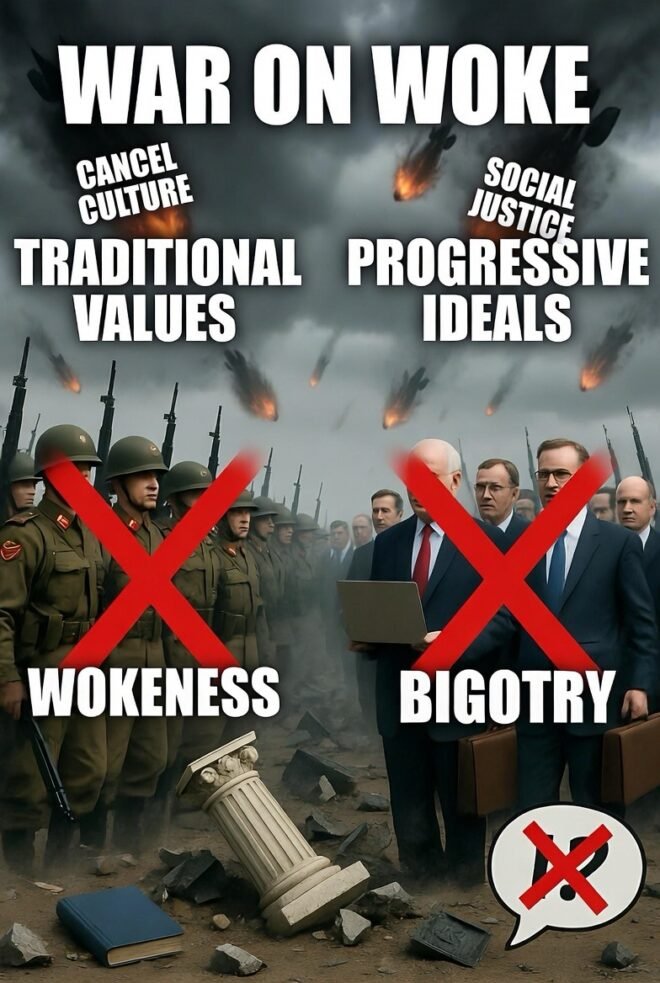
There is a peculiar irony at the heart of contemporary debates about “woke” politics in Australia. The word itself, borrowed from African American Vernacular English, originally signalled an alertness to racial injustice and systemic discrimination. Over time it expanded to include awareness of gender inequality, trans rights, Indigenous dispossession, refugee suffering, and other forms of marginalisation. But as the term travelled into mainstream discourse, it mutated. For many Australians today, “woke” is less an expression of solidarity and more an epithet: shorthand for performative activism, ideological policing, and cultural overreach. At the same time, a powerful anti?woke backlash has emerged. That backlash often frames wokeness as an attack on common sense and national identity, and in doing so it can become a thinly disguised war on the minorities whose rights and dignity the original movement sought to defend. This blog post unpacks that dynamic. It traces how wokeness evolved in Australia, examines the role of anti?woke media and politics in amplifying grievances, explores concrete examples where well?meaning reforms have provoked backlash, and considers what a healthier, less polarising path forward might look like.
To understand how we arrived here, it helps to recall the local roots of global movements. Black Lives Matter reverberated in Australia because Indigenous people face demonstrable and long?standing disadvantages: disproportionate incarceration rates, lower life expectancy, and ongoing fights over land and recognition. Similarly, the #MeToo movement illuminated sexual harassment in Australian workplaces and institutions. When Australian activists and institutions adopted the language of social justice, they did so within a multicultural nation where nearly a third of people were born overseas and where settler colonial history remains unresolved. Moments like the 2017 same?sex marriage debate and its eventual legalisation were victories that many would identify as “woke” wins because they expanded rights and visibility for marginalised communities.
Yet the promise and practice of wokeness in Australia have never been monolithic. For some, it remains a principled commitment to equality and an insistence on listening to lived experience. For others, especially in regional Australia and among older generations, it reads as an imposition by urban elites who are perceived to be imposing their values on the rest of the country. Polling shows this split: significant portions of the population either do not understand the term or see it in negative terms. That division is fertile ground for an anti?woke countermovement that can, and often does, redefine progressive reforms as threats to national cohesion and common sense.
The anti?woke backlash is not purely domestic. It exists within a transnational media and political ecosystem that borrows tropes, talking points, and rhetorical tactics from the United States, the United Kingdom, and beyond. In the U.S., cable news personalities and conservative podcasters framed “wokeness” as an existential threat to free speech and traditional values. In the UK, new outlets and broadcasters positioned themselves as defenders of ordinary people against metropolitan moralism. Australian media ecosystems have absorbed and localised many of these frames. Outlets and commentators that take an anti?woke line regularly portray progressive initiatives as expressions of elite virtue signalling, often conflating nuanced policy debates with cultural theatre.
Importantly, anti?woke media operates on a business model that rewards outrage. Social platforms amplify polarising content because it generates engagement; it attracts clicks, shares, and comments. Traditional media, chasing the same metrics, can adopt the same incentives. Stories that present culture wars as zero?sum battles do well in this environment because they produce clear villains and heroes and invite strong emotional responses. The result is that complex policy questions, about constitutional recognition, employment equity, or the content of school curricula, are reduced to dramatic contests about values and identity. In that reductive framing, minorities often end up being used as leverage in broader political fights rather than as citizens whose material disadvantages require careful public policy responses.
Concrete examples from recent Australian history show how this plays out. The 2023 referendum on an Indigenous Voice to Parliament was pitched by supporters as modest, practical constitutional recognition: an advisory body to ensure First Nations perspectives informed policy that affected their communities. Opponents framed the same measure as a divisive, elite?driven “woke” agenda that would privilege one group over another. That framing proved politically powerful. The Voice’s defeat was celebrated by many anti?woke commentators as a rebuke to progressive elites, but that victory came at a cost for the very communities the Voice aimed to help. After the referendum, conversations about closing the gap on health, education, and incarceration rates risked being pushed further down the agenda as “political” rather than urgent humanitarian imperatives.
Corporate responses to social issues illustrate a similar dynamic. When large Australian companies adopt diversity, equity, and inclusion (DEI) policies, support Indigenous art on planes, or endorse same?sex marriage, anti?woke critics often cast these moves as cynical “woke?washing” or as evidence that businesses are beholden to metropolitan elites. While some critiques of corporate inconsistency, such as firms supporting LGBTQ+ events while investing in industries that harm Indigenous land, are legitimate, the broader anti?woke narrative converts institutional attempts at inclusion into theatrical excess. The practical consequences are predictable: companies face boycotts or take a cautious retreat from overt social advocacy, and minority groups lose critical platforms and resources.
Education offers another flashpoint. Curriculum changes to better include Indigenous history or to address gender diversity have been attacked as ideological indoctrination rather than recognised as efforts to make schools safer and more inclusive for minority students. Opposition to such changes is often couched in the language of protecting children and preserving neutral, skills?based education – but the result is that teachers and schools can become reluctant to address issues that disproportionately affect vulnerable students, such as bullying of LGBTQ+ youth or the cultural dislocation felt by Indigenous children. That reticence is hardly neutral; it perpetuates harm.
To be clear, a sober critique of wokeness is not misplaced. There are legitimate concerns that certain manifestations of social justice activism can be performative, punitive, or counterproductive. When public discourse privileges symbolic gestures without delivering material change, when it resorts to shaming rather than persuading, or when ideologies become a test for social or professional belonging, those are real problems. Such tendencies can alienate potential allies and embolden opponents. Voices from within minority communities have also pointed to downsides. Some Indigenous commentators have criticised tokenistic recognition that lacks accompanying structural reform. Some conservative?leaning minorities worry that a single?story approach to identity flattens their experiences and encourages a victimhood narrative that they find unhelpful.
But here is the crucial distinction that often gets lost in heated debate: whatever the shortcomings of certain strands of wokeness might be, the anti?woke response frequently masquerades as a defence of neutral principles while actually undermining the wellbeing and rights of minorities. When opposition to inclusion is framed as a principled stand against “woke” excess, it can provide cover for policies and rhetoric that disproportionately harm those very groups. Calls to ban certain kinds of teaching about historical injustices, to outlaw DEI programs, or to dismiss calls for recognition can be presented as non?partisan coups against elite culture while in practice they erode protections and platforms for marginalised people.
Public rhetoric and the manner in which stories are reported matter. When mainstream and social media treat “woke” as an umbrella term for anything remotely progressive, whether it is anti?racist education, workplace diversity programs, or recognition of gender identity, the nuance of each initiative is lost. In a polarised media environment, the difference between symbolic recognition and policy reform collapses. Anti?woke narratives thrive by emphasising the symbolic and cultural, because symbols are easy to politicise and to mobilise around. The casualties in these fights are often real people: Indigenous elders who seek recognition and practical resources, trans young people whose access to healthcare and safe schooling becomes political fodder, refugees whose humanity is debated on talk shows rather than addressed at the border.
The effect on specific minorities in Australia is tangible. Indigenous Australians, for instance, have seen their modest proposals for enshrined advisory mechanisms dismissed as partisan and dangerous by opponents who label them “woke.” That dismissal does not address the practical problems of overcrowded housing, uneven access to health care, and disproportionate contact with the criminal justice system. Rather, it makes it harder to build the political consensus necessary for sustained reform. LGBTQ+ communities have won major legal and social victories yet debates around transgender rights and gendered spaces have produced a backlash that has increased hostility in some quarters, with real mental health consequences for vulnerable people. Immigrants and refugees find themselves at the centre of cultural narratives that conflate compassion with naivety and that blame multicultural policies for social and economic anxieties. Women and gender minorities who rely on affirmative policies to close pay gaps and ensure workplace safety find those policies dismissed as “woke nonsense” in public debate, risking reversal or dilution.
Anti?woke media plays a central role in shaping and amplifying these dynamics. Whether through opinion columns, prime?time segments, viral clips, or influencer feeds, media that consistently frames inclusion initiatives as elite impositions creates a feedback loop. Viewers and readers are fed a steady stream of stories that cast progressive reforms as frivolous or dangerous. Politicians, always sensitive to media narratives and electoral incentives, respond accordingly. When opposition leaders adopt anti?woke talking points, they turn cultural grievances into policy platforms. That is not always dishonest: many voters genuinely feel alienated by progressive rhetoric, and politicians can and should respond to those concerns. The problem arises when legitimate concerns are mixed with coded appeals to prejudice or when genuine policy debates are obscured by culture war theatrics.
Another complicating factor is transnational influence. Australian debates do not occur in a vacuum. Talking points, memes, and campaign strategies cross borders easily in the digital era. The US culture wars, the British debates about free speech and identity, and even disinformation campaigns from state actors have found local echoes in Australia. This cross?pollination can deepen polarisation, because arguments that worked elsewhere are repurposed without attention to local context and consequences. The globalisation of culture?war rhetoric also means that domestic policy discussions can be shaped by foreign narratives that serve other ends, from sowing discord to weakening public trust in institutions.
Given this tangled landscape, what can be done? First, we need to recover nuance. The conversation would benefit from distinguishing between Woke 1.0 – genuine efforts to address injustice through evidence, engagement, and institution?building – and Woke 2.0 – performative or punitive impulses that prioritise moral purity over practical outcomes. Emphasising the former and critically assessing the latter can help allies and critics find common ground. Second, media literacy is essential. Audiences should be encouraged to ask whether a story about a “woke” controversy is about a concrete policy affecting measurable outcomes, or whether it is primarily symbolic theatre amplified for clicks. Educators, civil society, and journalists share responsibility for restoring factual clarity to public debates.
Policy responses must be evidence?driven. If the aim is to strengthen social cohesion, fund programs that deliver concrete improvements in housing, health, education, and employment for disadvantaged communities rather than relying on symbolic gestures alone. Invest in community?led solutions that empower minorities to define and measure the success of reforms. Protect academic freedom and open inquiry in schools while ensuring that classroom materials are age?appropriate and pedagogically sound; both principles can coexist if policy is crafted thoughtfully rather than in reactionary bursts.
Finally, political leaders and media figures must resist the temptation to weaponise minorities as proxies in broader cultural fights. A politics that uses marginalised people as a moral battleground undermines the very fabric of a pluralist democracy. That requires media to reflect responsibly on the potential harms of their framing and politicians to weigh rhetoric against policy consequences. It also requires citizens to demand more from their leaders: not simply theatre, but sustained commitment to fairness and evidence.
At the end of the day, asking whether “woke” in Australia is a thinly disguised war on minorities depends on how the term is used. If wokeness is shorthand for a sincere, uncompromising pursuit of equity that honours evidence and lifts people materially, then it deserves engagement rather than derision. If, however, the anti?woke movement treats minorities as symbols to be manipulated in a broader appeal to grievance, then the backlash can and does function as a war on those same minorities, even when it is framed as a defence of neutrality or tradition. We must therefore be attentive to the difference between principled critique and cynical weaponisation.
Australia is at a crossroads. The debates we have now will shape whether our national story becomes more inclusive or more fractious. We can choose to preserve the dignity of those who have been marginalised by focusing on practical reforms and honest dialogue. Or we can allow cultural theatre and polarising media to drive policy choices that leave the most vulnerable worse off. To protect minorities and to advance the common good, the healthier path is clear: centre material change over symbolism, restore nuance over caricature, and ensure that media and political actors are held accountable for the consequences of how they frame and fight our public debates. Only then can the promise implied by being “woke” be realised without becoming a casualty of the backlash it has provoked.