
Introduction
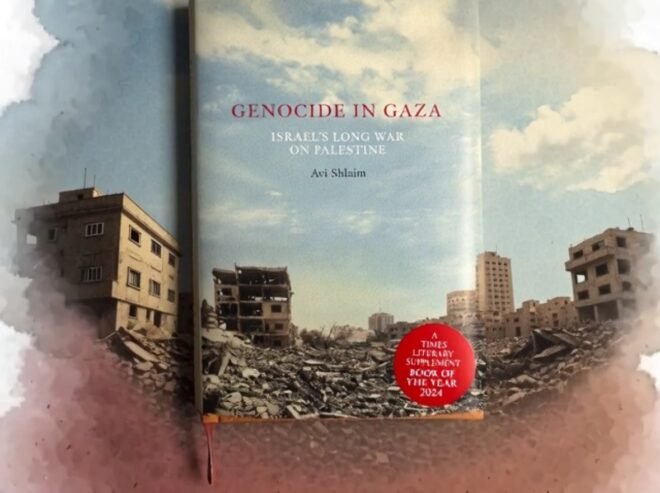
Avi Shlaim is one of the most prominent and provocative historians of the modern Middle East. Trained in the British and Israeli academic milieus and shaped by a personal history that spans Baghdad, Israel, and Britain, Shlaim has long been identified with the so-called “revisionist” school of Israeli historiography. His scholarship – from The Iron Wall to numerous essays and lectures – has reshaped how scholars and the public view Israel’s formation, strategy, and relations with its neighbours. His work is rigorously sourced, often polemical, and routinely attracts vigorous critique for perceived ideological bias.
In his latest contribution – presented and discussed here in the spirit of a wide, public-facing examination rather than an academic review – Shlaim places Israel’s policy toward Gaza in a long historical context. He frames the recurrent Israeli offensives against Gaza, culminating in the massive 2023–24 campaign that followed Hamas’s October 7 attack, as the logical outcome of a settler-colonial approach to Palestine. He and others use the language of “elimination,” “ethnic cleansing,” and even “genocide” to describe the cumulative effects and, they argue, the objectives of Israeli policy. These are weighty charges; they demand careful unpacking.
This blog post aims to translate Shlaim’s central claims into a sustained, accessible argument for a general audience while setting out the principal counterarguments, legal complexities, and diplomatic realities that surround one of the most contested debates of our time. The ambition is to present a thorough, balanced account that neither straightforwardly endorses nor reflexively rejects Shlaim’s thesis. Instead, it situates that thesis within history, doctrine, law, and politics so readers may better understand why such an allegation – genocide – is made, contested, and consequential.
1. Situating the Argument: Shlaim’s Perspective and Its Critics
Shlaim’s standing as a historian gives his claims weight. His family’s dislocation from Iraq, his academic career, and his critical reading of archives and political statements have left him predisposed to interrogate Israeli state practice, rhetoric, and strategy. In the new work under discussion, he treats the most recent Gaza offensive not as an isolated, disproportionate military campaign alone but as the apex of long-term structural processes rooted in the logic of settler colonialism.
Two clarifications are essential from the outset. First, charging a state with genocide is not merely polemical: it invokes an internationally codified crime defined by the 1948 Genocide Convention. That definition emphasises both actus reus (specific material acts) and mens rea (a specific intent to destroy, in whole or in part, a protected group). Second, Shlaim’s claim is not universally endorsed by scholars, legal experts, or governments. Many analysts see Israel’s actions as brutal and, in some instances, unlawful, but they draw sharp distinctions between war crimes, crimes against humanity, ethnic cleansing, and genocide – legal categories with different thresholds and consequences.
Criticism of Shlaim often follows two lines. Some reviewers accuse him of selective use of sources and of minimising Arab agency, violence, and anti-Jewish currents in the region. Others contend he obscures the existential fears and security constraints within which Israeli decision-makers operate. These critiques should temper but not automatically disqualify his conclusions; nor should they be allowed to dismiss out of hand the moral urgency that his book attempts to communicate.
2. A Brief Historical Framework: Gaza, Occupation, and Periodic Wars
To understand contemporary crises, a quick historical sketch is necessary.
• Pre-1948 and the creation of Israel: The late nineteenth and early twentieth centuries saw the rise of Zionism against the backdrop of European antisemitism and the crumbling Ottoman order. Jewish immigration to Palestine, land purchases, and demographic shifts set the stage for intercommunal tensions. The 1947 UN partition proposal and the subsequent 1948 war produced massive Palestinian displacement (the Nakba) and the creation of the State of Israel. These events continue to fuel mutual narratives of existential threat and injury.
• Occupation: The Six Day War of 1967 brought Gaza, the West Bank, East Jerusalem, and other territories under Israeli control. Settlements, military administration, and restrictions on movement marked the occupation era. International law and much of the international community regard these territories as occupied, with attendant legal obligations for the occupying power.
• The post 2005 reality in Gaza: Israel’s 2005 disengagement removed settlers and most permanent Israeli military presence from inside Gaza while leaving control over airspace, maritime access, and most entry points. Hamas’s 2006 electoral victory and 2007 takeover of Gaza’s institutions, coupled with rocket attacks against Israeli towns and a land and sea blockade, created a highly securitised environment. Gaza’s economy and infrastructure became increasingly dependent on aid and often vulnerable to full or partial sieges.
• Repeat cycles of warfare: From Operation Cast Lead (2008–09) through later operations (2012, 2014, 2021, and others) repeated large scale military offensives generated a steady death toll, widespread destruction, and recurring displacement. Each successive operation intensified Gaza’s humanitarian crisis while failing to resolve the political stalemate.
Shlaim sees these episodes not as episodic failures but as features of a system: policies that combine military coercion, economic marginalisation, and political exclusion to maintain long-term control over a territory and population while avoiding formal sovereignty or reintegration. Critics retort that Israel’s actions are defensive responses to terrorism and rocket attacks, framed by a security calculus that is often grim, costly, and imperfect.
3. The Doctrine of “Mowing the Lawn”
One of the most chilling metaphors commonly invoked in debates about Israel’s Gaza policy is “mowing the lawn.” Military planners and commentators have used the phrase to describe periodic operations intended to degrade militant capabilities without attempting comprehensive political resolution. The metaphor captures an operational logic: conduct a heavy operation; wait for insurgent capabilities to regenerate; repeat as necessary.
For Shlaim and others, “mowing the lawn” reveals cynical instrumentalization of violence. If the state tacitly accepts a recurring cycle of destruction and civilian suffering as the manageable price of containment, then policy cannot be read merely as reactive. The doctrine, so the critique runs, institutionalises a mode of governance over an impoverished, contained population that normalises harm.
Defenders of the practice argue that the alternatives are worse: a permanent reoccupation of Gaza would be costlier in blood and resources; dismantling Hamas entirely would require protracted counterinsurgency operations with high casualties; and diplomatic solutions have repeatedly faltered. From this perspective, episodic high-intensity campaigns, accompanied by efforts to warn civilians and minimise collateral damage, are an unfortunate but necessary tool to prevent even worse outcomes for Israeli civilians.
Both sides raise important moral and legal questions. Does a strategic doctrine that expects and accepts recurrent large scale civilian suffering meet the standards of international humanitarian law and human rights obligations? Can military necessity ever justify policies that foreseeably produce mass civilian harm when political alternatives remain unpursued?
4. Zionism and the Settler – Colonial Framework
A significant part of Shlaim’s thesis is an interpretive claim about the nature of Zionism and its implementation: namely, that Zionism in practice has exhibited core features of settler colonialism. Settler colonialism, distinct from classical colonialism, aims at replacing or displacing the indigenous population and remaking space rather than simply extracting resources.
Proponents of this framing point to several historical patterns:
• Land purchases and legal mechanisms that marginalised or dispossessed Palestinian peasants.
• The creation of distinct Jewish legal and civic institutions and zoning that prioritised Jewish settlement.
• The violence and expulsions accompanying Israel’s founding war.
• The continued expansion of settlements and military control in occupied territories.
Framing Zionism as settler colonialism is analytically powerful for scholars who want to connect patterns of dispossession and structural domination across colonial contexts. It reframes the Israeli-Palestinian conflict away from symmetrical nationalisms toward asymmetries of power, control, and dispossession.
Opponents reject the analogy. They emphasise Jewish historical connection to the land, the moral imperative of Jewish self-determination after centuries of persecution, and the fact that many early Zionist leaders sought coexistence through legal purchase and negotiated solutions. Some argue that the dynamics differ fundamentally from settler colonial cases such as North America or Australia, where colonisers came from contiguous imperial centres with no indigenous claims to national self-determination. For them, the struggle is better understood as competing nationalisms, territorial disputes, and security dilemmas rather than a classic settler project aimed at erasure.
This debate matters because it shapes how one interprets policy, motive, and the legal framework applicable to state conduct. If the settler-colonial frame is accepted, then practices of exclusion, periodic violence, and demographic manipulation become elements of a broader structural project; if rejected, they must be adjudicated case-by-case as security decisions with potential for criminality but without an ideological program of elimination.
5. Ethnic Cleansing, Crimes Against Humanity, and Genocide: Legal and Moral Distinctions
The legal terms “ethnic cleansing,” “crimes against humanity,” and “genocide” occupy different registers. Ethnic cleansing is a descriptive term–no single codified legal definition exists in a treaty–often used to describe forcible displacement and demographic engineering. Crimes against humanity, by contrast, are codified: widespread or systematic attacks against a civilian population, when committed as part of a policy. Genocide is the gravest of these crimes under international law: it requires not only certain material acts (killing, causing serious bodily or mental harm, deliberately inflicting conditions of life calculated to bring about the group’s physical destruction, and more) but also the specific intent (dolus specialis) to destroy, in whole or in part, a national, ethnic, racial, or religious group.
When scholars and human rights organisations use the term “genocide” with respect to Gaza and Israeli policy, they are asserting two things: (1) that Israeli acts meet one or more of the enumerated material elements; and (2) that Israeli policy was driven by an intention to eliminate Palestinians as a group, or a subset of them. Proving intent is exceedingly difficult in legal terms. It usually requires demonstrable patterns, official statements, and documentary evidence that indicate a policy goal of destruction. The presence of statements dehumanising Palestinians, policies that foreseeably produce mass death, and systemic practices of dispossession can be used to argue for the inference of intent – though evidentiary standards before courts such as the International Court of Justice (ICJ) or the International Criminal Court (ICC) remain exacting.
Many human rights organisations have argued that Israel’s operations in recent decades, and particularly the massive campaigns in Gaza, satisfy at least the material elements of grave crimes and may plausibly meet the threshold for crimes against humanity. Some have gone further and argued that the accumulated pattern, combined with rhetoric and blockades that render basic survival precarious, point toward genocidal intent or at least a foreseeable risk of genocidal outcomes.
States and legal scholars defending Israel resist the genocide label on several grounds:
• Stated military objectives are often framed as targeting Hamas and other armed groups, not Palestinians as a people.
• Israel has undertaken measures it characterises as attempts to spare civilians, including warnings and so-called “roof knocking” and temporary evacuation corridors (though the effectiveness and legality of such measures are contested).
• The genocide label is highly politicised, they argue, and using it without incontrovertible evidence risks trivialising the term and conflating distinct categories of international crimes.
This is more than technical hair-splitting. The difference between crimes against humanity and genocide is not merely semantic: it affects the nature of international responsibilities, the rhetoric applied by diplomacy and advocacy, and the moral weight borne by the international community.
6. Evidence and Counter – evidence: What Is At Stake
Those who accuse Israel of genocidal conduct point to a constellation of facts and behaviours:
• High civilian death tolls in densely populated zones, often from large aerial and artillery strikes.
• Destruction of infrastructure, including hospitals, water and sanitation systems, and shelters, sometimes leading to secondary deaths from disease and starvation.
• Policies that severely restrict the flow of food, medicine, fuel, and reconstruction materials.
• Public statements by officials that dehumanise Palestinians or advocate extreme measures.
• A historical pattern of dispossession stretching back to 1948.
Those who reject the genocide accusation emphasise different facts:
• Israel’s stated military aims, framed as destroying or debilitating terrorist organisations responsible for attacks on Israeli civilians.
• A record of attempts to minimise civilian casualties through targeting protocols, warning systems, and legal justifications grounded in the right to self-defense.
• The role of Hamas in embedding military assets within civilian infrastructure and using human shields – a fact which complicates precision warfare in densely populated territories.
• Diplomatic and legal actions taken by Israel to contest and litigate allegations, including before international courts.
Independent verification of all claims, casualty counts, the provenance of specific strikes, the presence of military assets in civilian structures, the intent behind policy decisions, is extraordinarily difficult in active conflict zones. That difficulty is precisely why impartial, transparent investigations are so essential, and why much of the public discussion remains contested.
7. The International Community: Responses, Limitations, and Politics
The international machinery created to address mass atrocities is political as well as legal. The UN system, regional organisations, and individual states often reach different conclusions based on political alliances, evidentiary access, and strategic interests.
• Fact finding missions, special rapporteurs, and NGOs can and do produce detailed reports that catalogue abuses and argue for legal characterisations. Their findings can be influential in shaping global opinion and in providing evidence for international prosecutions.
• States, and powerful allies, may be reluctant to endorse certain legal labels for geopolitical reasons. Veto politics in the UN Security Council, strategic partnerships, and domestic political considerations all temper the range of international action.
• Legal proceedings before international courts are slow and require high evidentiary standards. Political pressure, however, can lead to interim measures and heightened scrutiny even before a final legal determination.
Shlaim and others argue that political protection and strategic prioritisation have permitted policies that would otherwise attract international sanction. Critics of Shlaim counter that selective application of legal labels often reflects a politicised international order, and that singling out Israel obscures other mass atrocities and may themselves be used in partisan ways.
8. Ethical and Political Implications: Where to Go from Here?
Whether or not one accepts the genocide thesis, several practical and ethical obligations are clear:
• Humanitarian protection must be paramount. Civilians bear the brunt of modern asymmetric warfare; ensuring access to food, water, medicine, and shelter is a legal and moral duty.
• Impartial investigations are essential. Independent, transparent fact finding can narrow disputes over the facts and provide a basis for accountability where laws have been broken.
• Political solutions are indispensable. Military operations cannot produce lasting peace. Negotiated settlements that address security, sovereignty, rights, and dignity remain the only durable route to resolution, even if political conditions for them are currently distant.
• International legal norms must be applied consistently. The credibility of international law depends on even-handedness and political will to pursue accountability without double standards.
• Dialogue across divides, however fraught, is necessary to reconstruct the minimal trust required for negotiations and for any durable political settlement.
9. Assessing Shlaim: Strengths and Limits
Shlaim’s work has strengths that warrant serious attention. His archival sensibility, his capacity to synthesise political rhetoric with military practice, and his insistence on historicising contemporary violence push readers beyond immediate emotive reactions to structural analysis. He forces uncomfortable but necessary questions: what is the cumulative effect of repeated military campaigns on a civilian population; how do policies of control and containment intersect with broader political goals; when does security policy morph into systematic dispossession?
Yet his thesis also encounters limits. Converting a complex, multifaceted set of policies and actions into a single, long-term, intentional project of physical elimination risks compressing nuance and obscuring other causal factors: agency among Palestinian political actors, regional geopolitics, the legacy of wars across the Arab world, and the contingency of political decision-making under fear and threat. Moreover, demonstrating genocidal intent in legal terms remains exceptionally difficult and should not be asserted lightly.
Conclusion
Avi Shlaim’s argument, that Israel’s policy toward Gaza is best understood through the twin lenses of settler colonialism and a logic of elimination culminating in allegations of genocide, forces a serious public reckoning. Whether readers ultimately accept his conclusions depends on how they weigh cumulative evidence, interpret motive, and adjudicate competing narratives of security and dispossession.
What is indisputable is that the human cost has been staggering. Civilians on all sides have suffered enormously, and the prospects for lasting peace remain dim without major shifts in policy, accountability, and international engagement. The debate over terms, genocide, ethnic cleansing, crimes against humanity, matters not only legally but morally, because the labels we use shape the obligations we accept and the remedies we pursue.
For readers and citizens, the ethical imperative is to insist on independent investigations, humanitarian access, and urgent political diplomacy while resisting simplifications that obscure both victims’ suffering and the complexity of causes. Holding all parties to the standards of international law, pressing for evidence-based accountability, and pursuing an equitable political settlement remain the only realistic ways to transform cycles of violence into possibilities for justice and coexistence.
In the end, Shlaim’s work performs an important public service by bringing these issues into sustained, historically informed debate. Whether one agrees or not, the questions it raises about intent, structure, and responsibility should not be dismissed: they require careful, sober, and sustained attention from scholars, policymakers, and engaged citizens alike.