
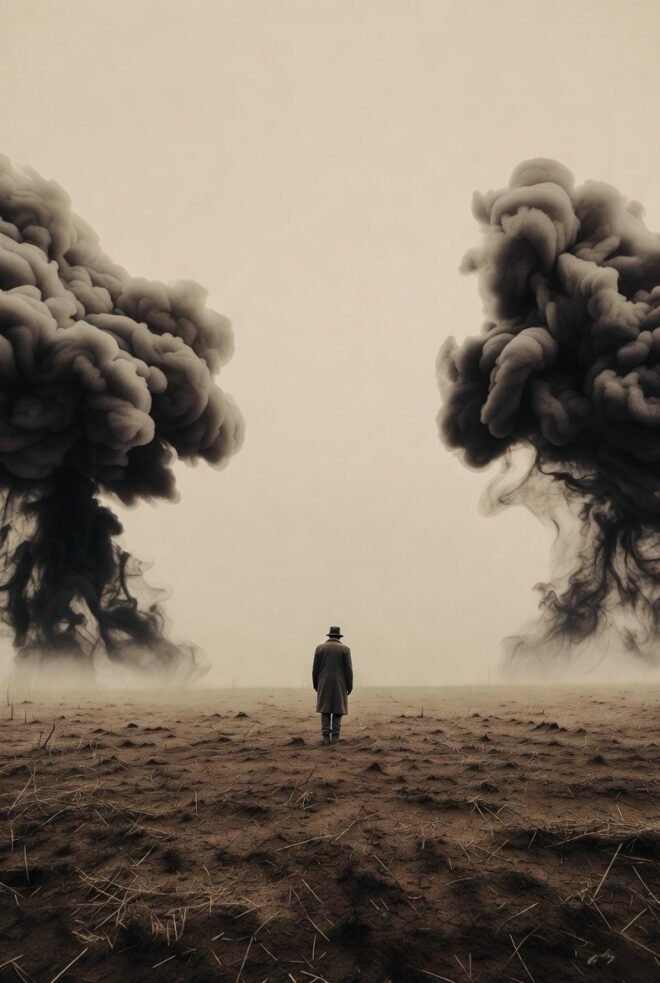
I often write reflections here, but today I offer something different – a lyrical composition meant to be read aloud, breathed in, and carried with you. It is a song for those who pause and wonder at the slender thread between what came before and what comes after: a life that glitters for an instant, bookended by nothingness. Read it as a hymn, a meditation, a call to dissolve walls and hold hands in the dark.
Between Two Nothings
(For the wanderer, the builder, the lover, the stranger)
Prelude – The Quiet Before
Before the first inhalation, before the name was given,
there was a vastness without edges, a hush without shape.
No heartbeat rehearsed its opening drum. No footfall pressed the dust.
There was only the slow, indifferent swell of the unmeasured,
an ocean of silence whose surface never remembered ripples.
You were not yet a story; you were not yet a sorrow nor a song.
You were a blank horizon, an unopened eye, the promise of possibility
nestled in the indifference of infinite nights.
And when the last breath unthreads,
when neurones quiet like lanterns whose oil has dwindled,
there will again be that same patient expanse,
the same dark ledger that keeps no tally of who laughed or who wept.
All that remains of you will be the afterglow in other bodies,
the soft pressure of a hand in a memory, the echo of a laugh in someone’s chest.
Then the ledger will close, the ocean will forget the ripple,
and the silence will take back what was borrowed.
This is not doom. This is the frame that makes the painting urgent,
the hush that lets music finally mean something.
We are born into a pause and released into the same pause.
Between them, we sparkle only for a breath – an eye-blink, or less.
Chorus – The Blink
We are but a blink between two nothings,
a single flare that sketches a face against the dark.
We come from nowhere and go where the stars keep their secrets,
and in the small brightness we are given, we must learn to light other candles.
Not to hoard heat, not to mark the world with our names,
but to warm hands and let our embers pass from palm to palm,
so that though the fire dies, its kindness lives in another’s night.
Verse I – Scaffolds of Bone
Look at your hands: scaffolds of bone and soft insistence,
clever instruments, mortal maps that bowl with effort and ache.
They will harden and loosen and return to the dust that made them.
All our certainties are built on this temporary scaffold;
we say “forever” with the voice of those who have yet to count the seasons.
We crown ourselves with titles and hand our judgments like swords.
But the sky does not bend to our crowns. The soil will not be bribed.
How strange to practice cruelty with something so fragile in our fingers,
to believe that a scaffold can command the weather.
Remember: the bones are temporary scaffolding,
the name written on a ledger that will be burned.
What remains, if anything, is the way we used the hands —
the bridges we built, the loaves we broke, the wounds we tended.
Othering is a brittle beam propping an empty throne.
Hate is a hammer that splits the plank of our own house.
Do you wish to spend the brief light smashing the walls you live inside,
or to open them and let the whole world breathe?
Refrain – Do Not Hoard the Sun
Do not hoard the sun as one hoards coins,
do not stitch your doorways with spikes of contempt.
What profit in standing on a mound of cold stones?
The tide will erase your footprints; the gulls will ignore your flags.
If you must build, build with wood and laughter,
build a house whose threshold welcomes the tired,
whose roof hums with the quiet songs of many mouths.
Let your legacy be this: a long echo of small mercies,
the soft architecture of remembered compassion.
Verse II – Vanity and Toil
We toil for myths – empires of our own invention,
as if the grindstone could polish us into immortality.
Our calendars crowd with debts unpaid in the currency of tenderness.
We chase titles like migrating birds that never taste the sea.
Vanity persuades us the stage is all that matters,
and that other faces are props that enhance our role.
Men and women re-centred become smaller than they were,
for a spotlight can flatten the heart into a coin and call it true.
But vanity is no purifier of sorrow.
It cannot freeze the rot of regret or stitch a wound into a crown.
The tyrant’s marble will eventually crack and tumble;
the scholar’s ink will fade to blurs that birds cannot read.
What remains is not ledger nor monument but the whisper left in someone’s ears:
“I was seen. I was loved. I was not invisible.”
If life is an eye-blink, then spend it making bright that neighbour’s blink,
not burying them beneath your shadow to make yours seem taller.
Bridge – The Folly of Othering
Othering is a small grave dug in the centre of your garden,
a place where you bury names that don’t match yours.
You plant suspicion like winter seeds and expect spring.
You call differences faults, unfamiliar accents sins,
and build fences in the mud because mud looks solid when night falls.
But all of us are made of the same dust, the same starlit ash.
We carry the same hunger in our bellies, the same grief in our chests,
the same childlike longing to be noticed before we vanish.
Consider: in the thin ledger of your life, how many pages are devoted to contempt?
How much ink is spent proving someone other when you could write kindness instead?
The smallest kindness dissolves the border; the smallest cruelty hardens it.
Let your ledger fill with bridges. Let your hands be known for mending,
not for marking who is worthy and who is not.
Interlude – A Child on the Shore
Imagine a child on the shore building towers of wet sand,
laughing as waves erase yesterday’s perfection without rancour.
The child does not mourn the loss with malice but with a readiness for renewal.
Neighbours join, then strangers; buckets pass, conversation rises.
No one claims the sand as eternal, and so everyone plays.
This is wisdom: to act without the illusion of permanence,
to give freely because the tide will have its way regardless.
Be a child in the face of your briefness. Learn to rebuild with others.
Your joy shall be the only true monument.
Verse III – Bitter Worse Than Death
There is a bitterness worse than death: the bitterness of a life spent in hardness.
To be bound by resentment is to pinch out your own warmth.
Death ends the body’s quarrels; bitterness multiplies them across the years.
It turns small grievances into siegeworks that block the morning sun.
When hatred becomes a practice, it teaches children to be small,
to measure souls by the breadth of their malice, not by the grace of their touch.
But bitterness can be transmuted.
All alchemies begin with an opening: confession, hand reached out, apology given.
A wounded heart can become a wellspring if tended.
We can choose to let sorrow teach sympathy rather than fortify disdain.
We can hold our losses like porous stones that polish other palms,
and find in mutual vulnerability a strange and lasting joy.
Chorus – The Blink Renewed
We are a blink between two nothings, yes,
but in that flash is a universe of possible mercies.
One breath, two breaths: our currency is brief and precise.
Spend it on love, on remembering the frailty in every face.
Be a coin that buys bread for strangers, a lantern passed in storm,
so that when the eye closes at last, some heart will keep the ember warm.
Verse IV – The Web of Small Actions
Do not expect thunder to change the world alone.
Communities are rewoven by a thousand quiet hands.
Visit an elder. Bring soup to a neighbour. Teach a child to read.
Speak kindly to the clerk. Forgive the driver who cut you off.
These are not insignificant acts; they are the stitchwork of civilisations.
Each small grace accumulates like snow until avalanches of mercy reshape the slopes.
A single book read aloud in a dusty room may alter a future no census can predict.
A small apology can break a century of hostility.
We are not required to fix all wrongs.
We are required to be present where presence matters,
to be rigorous in compassion and lavish with it like sunlight.
These small acts are how we make our transient days resonate longer
in the bodies and memories of others – the only kind of long anyone can claim.
Verse V – Science and Spirit
Look at the atoms that compose you: ancient travellers stolen from the bones of long-dead stars.
Think of the sea whose salt is memory, think of the mountain whose stone remembers winds.
Science tells us the same story as so much prayer: we are ephemeral arrangements of long histories.
Our cells will die; our molecules will move on to new shapes.
The same universe that swallowed our ancestors will shape our children.
This fact is not a verdict against meaning; it is an invitation.
If everything returns to the same ocean, then the only differences we make must be of light,
not of substance. Shine kindly, for light carries. Shine generously, for light multiplies.
The certainty of nothingness need not terrify us into apathy.
It may galvanise us into tenderness, for tenderness is a practical rebellion
against the cold logic of solitude.
Refrain – The Practical Rebellion
Tenderness is a practical rebellion.
It is an act of defiance against the indifferent dark.
When you give up a seat, when you share a story, when you heal a wound,
you are signalling that something matters here besides the ledger of profit.
You proclaim that the blink is worth more than despair.
You make a small, stubborn world in which strangers become kin.
Verse VI – Music, Memory, and Immortality
What lasts is not the marble but the music.
Poets tremble with the knowledge that a single line can change a heart.
Songs travel across generations uninvited and are welcomed.
A lullaby hummed in a cold room may warm a lineage.
We are made immortal by echoes: the way we loved, the way we forgave,
the way we taught others to stand and to sing.
So compose your small tunes carefully.
Teach compassion like a hymn. Sew wisdom into children’s play.
Plant stories in the ears of those who will carry them forward.
When the ledger closes, no ledger-keeper will ask for your trophies.
They will ask if you were kind, if you noticed the stranger tremble,
if you made room at the table for someone who had been left out.
Bridge II – The Global Hourglass
Think now of humanity as a single hourglass,
grains passing from the wide bulb of before into the narrow throat of our temporal now,
then spilling into the bulb of after where the pale light waits.
We are piles of those grains, each one unique in shape and sheen.
We do not fall alone; our descents touch the neighbours’ fall.
Cracks in one bulb affect the flow of all. What happens to the face in one hour
reverberates across continents, for commerce, disease, and compassion alike
ignore the lines men draw on maps.
This makes our actions grave and necessary.
If we wall the hourglass with suspicion, the flow jams and then breaks.
If we oil it with kindness, the glass ticks smoothly,
and more song will fit into the span allotted.
Verse VII – The Wisdom of Ancestors
Hear the ancestors speak – not the loud generals, but the small voices:
the grandmother who told a child how to knit peace from scraps,
the farmer who shared seed in a lean year, the teacher who kept after school for a single troubled boy.
They do not seek marble; they seek breathing room for the next one to learn.
We are indebted to them. We owe them a life that repays patience with courage.
Build not monuments to your vanity but networks to bear the next winter.
There is nobility in daily fidelity, in showing up, in laying one brick of benevolence after another.
Verse VIII – The Limping Saints and the Quiet Heroes
Let me tell you about the limp that saved a neighbourhood:
a woman with a twisted ankle who still walked door to door,
checking lamps, coaxing frightened children outside to play.
She could not stop the war, could not elect a leader, could not sign a treaty.
But she taught a nation how to breathe next to its neighbour again.
We lionise the big rescues, yet a dozen small saints reknit the world.
When you feel useless, remember this: the smallest repair is an act of cosmic scale.
You do not need to move mountains to be remembered; you need to move one pebble
and make a path for someone who follows.
Chorus – The Blink, Affirmed
We are a blink between two nothings, and that is our license.
We are allowed to be bright for a second and then dissolve.
Be bold in that shortness: repair, sing, stitch, forgive.
These are the currencies of meaningfulness in a market of empty crowns.
Make your small ledger full of lives touched, not trophies hoarded.
Turn your blink into a kindness that outlasts sorrow.
Verse IX – Confronting Hatred
When hatred knocks like a beggar at your gate, look upon its face with suspicion,
then remember your own fragility and answer with policy and grace.
Set boundaries where harm is real, but do not build citadels of contempt.
Teach your children to ask questions and to listen to answers uncomfortable.
Educate not to win but to widen. Empathy is learned in practice,
not inherited by default. Confronting hatred is a patient labour:
you unmask patterns, you restitch narratives, you create safe spaces for truth.
There will always be those who choose bitterness as identity.
You cannot make every heart tender, but you can stop teaching contempt.
Do not let the loudest clamour define the quiet majority.
Naming evil is necessary; reducing it to caricature is not.
You fight it with cunning and compassion, law and love,
coercion where safety demands, education where ignorance reigns.
Verse X – The Mirror and the Other
Look into the mirror and see not just your face but everyone you have met.
Each person is a version of you altered by geography and grammar.
When you see the refugee in the news, see the child you once were,
shivering in the dark, wanting only a warm blanket and a spoken name.
When you meet the stranger who cancels your plan, imagine the day’s burdens
that pried them loose like a nail. Practice the imaginative muscle of mercy.
Once you have rehabilitated your empathy, you will carry fewer stones.
Verse XI – Rituals of Remembering
Create rituals that remind you of your smallness and your power.
Pause for a minute each dawn to acknowledge the ocean of before,
then each dusk to hand back to the ocean what you cannot keep.
Host small ceremonies in which apologies are offered like bread.
Plant trees for people you love and for those you never met.
Let the saplings become the physical grammar of your legacy.
When the sapling shades someone in fifty years, you will have made an argument
against the tyranny of the brief by the simple grammar of shelter.
Coda – The Quiet After
When the last synapse fades, do not fear the returning dark.
You have been part of a brief apology from the universe: a little light borrowed.
If you have spent it well – mending rather than maiming, inviting rather than isolating —
then the after will be less a blank erasure and more a ledger of whispers:
songs hummed by children you will never meet, gardens tended by hands grown old,
a phrase that has slipped again into use because someone taught it at a table.
You become warmth in other bodies. Your blink becomes a pattern in the fabric,
a seam others learn to follow.
Final Refrain – Leave Light, Not Ruins
So leave light, not ruins. Leave stitches, not scars.
Make the short bright of your life a scaffold for laughter, not a fortress of spite.
Othering will never build a home where the heart can sleep well.
Compassion will build a village that survives the storms.
We are a blink between two nothings; let that knowledge make us merciful,
not desolate. Let it make us daring in our tenderness.
If all that remains of you is the memory of a touch, make it a kind one.
If all that remains is a single sentence told of you in a kitchen,
let that sentence be about how you made room at the table.
Epilogue – A Wish
I offer this song not as sermon but as companionable counsel:
we are brief, yes – this is not tragic but clarifying.
May you hear the old poet under the sun, may you learn the child on the shore,
may you practice the small mercies that make life’s blink into an echo that matters.
If you liked this, carry it forward; pass the text along, not to amplify my name,
but to widen the chain of light. In the end there is nothingness again:
let us spend the intervening breath drawing maps of kindness so that the next who arrives
may find a world that remembers how to be tender.
by Bakchos


Bakchos, this is a very underrated poem, it’s got a lot of power and meaning.