
Ngaya bamal.
Sun rides high – warami, old people,
the barray (land) shimmers
as cicadas cry out their heat song.
By the ngurra (camp),
we weave,
fish for garara (mullet),
burra (children) run beside the gum,
cool in the shade –
warami, barray, as always.
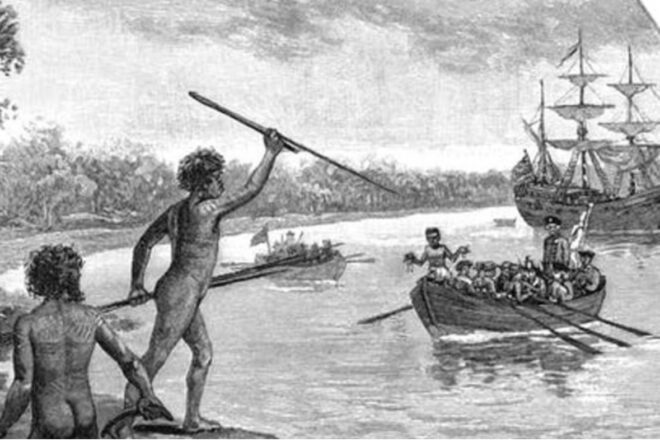
Then the sea grows restless.
Shapes on the ngura (water)
big and sharp, white as yamay (clouds),
not whale, not canoe,
not remembered by river or Sky Father.
We crouch behind rocks,
old people holding burra close,
our hearts jumping like garradja (kangaroo).
White-faced men
in heavy, shining ngurunga (clothing),
not possum skin nor wallaby –
wrapping their skin in strangeness,
walking as if they own barray,
loud voices crashing.
Doongal (confusion) swirls;
are they ghosts from old story?
Garrigarang (sea) and ngurra (earth) do not welcome,
the air is tight with never-before.
We keep to shadow,
speak low –
Ngaya bamal? Who are these ones?
Why no song, no ochre on skin,
no word to Country before they drink,
no gift to the spirits?
Do they know guray (law)?
Do they see buluwang (important places)?
They point,
they gather wood selfishly,
no glance for Daramu (trees),
no sign for Biyal (sky).
Fish sense strangeness –
garara hide deep,
birds watch, silent on high branches.
Even the wind,
nhamarra (friend), is unsure.
We take the story home,
speak to winangadyi (elders),
words like dhiyara (ashes):
Ghosts? Lost? Trouble?
Our tongues twist around new threats.
We sit around the fire,
eyes wide in the orange burn –
the dreaming feels thinned,
even the night creaks different.
But mother holds burra close,
old ones sing soft into darkness –
telling Country we remember,
telling ancestors we watch.
Ngaya Gadigal.
We belong to Warrane.
No storm, no strangeness
can break our song,
carrying us forward
as stars paddle the night.
by Bakchos



Another of your poems came up on X. This has transported me back in time to the arrival of the First Fleet at Sydney Cove. I can smell the ocean, I can hear the people, confusion on both sides. Another very evocative poem, thank you.
Thanks Aurora for your kind and positive feedback.
Mum said that you were a gifted poet when you were younger, and you still are. This poem has power and pathos, and memory, and beginnings and endings. The end of one form of existence for the Indigenous peoples and the convicts, and new beginnings for both.
Imagine waking up one morning and seeing something, multiple somethings, that you haven’t seen before, arrive and change your lives forever. I think it’s something that we can’t really comprehend today, it would be like aliens arriving from out of space and claiming earth simply because they have superior technology.
An evocative poem Mr Bakchos, it transported back to that first encounter between old and new, it certainly achieved its intended purpose.