
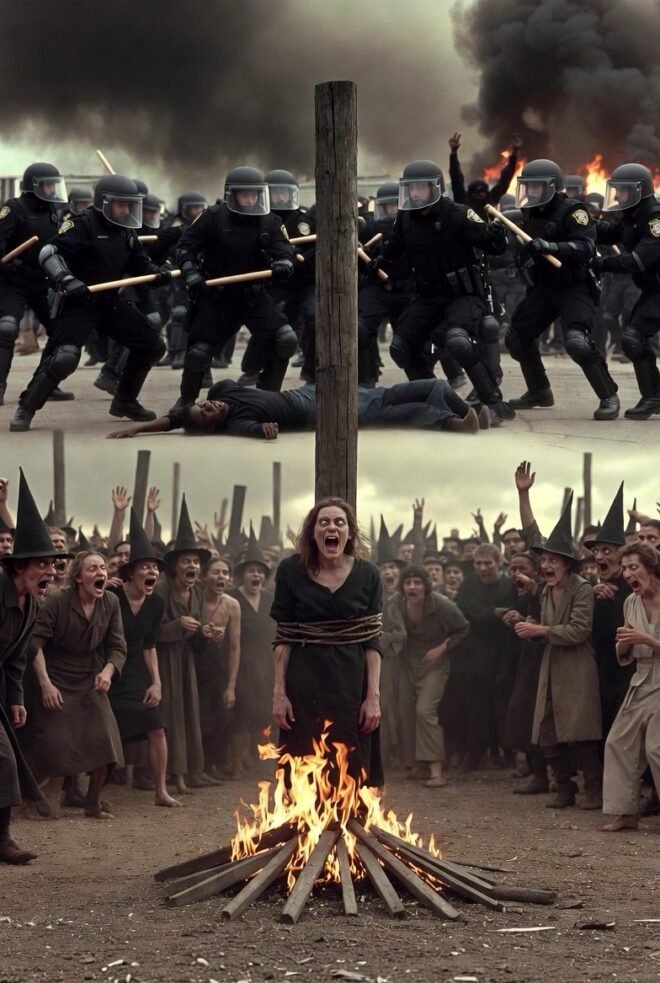
I have spent the majority of my life as an advocate for human rights – from living at the Aboriginal Tent Embassy and standing with Indigenous communities to working alongside people who are homeless in and around Sydney. I have used my blog and social media accounts to promote human rights, peace, harmony and respect for all humans. For that work I have received a great deal of abuse; I count the hostility as a sign that some progress has been made. The following essay does not seek to prescribe remedies. It seeks only to examine, in detail and with historical perspective, how societies manufacture scapegoats, how those processes persist in modern Australia, and how the echoes of early persecutions resonate in contemporary stereotypes and political narratives.
From Witch Hunts to Modern Labels: A Continuity of Scapegoating
The metaphor of the witch hunt is more than rhetorical flourish. The persecutions that swept across early modern Europe did not arise from isolated superstition; they emerged from social anxieties, economic stress, communal rivalries and legal systems that readily accepted testimony grounded in fear and rumour. Those same dynamics – fear, rumour, institutional complicity and opportunistic leadership – endure in modern forms. Where once a woman might be accused of witchcraft for being different, today entire communities can be reduced to single, damning labels: “Muslim,” “refugee,” “Aborigine,” “free thinker.” These labels, when wielded by political actors, media outlets, and rumour networks, perform the same social work as accusations of witchcraft: they mark difference as danger, legitimate exclusionary policies, and mobilise collective hostility.
The case of Anna Schmieg, executed in 1676 in Langenburg, is a stark illustration of how communal anxieties are converted into legal violence. Schmieg, a miller’s wife, was accused of poisoning a child by infusing a cake with malevolent powers. The sequence of events that led to her conviction – reputational stigma, a suspicious death, a judicial investigation that pivoted to seeking proof of occult causation, and the extraction of a confession under duress – is depressingly familiar. The judicial culture of the time permitted, even encouraged, the translation of private grievances into public prosecutions predicated upon fear. Notably, however, some jurists and intellectuals of the era – university scholars in Altdorf and Strasburg – voiced reservations regarding the legality and morality of such trials. Their dissent, limited though it was, pointed toward a recognition that public order and justice might be betrayed by unexamined collective panic.
That episode offers a template for reading modern Australia. The mechanics are similar even when the accuser’s language has changed. Popular anxieties are reframed by media narratives and political rhetoric; legal and policing responses are justified as essential to public order; communities identified as “other” receive heightened scrutiny and punishment. The parallel is not exact – we no longer assemble to burn supposed witches – but the social logic is continuous: minority status or cultural difference becomes the emblem of social danger.
Historical Roots: Policies, Practices and a Legacy of Exclusion
To grasp the contemporary landscape, it is necessary to situate Australian attitudes within their historical trajectory. From the moment of colonisation, Indigenous Australians were subjected to dispossession, cultural denigration and legal frameworks premised on exclusion. The White Australia policy, embodied in the Immigration Restriction Act of 1901 and sustained by mechanisms such as dictation tests into the mid-twentieth century, institutionalised racial preference and exclusion for decades. Although the architecture of overt legal exclusion began to be dismantled in the 1960s and 1970s – with reforms in 1966 allowing non-Europeans to become citizens after five years of residency and later the formal abandonment of racially discriminatory immigration policies – the cultural and institutional residue of those policies persisted.
Concrete statistics point to that persistence. Indigenous Australians now constitute roughly 4% of the national population yet make up approximately 37% of the prisoner population – a stark and incontrovertible index of systemic inequality rather than individual culpability. Similarly, demographic manipulations under earlier immigration regimes produced profound reductions in non-European populations; by 1947 the non-European presence in Australia had fallen to 0.21 percent, a dramatic contraction that shaped national self-perception and entitlement. Those historical policies did not simply disappear with the stroke of a legislative pen; they become embedded in political culture, in the assumptions of journalists, in institutional practices of policing, welfare, and education.
Multiculturalism, announced as policy in the 1970s and intended to mark a new chapter of inclusion, frequently became a surface-level celebration of culinary diversity and festival visibility rather than a structural commitment to equality. The rhetorical celebration of diversity often coexisted with practices that maintained inequity: token representation in leadership roles, compartmentalisation of cultural recognition into sanctioned times and places, and the continuing cultural code that equated Australianness with a narrow set of historical and racial markers. Thus multiculturalism’s promise often remained unrealized in the lives of those who bore the brunt of social exclusion.
Contemporary Flashpoints: Cronulla, Sydney and the Language of Violence
Modern Australia has witnessed public episodes that expose the durability of these tensions. The Cronulla riots of December 2005 are a chilling modern analogue to earlier communal expulsions. A mass of some 5,000 mostly Anglo-Australians gathered to “reclaim” a beach perceived as being dominated by Middle Eastern communities. That gathering, catalysed by localised incidents and expanded through mobile phone messaging and sensationalist coverage, devolved into racialised violence. Slogans and graffiti – “We grew here, you flew here,” “100% Aussie Pride” – condensed a narrative of belonging defined against the foreign. Dozens were injured, over one hundred arrested, and the event occasioned legislative responses and increased policing powers couched in the language of public safety. The riots illuminated how quickly community grievances, amplified by inflammatory media framing and political silence or denial, can metastasise into collective aggression.
A later instance, the Sydney protests of 2012 that began on September 15 in response to the crude anti-Islamic film Innocence of Muslims, similarly revealed the tightrope walk between democratic protest and public panic. What began as expressions of outrage at a perceived blasphemy deteriorated in parts into violence, with 19 protesters and six police officers recorded as injured, and eight arrests for conduct including assault and rioting. Headlines focused on the more extreme imagery – calls for beheadings, attacks on diplomatic premises – and the narrative was often simplified to depict Muslims as inherently volatile. That simplification ignored the broader context: a global political moment of hyper-mediatised outrage fed into local apprehensions and pre-existing stereotypes.
These episodes did not occur in a vacuum. They are symptomatic of recurring patterns: a local incident becomes a totemic symbol for deeper anxieties; media framing gravitates toward sensational detail; political actors either inflame rhetoric for electoral advantage or minimise structural causes; and whole communities become signified as threats. In this dynamic the demand for immediate coercive responses – greater policing, emergency legislation, border control measures – often escalates at precisely the moment when measured civic reflection is most needed.
The Media’s Role: Architecture of Othering
A central mechanism by which minorities are consigned to the margins is the media – understood here in the broad sense to include mainstream press, television, and digital platforms. Empirical studies have repeatedly demonstrated a pattern: Muslims, refugees and Indigenous Australians are disproportionately represented in negative frames. The work of scholars and media analysts shows that Muslim characters on television are underrepresented and when present are often portrayed through prisms of extremism or victimhood. One study cited Muslim representation as just 1.1% of television characters, and those representations were often linked to narratives of violence. Newspaper coverage, particularly among certain outlets, leaned toward securitisation and sensationalism rather than nuanced engagement.
Refugees are frequently portrayed in dehumanising terms: “illegal boat arrivals,” “queue jumpers,” potential criminals or economic burdens. Such reductive language shapes public sensibility, making draconian policy responses politically legible. Offshore detention regimes, justified in the language of border protection and national security, have been normalised through this discursive architecture despite recurrent human rights critiques.
Indigenous Australians fare no better in typical media frames, which emphasise deficits – crime, alcoholism, welfare dependency – instead of accomplishments and cultural resilience. Media stories about Indigenous health and welfare often foreground pathology; positive stories are the exception rather than the rule. Early cinematic practices even reproduced racialised caricature through blackface and reductionist portrayals. This pattern of representation re-enforces a cultural script in which Indigenous people are framed primarily as problems requiring intervention rather than as full citizens whose longstanding contributions and rights require recognition.
Yet the media also contains instances of counter-narrative. Accounts of refugee achievement, such as community leaders who have become civic pillars, and stories of Muslim and Indigenous contributions to Australian social and cultural life exist, but they are frequently marginalised beneath the noise of sensational stories. Statistical analyses suggest that a large proportion of refugee-related coverage emphasises cost, crisis, and security over contribution. One study suggested that as much as 70% of refugee stories were negative, focusing on the economic or security angle rather than social benefit.
Contributions Overlooked: Indigenous Knowledge, Culture and Economy
Against the stereotypical frames, a deep and variegated record of Indigenous contribution demands attention. Aboriginal and Torres Strait Islander peoples possess knowledge systems, cultural practices and technologies developed across millennia that have shaped environmental stewardship, scientific understanding, artistic expression and social forms.
Environmental management practices are among the most consequential. “Fire-stick farming” – the deliberate and controlled application of fire to manage landscapes, encourage biodiversity, and reduce catastrophic wildfires – exemplifies traditional ecological knowledge that contemporary land managers increasingly recognise as valuable. Indigenous rangers programs, which combine traditional knowledge with contemporary conservation science, have created thousands of jobs and generated measurable social and environmental benefits. Indigenous Protected Areas and community-led management initiatives also produce economic and ecological returns, challenging the narrow conception that Indigenous custodianship is antithetical to development.
Cultural contributions are substantial and multifaceted. Visual and performing arts – from bark painting and dot work to contemporary film, music and dance – have not only enriched national culture but also created economic opportunities through tourism and global art markets. Companies and groups such as Bangarra Dance Theatre foreground living cultural practice that traverses local knowledge and international recognition. Indigenous literature, oral tradition and storytelling provide enduring cosmology and ways of understanding landscape and social relations that have informed broader Australian arts and letters.
Scientific knowledge, too, is embedded in traditional practices. Botanical and ecological understanding, medicinal use of native flora, and Indigenous astronomical knowledge – which has its own systems of navigation and seasonal calendars – predate and in many respects continue to inform modern scientific inquiry. Long-standing trade networks and material technologies demonstrate innovation and economic complexity that predate colonisation.
Sport and community life are further areas of significant contribution. Indigenous athletes in national and international arenas have been sources of pride and social cohesion. Sports participation and leadership in community programs foster resilience and social capital in contexts where the traumas of dispossession continue to reverberate.
These contributions complicate reductive media narratives and statistical depictions that reduce Indigenous life to indices of pathology. They illustrate that Indigenous people are not merely subjects of policy but active generators of culture, knowledge and economic value.
Political Leadership and the Incentives of Division
Political actors have frequently found electoral advantage in the language of exclusion. The construction of others as security risks, cultural threats, or economic burdens has been a recurring theme across party lines at various times. From the enactment and maintenance of the White Australia policy at federation to modern asylum and border policies, politics has repeatedly instrumentalised fear.
Historical and contemporary episodes underscore this reality. The “Children Overboard” affair in 2001 – in which refugees were depicted as endangering children to provoke rescue – became a political touchstone with electoral repercussions. The Tampa affair the same year, where a rescue ship was refused entry, produced an assertion of sovereign authority in the form of “we decide who comes to this country,” language that resonated with a constituency predisposed to hard line border policies. More recently, politicians have sometimes deployed rhetoric that pathologizes migration or minority communities; assertions that whole groups are ill-suited to Australian society or pose exceptional risks have entered public debate.
The political calculus often privileges short-term optics and fear-driven mobilisation over long-term cohesion. Parties and leaders who frame minorities as political liabilities create a feedback loop: media attention to alleged problems legitimises political rhetoric; that rhetoric, in turn, normalises securitisation and punitive responses. The policy consequences are concrete: expanded policing powers, detention regimes, and legislative frameworks that allow for draconian responses during episodes of perceived emergency.
The Silence and the Counter-Voices of Intellectuals
One striking comparative point between seventeenth-century European witch trials and contemporary scapegoating in Australia is the presence or absence of dissident institutional voices. In Schmieg’s time, university jurists and philosophers – albeit a minority – raised questions about the evidentiary basis and morality of witch prosecutions. In modern Australia, public intellectuals, jurists, and scholars do offer critique and analysis: academics such as Ghassan Hage and Indigenous scholars like Marcia Langton and public commentators such as Waleed Aly and Stan Grant have publicly interrogated narratives of exclusion, structural racism and the media’s role in perpetuating stereotypes. Race commissioners and human rights advocates also intervene in public debate. Yet these voices often find themselves marginalised, attacked, or dismissed in broader public discourse. When they speak, the backlash is sometimes fierce, which deters sustained public engagement from a wider set of institutional figures.
The effect is twofold. First, critical perspectives that call attention to structural causes of exclusion are constrained in their reach; they may inform academic debate and policy research but have limited capacity to reshape mass media frames. Second, the marginalisation of those voices reinforces a cultural climate in which alarmist and exclusionary narratives face little effective challenge. Where intellectuals retreat into professional or academic circles, the public square is left to sensationalist media and opportunistic politics.
Narrative Structures: How Societies Build Walls of Prejudice
Beyond specific actors – politicians, journalists, community leaders – there exist narrative structures that create and sustain prejudice. Narratives are not merely stories; they are habitual ways of organising perception. They determine which facts are salient, which voices are believed, and which harms count as public concerns. In the Australian context, several persistent narrative structures deserve attention.
1. Security Framing: A disproportionate number of minority-related stories are framed in terms of threat and risk. Muslims are frequently linked to terrorism; refugees to illegality and invasion; Indigenous communities to disorder and dependency. Security language narrows the moral imagination, rendering human rights concerns secondary to immediate risk management.
2. Deficit Narratives: Indigenous communities are often represented primarily as subjects of pathology – poor health, low educational outcomes, criminal justice system overrepresentation. These narratives foreground failure rather than resilience and history, masking causation rooted in colonization and institutional neglect.
3. Tokenistic Multiculturalism: Cultural diversity is celebrated superficially – through festivals, food and cultural observances – while power structures and economic inequalities remain intact. This tokenism allows for a veneer of inclusion without substantive redistribution of status or authority.
4. The Model Minority and Bamboo Ceiling: Some groups, particularly Asian Australians, confront a paradox. Economically and educationally successful individuals coexist with structural limitations in advancement, described as a “bamboo ceiling.” The narrative of meritocracy obscures systemic barriers that prevent equitable access to leadership.
5. Media Economy Incentives: Sensational stories sell. Media outlets structured around audience attention and commercial reward systems gravitate toward conflict, scandal and moral panic. That economic incentive is a structural factor in the reproduction of hostile narratives.
These narrative structures are mutually reinforcing. Security framing legitimises deficit stories; tokenism provides alibis for entrenched inequality; media incentives ensure that simplified frames dominate public attention. The result is a social environment in which minorities are persistently represented as problems rather than as complex, contributing human communities.
Evidence of Rising Hostility: Hate Incidents and Social Indicators
Empirical data points underscore the human cost of these narrative structures. Reports document increases in antisemitic, Islamophobic and racially targeted incidents. Between 2024–25, an established Jewish community advocacy body recorded 1,654 antisemitic incidents, a notable increase over prior averages. Islamophobic incidents multiplied following geopolitical events, with hundreds of recorded occurrences after the violence of October 2023. Asian Australians experienced hundreds of COVID-era attacks. Indigenous Australians continue to report alarming rates of prejudice: surveys indicate that a large portion have experienced racism, with some measures suggesting a significant uptick in reported incidents in recent years.
These incidents are not abstract statistics. They represent physical assaults, social exclusion, psychological harm and the erosion of trust between communities. They also have policy ramifications: they shape policing priorities, influence legislative responses, and infiltrate civic life. The aggregation of individual instances of hostility forms a climate that, in turn, normalises discrimination and marginalisation.
A Cautionary Conclusion: History’s Warning
If history is to be read as tutor, the lesson is clear: societies that permit the persistent othering of minority groups under the guise of public safety, cultural preservation, or economic prudence risk repeating the most shameful episodes of the past. The witch trials of seventeenth-century Europe were not merely tragic accidents of superstition; they were the products of social pressures that found easy targets in those already marked as different. Australia’s own history – from the legal architecture of the White Australia policy, through the Cronulla riots, to contemporary patterns of media framing and political rhetoric – demonstrates that the social machinery that manufactures scapegoats has enduring potency.
This is not an argument that the present is identical to the past. Institutions, laws, public sensibilities and the resources available for critique are different. There is a robust civil society, committed scholars, human rights instruments, and individuals – including many who have given their lives to advocacy – who resist exclusionary narratives. Nevertheless, the capacity for regression persists. Negative framings, opportunistic politics, and media incentives can rapidly reshuffle public perception.
The record of Indigenous contribution – in environmental stewardship, in culture, in knowledge systems and economy – exemplifies the degree to which official narratives can either conceal or reveal truth. A similar dynamic applies to the experiences of refugees and Muslim communities: reductive depictions often obscure the everyday realities of contribution, service, and integration.
This essay has aimed to document and analyse the mechanisms by which minorities are marginalised within Australian public life, tracing lines from historical persecution to contemporary stereotype. It has recounted episodes of violence and exclusion, sketched the role of media and politics in producing and sustaining harmful frames, and highlighted the voices that challenge the dominant narratives. It has also underscored empirical indications of rising hostility. The intent has been descriptive and analytical rather than prescriptive; the record itself, and the comparisons with earlier historical injustices, offer a bleak but necessary mirror.
If there is any single point to take forward from this exposition, it is that narratives matter. The labels a society accepts and repeats shape policy, legal outcomes, and the very texture of everyday life. When labels reduce complex human beings to single, negative characteristics, they prepare the ground for exclusion, discrimination and violence. The witch hunts of the past were successful precisely because they were plausible within their social context. Modern forms of scapegoating are no less plausible in their time when permitted by political rhetoric, media attention, and social indifference.
I offer this account as someone who has worked for many years in the difficult, often thankless field of human rights advocacy. My own experience of hostile response confirms that resistance to prevailing narratives is neither easy nor safe. Yet the historical record – from the beheadings in seventeenth-century Germany to the tumult of contemporary Sydney streets – compels attention. The story is not one of inevitable descent into conflict. It is, rather, a documentation of how societies construct, maintain and sometimes dismantle the categories that separate “us” from “them.” That documentation is a necessary precursor to any civic reckoning about who counts as fully human and who is permitted the protection of law and sympathy of community.




It seems to me that Corporal (a very modest military rank) Ben Roberts-Smith is being scapegoated by the ADF. What happened to chain of command responsibility?
Ben Roberts-Smith and other SAS personnel alleged to have committed war crimes must take responsibility for their actions. That said, each is entitled to the presumption of innocence until a court, if a court ever does, finds one or more guilty of a crime.
Those further up the chain of command who knew and didn’t take action also need to face criminal prosecution, the rule of law demands no less.
Humanism is the only way forward for humanity.
Scapegoating is easier than investigating.