
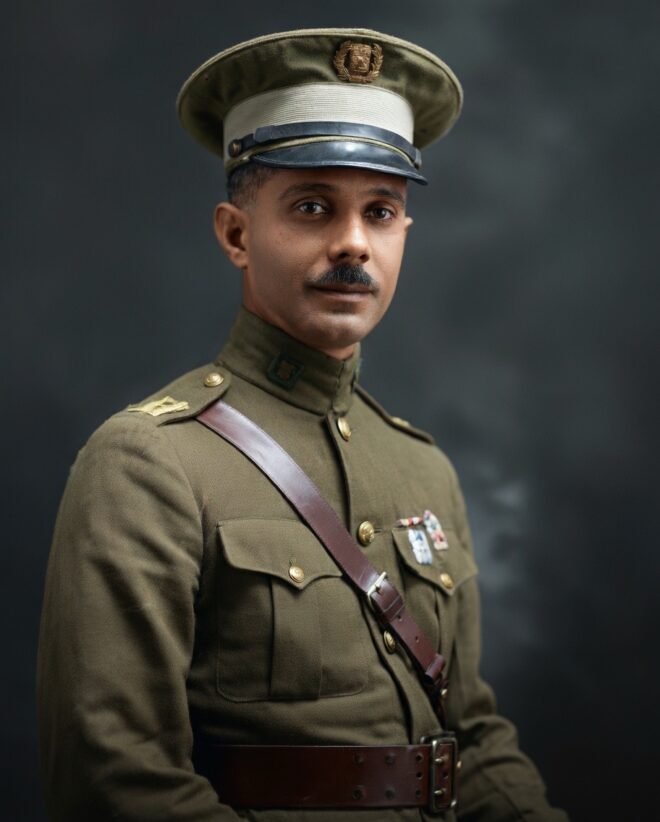
Introduction: When the State Decides Who Belongs
In October 1937, on the island of Hispaniola, a soldier or a civilian volunteer held up a sprig of parsley to a trembling man or woman and asked one simple question: what is this? The answer — or rather the inability to answer in the correct way — determined whether that person lived or died. The word in Spanish is perejil. For Haitian workers who had grown up speaking Kreyol or French, the rolled “r” of the Spanish pronunciation was nearly impossible to replicate. That inability to trill a single consonant became a death sentence. Estimates of the dead range from 500 to as many as 35,000, with the scholarly consensus settling on somewhere between 12,000 and 15,000 people systematically slaughtered by machete and rifle over the course of a few days. The event is known as the Parsley Massacre, or El Corte — The Cutting — and it stands as one of the most visceral and deliberate acts of ethnic cleansing in twentieth-century Latin American history.
Nearly ninety years later, in the United States of America, a different kind of shibboleth is at work. It is not a sprig of parsley but a birth certificate, a surname, the colour of one’s skin, the accent with which one speaks English, or simply the country one came from. The 45th and 47th President of the United States, Donald J. Trump, has presided over immigration enforcement policies that critics argue represent a structural effort to reshape who belongs in America — and who does not. The machinery is different. The body count, at least in the immediate sense, is not comparable. But the logic — the deep, animating logic of exclusion, of drawing a line between Us and Them, of deciding that certain people are alien to the national body regardless of how long they have lived there — invites serious historical comparison.
This essay explores the Parsley Massacre of 1937 in its historical context, examines the ideology of racial and national exclusion that drove Rafael Trujillo’s campaign of de-Haitianisation, and draws a careful, evidence-based comparison with the immigration enforcement and rhetorical framework of the Trump administration. It argues that while the scale and methods differ profoundly, the underlying ideological architecture — the designation of an ethnic or national group as inherently foreign, dangerous, and incompatible with the national identity — is disturbingly recognisable.
Hispaniola: A Shared Island, A Contested Border
The island of Hispaniola, shared between Haiti in the west and the Dominican Republic in the east, has always been a place of entangled histories. Haiti — the land of Kreyol and the first Black republic — carried out the only successful slave revolution in history when it declared independence in 1804. The Dominican Republic, on the eastern side, had its own complicated relationship with both Haitian rule and with its own African heritage. The two nations evolved separately and unequally, shaped by different colonial legacies, different languages, different relationships with the United States, and different economic fortunes.
By the early twentieth century, Haitian workers — many of them poor, landless, and desperate — had been crossing the border into the Dominican Republic in significant numbers, drawn primarily by the sugar-cane plantations that dominated the Dominican economy. The border itself was porous and, in many communities, largely irrelevant. People on both sides were often indistinguishable from one another: mixed African and European heritage, shared traditions, intermarriage. The French-Creole and Spanish languages marked a distinction that was linguistic before it was ethnic, and even that distinction was blurred in the borderlands where people grew up bilingual or code-switching between both.
Rafael Leonidas Trujillo came to power in 1930, having risen through the National Guard — a military force trained by the United States Marine Corps during the American occupation of the Dominican Republic. Trujillo was a man of mixed racial heritage who reportedly used face powder to lighten his appearance, a detail that speaks volumes about the complex, often self-negating nature of the racial ideology he would eventually weaponise. He governed as a fascist-leaning military dictator, consolidating power through terror, cult of personality, and the systematic elimination of political opponents.
La Dominicanización de la Frontera: The Logic of Ethnic Cleansing
The massacre of 1937 did not emerge from nowhere. It was the violent culmination of a policy Trujillo had been developing for years: la dominicanización de la frontera, the Dominicanisation of the border. The project had two intertwined goals. The first was territorial: to assert unambiguous Dominican sovereignty over the frontier regions, which had long been contested. The second was racial and cultural: to purge the borderlands of Haitian presence and identity, to create a Dominican population that was — in Trujillo’s ideology — Hispanic, Catholic, and lighter-skinned.
Professor Edward Paulino of John Jay College has described this as an “erasing of the Kreyol” — a project of de-Haitianisation in which an entire language, culture, and people were to be eliminated from the national landscape. The Haitian workers who had lived and laboured in the Dominican Republic for years, in many cases for generations, were suddenly reclassified as alien invaders, as a demographic threat to Dominican identity. They were not deported. They were killed.
The use of machetes rather than firearms was deliberately chosen. Trujillo wanted the massacre to appear as a spontaneous popular uprising — Dominican citizens defending themselves against Haitian encroachment — rather than a coordinated state action. In fact, as the US ambassador reported in a cable to President Franklin D. Roosevelt, it was precisely the opposite: a systematic military campaign, with the National Police and Army augmented by civilian volunteers, targeting all Haitian residents in the borderlands. At the port of Montecristi, a thousand people were forced off the pier and drowned. Across the frontier, people were shot, strangled, and hacked to death. And the parsley — el perejil — became the instrument of identification, exploiting the phonetic difference between Spanish and Kreyol speakers to separate the marked from the unmarked, the Us from the Them.
The international response was muted. Trujillo paid an indemnity of $750,000 — later reduced — to Haiti. The United States, whose Marines had trained the very Guard that carried out the killings, said relatively little. The massacre receded into obscurity for decades, little known outside Caribbean historiography, a wound kept open most powerfully through literature: Edwidge Danticat’s novel The Farming of Bones brought the horror to a wider English-speaking readership in 1998, more than sixty years after the event.
The United States: Building a Wall, Defining a People
Donald Trump descended a golden escalator in June 2015 and announced his candidacy for the US presidency with the claim that Mexico was sending rapists, criminals, and — he generously added — “some good people” across the southern border. The rhetorical template was set from that first moment: the immigrant as threat, the border as wound, the Other as criminal by default. It was language that had antecedents in American nativist movements stretching back to the Know-Nothings of the 1850s and the Chinese Exclusion Act of 1882, but it found in Trump a populist vessel perfectly suited to the media ecosystem of the twenty-first century.
Trump’s first term (2017–2021) saw a series of sweeping immigration enforcement actions: the Muslim ban that blocked entry from several majority-Muslim countries; the family separation policy that removed children from their parents at the border; the reduction of refugee admissions to historically low levels; the end of DACA protections for hundreds of thousands of young people brought to the US as children.
His second term, beginning in January 2025, has accelerated and expanded these measures. Mass deportation operations have targeted not only recent arrivals but long-term residents, including people who have lived legally in the United States for decades. Raids have been conducted in schools, churches, and hospitals — spaces historically understood as sensitive locations exempt from immigration enforcement.
The administration has deployed the Alien Enemies Act of 1798 — a wartime statute last used during the Second World War — against Venezuelan migrants, labelling members of the Tren de Aragua gang as a foreign enemy force and using this designation to justify expedited deportation without due process. Courts have contested these actions, but the administration has at times defied or circumvented judicial orders.
The rhetoric accompanying these policies has not softened: Trump has described undocumented immigrants as “poisoning the blood” of the country, language that echoes, with disturbing precision, the racial biology of early twentieth-century European fascism.
Comparing the Incomparable: Ideology, Scale, and Method
Any serious comparison between Trujillo’s massacre and Trump’s immigration enforcement must begin with an acknowledgement of scale. Fifteen thousand people were butchered with machetes over several days in 1937. That is not what is happening in the United States. People who conflate the two in terms of violence or immediacy do a disservice to the victims of El Corte and to historical precision. The comparison is not one of equivalence but of ideology — of the political logic that animates both projects.
Consider first the structure of the argument. Trujillo designated Haitian workers — people who had lived and worked in the Dominican Republic for years, many of them economically essential to the sugar economy — as fundamentally alien to the national body. Their labour was welcomed; their existence was not. They were told, in effect, that they could never truly belong, that their presence was a contamination of Dominican identity, and that the nation had both the right and the duty to remove them. Trump’s rhetoric toward undocumented migrants — and at times toward legal immigrants and even citizens of immigrant descent — follows a structurally identical pattern. They are described not as human beings in complex circumstances but as an invasion, a poison, an existential threat to the American way of life.
The shibboleth is also worth dwelling on. Trujillo’s soldiers used the word perejil because its phonetic difficulty reliably distinguished Kreyol speakers from Spanish speakers — a linguistic test standing in for an ethnic identity. The modern equivalent is not a sprig of parsley but it is no less real: it is a name that sounds foreign, a skin colour that reads as non-white, an accent that marks one as Other. Under the Trump administration, cases have emerged of US citizens and legal residents being detained, questioned, or threatened with deportation based on their appearance or ethnicity — particularly Hispanic and Black individuals. The shibboleth has changed form, but the underlying mechanism — using superficial markers to assign belonging or non-belonging — remains.
The role of the state in manufacturing a sense of crisis is another point of comparison. Trujillo did not respond to a Haitian invasion; he manufactured the perception of one to justify a project he had already decided upon. The evidence of a coordinated military operation rather than a popular uprising was noted even at the time by the US ambassador. Similarly, Trump’s claims of a border “invasion” — the specific word used in executive orders invoking emergency powers — have been challenged by criminologists and immigration researchers who consistently find that undocumented immigrants commit crimes at lower rates than native-born citizens. The crisis, to a significant degree, is constructed. It is politically useful precisely because it is constructed.
There is also the question of the role of the United States in both stories. The National Guard that carried out the Parsley Massacre was trained by the US Marines during the American occupation of Haiti and the Dominican Republic. American economic interests in the sugar industry shaped the conditions that brought Haitian workers to the Dominican borderlands in the first place. America was, in a structural sense, complicit in creating the conditions for the massacre and then said almost nothing when it occurred. In the contemporary moment, the United States is not a bystander to its own policies — it is the actor. The question of complicity becomes a question of democratic accountability.
The Long Shadow: Exclusion and Its Consequences
One of the most instructive aspects of the Hispaniola case is what happened after the massacre. The island did not heal. Today, as Professor Paulino notes, the Dominican Republic remains shaped by an exclusivist conception of Dominican identity that continues to relegate people of Haitian descent to second-class status — to being seen as aliens and outsiders even on an island they have inhabited for generations. The wound became a scar, and the scar became a feature of the landscape. The ideology that drove the massacre was never fully repudiated; it was institutionalised. Dominicans of Haitian descent have faced periodic campaigns of deportation, statelessness, and discrimination in the decades since. A 2013 ruling by the Dominican Constitutional Tribunal retroactively stripped citizenship from hundreds of thousands of people of Haitian descent, some whose families had lived in the country for generations.
This is the long-term consequence of building a national identity on exclusion. Once a state has defined a segment of its population as inherently alien — as biologically, culturally, or linguistically incompatible with the national body — it becomes very difficult to walk that definition back. The stigma attaches not to immigration status but to ethnicity, and it passes down through generations. Children and grandchildren of immigrants find themselves still regarded as foreign, still asked to prove their belonging in ways that are never asked of those whose ancestry fits the approved national template.
In the United States, this dynamic has deep historical roots: in the treatment of Indigenous peoples, in the legacy of slavery, in the internment of Japanese Americans during the Second World War, in the deportation of Mexican Americans during the Great Depression. What distinguishes the current moment is the explicit revival of this logic as a governing philosophy rather than an unfortunate episode to be apologised for. The current administration’s framing of immigration as an invasion, of immigrants as poisonous, of demographic change as an existential threat — these are not policy positions in any conventional sense. They are identity declarations. They say: this is what America is, and that is what you are, and the two are not compatible.
Conclusion: The Grammar of Belonging
The sprig of parsley held up at the end of a machete is one of the most arresting images in the history of political violence. It captures, in a single act, the absurdity and the horror of the nationalist project in its most extreme form: that a person’s right to live could hinge on the sound of a single syllable. It was not really about language, of course. It was about race, economics, and power. The linguistic test was merely the instrument through which a pre-existing decision — that these people did not belong, that they were not truly human in the relevant political sense — was implemented.
No one is holding a sprig of parsley in the United States today. But the grammar of belonging — the system by which some people are designated as natural members of the national community and others are designated as permanent outsiders regardless of their actual lives and ties — is being actively rewritten. When a president describes immigrants as poisoning the national bloodstream; when a legal framework is constructed that allows the mass removal of people who have lived their entire adult lives in a country; when entire ethnic and national groups are rhetorically associated with criminality and existential threat — the grammar is changing.
History does not repeat itself with neat precision. The specific circumstances of Hispaniola in 1937 — the particular configuration of dictatorship, racial ideology, labour exploitation, and border contestation — will not be replicated in the United States in 2025. But history does offer patterns, and one of the most durable patterns in the modern history of nationalism is this: that when a state begins to define a portion of its population as inherently alien, as biologically or culturally incompatible with the national identity, it rarely stops at deportation. The logic of exclusion, once institutionalised, tends to find new forms and new applications.
The victims of the Parsley Massacre were not abstract symbols. They were men and women and children who had built lives, families, and communities in the borderlands of Hispaniola. They were killed not for anything they had done but for what they were — or rather, for what a dictator had decided they were. Their deaths remind us that the language of national purity is never merely metaphorical. It is always, ultimately, about bodies: which bodies belong, and which do not, and what happens to the ones that are decided against.
The question that the comparison between Trujillo and Trump forces us to ask is not whether Donald Trump is a dictator — the institutional differences between a Caribbean military dictatorship in the 1930s and a twenty-first-century American democracy are real and significant. The question is whether the ideology of exclusion, the project of deciding that certain people can never truly belong, can flourish within democratic institutions, and what those institutions do — or fail to do — to resist it. The answer to that question is still being written. History will judge it, as it has judged the island of Hispaniola, by what is left behind.

Thanks Bakchos, another original weaving together of seemingly different or unrelated historical or literary events into an elaborate narrative. I don’t always agree with how you weave goes together, but, it always provides something to ponder, and often to read further into.
Thank you for your dedication and ongoing efforts to present an alternative narrative to the world’s current right wards drift. Your dedication is acknowledged and appreciated.
Jen
Jen I think that the way Bakchos weaves his ideas together are creative and make powerful points. His idea seems to be more about getting people to think about the issues, rather than providing all the answers.
I’m from the Iberian peninsula as you know, this is the first time I’ve heard about Trujillo’s deliberate “de-Haitianisation” campaign. I wish that I could say that I’m surprised, unfortunately that’s not the case. It’s important that events like this are remembered. Trump is seriously a blight on humanity. He is everything that is wrong with American democracy and the infuriation of unchecked infusions of billionaires money into the democratic process.
You’ve drawn an interesting and powerful analogy between Trump’s United States and Trujillo’s Dominican Republic. This kind of “othering” does lasting damage to institutions and to democracy itself.
Black and brown people have always been expendable in the interests of Western colonialism.
Cet essai accomplit quelque chose de difficile avec une honnêteté remarquable : il établit une comparaison historique sans tomber dans le piège du sensationnalisme. L’auteur reconnaît dès le départ que l’échelle des deux événements est incomparable — quinze mille morts à la machette d’un côté, des politiques d’expulsion de l’autre — et c’est précisément cette honnêteté qui donne à l’argument toute sa force.
Le choix du perejil comme fil conducteur est particulièrement efficace. Ce détail — une syllabe roulée qui décide de la vie ou de la mort — illustre avec une économie brutale la mécanique de l’exclusion : elle n’a pas besoin de logique profonde pour fonctionner. Il suffit d’un signe, arbitraire mais cohérent, pour séparer le Nous du Eux. L’essai démontre avec conviction que ce signe a changé de forme mais non de fonction.
Là où l’argument mérite d’être nuancé, c’est dans la distinction entre régime totalitaire et démocratie fragilisée. Trujillo n’avait pas de tribunaux indépendants pour contester ses ordres, pas de presse libre pour documenter les massacres, pas d’opposition organisée pour résister. Les États-Unis de Trump, malgré leurs tensions profondes, possèdent encore ces garde-fous — imparfaits, contestés, mais existants. La résistance judiciaire aux décrets sur les Ennemis Étrangers en est la preuve. Cette différence institutionnelle n’absout pas la rhétorique toxique, mais elle modifie la trajectoire possible.
Ce qui reste indéniable, et ce que l’essai démontre avec force, c’est que le langage précède toujours l’acte. Avant les machettes, il y avait les discours. Avant les expulsions massives, il y a la déshumanisation rhétorique. C’est dans cet espace — entre le mot et l’acte — que la démocratie doit intervenir. L’histoire d’Hispaniola nous rappelle douloureusement ce qui arrive quand elle n
le fait pas.
I can some direct parallels between Trump’s America and Trujillo‘s Dominican Republic. I fear that the long term consequences will be similar. Distrust in the community and the undermining of the democratic process.
I don’t understand that kind of hate, but I do fear that Pauline Hanson is fanning the flames of hate for her own short term gain. That isn’t patriotism, at its core it is hate for Australia and our democratic institutions.
Dutton fanned the same flames. Politicians who traffic in fear of the Other are responsible for the much of the hate. Hanson’s bigotry and drive division. She is a destroyer, not a unifier.
Irrational hate, and insatiable greed are destroying the planet and everything that lives on it.
Hate is easy political currency, but is ultimately destructive to society and to democracy. It’s high time that everyone gave hate a big miss.