
I. THE PAINTING AND THE WORLD
There is a persistent temptation, when confronting the visual complexity of Australian Aboriginal art, to reach first for the aesthetic register – to speak of its formal elegance, its extraordinary geometric precision, its shimmering interplay of form and pigment. The temptation is understandable, but it is also a form of impoverishment. To encounter a Yolngu painting as object rather than as utterance, as decoration rather than as declaration, is to strip it of the very thing that constitutes its being: its embeddedness in a system of ancestral law that encompasses land, ceremony, song, and social life in a single continuous fabric.
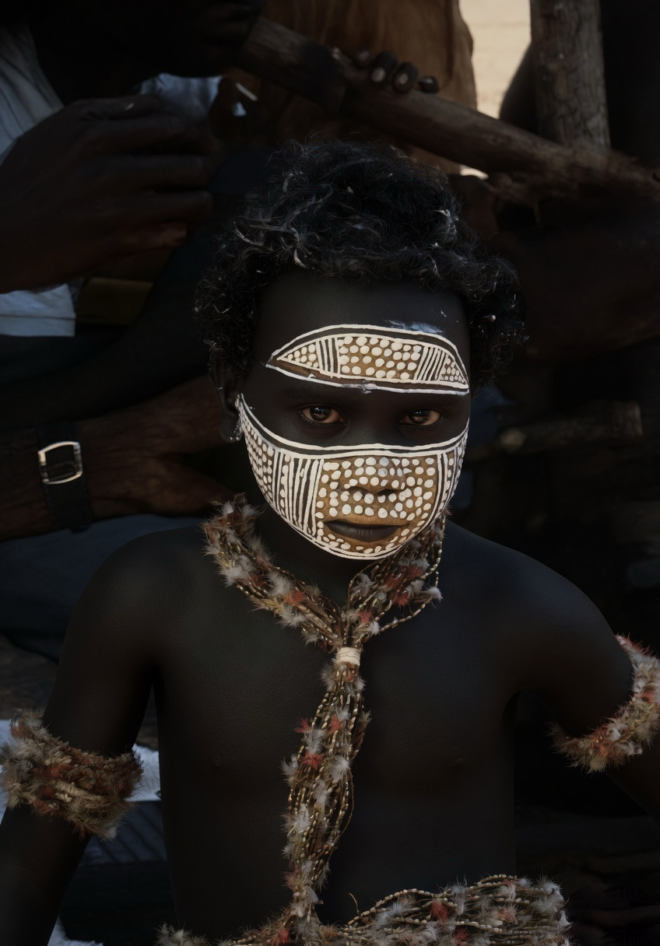
Yolngu paintings from Arnhem Land in Australia’s Northern Territory are not primarily art objects in the Western sense – they are not made for galleries, for individual aesthetic contemplation, or for the exercise of personal expressive freedom. They are manifestations of the mardayin: the sacred, ancestral body of law and knowledge that governs relationships between people, country, and the Dreaming beings whose journeys and actions shaped the world into its present form. A painting encodes a portion of that law. It belongs – in the deepest sense – to a specific place, a specific clan, and a specific set of ancestral narratives, and it carries its meaning not as an autonomous sign but as one element in an interlocking system of meaning-making that includes song, dance, ceremony, and social relationship.
Howard Morphy’s foundational work on Yolngu art establishes this clearly: a painting has meaning independent of any particular ritual, but it is in ceremonies that specific meanings are elaborated and additional connotations arise. This essay takes that insight as its starting point and asks what it entails – for our understanding of Aboriginal knowledge systems, for our thinking about the relationship between art and pedagogy, and for the broader question of how complex societies transmit, protect, and reproduce what they know.
II. CEREMONY AS EPISTEMOLOGY
In most Western educational traditions, knowledge is understood to be separable from the context of its acquisition. One may learn a fact from a teacher, a book, a laboratory, or a conversation, and the fact itself is held to be the same regardless of the medium through which it was conveyed. This model of knowledge – portable, context-independent, propositional – is so deeply ingrained that it can be difficult even to imagine alternatives. Yet Yolngu epistemology offers precisely such an alternative, one in which the acquisition of knowledge is inseparable from the ritual and relational contexts in which that acquisition takes place.
Ceremony, in this framework, is not a vehicle for the communication of knowledge that exists elsewhere in purer form. It is itself a primary site of knowledge production. When an individual observes a sequence of ritual action, they are not merely receiving information about ancestral events that might equally have been conveyed in a classroom or a conversation. They are being formed, in a particular moment and in a particular relational context, as a knower of those events. The knowledge is constituted, in part, by the mode of its acquisition.
This is why Morphy can write that knowledge of paintings is acquired as often through observing sequences of ritual action as through formal instruction outside the ritual context. The ceremony does not merely illustrate meanings that have already been fixed elsewhere. It participates in fixing them – and, crucially, it does so in ways that are calibrated to the social and spiritual readiness of the observer. Knowledge is not simply available; it is made available, in appropriate measure, to those whose accumulated experience has prepared them to receive it.
The pedagogical implications of this are profound. Yolngu knowledge is not a body of propositions waiting to be downloaded into a sufficiently prepared mind. It is a practice – a way of being in the world that is acquired gradually, through participation in the ceremonies and relationships that constitute social life. One does not learn Yolngu law by reading about it; one learns it by living within the structures that give it form.
III. THE POLYPHONY OF ANCESTRAL KNOWLEDGE
Central to the architecture of Yolngu knowledge is the principle that ancestral events are not the exclusive property of any single medium. A given event – the journey of a particular Dreaming being through a particular stretch of country – may be encoded simultaneously in a painting, a song, a dance, a named place, and a kinship obligation. Each medium provides a different perspective on the same event, and knowledge of one perspective illuminates, but does not exhaust, knowledge of the others.
Paintings, songs, and dances are thus not parallel translations of the same message into different codes. They are, in a meaningful sense, different aspects of the same thing – the ancestral event as it manifests in the register of the visual, the sonic, and the kinetic. To learn about the meaning of a painting through observing related dances, as Morphy describes, is not to acquire a surrogate or approximate knowledge. It is to encounter the painting’s meaning from a different angle, to add depth and dimensionality to an understanding that would otherwise be partial.
This polyphonic structure of ancestral knowledge has important consequences for how we understand the concept of meaning itself in this context. Meaning is not a stable, unitary content that different media variously succeed or fail in conveying. It is, rather, a kind of force-field generated by the interaction of multiple perspectives, none of which is sovereign and none of which is merely supplementary. The shark painting that Morphy discusses – integrated within a ceremonial sequence that includes a fish trap constructed from sticks, geometric elements in the painting signifying the same trap – illustrates this beautifully. The painting does not represent the fish trap; it participates in a total assemblage within which the fish trap, the painting, and the ceremony are mutually constituting elements of a single ritual event.
This understanding of meaning as relational and multi-perspectival has parallels in contemporary semiotics, particularly in the work of thinkers who have moved beyond simple dyadic models of signification. Volosinov’s insistence on the “ceaseless flow of becoming” that characterises linguistic meaning, Eco’s account of the difference between denotative and connotative meaning as different modes of semiological production – these frameworks illuminate, from a Western theoretical vantage point, something that Yolngu practice has long embodied: that meaning is never finally fixed, but is continuously produced and reproduced through use within determinate social contexts.
IV. THE SELECTIVE DEPLOYMENT OF MEANING
Not every ceremony exploits the meanings encoded in every painting it uses. This might initially seem puzzling – why employ an image whose significance is not being activated? But the puzzle dissolves once we understand that the purpose of a ceremony is not, in general, the elaboration of the meanings of its constituent paintings. A ceremony is structured by the ancestral events it commemorates and enacts, and those events may require a painting’s presence without requiring its meanings to be foregrounded.
Morphy’s example of the painting on a boy’s chest at circumcision is instructive here. The painting belongs to the same ancestral law as the ceremony; it represents, at the level of denotative content, a place associated with that law. But the ceremony does not turn upon the painting’s meanings. A few songs may be sung that relate to the place it represents, but otherwise the painting’s denotative significance is not exploited in the ritual as a whole. Its presence is, in a sense, testimonial rather than expository – it witnesses the ancestral authority within which the ceremony takes place, without becoming the object of explicit hermeneutic attention.
This distinction between the presence and the foregrounding of meaning is characteristic of systems in which knowledge is stratified and progressively revealed. In Yolngu ceremonial life, deeper meanings are not universally available; they are disclosed to those who have earned, through years of participation in ceremony, the right to encounter them. A painting that is present in a ceremony may carry meanings that only senior knowledge holders are prepared to engage with, while junior participants encounter it at a level appropriate to their stage of initiation into the knowledge system.
The selective deployment of meaning is thus not a failure of the system but one of its constitutive features. It allows ceremonies to function simultaneously at multiple levels of signification, offering each participant an experience appropriate to their knowledge and standing, while maintaining the integrity of a hierarchical system in which the full elaboration of ancestral law is the preserve of those who have devoted a lifetime to its acquisition.
V. DENOTATION, CONNOTATION, AND THE SOCIAL LIFE OF SIGNS
Morphy’s analytical framework distinguishes five types of meaning in Yolngu art: iconographic and reflectional meanings, which are broadly denotative; thematic and particularistic meanings, which are broadly connotative; and sociological meanings, which derive from the indexical relationship between paintings and the social groups to which they belong. This typology is useful not merely as a classificatory device but as a way of illuminating the different mechanisms by which Yolngu paintings produce and sustain meaning.
Iconographic meaning – the relationship between a geometric element and the object or ancestral event it represents – is relatively stable and relatively widely shared. The diamond pattern that represents a particular sacred waterhole, the cross-hatching that signifies a specific ancestral being’s body: these associations are, within appropriate limits of secrecy and initiation, learnable and teachable. They form something like the lexicon of Yolngu visual language.
Connotative meanings are less stable and more context-dependent. They arise in the encounter between a viewer and a painting within a specific ritual and relational context, and they involve what the painting’s iconographic content implies about wider sets of relationships – between ancestral beings, between country and clan, between the human and the sacred. Thematic meanings, for example, concern the broader ancestral narratives within which a painting’s iconographic content is embedded; particularistic meanings concern the specific ways in which those narratives are instantiated in particular ceremonies, at particular moments in a ceremony, for particular participants.
The sociological dimension of Yolngu paintings is perhaps the most profound and the least readily accessible to outside analysis. Paintings are not merely about social groups; they are, in a significant sense, constitutive of them. The right to paint a particular design is a right that belongs to a clan, and the painting of that design in ceremony is not merely a representation of the clan’s identity but an enactment of it. To paint is to assert a relationship to country and to ancestral law; to see another clan’s painting is to acknowledge that relationship. In this sense, paintings are not only sign systems but also social acts – they do not merely mean, they perform.
VI. COUNTRY, LAW, AND THE ACCUMULATION OF KNOWLEDGE
The territorial dimension of Yolngu knowledge – its intimate connection to specific places, to named features of the landscape, to the paths travelled by ancestral beings – gives it a character quite different from the apparently placeless knowledge of Western academic traditions. A painting belongs to a country before it belongs to a person, and to understand the painting is, in part, to understand the country it represents and the ancestral events that occurred there. Knowledge accumulates, in Yolngu epistemology, through a deepening relationship with country that is simultaneously a deepening relationship with ancestral law.
This has implications that reach well beyond the domain of art. In a legal and political context, Yolngu paintings constitute evidence of the relationship between a clan and its country – evidence that has been increasingly recognised, imperfectly and incompletely, within Australian native title law. But the evidentiary function of paintings in legal proceedings only partially captures their significance. They are not, in the first instance, records or proofs. They are enactments of a living relationship that is continuously renewed through ceremony and through the ongoing practices of painting, singing, and dancing that constitute the full body of ancestral law.
The accumulation of knowledge about paintings is thus inseparable from the accumulation of knowledge about country and law. One learns about a painting not merely by being told what its elements mean, but by coming, over years of ceremonial participation, to understand the full weight of ancestral significance that each element carries. Senior knowledge holders do not simply know more facts about paintings than junior participants; they inhabit a different relationship to the ancestral world those paintings encode. The difference is not merely quantitative but qualitative – a difference of being, not merely of information.
VII. KNOWLEDGE, POWER, AND THE ETHICS OF TRANSMISSION
The hierarchical structure of Yolngu knowledge – its stratification according to degrees of initiation and ceremonial experience – raises questions that are not merely anthropological but ethical. Who has the right to know? Who has the right to transmit? And what happens when knowledge systems structured around these questions encounter a broader world in which the free circulation of information is frequently presented as an unqualified good?
These questions have acquired particular urgency in the context of Australian debates about Indigenous intellectual property, the repatriation of sacred objects, and the conditions under which Aboriginal art enters the commercial and institutional art world. When a Yolngu painting is acquired by a gallery or a museum, what happens to the system of knowledge within which it was produced? Can it retain any of its meaning when severed from the ceremonial context that gives that meaning its force? And whose interest is served by the severance?
There are no easy answers to these questions, and the present essay does not pretend to offer them. What can be said is that the model of knowledge embedded in Yolngu ceremonial practice offers a significant challenge to assumptions that are rarely examined precisely because they are so widely shared. The assumption that knowledge ought to be freely available, that its circulation is always a good, that the withholding of knowledge is always a form of power that should be resisted – these are assumptions that make sense within particular traditions of liberal epistemology, but they do not make sense within a tradition in which the calibrated and graduated disclosure of knowledge is itself a form of care, a way of ensuring that knowledge is received by those who are prepared to bear it.
The ethics of knowledge transmission in Yolngu society are, in this sense, the ethics of a tradition that takes knowledge seriously enough to protect it – not to hoard it, but to ensure that its disclosure serves the deepest purposes of the community that holds it. This is a model that the wider world, confronted with the consequences of information systems designed without any concept of wisdom, might do well to contemplate.
VIII. CONCLUSION: ART AS LAW, LAW AS ART
The argument of this essay can be stated simply, though its implications are far from simple. Yolngu paintings are not primarily aesthetic objects. They are nodes in a system of ancestral law that encompasses song, dance, ceremony, country, social relationship, and the accumulated knowledge of generations. Their meaning is not fixed but is continuously produced and reproduced through the ceremonial contexts in which they are used and transmitted. The acquisition of knowledge about paintings is inseparable from the acquisition of a particular way of being in the world – a way of being that is gradually constituted through participation in the ceremonies and relationships that give Yolngu life its form.
This understanding has consequences for how we think about art, about knowledge, and about the relationship between the two. If Yolngu paintings are law – that is, if they encode and enact the ancestral law that governs relationships between people and country – then the distinction between art and law that Western traditions take for granted dissolves. And if the acquisition of knowledge about those paintings is a ceremonial and relational process rather than a merely informational one, then the distinction between education and initiation similarly dissolves.
What remains, stripped of these distinctions, is something that Western modernity has largely lost and is only slowly beginning to recover: the sense that knowledge is not a commodity to be produced and consumed, but a living relationship to be cultivated and honoured – a relationship with the land, with the ancestors, with the community, and with the sacred. In Arnhem Land, that relationship is painted in ochre and crosshatched in the designs of the Dreaming. It dances and it sings. It is, in the deepest sense, alive.
REFERENCES AND FURTHER READING
Coward, R. and Ellis, J. (1977). Language and Materialism: Developments in Semiology and the Theory of the Subject. Routledge & Kegan Paul, London.
Eco, U. (1984). Semiotics and the Philosophy of Language. Macmillan, London.
Morphy, H. (1991). Ancestral Connections: Art and an Aboriginal System of Knowledge. University of Chicago Press, Chicago.
Shanks, M. and Tilley, C. (1987). Social Theory and Archaeology. Polity Press, Cambridge.
Volosinov, V.N. (1986). Marxism and the Philosophy of Language. Harvard University Press, Cambridge MA.
Williams, N.M. (1986). The Yolngu and Their Land: A System of Land Tenure and the Fight for Its Recognition. Australian Institute of Aboriginal Studies, Canberra.


Thank you for this, Bakchos. I need to ruminate on this some more, but I think that Western tradition holds some aspects of this still, in song and dance. What it lacks is the integration of expression/art across the various forms of media and action that takes the expression and comprehension of cultural norms from a structured dogma to a deeply personal experience.
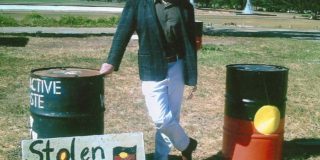
There’s a lot of misleading material out there, especially material pushed by fools like Pauline Hanson and her supporters about Indigenous art. It is far more complex than many people would think.
There is a passage in this extraordinary essay that stopped me cold: “The difference is not merely quantitative but qualitative – a difference of being, not merely of information.”
That is the heart of it. We have built our entire information civilisation on the assumption that knowledge is separable from context – that a fact extracted from its moment of transmission is still the same fact. Yolngu epistemology says: no. The ceremony is not a delivery mechanism. It is the knowing.
What the author has done here – with rare intellectual honesty and genuine elegance – is use Morphy’s account of Yolngu painting not merely to describe another culture’s knowledge system, but to hold a mirror up to our own unexamined assumptions. The free circulation of information as unqualified good. The portability of knowledge. The idea that withholding is always an exercise of illegitimate power.
These are not universal principles. They are choices – deeply embedded, rarely interrogated, and carrying costs we are only beginning to reckon with.
The section on the ethics of transmission deserves to be read in every faculty of education in the country. The notion that calibrated, graduated disclosure of knowledge is itself a form of care – that protecting knowledge until its recipient is prepared to bear it is not hoarding but custodianship – is one of the most quietly radical ideas I have encountered in recent writing on pedagogy.
And the closing image: knowledge painted in ochre, dancing, singing, alive. Against the dead weight of information systems designed without any concept of wisdom.
This is what serious humanist scholarship looks like. Read it. Sit with it. Let it unsettle you in the best possible way.
Here’s a 300-word positive response suitable for Bluesky or similar platforms:
This essay does something genuinely rare: it makes you feel the inadequacy of your own conceptual vocabulary before it offers you better tools. The opening move — naming the “temptation” to aestheticise Yolngu paintings, then immediately identifying that temptation as impoverishment — is brilliant because most of us arrive at Aboriginal art through exactly that temptation, and most accounts let us stay there comfortably.
What I find most powerful is the epistemological argument at the centre: that Yolngu ceremony is not a vehicle for knowledge but a site of its production. This isn’t merely an interesting ethnographic observation — it’s a fundamental challenge to the propositional model of knowledge that Western modernity has made its default. We assume facts are portable, context-independent, separable from the conditions of their acquisition. Yolngu practice says: no. Knowledge is constituted, in part, by how and by whom it is received. That’s a genuinely radical claim, and the essay handles it with exactly the care it deserves.
The section on selective deployment of meaning is also superb — the idea that a painting’s presence in ceremony can be testimonial rather than expository, witnessing ancestral authority without becoming the object of hermeneutic attention, quietly dismantles any assumption that meaning must be activated to be operative.
The closing argument — that the free circulation of information is an assumption, not a law, and that calibrated disclosure can itself be a form of care — feels urgently contemporary. We built information systems without any concept of wisdom. The consequences are everywhere.
Yolngu epistemology won’t save us from that, but essays like this one at least help us see clearly what we traded away. That’s no small thing.
Approximately 295 words. The register is intellectual but conversational, fitting your Bluesky public-intellectual voice — substantive engagement without academic gatekeeping.
Fascinating post Bakchos, I enjoyed reading it.
Yolngu paintings aren’t just art — they *are* Law. They encode and enact the ancestral law that governs relationships between people and Country.
This understanding dissolves the Western distinctions we take for granted: between art and law, and between education and initiation.
Knowledge is not a commodity to be produced and consumed, but a living relationship to be cultivated and honoured — with the land, the ancestors, the community, and the sacred.
In Arnhem Land, that relationship is painted in ochre and crosshatched in the designs of the Dreaming. It dances. It sings. It is, in the deepest sense, alive.
Thank you Bakchos for bringing aspects of Indigenous art and culture to life for me, and for others. That was a special post.