
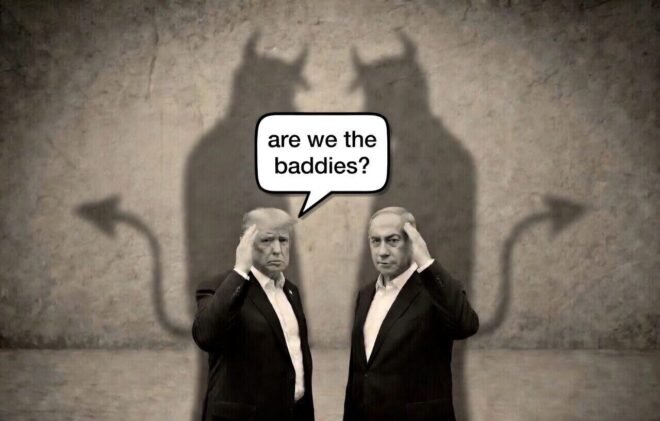
I. A Sketch That Hits Too Close to Home
In a celebrated sketch from the British comedy duo Mitchell and Webb, two SS officers pause amid the machinery of wartime horror to ask each other a disarmingly simple question: Are we the baddies? The joke lands because the answer is obvious to everyone except them. They notice, for the first time, the skull motifs on their uniforms and begin to wonder what those symbols might say about the side they have chosen. It is satire about the human capacity for moral self-delusion – the way ideology, habit, and institutional loyalty can prevent people from seeing what is directly in front of them.
The sketch has migrated from comedy cult status into genuine political shorthand, because it describes something real. Nations, like individuals, are capable of constructing elaborate justifications for actions that, viewed from the outside, look indistinguishable from the conduct they claim to oppose. Fast-forward to March 2026, and the joint US-Israeli strikes on Iran – launched on February 28 – force a similar moment of introspection for the West. What began as targeted airstrikes against Iranian military sites, nuclear facilities, and leadership, including the assassination of Supreme Leader Ali Khamenei, has escalated into a full-scale conflict. Iran has retaliated with missile barrages across the Middle East, disrupting oil flows and drawing in regional powers. This “unprovoked attack” cements the West as the aggressors, surrendering any vestige of moral superiority to a “Zionist agenda,” while nations like Australia prioritise subservience over international law – serves as the foundation for this essay.
In pursuing a truth-seeking lens, we’ll balance partisan narratives with factual scrutiny, acknowledging that while Iran’s regime is no paragon of virtue – plagued by human rights abuses and proxy warfare – the West’s actions risk mirroring the very authoritarianism it condemns.
II. The History the West Prefers to Forget
Any honest reckoning with Western moral claims in the Middle East must begin in 1953. In August of that year, the CIA, working alongside British intelligence under Operation Ajax, orchestrated the overthrow of Mohammad Mossadegh, Iran’s democratically elected Prime Minister. Mossadegh’s offence was to nationalise the Anglo-Iranian Oil Company – now BP – returning Iranian petroleum resources to Iranian public ownership. For this act of democratic self-determination, he was deposed in a coup that installed Mohammad Reza Shah Pahlavi and his SAVAK secret police, an apparatus notorious for torture and political repression.
The United States formally acknowledged its role in the coup only in 2013, sixty years after the fact. The CIA declassified documents confirming the operation was, in its own words, “carried out under CIA direction” and was intended to bring about the Shah’s restoration (National Security Archive, 2013). This single act generated consequences that reverberate to the present day: it discredited Iranian secular liberalism, alienated a generation from Western-backed modernisation, and created the political conditions in which the 1979 Islamic Revolution became not merely possible but, to many Iranians, desirable.
The revolution brought Ayatollah Khomeini to power, established the theocratic system that governs Iran today, and ignited a hostility with Washington that has never been resolved. What Western commentators rarely acknowledge is that the Islamic Republic did not emerge from a vacuum – it emerged from a vacuum left by Western interference. When Iran’s Foreign Ministry describes American actions as a continuation of historic aggression, this is not mere propaganda. It is a historically literate argument with a documented evidentiary basis.
The JCPOA – the Joint Comprehensive Plan of Action signed in 2015 – represented the most serious attempt in decades to resolve the nuclear dimension of this antagonism through diplomacy. Iran agreed to verifiable limits on uranium enrichment; the United States, European Union, Russia, and China agreed to sanctions relief. The IAEA confirmed Iran’s compliance. In 2018, the Trump administration withdrew unilaterally, reimposing sanctions and initiating what it called a “maximum pressure” campaign. Iran responded by progressively exceeding the enrichment limits it had agreed to observe. By 2023, IAEA reports indicated Iran had enriched uranium to 84 percent purity – close to weapons-grade – having been given every incentive to do so and no diplomatic off-ramp (IAEA Board of Governors, 2023).
This history matters because it shapes how a hypothetical strike would be understood across most of the world. For the Global South – a loose but meaningful term for nations that experienced European colonialism and its aftermath – Western military action in the Middle East does not arrive without context. It arrives trailing 1953, the 2003 invasion of Iraq on fabricated intelligence, the destabilisation of Libya, and decades of unconditional support for Israeli military operations that have killed tens of thousands of Palestinian civilians. The West’s self-image as a defender of international order coexists, uncomfortably, with a track record that looks quite different from the receiving end.
III. The 2026 Strikes: Unprovoked Aggression or Pre-emptive Defence?
On February 28, 2026, at approximately 9:45 a.m. IRST, US missiles and Israeli fighter jets struck over 500 targets in Iran, including air defences, missile launchers, and leadership compounds. President Trump, in a video statement, framed Operation Epic Fury as targeting Iran’s “menacing activities,” citing the 1979 hostage crisis, support for Hamas and Hezbollah, and nuclear ambitions. Netanyahu called it Operation Roaring Lion, a “pre-emptive attack” to remove threats. Khamenei’s death was confirmed, alongside other high-ranking officials like IRGC Commander Mohammad Pakpour.
Iran denounced the strikes as “unprovoked, illegal, and illegitimate,” retaliating with missiles targeting US bases in Iraq, Syria, and Gulf states, as well as Israeli cities. Civilian casualties mounted: Iranian reports claim hundreds dead in Tehran and Isfahan, while Israeli sources report two civilians killed in Yehud. Oil prices spiked 10%, with Iran threatening to close the Strait of Hormuz.
Was this unprovoked? Proponents argue Iran’s nuclear breakout loomed, with IAEA reports indicating advanced enrichment. Iran’s proxies had attacked US forces and Israeli targets, including intensified Hezbollah barrages. A pro-Israeli social media post asserts, “This conflict did not start because of Israel. It started because the Islamic Republic of Iran decided to threaten the US, the Gulf States, Israel…”
Critics, however, see hypocrisy. UN experts condemned the strikes as violations of international law, prohibiting attacks on civilians and infrastructure. The Lemkin Institute warns of geopolitical domination masked as defence, linked to “Greater Israel” plans. Reports note nearly 30 UN rapporteurs labelling it “unprovoked.” Iran’s Foreign Ministry rejected claims of imminent attacks, citing US aggression as evidence.
Non-partisan analysis questions the timing: “Israeli Defence Minister Israel Katz described the first strikes… as a ‘pre-emptive strike’… although he did not explain why there was a need to take military action at this time.” Other analyses suggest Trump was “dragged into war by an Israel determined to reshape the Middle East.” By launching without clear provocation, the West has forfeited moral superiority, appearing as the “baddies” in this narrative.
Delving deeper, the strikes’ planning reveals a pattern of escalation. Leaked documents from early 2026 show US-Israeli intelligence sharing intensified after Iran’s alleged drone strikes on Saudi oil fields in January. Yet, independent verification of those incidents remains scarce, with some attributing them to internal Saudi dissent. Iran’s ballistic missile program, while advanced, had not been used offensively against Israel or the US since 2020. The attack’s scale – destroying Natanz and Fordow nuclear sites – suggests not defence but regime change intent, echoing the 2003 Iraq invasion’s flawed justifications.
Moreover, the humanitarian toll undermines Western claims. Hospitals in Tehran reported overwhelmed wards, with children among the victims of collateral damage. Social media footage shows rubble-strewn streets, evoking memories of Gaza’s devastation. If the West champions human rights, how does this square with actions that exacerbate suffering? This is “moral perfidy”, the United States makes alliances with authoritarian regimes like Saudi Arabia – while condemning Iran – selective ethics in action.
IV. Zionism, Israeli Policy, and the Limits of Criticism
Any serious essay on Western conduct in the Middle East must grapple with Zionism – carefully, and without collapsing into the kind of bad-faith conflation that treats criticism of Israeli government policy as inherently antisemitic, or that treats the label “Zionist agenda” as a self-explanatory accusation requiring no further analysis.
Zionism, in its foundational form, is the political movement for Jewish self-determination in a historical homeland – a movement that emerged in the late nineteenth century in direct response to virulent European antisemitism and found its most terrible vindication in the Holocaust. The State of Israel’s existence is not the subject of serious legal contestation in mainstream international law, and criticism of Israeli government policy is neither equivalent to, nor inherently connected with, opposition to that existence.
What is subject to legitimate and well-documented criticism is a specific strand of Israeli political thought – associated with Revisionist Zionism and its contemporary heirs, including elements of the current governing coalition – that pursues territorial maximalism at the expense of Palestinian rights, international law, and regional stability. Finance Minister Bezalel Smotrich has publicly presented maps of a “Greater Israel” incorporating Jordan. National Security Minister Itamar Ben-Gvir has advocated for the expulsion of Arab citizens of Israel. The International Court of Justice, in January 2024, found it “plausible” that Israel’s conduct in Gaza constituted genocide, and ordered provisional measures – a finding of historic gravity that received comparatively muted coverage in mainstream Western media (ICJ, Application of the Genocide Convention, January 2024).
The relevance of this to our current analysis is direct. When Western governments participate in, or endorse, military action that serves the strategic goals of an Israeli government whose stated aims include territorial expansion inconsistent with international law, that government is aligning itself not with Israel’s legitimate security interests – which are real and deserve respect – but with a specific political programme that a large portion of the international community, and a significant minority of Israeli citizens, regards as dangerous. That is not antisemitism. It is analysis. The confusion between the two has been weaponised so thoroughly that it now functions, in many political environments, as a barrier to honest debate.
V. Australia and the Deputy Sheriff Problem
Australia’s foreign policy has a recurring structural problem: it is designed, at its deepest level, around the assumption that alignment with the most powerful Anglophone ally of the day is the necessary condition of national security. In the nineteenth century, that ally was Britain. Since 1942, it has been the United States. The logic is understandable given Australia’s geography – a mid-sized nation of 27.7 million people on the edge of Asia, far from the centres of Western power – but it produces a foreign policy that is sometimes difficult to distinguish from strategic subservience.
The pattern is well-established historically. Australia committed troops to Vietnam, where the United States was not defending itself but prosecuting a proxy war in a country that had not attacked it. Australia joined the 2003 invasion of Iraq despite the absence of a Security Council mandate and despite clear warnings from its own intelligence services that the evidence for weapons of mass destruction was thin (Flood Report, 2004). Australia has consistently provided intelligence facilities – most notably Pine Gap, the joint surveillance station near Alice Springs that supports US military and intelligence operations globally – without always being fully informed about how that intelligence is used.
Australia’s swift endorsement of strikes on Iran follow this pattern precisely. Predictably the justification are alliance obligations, regional stability, and the threat posed by Iranian nuclear ambitions. What has gone unexamined are the questions that any genuinely sovereign foreign policy would require answering first: is this action legal? Is it proportionate? Does it serve Australian interests and values, or does it serve the interests of a particular faction within a partner government?
There is a genuine alternative, and it has a contemporary exemplar. New Zealand, despite sharing intelligence ties through the Five Eyes network, has maintained a more independent foreign policy posture on Middle Eastern conflicts and has been willing to explicitly invoke international law as a constraint on its alignment decisions. Australia’s political culture tends to regard such independence as naive or reckless. The record suggests, however, that the naivety runs in the other direction: toward a reflexive loyalty that has repeatedly committed Australian lives and resources to conflicts whose premises did not withstand scrutiny.
The phrase – “tugging the forelock” – is undiplomatic but not inaccurate. A forelock, in its original usage, was tugged by a social inferior in deference to a superior. Applied to foreign policy, it describes a relationship in which one party substitutes the other’s judgment for its own. Australia is not a weak or inconsequential state. It has the resources, the institutional capacity, and the international standing to exercise genuine moral leadership. Its repeated choice not to do so is a choice, not an inevitability.
VI. The Moral Collapse and What It Costs
Let us be precise about what “moral collapse” means in this context, because the phrase risks becoming merely rhetorical. It does not mean that the West is uniquely evil or that Iran’s theocratic government is a victim deserving unconditional sympathy. The Islamic Republic executes political dissidents, brutalises women who resist mandatory veiling, funds armed groups that deliberately target civilians, and has been credibly accused by UN experts of crimes against humanity in its suppression of the 2022–2023 protests (UN Human Rights Council, 2023). None of this is in dispute.
Moral collapse means something more specific: it means the abandonment of the standards one claims to uphold, specifically when upholding them becomes costly. The West does not lose its moral authority by being imperfect – all states are imperfect. It loses it by applying rules selectively: demanding that Russia be held accountable for violations of Ukrainian sovereignty while excusing structurally identical violations when committed by allies; invoking international humanitarian law against adversaries while supplying the weapons that make its violation possible when friends are the ones pulling the trigger.
The costs of this collapse are concrete. First, it validates the narrative that international law is not a universal standard but a tool of Western power – a narrative that China, Russia, and Iran actively promote and that, because of Western behaviour, carries genuine persuasive force in the Global South. Second, it closes off the diplomatic space in which moderate Iranians, reformists, and civil society actors – who exist, in significant numbers, despite the theocracy – might build toward change. Military action that kills civilians and destroys infrastructure does not weaken authoritarian governments; the historical record strongly suggests it strengthens them by generating the siege mentality on which authoritarian legitimacy depends. Third, it accelerates nuclear proliferation. North Korea watched what happened to Libya’s Muammar Gaddafi after he surrendered his weapons programme. Iran watches. Every nation with the technical capacity to consider a nuclear deterrent watches.
There is also a domestic cost, less often discussed. Democratic societies that conduct or endorse illegal wars do not emerge morally unscathed. The Vietnam War produced a crisis of American institutional trust from which the country has arguably never fully recovered. The Iraq War produced a similar, if less acute, crisis in Britain and Australia. Each time a government leads its citizens into a conflict on premises that later prove false or legally indefensible, it makes the next generation more cynical about the claims those governments make – including the legitimate ones.
VII. Reclaiming the Moral Compass
None of this analysis leads inevitably to pacifism or to the conclusion that military force is never justified. The Kosovo intervention of 1999, despite its legal ambiguities, stopped an active genocide. The argument for humanitarian intervention in cases of mass atrocity has genuine philosophical and legal weight. What distinguishes legitimate uses of force from the conduct described in this hypothetical is not the use of force itself but its relationship to law, to proportionality, to honest accounting of consequences, and to the absence of alternative means.
A West genuinely committed to the values it espouses would approach Iran differently. It would maintain and honour the diplomatic agreements it negotiates rather than tearing them up when domestic politics demands it. It would apply consistent standards: the same scrutiny brought to Iranian nuclear ambitions would be brought to Israeli nuclear opacity, given that Israel is one of only four nations outside the Non-Proliferation Treaty. It would distinguish between Iranian state conduct it opposes and the Iranian people, who have demonstrated, repeatedly and at enormous personal cost, that they are capable of and hungry for democratic change. It would make the latter the target of its policy rather than the collateral damage of its wars.
Australia, specifically, might begin by committing to a foreign policy review with an explicit international law mandate – one that requires any decision to contribute Australian resources to military action to be assessed against the UN Charter standard before, not after, the decision is made. This is not radicalism. It is what sovereignty actually means.
The Mitchell and Webb sketch ends with the two officers still uncertain, still half-committed to the comfortable delusion that they must be on the right side because they have always assumed they are. The joke, and the horror, is that the assumption is doing all the work. Real moral seriousness requires more than assumption. It requires the willingness to look at what we are actually doing, hold it against the standards we claim, and reckon honestly with what we see.
We are at one of those moments. The question is whether we have the honesty to ask it, and the courage to act on the answer.
Key Sources & Further Reading
National Security Archive (2013). CIA Confirms Role in 1953 Iran Coup. George Washington University. nsarchive.gwu.edu
IAEA Board of Governors (2023). Verification and monitoring in Iran. GOV/2023/26. iaea.org
International Court of Justice (2024). Application of the Convention on the Prevention and Punishment of the Crime of Genocide in the Gaza Strip (South Africa v. Israel). icj-cij.org
UN Human Rights Council (2023). Report of the Independent International Fact-Finding Mission on the Islamic Republic of Iran. A/HRC/52/67. ohchr.org
UN Charter, Article 2(4) and Article 51. un.org/en/about-us/un-charter
ICJ (1986). Military and Paramilitary Activities in and against Nicaragua (Nicaragua v. United States). icj-cij.org
Flood, P. (2004). Report of the Inquiry into Australian Intelligence Agencies. Australian Government.
Kinzer, S. (2003). All the Shah’s Men: An American Coup and the Roots of Middle East Terror. John Wiley & Sons.
Parsi, T. (2017). Losing an Enemy: Obama, Iran, and the Triumph of Diplomacy. Yale University Press.
Mitchell & Webb (2006). “Are We the Baddies?” That Mitchell and Webb Look, BBC Two.
The West are hypocrites. They engage in the same kind of human rights violations that they condemn in others. The West allies with one Middle Eastern country then uses it as a base to attack another Middle Eastern country, ostensibly in the name of defending human rights, the irony, the ally is often a worse violator than the country being “liberated” from political oppression.
If hypocrisy is bad, which it is, then the West are absolutely the baddies. The real “baddies” in the scenario presented in the post is Zionism, particularly Christian Zionism in the United States which empowers Zionist Israel. Zionist Israel is responsible for massive human rights abuses in the Middle East.
Votre analyse est pertinente et invite à une réflexion nécessaire sur le rôle des puissances occidentales dans les conflits actuels. En effet, l’histoire des interventions américaines en Iran, depuis le coup d’État de 1953 contre Mossadegh jusqu’au retrait unilatéral de l’accord JCPOA en 2018, illustre un pattern de déstabilisation qui érode la confiance internationale. Les frappes récentes du 28 février 2026, menées par les États-Unis et Israël contre plus de 500 sites iraniens, y compris des installations nucléaires, et l’assassinat du Guide suprême Ali Khamenei, semblent disproportionnées et non provoquées, surtout dans un contexte où l’Iran n’avait pas franchi de lignes rouges claires.
Cependant, il convient de nuancer : les représailles iraniennes, avec des missiles causant des victimes civiles et perturbant les flux pétroliers, soulignent que la violence engendre la violence. Critiquer les alliances avec des régimes autoritaires comme l’Arabie saoudite est légitime, mais une diplomatie inclusive, incluant une relance du JCPOA et un engagement multilatéral via l’ONU, pourrait être la voie logique vers la désescalade. Pour l’Australie, une révision de sa politique étrangère en faveur d’une souveraineté accrue, plutôt que d’une alignement automatique sur Washington, serait une étape rationnelle pour préserver ses intérêts nationaux et contribuer à un ordre mondial plus stable.
En somme, se poser la question “Sommes-nous les méchants ?” est un exercice salutaire, mais la solution réside dans le respect du droit international et le dialogue, non dans l’escalade unilatérale.
Votre réponse appelle à une réflexion sérieuse, et je partage en grande partie votre diagnostic. Le rappel historique — de Mossadegh au JCPOA — est essentiel pour comprendre pourquoi la méfiance iranienne envers l’Occident n’est pas irrationnelle. Si les événements du 28 février 2026 se confirment tels que vous les décrivez, il est difficile de les qualifier autrement que d’escalade majeure aux conséquences imprévisibles.
Cela dit, je vous rejoins sur la nécessité de nuancer. Aucun acteur dans ce conflit n’est exempt de responsabilité, et réduire la complexité géopolitique à un simple schéma « agresseur/victime » risque de fermer les portes que la diplomatie doit maintenir ouvertes. La relance d’un cadre multilatéral — qu’il s’agisse d’une version révisée du JCPOA ou d’un mécanisme onusien plus robuste — reste la seule voie crédible vers une stabilisation durable.
Sur la question australienne, je trouve votre point particulièrement pertinent. Une politique étrangère fondée sur l’intérêt national clairement défini, plutôt que sur la loyauté automatique à Washington, n’est pas de l’isolationnisme — c’est de la maturité stratégique.
La question « Sommes-nous les méchants ? » est effectivement salutaire, à condition qu’elle débouche sur des actes concrets et non sur une simple culpabilité rhétorique. Le droit international ne peut être sélectif : il doit s’appliquer à tous, ou il ne s’applique à personne.
Ihre Analyse trifft einen wichtigen Punkt: Das Muster westlicher Einmischung – von der CIA-gestützten Absetzung Mossadeghs 1953 bis zum einseitigen Ausstieg aus dem JCPOA 2018 – hat das internationale Vertrauen nachhaltig beschädigt. Die Ereignisse vom 28. Februar 2026, mit Angriffen auf über 500 iranische Ziele einschließlich Nuklearanlagen sowie dem Tod Khameneis, werfen ernsthafte Fragen über Verhältnismäßigkeit und völkerrechtliche Grundlagen auf.
Dennoch ist Ihre Einschätzung zur iranischen Gegenseite zutreffend: Raketenangriffe mit zivilen Opfern und Störungen globaler Öllieferketten zeigen, dass auch Teheran Verantwortung für die Eskalation trägt. Gewalt erzeugt Gegengewalt – das ist keine Entschuldigung, sondern eine nüchterne Analyse.
Besonders bemerkenswert ist Ihr Hinweis auf Australien. Eine Außenpolitik, die auf echter strategischer Autonomie beruht statt auf reflexartiger Gefolgschaft gegenüber Washington, liegt tatsächlich im australischen Nationalinteresse. Die AUKUS-Partnerschaft und ähnliche Strukturen verdienen eine kritische Überprüfung in diesem Licht.
Letzten Endes bleibt die Frage “Sind wir die Bösen?” wertvoll – nicht als Selbstgeißelung, sondern als moralischer Kompass. Die Antwort liegt im Bekenntnis zum Völkerrecht, zur multilateralen Diplomatie und zur Wiederbelebung von Abkommen wie dem JCPOA. Einseitige Eskalation hat noch keinen dauerhaften Frieden geschaffen.
Christian nationalism and MAGA have finally burst the bubble of Western moral exceptionalism, it was always an illusion, that illusion is finally shattered. Thank you President Trump for finally shattering that illusion.
That Mitchell & Webb moment—“Are we the baddies?”—isn’t just dark British comedy; it’s a civic mirror. In the scenario you describe, where strikes spiral into full-scale conflict, that question becomes urgent: can we see the symbols on our own uniforms before it’s too late?
A clear-eyed view must neither whitewash Iran’s abuses nor excuse escalation that erodes international law. Truth-seeking means naming wrongs on all sides, insisting on accountability, and resisting the easy drift into moral self-delusion or tribalism. Diplomacy, not dominance, is the route back.
Optimism is simple: people, institutions, and nations can course-correct. If we insist on transparency, multilateral norms, and the courage to ask the awkward questions, we can turn this from a moment of collective guilt into a turning point for justice and lasting peace.
The true world terrorist is the United States. The U.S. is nothing more than the handmaiden of the billionaire oligarchs.
Through a truth-seeking lens, let’s balance partisan spin with facts: Iran’s regime is riddled with human rights abuses & proxy wars—no saint. But the West’s moves risk echoing the authoritarianism it decries.
Guess what! The West has always been the baddies. The West has a long history of invading and manipulating weaker countries, all to the benefit of, the West of course. Let’s not forget that the United States is simply an army available at short notice to do the bidding of the billionaire oligarchy.
Thanks mate , it appears that the western ruling system has been on the wrong side since the dark ages, and only now just coming to light?
President Trump is destroying the world in an attempt to deflect from the fact that his name appears in the Epstein files more times than Jesus’ name appears in the New Testament. Trump isn’t bad, he’s a pathetic human being.
Zionism as a historical response to European antisemitism is intelligible and, in its foundational premise, morally serious. A people systematically targeted for annihilation across a continent sought sovereign refuge. That claim deserves honest engagement, not reflexive dismissal.
But movements, like states, are not static. What began as a project of survival has, in one of its dominant contemporary expressions, become something qualitatively different — a programme of territorial maximalism that treats international law as optional, Palestinian humanity as negotiable, and criticism as inherently malicious. These are not the same thing, and treating them as interchangeable is an intellectual and political failure with catastrophic real-world consequences.
The weaponisation of antisemitism accusations — and genuine antisemitism absolutely exists and demands vigorous opposition — as a silencing mechanism has done something particularly corrosive: it has made honest solidarity with Jewish communities harder, not easier, by associating legitimate critique with bad faith.
When institutional language collapses this distinction, analysis becomes impossible. Policy becomes unaccountable. And the people paying the heaviest price for that unaccountability are not the ministers drawing maps of Greater Israel — they are the civilians beneath the rubble.
Clarity is not hostility. It is the precondition for justice.