
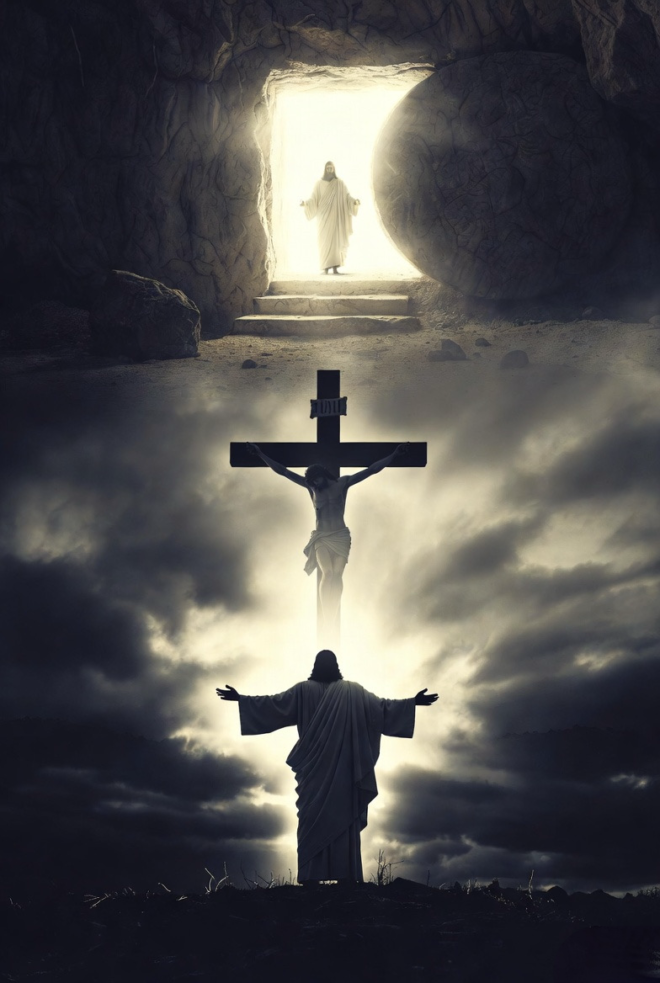
I. The Upper Room
They gathered where the lamplight held the night at bay,
and bread was broken gently into willing hands.
A teacher poured out wine as dark as fading day,
and love was passed like flame between unsteady hands.
II. The Washing
He knelt before them, basin-borne, and cupped their feet,
the sovereign stooping low to serve the ones he chose.
In water wrung from linen came a truth complete:
that greatness wears the form of one who humbly bows.
III. The Garden
Gethsemane was silver-grey beneath the moon’s cold eye,
the olive groves had heard a thousand prayers before.
Alone, he gave his trembling will up to the sky,
and in that silence, something ancient closed a door.
IV. The Arrest
The torches came like fireflies between the ancient trees,
with swords and wooden staves and one who bore a kiss.
He stood without resistance in the midnight breeze –
not helplessness, but mercy chose to suffer this.
V. The Trial
Before the stone-faced governors of empire and of law,
a question hung unanswered in the morning air.
What truth is this? the prefect asked – then washed his hands
and let the question rot unanswered in the air.
VI. The Way
The cobblestones of Jerusalem have worn to smooth and pale,
but once they bore the weight of wood and wounded feet.
A mother watched in silence past the city veil –
a mother storing grief the way the marrow stores its heat.
VII. The Crucifixion
The hill was bare as mercy stripped to bone and sky,
and three were lifted up on beams of borrowed wood.
Between two others, one made no attempt to cry
for rescue – only prayed that all be understood.
VIII. The Darkness
At noon the light withdrew as if the sun turned inward,
and earth itself fell still, attending what was done.
A veil was torn in two, from outer edge to inner core –
between the seen and unseen, something was undone.
IX. The Descent
What passes through the gate that none return to tell
is kept in silence deeper than the deepest sea.
Some say he walked through every locked and bolted cell
of grief, and lit a lamp in every vacancy.
X. The Vigil
The women sat with spices and with grief well-known,
the kind that settles in the body like cold stone.
They did not leave – they kept their watch beside the tomb,
the way the faithful do: they tend, and wait, and stay.
XI. The Harrowing
In every tradition, death is not the final word –
across the many names the sacred wears through time,
the soul that enters darkness is not left unstirred:
a hand extended reaches past the edge of rhyme.
XII. Before the Dawn
The third day came as third days always come:
with birds before the light, and dew on ancient stone.
The universe breathed softly; everything was numb
with the enormous quiet of a God alone.
XIII. The Empty Tomb
She came with oil and grief – and found the stone rolled clear.
She thought: the gardener. She thought: someone has moved him.
Then one word broke the whole of morning: her name, here,
spoken as if her name itself had been rewritten.
XIV. The Recognition
He was not ghost nor memory nor wish made briefly flesh,
but something the disciples could not yet articulate –
familiar as the breaking of the bread afresh,
familiar as a wound still wet with saving grace.
XV. The Gift That Remains
What crosses every boundary of creed and tongue and land
is this: that suffering is met, and not abandoned.
That someone in the darkness reached a knowing hand,
and love, though briefly buried, would not stay in the ground.
by Bakchos



Beautiful Triduum poem Bakchos, I hope that people read it over Easter and reflect on what Easter is really meant to be about.
Good poem Bakchos, powerful image.
Nice poem Bakchos, enjoy your Easter break.
Bakchos that’s a beautiful retelling of the Triduum. Congratulations on a masterful poem.
This poem is a powerful Easter meditation, thank you for sharing it.
A peaceful and gentle meditation for Easter. Quietly beautiful.
Ce poème-séquence est une œuvre ambitieuse et, dans l’ensemble, admirablement accomplie. La structure en quinze stations évoque délibérément les chemins de croix liturgiques, tout en s’en affranchissant pour atteindre une universalité laïque — un équilibre délicat, réussi avec tact.
Ce qui fonctionne : La langue est sobre sans être froide. Des images comme « a mother storing grief the way the marrow stores its heat » ou « spoken as if her name itself had been rewritten » atteignent une beauté authentique, ancrée dans le corps et dans le concret. La section IX (The Descent) possède une réserve théologique rare : plutôt que de décrire l’indescriptible, le poème choisit le silence — geste juste et courageux.
Ce qui fragilise : Quelques fissures formelles méritent attention. La strophe V répète mot pour mot « unanswered in the air », ce qui ressemble moins à un refrain voulu qu’à une négligence éditoriale. La section VIII multiplie les préfixes privatifs (withdrew, undone, unseen) jusqu’à l’effet légèrement mécanique. La section XI, en voulant embrasser toutes les traditions, risque une générosité qui dilue l’image centrale.
Au total : une séquence de Passion digne et souvent émouvante, dont la voix — mesurée, non-sectaire, humaniste — est sa force la plus durable.
A wonderful Easter poem. Congratulations Bakchos on your wonderful achievement.