
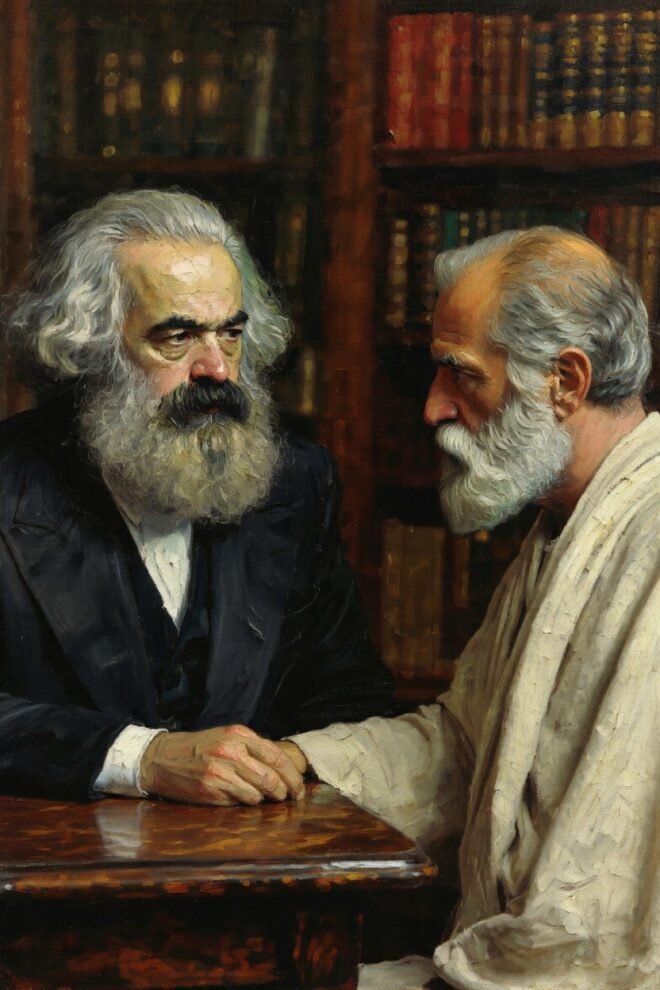
There is a peculiar comfort in believing that the world as it stands is the world as it must be. Power, we tell ourselves, flows naturally to those most capable of wielding it. Hierarchies arise because someone must lead. Inequality persists because talent and effort are unequally distributed. These explanations feel like common sense precisely because they are so pervasive — woven into the fabric of how we talk about society, work, and worth. Yet this very pervasiveness ought to give us pause. When an account of the world happens to justify the arrangements most beneficial to those who hold the greatest power within it, we are entitled to ask whether we are dealing with truth or with mythology.
It is this question — the question of what is chosen and what is inevitable, what is constructed and what is natural — that sits at the heart of any serious analysis of power in society. Two figures separated by nearly two and a half millennia have proven most illuminating in confronting it: Sophocles, the Athenian tragedian, and Karl Marx, the nineteenth-century political economist and philosopher of history. On the surface, these two thinkers appear to have little in common. One writes in verse about a king who unknowingly murders his father and marries his mother; the other writes in dense prose about commodity fetishism and the laws of capitalist accumulation. Yet both are fundamentally concerned with the same problem: the way that human beings systematically misread the sources of their own suffering, mistaking the products of history and social arrangement for the decrees of nature or fate.
This essay argues that power relationships in society are neither natural nor inevitable, but are instead historically produced and ideologically maintained. Drawing on Sophocles’ Oedipus Tyrannus and the social theory of Karl Marx, I will argue that the most enduring feature of power is its capacity to conceal itself — to present what is chosen as necessary, and what is necessary as chosen. Understanding this inversion is not merely an academic exercise. It is the precondition for any meaningful thinking about change.
I. The Blindness of Oedipus and the Ideology of Power
Sophocles’ Oedipus Tyrannus begins with a plague. Thebes is suffering, and Oedipus — the brilliant ruler who once solved the riddle of the Sphinx — is determined to find the cause. The oracle declares that the city is polluted by the presence of the killer of the former king, Laius. Oedipus launches a relentless investigation, confident in his own rational powers, certain that knowledge and will can overcome whatever obstacle stands before him. He is, by every measure available to him, the most capable man in Thebes.
What the tragedy reveals, of course, is that Oedipus is also the least self-knowing. The man who solved the riddle of the Sphinx — ‘What walks on four legs in the morning, two at noon, and three in the evening?’ — cannot solve the riddle of himself. When the blind prophet Tiresias enters the stage, his message is devastating in its directness. ‘Your ears and your mind are as blind as your eyes,’ he tells Oedipus. The man who sees everything sees nothing. The man who commands cannot comprehend the nature of his own authority — or its origins in parricide and incest.
This dramatic irony is not simply a device of narrative suspense. It is a profound statement about the relationship between knowledge, power, and self-deception. Oedipus did not choose to kill his father or marry his mother; in a meaningful sense, he did everything he could to avoid doing so. He fled what he believed to be his home precisely to escape the oracle’s prophecy. Yet the very act of flight — the exercise of what felt like autonomous agency, rational self-determination — was itself the mechanism by which the prophecy was fulfilled. He believed he was escaping fate; he was enacting it.
The relevance to power is this: Oedipus at the crossroads did not think of himself as an agent of destiny when he struck down the stranger who had nearly run him off the road. He thought of himself as a proud nobleman defending his honour. The act felt free, chosen, righteous. The broader context — the prophecy, the social codes of aristocratic honour that made violent retaliation almost obligatory, the structural position of a man raised to believe himself exceptional and therefore entitled to exceptional responses — all of this was invisible to him. What was socially conditioned appeared as personal choice. What was foreordained by a web of circumstances he had no part in creating appeared as freedom.
Power, Sophocles suggests, operates precisely through this kind of blindness. It does not announce itself as power. It presents itself as reason, as order, as the natural hierarchy of things. The king rules not because he has seized power, but because he has proven himself most worthy. And if the king is ultimately revealed to be the source of the very plague he sought to cure — if the most powerful man in Thebes is himself the origin of the city’s corruption — then the legitimacy of power grounded in apparent merit and apparent knowledge is radically destabilised.
II. Marx and the Inversion of Choice and Necessity
Karl Marx, writing more than two millennia after Sophocles, diagnosed a structurally similar form of blindness at the heart of capitalist society. For Marx, the central mystification of capitalism was not the ignorance of any individual, but rather a systematic feature of how capitalist social relations presented themselves. He called this phenomenon ‘commodity fetishism’: the process by which the social relations between people — relations of exploitation, hierarchy, and domination — appear instead as natural relations between things.
The price of a commodity, for example, appears to be an objective property of the commodity itself, like its weight or colour. That this price is in fact the expression of a specific historical relationship between capital and labour — a relationship involving coercion, expropriation, and the legal enforcement of property rights — is rendered invisible. Workers appear to sell their labour freely, as equal parties to a contract. The compulsion that underlies this freedom — the fact that the vast majority of people own nothing but their labour-power, and will starve unless they sell it — is obscured behind the juridical fiction of free exchange.
Marx’s great insight was to show that this is not simply a matter of ignorance or false belief that could be corrected by better education. It is a structural feature of the system itself. Capitalism generates, as a condition of its own functioning, the ideological forms that make it appear natural and inevitable. The worker who experiences her wage as the just reward for her effort, the entrepreneur who experiences her profit as the deserved return on her risk and ingenuity, the economist who treats the market as a natural phenomenon obeying eternal laws — all of these are not simply mistaken. They are responding rationally to the surface appearances of a system that is genuinely mystified.
This is the deeper meaning of Marx’s claim that it is not consciousness that determines social being, but social being that determines consciousness. We do not first form ideas about the world and then organise society accordingly. Rather, the social relations we inhabit — the forms of work, ownership, and exchange that structure our daily lives — generate the categories through which we think about the world. Power is not simply imposed from above; it is reproduced from within, in the very way we understand ourselves and our choices.
The parallel with Oedipus is striking. Just as Oedipus mistakes the conditioned for the chosen and the chosen for the inevitable, so the subjects of capitalist society systematically mistake historically produced inequalities for natural differences in talent or virtue, and mistake historically contingent arrangements of property and power for the necessary preconditions of civilised life. In both cases, the effect is to foreclose thinking about alternatives — to make the existing order appear not as one possibility among many, but as the only possible world.
III. The Mechanics of Power: Hegemony and Consent
How precisely does power achieve this kind of consent? How does it naturalise itself in the minds of those it dominates? The Italian Marxist Antonio Gramsci, writing from a Fascist prison in the 1930s, developed one of the most influential frameworks for thinking about this question. His concept of ‘hegemony’ describes the process by which the worldview of a dominant class becomes the common sense of an entire society — not through force alone, but through the active intellectual and moral leadership of institutions, media, education, religion, and culture.
Hegemony does not mean that the dominated classes are simply duped. People are not passive recipients of ideology. Rather, hegemony involves the active incorporation of subordinate groups into a vision of the social order that serves the interests of the dominant, while offering enough genuine concessions and partial truths to sustain consent. The promise of social mobility, for example, is not entirely empty. Some people do move up. But the existence of individual exceptions does not alter the structural reality that the rate of social mobility is highly constrained, and that the system as a whole reproduces inequality across generations.
What Gramsci understood, and what the Oedipus myth dramatises, is that power is most secure not when it is most brutal, but when it is most invisible. A sovereign who must constantly resort to violence to maintain order has already lost the ideological battle; his power is nakedly coercive, and therefore visibly contingent. But a social order in which people internalise the logic of their own subordination — in which the worker believes that her poverty is the result of her own insufficient effort, in which the marginalised believe that their marginalisation reflects their inherent limitations — achieves a far more stable and economical form of domination.
Tiresias speaks this truth to Oedipus directly, but Oedipus cannot hear it. He cannot hear it not because he is stupid — he is, by the standards of the play, the most intelligent man in Thebes — but because the truth Tiresias speaks would require him to radically reconstruct his understanding of himself, his authority, and the order over which he presides. Power does not simply blind those who lack it. It also blinds those who possess it, because recognising the contingent and constructed nature of one’s authority is deeply threatening to its maintenance.
IV. History, Change, and the Ambiguity of Capitalism
One of the most important and frequently misunderstood aspects of Marx’s thought is his attitude toward capitalism itself. Marx was not simply an anti-capitalist who saw nothing but exploitation and suffering in the capitalist mode of production. He was a dialectical thinker who understood capitalism as a historical stage — a necessary, if brutal, phase in the development of human productive powers.
Capitalism, for Marx, was revolutionary. It shattered the fixed hierarchies of feudal society. It dissolved ancient forms of community and tradition. It created, for the first time in human history, the productive forces capable of meeting the material needs of all of humanity. Its restless drive to accumulate, to innovate, to expand, generated both the technology and the social forms — the urban working class, the global market, the centralised state — that would ultimately provide the material basis for a more just social order. Marx did not mourn the old world that capitalism destroyed. He recognised that history moves through contradiction, and that the violence and exploitation of capitalist development were also, in a terrible sense, the preconditions for the possibility of something better.
This is the source of what one might call the constitutive ambiguity of Marx’s work. Capitalism is simultaneously condemned as a system of exploitation and recognised as an engine of historical progress. It is both the problem and, in a paradoxical sense, the solution — or at least the necessary precondition for a solution. Understanding this dual character is essential for grasping Marx’s relevance today, in a period that increasingly resembles what he called a time of transition: an old order in decline, a new one not yet born.
We live in a moment of profound instability in the structures of global power. The postwar liberal order — with its multilateral institutions, its commitments to democratic governance, its carefully managed but broadly expanding forms of social welfare — is under intense pressure. The certainties that seemed to define the end of the twentieth century have dissolved. What was presented as the inevitable end-point of history — liberal democracy and market capitalism as the final form of human social organisation — has been revealed as one historically contingent arrangement among others, now facing crises it cannot easily manage.
Marx’s framework helps us to see that this instability is not a deviation from normality, but rather the normal condition of capitalist society. Crises are not accidents; they are built into the structure of a system organised around the relentless accumulation of capital in the hands of an ever-smaller fraction of the population. And the ideological forms that have served to naturalise this system — the meritocratic narrative, the fetishism of individual liberty, the identification of market freedom with freedom as such — are themselves now under strain.
V. Choice, Necessity, and the Question of Agency
The deepest question raised by both Sophocles and Marx is ultimately a question about agency: to what extent are human beings genuinely free to shape the conditions of their own lives, and to what extent are they the products of forces they neither chose nor control?
The temptation, when confronted with the full weight of structural determination, is to conclude that agency is simply illusory — that we are all Oedipus, stumbling toward a fate written before we were born, our experience of freedom nothing more than ignorance of the necessity that governs us. This is a misreading of both Sophocles and Marx. Oedipus is a tragedy not because fate is omnipotent, but because knowledge — when finally obtained — makes possible a different kind of response. Oedipus cannot undo what he has done. But his recognition of the truth is itself a form of transformation. He goes into exile not as a passive victim of fate, but as a man who has confronted the truth of his own situation and chosen to accept its consequences.
For Marx, similarly, the recognition of the structural determinants of social life is not the end of agency but its beginning. Understanding that what appears as natural necessity is actually historical construction is the precondition for collective action to change it. The critique of ideology is not a counsel of despair; it is the clearing of the ground on which genuine political agency becomes possible. Workers who understand the structural sources of their exploitation are not therefore absolved of the need to organise and struggle. They are, rather, better equipped to do so effectively.
The distinction that both Sophocles and Marx press upon us — between what is genuinely necessary and what is merely presented as such, between what we are compelled by circumstances to do and what we choose while believing ourselves compelled — is not a philosophical nicety. It is a practical and political distinction of the first importance. Every system of domination depends on collapsing this distinction, on convincing those it dominates that no alternative exists, that the present order is the natural order, that resistance is futile or foolish.
And every project of emancipation begins with reopening it. To ask, as Marx asks, who benefits from a given arrangement and who loses; to ask, as Tiresias asks, what it is that we are not seeing; to refuse the comfort of false necessity — these are the fundamental acts of political consciousness. They do not guarantee success. Oedipus, after all, does not escape his fate. But the form of his confrontation with it — the relentless, however belated, pursuit of truth — transforms tragedy from mere suffering into something that compels recognition and, perhaps, instruction.
VI. Power Relationships Today: The Continuing Relevance
The power relationships that structure contemporary society bear the marks of the long history traced by both Sophocles and Marx. Economic inequality has reached levels not seen since the Gilded Age. The wealthiest one percent of the global population holds more wealth than the remaining ninety-nine percent combined. This is not the result of proportionally greater virtue, effort, or intelligence on the part of the wealthy. It is the result of a set of legal, political, and economic arrangements — property rights, inheritance laws, financial regulation, the structure of corporate governance — that systematically direct surplus value toward capital at the expense of labour.
Yet the ideological forms that sustain this arrangement remain remarkably powerful. The narrative of meritocracy — the story that position in the social hierarchy reflects merit, and merit reflects effort and talent — continues to command widespread assent, even among those most harmed by its implications. If you are poor, the logic runs, it is because you have not worked hard enough, or been smart enough, or made the right choices. The possibility that the game itself is rigged — that the choices available to people are structured by their position in a system they did not choose — remains difficult to think, not because it is implausible, but because the entire apparatus of common sense militates against it.
This is the Oedipal structure of contemporary ideology. We believe we act freely while the structures that constrain our freedom remain invisible. We believe our success is chosen while our failures appear as fate. Marx’s inversion — that what we think we choose is often determined, and what we think is determined is often the product of choice — remains as illuminating today as it was in the mid-nineteenth century, perhaps more so, given the sophistication with which power now operates through media, algorithmic curation, and the management of information environments.
What has changed is the particular form that power takes and the specific ideological languages through which it legitimates itself. Nationalism, religious fundamentalism, and technocratic managerialism have each in different periods and different contexts served as the common-sense frameworks through which existing power relations are naturalised and alternatives made unthinkable. Understanding these languages — not simply as false beliefs to be corrected, but as responses to real social dislocations that genuine structural change must address — is among the most urgent intellectual tasks of the present moment.
Conclusion: Toward a Politics of Clarity
Sophocles and Marx are not, of course, the only guides available to us in thinking about power. Feminist theory has shown how gender hierarchies are naturalised through narratives of biological difference. Post-colonial thought has demonstrated how the legacies of imperial domination persist in the political and economic structures of the present. Critical race theory has analysed the ways that racial hierarchy is reproduced through ostensibly neutral legal and institutional forms. Each of these traditions performs, in its own domain, the same fundamental operation: the denaturalisation of what presents itself as natural, the historicisation of what presents itself as eternal, the politicisation of what presents itself as simply given.
What unites them, and what unites them with Sophocles and Marx, is the conviction that understanding power requires a willingness to be uncomfortable — to see ourselves as implicated in the structures we inhabit, to recognise the extent to which our apparently free choices are shaped by forces we did not choose, to hear, however painfully, the words of Tiresias: that our ears and our minds are as blind as our eyes.
This is not a call for paralysis or guilt. It is a call for clarity. The first step toward changing a system is understanding how it works — not just its surface operations, but its deep structural logics, the ways it reproduces itself through ideology and consent as well as through force. The second step is recognising that because these structures are historical — because they were made by human beings acting within specific social conditions — they can in principle be unmade by human beings acting collectively and with sufficient understanding.
Oedipus discovers the truth too late to avoid his fate, but not too late to bear witness to it. In his tragedy, Sophocles offers his audience something rarer and more valuable than a happy ending: the recognition that the truth, however terrible, is preferable to comfortable blindness. Marx, similarly, did not promise an easy path to a just society. He promised only that those who understood the real nature of the social order in which they lived were better placed to act effectively within it — and, ultimately, to transform it.
Power in society is not a natural phenomenon, like gravity, operating by laws that are fixed and unchangeable. It is a social phenomenon, produced and reproduced by human action, sustained by ideology and consent, and therefore, however durably, subject to challenge and transformation. This is the hard-won lesson of both the Greek stage and the political-economic tradition that bears Marx’s name. It is a lesson that every generation must learn anew, from the specificity of its own historical situation — with clear eyes, clear minds, and the willingness to follow the argument wherever it leads.


If humanity wants to move forward, we need to remove the authority of religion and money from our society. Humanity needs to find a better path forward.
We often find solace in the notion that society’s structure is inevitable, a reflection of natural order rather than human design. It’s reassuring to think that authority gravitates toward the adept and ambitious, that leadership structures emerge from necessity, and that disparities in wealth and status stem solely from varying levels of skill, drive, and merit. These ideas masquerade as intuitive truths, embedded deeply in our cultural narratives—shaping discussions on economics, education, and personal success. They echo in boardrooms, classrooms, and media outlets, reinforcing the idea that the system rewards the worthy while sidelining the rest.
But this ubiquity should spark skepticism. Why do these justifications align so neatly with the interests of the elite? Consider how historical empires rationalised conquest as divine right, or how modern capitalism frames extreme inequality as the byproduct of innovation and hard work, ignoring systemic barriers like inherited wealth, discrimination, or unequal access to opportunities. In reality, power often perpetuates itself through mechanisms that favor the already privileged: lobbying, nepotism, and policies that entrench advantages. When billionaires fund think tanks to promote “meritocracy” while dodging taxes, or corporations tout “equal opportunity” amid wage gaps, it’s worth probing deeper.
This isn’t to dismiss individual agency entirely—talent and effort matter—but to recognise that the dominant worldview may serve as a veil, obscuring exploitation and injustice. By questioning these myths, we open doors to reform: progressive taxation, inclusive education, and accountability for those at the top. True progress demands we dismantle the comforting illusions that preserve the status quo, fostering a society where power is earned through equity, not inherited through illusion. Only then can we build a world that truly reflects our collective potential, rather than the self-serving stories of a few.
The concept of meritocracy, where social and political positions are allocated based on individual ability, talent, and effort rather than birthright or wealth, has deep historical roots that predate the term itself. While the word “meritocracy” was coined in 1958 by British sociologist Michael Young in his satirical book “The Rise of the Meritocracy”, which portrayed it as a dystopian system entrenching new forms of inequality, the underlying ideas trace back millennia across various civilisations.
One of the earliest manifestations appears in ancient China, where philosopher Confucius (551–479 BCE) promoted governance by those with moral and intellectual merit rather than hereditary status. This philosophy influenced the imperial examination system (keju), formalised during the Sui Dynasty (581–618 CE), which selected government officials through rigorous civil service exams open to commoners, creating an administrative meritocracy that endured for over a millennium. By the 17th century, this model spread to British India, introducing merit-based selection in colonial administration.
In ancient Greece, Plato’s “The Republic” (circa 375 BCE) advocated for a meritocratic hierarchy led by “philosopher-kings”—wise rulers selected through education and innate ability—while Aristotle echoed similar sentiments in favouring rule by the virtuous elite. These ideas resonated with aristocracy as “rule of the best,” emphasising moral and intellectual excellence over lineage.
The Enlightenment era (17th–18th centuries) revitalised meritocratic principles in Europe and America, influenced by thinkers like John Locke and Voltaire, who championed reason and individual potential. In the United States, Founding Fathers such as Thomas Jefferson and Benjamin Franklin embodied this through their emphasis on self-improvement and opportunity, aligning with democratic ideals and the “self-made man” narrative popularised in the 19th century. Observers like Alexis de Tocqueville noted in the 1830s how American society fostered a belief in advancement through effort, though often amid racial and gender exclusions.
By the 19th century, meritocracy influenced reforms like Napoleonic France’s promotion based on talent and Britain’s shift from nepotism to exam-based civil service. Post-World War II, it gained traction in Western democracies, tied to education expansion and social mobility, yet critics like Young warned of its potential to mask systemic biases. Today, meritocracy remains contested, often viewed as a myth perpetuating inequality rather than a pure historical ideal.
COMMUNIST!!
Only a total unhinged moron would support Marx and Communism. You are the moron I’m talking about!!
You’re showing how uneducated you really are.
Clearly you’re a certified genius … or a certified something … that’s for sure ?
This is the crux of the issue: how precisely does power secure consent and naturalise itself among those it dominates? Antonio Gramsci’s concept of ‘hegemony’ explains that the ruling class’s worldview becomes society’s common sense through the moral and intellectual leadership of institutions — media, education, religion, and culture.
This essay is a compelling intellectual exercise, masterfully weaving Sophocles and Marx into a critique of power’s ideological veils. Its thematic ingenuity and stylistic polish make it a rewarding read, particularly for those interested in how myths of inevitability sustain inequality. However, its oversights—sparse evidence, unaddressed intersections, and unexamined counterviews—prevent it from achieving the “clarity” it advocates. As a bridge between literature and theory, it succeeds admirably; as a blueprint for understanding or challenging contemporary power, it invites further elaboration. Readers will leave provoked, if not fully convinced, underscoring the essay’s value as a catalyst for deeper inquiry.
« Pouvoir, Destin et Fausse Nécessité : les rapports de pouvoir dans la société de Sophocle à Marx » est un essai interdisciplinaire ambitieux qui établit un pont entre la tragédie grecque antique et l’économie politique moderne pour disséquer la manière dont les structures de pouvoir se déguisent en vérités inévitables. L’auteur soutient que le pouvoir dissimule sa nature construite par le biais de mécanismes idéologiques, en traçant des parallèles entre l’Œdipe Roi de Sophocle et les critiques du capitalisme par Karl Marx, tout en intégrant le concept d’hégémonie d’Antonio Gramsci. L’argument central de l’essai — selon lequel reconnaître cette « fausse nécessité » est indispensable à l’exercice de l’agency et au changement — est intellectuellement provocateur et d’une actualité saisissante, notamment à une époque marquée par l’élargissement des inégalités et la polarisation idéologique. Cependant, si l’essai brille par son élégante synthèse de penseurs disparates, il cède parfois à la surgénéralisation, à des contre-arguments insuffisamment développés et à un penchant pour l’effet rhétorique au détriment de la rigueur empirique. Cette critique évalue la profondeur thématique, la structure argumentative, la langue et l’efficacité globale de l’essai, et conclut qu’il excelle en tant que méditation philosophique, mais qu’il reste en deçà d’une analyse sociale exhaustive.
Analyse thématique
Sur le plan thématique, l’essai s’articule autour de l’inversion du choix et de la nécessité : ce que les sociétés perçoivent comme naturel — hiérarchies, inégalités — est souvent historiquement contingent, tandis que les véritables nécessités se trouvent occultées par l’idéologie. Cette idée est illustrée par la cécité tragique d’Œdipe — ses actions « libres » accomplissant précisément la prophétie qu’il cherche à fuir — ainsi que par le fétichisme de la marchandise chez Marx, où des rapports d’exploitation apparaissent comme des lois objectives du marché. L’intégration du concept gramscien d’hégémonie apporte une nuance supplémentaire, en expliquant comment le pouvoir obtient le consentement non par la force brute, mais par le biais du « sens commun » culturel — comme les récits de méritocratie qui légitiment les inégalités.
L’un des points forts de l’essai réside dans ses parallèles perspicaces, qui rendent accessibles des théories abstraites. L’aveuglement d’Œdipe sur lui-même fait écho à la manière dont les individus sous le capitalisme intériorisent leur subordination, en attribuant la pauvreté à des défaillances personnelles plutôt qu’à une logique systémique. L’extension aux enjeux contemporains — tels que la curation algorithmique et le nationalisme comme outils idéologiques modernes — ancre des idées antiques et du XIXe siècle dans le présent, les rendant pertinentes pour des lecteurs aux prises avec les crises du XXIe siècle, comme l’érosion de la démocratie libérale.
Cette ambition thématique révèle néanmoins certaines faiblesses. L’essai traite le pouvoir comme une entité monolithique, en ignorant largement ses intersections avec la race, le genre ou le colonialisme, jusqu’à une brève mention en conclusion. S’il reconnaît l’existence des théories féministes, postcoloniales et critiques de la race, celles-ci sont reléguées à une énumération cursive plutôt qu’intégrées à l’analyse, ce qui en dilue la portée. On pourrait par exemple s’interroger sur la manière dont l’autorité patriarcale d’Œdipe ou le tropisme eurocentrique de Marx viendraient compliquer le propos. Par ailleurs, la lecture dialectique du capitalisme proposée par l’essai — à la fois exploiteur et progressiste — demeure insuffisamment approfondie. L’essai salue le rôle révolutionnaire du capitalisme dans la destruction du féodalisme, mais ne se confronte pas à ses échecs, tels que la dégradation environnementale ou l’exploitation persistante du Sud global, qui pourraient pourtant remettre en question la thèse du « progrès historique » chez Marx.
One of your New York friends, Marc, introduced me to your blog about 18 months ago. I’ve worked with Marc on a number of human rights matters. I enjoy reading your views on the many issues that you have expressed your views on. I have often wondered what drives people like you and Marc to keep challenging the powers that be. I’m pleased that some people still have the fight left in them. Keep up the struggle l, it’s important.