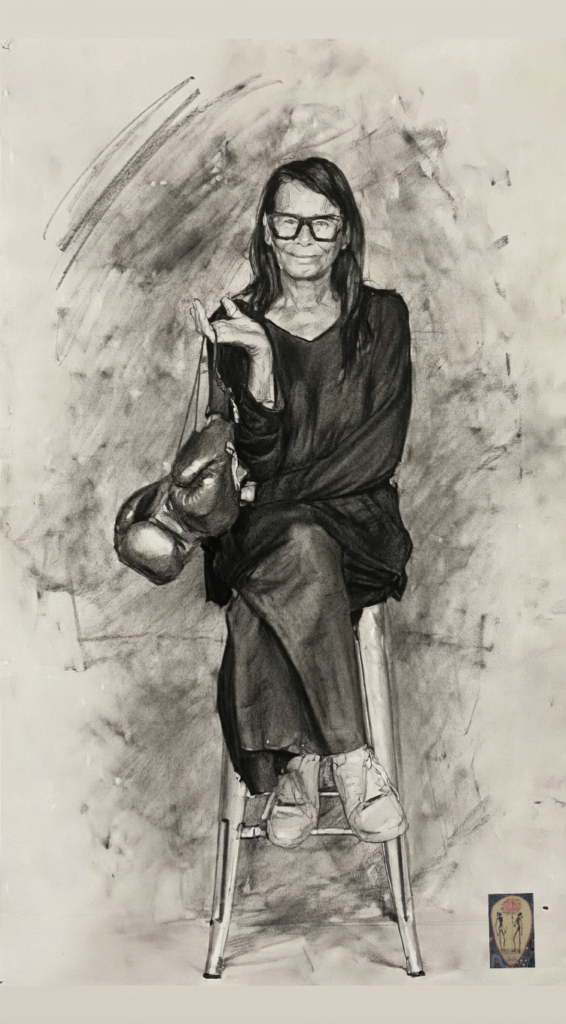
Widjabul Wiyebal Woman of the Bundjalung Nation
8 July 1959 – 21 March 2026
“You know who you are. We have been here for thousands of years. How extraordinary that is. So always be generous and kind.”
Pastor Frank Roberts Junior, to his children
The Return to Country
On 21 March 2026, a woman who had spent six decades teaching Australia to welcome itself home returned, at last, to Country. Rhoda Ann Roberts AO – Widjabul Wiyebal woman of the Bundjalung Nation, daughter of lizard totem, twin, mother, mentor, artist, and trailblazer – passed peacefully after a seven-month battle with a rare ovarian cancer. She was sixty-six years old. The words her family chose to mark her passing were not measured in achievements. They were measured in love: words fail, they said, to capture the depth, the intelligence, the warmth. She dedicated her life to culture, to Country, and to people from all walks of life. She never judged. She never discriminated. She always wanted to help uplift.
That is the whole truth of Rhoda Roberts – and it is a truth that simultaneously understates everything she accomplished. Because the woman who never judged was also the woman who remade Australia’s ceremonial landscape from the ground up. The woman who never discriminated also broke every barrier placed before her, with a grace so complete that the barriers themselves seemed briefly ashamed of their existence. She coined a phrase – Welcome to Country – that reshaped the opening of every parliament, every graduation, every corporate conference, every international sporting event held on this continent. She did not invent the protocol; she revived it, translated it, gave it a name, and handed it back to the nation as a gift it did not know it needed. That is the genius of Rhoda Roberts. She made transformation feel like homecoming.
To eulogise her is to trace a line that begins in deep Bundjalung time, runs through the trauma of colonisation and the fire of activism, and arrives at a contemporary Australia that is, in no small part, more honest about itself because she walked through it. Her life was not a list of firsts – though the firsts were many and historic. It was a philosophy made flesh: that excellence is sovereignty, that storytelling heals, that culture kept alive is a people kept alive, and that generosity is the most radical act a human being can perform.
Roots Deep as River Red Gum
She entered the world on 8 July 1959, at Canterbury Hospital in Sydney, born a twin alongside her sister Lois. The twins arrived into a family already shaped by resistance. Her grandfather, Frank Roberts Senior, had been a pastor and a founder of the Aboriginal Progressive Association, a man who built a settlement – Cubawee, near Lismore – and watched authorities bulldoze it in 1964. The lesson was not lost on his descendants: that what is built on Country can be taken, but what is carried inside cannot.
Her father, Pastor Frank Roberts Junior, was the defining force of her formation. Raised under the shadow of the Aboriginal Protection Board on Cabbage Tree Island, he went on to study at Oral Roberts University in Tulsa, Oklahoma – where he prayed alongside Martin Luther King Junior. He returned to Australia transformed, joined the Aboriginal Tent Embassy in 1972, lobbied Prime Minister Gough Whitlam on land rights, and helped secure the landmark 1967 referendum. He co-founded the Koori Mail. He was the first Indigenous appointee to the Australian Board of Missions. He was, in the deepest sense, a nation-builder. And he raised his daughter to understand that identity was not a burden, but an inheritance of extraordinary weight and beauty.
The family moved to Lismore in northern New South Wales when the twins were eighteen months old – a return to Bundjalung Country that was itself an act of cultural intention. Her mother, Muriel, was a white, well-educated woman; a gifted dressmaker who had fallen in love with a man whose very existence defied the racial order of the era. Together, Frank and Muriel built a home full of music, books, and stories. Rhoda grew up hearing both the cadences of Bundjalung culture and the rhythms of a broader world. She absorbed everything.
What she also absorbed, daily, was racism. Colour bars at local cafes. A swimming pool that permitted Aboriginal children only during school carnivals – never on weekends, when the town was simply living its life. Careers advisers who looked at a bright, curious young woman and told her she would end up like cousins on the mission. A hospital matron who refused to train her as a nurse on racial grounds alone. These were not historical abstractions. They were the furniture of her adolescence. She left Richmond River High after Year 10 – one of the first Aboriginal students in the district to reach that milestone – not because she could not continue, but because she would not continue to be diminished.
She went, instead, to nursing – training at Canterbury Hospital, working on Hayman Island, then travelling to London for advanced accident-and-emergency training at Westminster Hospital. From there she moved through Italy, Greece, and India, nursing, volunteering, witnessing. These years abroad did something essential: they showed her that the marginalisation she had experienced in Lismore was not a local accident but a global structure. And they showed her, with equal clarity, that culture – story, ceremony, art, song – was everywhere the thing that kept people human in the face of that structure. She came home to Sydney in the mid-1980s knowing, with the precision of a person who has survived hardship, exactly what she was for.
A Name for an Ancient Ceremony
She enrolled at Brian Syron’s acting studio. She began touring theatre productions. The shift from nursing to the arts was not a departure; it was a continuation. Both vocations were about tending to the living, about keeping something vital from going out. And in the Sydney of the late 1980s, the Indigenous arts scene was electric with possibility and grievance in equal measure. The reconciliation conversation was beginning to stir. Aboriginal artists were demanding stages, not margins. The question was not whether to speak, but how to make the speaking irresistible.
In 1987, Rhoda attended the First National Black Playwrights’ Conference and Workshop in Canberra. The gathering was, by all accounts, a watershed – creatives, elders, and activists converging to ask what an authentic Indigenous theatrical voice looked like on the national stage. From that energy, the Aboriginal National Theatre Trust emerged in 1988. Rhoda was a co-founder, alongside Brian Syron, Lydia Miller, and others, with the great Justine Saunders as a guiding presence. It was Australia’s first national Indigenous theatre company, and it was built not just to produce plays but to produce a new cultural confidence.
It was in this context – organising events, welcoming delegates, thinking about protocol – that Rhoda did something quietly revolutionary. She began inviting the traditional custodians of each location to formally welcome participants onto their Country. The practice was ancient; what was new was naming it, formalising it, and insisting on its place at the beginning of every gathering. Welcome to Country was not coined in a boardroom or by committee. It emerged from a woman’s deep understanding that respect for the land begins with acknowledging who has always cared for it. That a ceremony performed for tens of thousands of years deserved a name, a place on the program, and the seriousness it had always been owed.
The phrase spread. At first through activist and arts networks, then through education and government, then – as the reconciliation movement gathered force through the 1990s – into the mainstream. Today, Welcome to Country is performed at the opening of the Australian Parliament. It precedes Olympic ceremonies. It opens university graduations, corporate conferences, hospital grand rounds, and international summits. It is taught in primary schools as foundational civic knowledge. All of this traces back to a Bundjalung woman who understood that an ancient protocol needed a contemporary vehicle – and built one.
First Voice on the Screen
While culture-making occupied one arm, media occupied the other. In 1989, SBS Television launched First in Line, co-hosted by Rhoda and Michael Johnson. They were, in that moment, the first Indigenous presenters on Australian prime-time television. The significance cannot be overstated. Australian television had been, for its entire history, a mirror that showed the nation to itself – and that mirror had never once reflected an Aboriginal face in a prime-time presenter’s role. Rhoda Roberts stepped in front of the camera not merely as a journalist, but as a correction. As proof that the oversight had been exactly that: an oversight, now remedied.
In 1990 she fronted Vox Populi, the first Indigenous-hosted prime-time current affairs program. She produced documentaries. She wrote, directed, and shaped narratives that countered the stereotypes not by arguing against them, but by simply replacing them with something richer, more honest, and more interesting. For two decades from 1992, she produced and presented Deadly Sounds for Vibe Australia – a weekly national program amplifying Indigenous voices in music and culture. She contributed to ABC Radio National’s Awaye! She understood instinctively that the revolution in representation would not be won in a single broadcast but in the accumulated weight of presence, week after week, year after year, until absence was no longer the default.
The late 1990s brought a grief that would have broken many. In July 1998, while Rhoda was deep in the preparations for the Festival of the Dreaming, her twin sister Lois vanished. She had been hitchhiking near Nimbin. Police initially dismissed the family’s anguish with the cruel and cavalier phrase “gone walkabout”. Six months later, Lois’s remains were found in Whian Whian State Forest. She had been held captive, tortured, sexually assaulted, and murdered. She was thirty-eight years old. The case has never been solved. Rhoda took in Lois’s daughter Emily and raised her alongside her own children, Jack and Sarah. The loss never left her – she said she thought of Lois every night before sleep, every morning on waking, that Lois would always remain young. But she refused to let grief hollow her out. She threw everything back into the passion she had for the arts. That is not a cliché. It is the most precise description of what radical love looks like when it refuses to become despair.
The World Looked On and Saw Itself
The Sydney 2000 Olympics Opening Ceremony is remembered as one of the most spectacular in the history of the Games. What fewer people know, or remember clearly enough, is that its most profound eight minutes belonged to Rhoda Roberts. As Creative Director of the Indigenous segment – titled Awakening – she designed a sequence of song, dance, and ceremony that welcomed the world not merely to Australia but to the oldest living culture on earth. The entire globe, watching from every time zone, saw Bundjalung Country being honoured on its own terms. It was not a museum piece. It was not a postcard. It was a living culture at its most magnificent, presented by the woman who had spent her career insisting that magnificence was always what it had been.
The path to that moment had been long in construction. In 1995, Rhoda was appointed Indigenous Cultural Advisor for the Sydney Games. As Artistic Director of the Festival of the Dreaming in 1997, she curated four years of events that introduced non-Indigenous Australia to the full diversity and excellence of First Nations arts – music, theatre, dance, literature, film, and visual art converging in venues that had previously been closed to Aboriginal voices. Audiences encountered not an anthropological curiosity but a living, present, accomplished cultural world. No-one had seen Aboriginal Australia like this before, she later recalled. They saw it in all its diversity. They saw the excellence.
The momentum from those years carried her across the globe. She contributed to the Rugby World Cup 2003 opening. She was part of the Athens Olympics handover ceremony. She worked on the opening of the Musée du Quai Branly in Paris. She was Creative Director of Sydney New Year’s Eve celebrations from 2008 to 2011. Each engagement embedded Welcome to Country principles into international cultural practice. Each one placed an Aboriginal woman at the centre of the world stage – not as representative of Australia’s troubled past, but as architect of its creative present.
She founded festival after festival: the Dreaming Festival, relocated to Woodford in 2004 and running under her artistic direction until 2009; the Sydney Dreaming Festival; QPAC’s Clancestry Festival, co-directed with deep care for community. She directed Garma Festival in 2010. She established Dance Rites at the Sydney Opera House forecourt – a national competition for First Nations dance groups that became, in time, a transformative force for communities across the continent. These were not platforms she was handed. They were platforms she built, often from nothing, with the understanding that genuine cultural change requires not a moment but an infrastructure.
The House on the Harbour
In 2012, the Sydney Opera House created a position that had not previously existed – and created it because one woman had demonstrated, beyond argument, that it needed to exist. Head of First Nations Programming was the title. Rhoda Roberts was the appointment. She was the first person to hold the role at any major Australian performing arts institution, and she held it until 2021. In those nine years, she transformed one of the world’s most recognisable buildings into a home for First Nations storytelling at its most ambitious.
Under her stewardship, the Opera House became a site of ceremony as well as performance. The Badu Gili sail projections – illuminating the iconic shells with First Nations imagery for five minutes each evening – became a ritual of presence, a reminder to the harbour city that this building sits on Gadigal Country. Songlines illuminations for Vivid Sydney brought ancestral stories to light in ways both ancient and utterly contemporary. The Homeground festivals gave emerging First Nations artists access to the nation’s premier performance spaces. Deadly Voices from the House – weekly talks and a podcast – created an ongoing conversation between First Nations thinkers and the broader public. She launched Woggan-ma-gule ceremonies at Barangaroo, weaving welcome into the fabric of the precinct. Every intervention was both aesthetically rigorous and culturally grounded. This was her signature: excellence as sovereignty, performed with impeccable craft.
Her reach extended far beyond the Opera House. She served as Creative Director of Parrtjima Festival in Alice Springs – a light festival in the desert that became one of the most visually arresting cultural events in the country. She directed Boomerang Festival at Bluesfest. She was First Nations Creative Director at the Northern Rivers Performing Arts organisation. She consulted at NIDA and served as inaugural Elder in Residence at SBS. She produced operas. She directed documentaries. She sat on the boards of the NSW Anti-Discrimination Board, Actors Equity, NAISDA, the Yothu Yindi Foundation, Playwriting Australia – where she served as Chair – the Sydney Opera House Trust, and many others. She advised governments. She mentored artists. She showed up, again and again, with the same quality of attention for a young First Nations performer finding their feet as she brought to the world stage.
My Cousin Frank
In her final years, Rhoda did something characteristically intimate and characteristically bold. She turned to her own family’s story. My Cousin Frank was a one-woman show – written and performed by Rhoda – honouring her relative Frank Roberts: the boxer who, at the Tokyo Olympics in 1964, became Australia’s first Aboriginal Olympian. The production was staged at the Opera House and at NORPA venues in 2024 and 2025. It was, by all accounts, her most personal work: part autobiography, part family history, part meditation on dispersal and pride and the strange, painful, joyful business of being a Black Australian in a country still learning to love you back.
She was still performing it when she received her diagnosis. She continued working through treatment with the same unsentimental dedication she had brought to everything. In December 2025, the Opera House gathered her community for a surprise celebration of her life and legacy – a room full of the people she had mentored, collaborated with, argued with, laughed with, and carried. She received the tribute with the grace of someone who had long ago made peace with the idea that the work mattered more than the recognition, even when the recognition was deserved and long overdue.
She died on 21 March 2026, surrounded by family on Country. The date is not incidental: the first day of autumn in the southern hemisphere, when the light begins to soften and the land readies itself for a different kind of beauty. She was on her one-hundred-acre farm in northern New South Wales, near the Bundjalung Country she had returned to as an infant and never, in the deepest sense, left. Her long-term partner, Steven Field, was at her side. Her children – Jack, Sarah, and Emily – carried her home.
What She Left Behind
Honours came, as they always do, somewhat too late and somewhat inadequately. The Sidney Myer Facilitators Award in 1997. The Deadly Award for Broadcasting in 1998. Officer of the Order of Australia in 2016. The Helpmann Awards’ Sue Nattrass Award in 2018 – recognising sustained contribution to the performing arts. The Ros Bower Award in 2019. A Lifetime Achievement Award at the First Nations Media Awards. Prime Minister Anthony Albanese paid tribute. Artists, curators, directors, and community leaders across the country spoke of a woman who had opened doors they had not previously known existed, and who had done so not with fanfare but with the quiet certainty of someone who understood that the doors had always been theirs by right.
She also left, in the record of her public thinking, a body of reflection that deserves to be read alongside her creative work. After the 2023 Voice referendum defeat, when many First Nations leaders expressed grief and exhaustion, Rhoda spoke of optimism. Not the optimism of the wilfully naive, but the hard-won optimism of a woman who had watched her grandfather’s settlement bulldozed and had nonetheless built a career on the premise that change was not only possible but inevitable. She spoke of the next generation – educated, critical, clear-eyed – and said that they would give back to Australia in ways the country had not yet begun to imagine. That confidence was not performance. It was earned.
What Rhoda Roberts left behind is not easily catalogued. It is in every Welcome to Country performed on this continent – in every parliament, every classroom, every stadium, every corporate foyer, every hospital ward where a custodian is invited to speak first, before proceedings begin, before anything else is said, because what they say matters and always has. It is in the artists she mentored who now fill stages she built, who now run festivals she founded, who now teach students the lessons she spent a lifetime learning and sharing. It is in the festivals and the films and the radio programs and the operas and the one-woman shows and the policy documents and the board papers and the conversations that happened in green rooms and green fields and ceremonial circles. It is in her children, in her niece, in her community, in the understanding – slowly but surely becoming common knowledge – that this country’s oldest living culture is not a historical curiosity but a living, present, irreplaceable intelligence.
She was a Widjabul Wiyebal woman of the Bundjalung Nation. Her totem was the lizard – an animal that moves with precision, adapts without losing its essential nature, and knows exactly where the sun is at every moment of the day. She was born a twin, lost a twin, and carried that loss as fuel rather than wound. She was a nurse and an actor and a broadcaster and a festival director and a playwright and a performer and a board member and an Elder and a mentor and a mother. She coined a phrase that is now as fundamental to Australian civic life as the national anthem – and is, arguably, more honest about who we are and where we are.
In the Bundjalung tradition, when someone of significance returns to the Dreaming, the land knows. The rivers know. The lizards in the long grass know. Rhoda Roberts knew the land that knew her, and she spent her life making sure the rest of us could begin to learn that kind of knowing too. Welcome to Country was never just a ceremony. It was a lesson in how to be human on this earth – how to arrive with gratitude, to acknowledge what was here before you, to understand that you are a guest and a steward and a temporary presence on a land that will endure long after you.
She taught us to welcome ourselves home. Now we must learn to deserve it.