I. The Package on the Porch
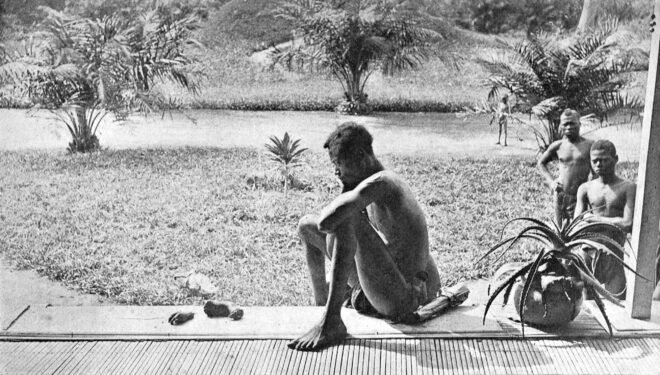
There are moments in history so compressed with horror that no amount of preparatory context can fully ready the imagination to receive them. The summer morning in 1902 when a man named Nsala of Wala arrived at a missionary compound in the Congo Free State, supported on either side by companions because he could not walk unaided, is one such moment. He carried a parcel wrapped in plantain leaves. Inside were the severed hand and foot of his young daughter.
Nsala had failed to meet his rubber-harvesting quota. The punishment administered by agents of King Leopold II of Belgium’s private empire was the killing and mutilation of his wife and child, with the remains returned to him as an object lesson in the cost of inadequacy. He brought what was left of his daughter to the mission not because he believed anything could be undone, but because he needed a witness – someone outside the sealed world of organised brutality who might carry knowledge of what had happened beyond the reach of those who had done it.
The missionary who received him was Alice Seeley Harris. Her husband John was away. She was alone when she unwrapped the parcel. What she did next – reaching for her camera, arranging the composition, pressing the shutter – transformed a private moment of unbearable grief into one of the most consequential photographs of the twentieth century. That act, and the decade of advocacy it inaugurated, offers a study in the intersection of individual conscience, technological possibility, and the ethics of bearing witness in the face of industrialised atrocity.
II. Leopold’s Private Kingdom
To understand what Alice Harris witnessed, it is necessary to understand the system that produced it – one of the most deliberately concealed atrocities in the history of European imperialism. In 1885, at the Conference of Berlin, the major European powers effectively awarded King Leopold II of Belgium personal sovereignty over an enormous stretch of central Africa, a territory he called the Congo Free State. The arrangement was justified in the language of humanitarianism and free trade. Its reality was neither.
Leopold was a monarch of extraordinary personal ambition and financial cunning. When rising rubber prices in the 1890s made the Congo’s natural resources suddenly lucrative, he mobilised a mercenary force known as the Force Publique to extract that wealth through a system of coerced labour so brutal that it is difficult, even at this remove, to convey its character without appearing to exaggerate. Workers who failed to meet rubber quotas had their hands – or the hands of their family members – amputated. Villages that resisted were burned. Women and children were taken hostage as leverage against men sent into the jungle to harvest. The Force Publique was required, as proof of firearms expenditure, to return a severed human hand for every bullet fired, which created an incentive structure that spread mutilation as a routine administrative practice.
Estimates of the death toll across Leopold’s reign vary widely, but historians have generally converged on a figure somewhere between eight and ten million people, with some arguing the true number may be higher. This was not a war, or a famine, or a plague, though all three were accelerated by the conditions Leopold created. It was, in the most clinical sense, a managed extraction of human labour that treated human beings as disposable inputs to a commercial operation. The Congo Free State was, in everything but name, a privately owned death camp spread across two million square kilometres.
What made this possible, beyond Leopold’s specific capacities for cruelty and manipulation, was distance and silence. The Congo was remote. Communication was slow. European publics had no way to see what was happening, and Leopold’s diplomatic machinery worked assiduously to ensure they never would. He commissioned favourable reports, cultivated journalists, and presented himself in Brussels and London as a philanthropist reluctantly shouldering the burden of African civilisation. The silence was structural, and it was deliberately maintained.
III. A Missionary’s Education
Alice Seeley Harris arrived in the Congo in 1898, four days after her marriage to John Hobbis Harris, with no particular expectation of becoming a human rights campaigner. She had been raised in Somerset by parents who combined Christian faith with a genuine social conscience – her father worked in a factory, and Alice grew up aware, in a way many of her class were not, of what labour actually looked like from the inside. She had yearned for a life less conventionally confined than the one Victorian England typically offered women of modest but respectable circumstance, and marriage to John – a man whose own religious convictions ran toward action rather than doctrine – offered that possibility.
The plan was literacy and evangelism: teaching reading and bringing the gospel to rural communities in a region that British Baptist missionaries had identified as spiritually underserved. It was a goal that reflected the sincere, if sometimes imperious, conviction of nineteenth-century Protestant missionaries that they were participating in a genuine act of service. Whatever the limitations of that worldview, Alice and John Harris appear to have held it without cynicism.
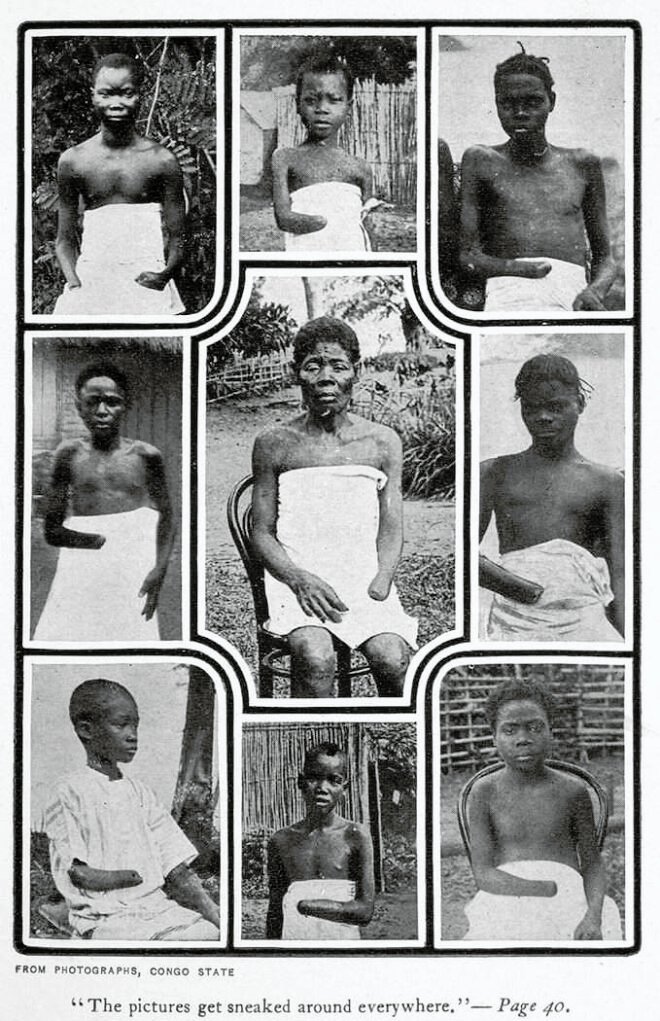
What they encountered instead was a landscape of systematic mutilation. Children and adults missing hands. Young people with stumps where arms had been. A pattern of injury too consistent and too widespread to be explained by accident or even conventional violence. It took time to understand the full architecture of what they were seeing – the quota system, the Force Publique, the hostage-taking, the deliberate terror – but once understood, it could not be unseen. The question was what to do with knowledge of this kind, in a place this remote, with tools this limited.
IV. The Camera as Moral Instrument
Alice had brought a camera to the Congo for the entirely ordinary purpose of documenting natural history – insects, flora, the kind of amateur scientific observation that a person of curious disposition and modest scientific education might pursue alongside other work. Photography in 1898 was not yet the democratised medium it would become; cameras were expensive, glass plates were fragile, and the technical knowledge required to produce a usable image was considerably more demanding than in later eras. But Alice had learned the craft, and she understood its properties.
What she recognised, confronted with the reality of Leopold’s Congo, was that photography offered something that written testimony – however accurate, however passionate – could not reliably deliver: the confrontation of an audience with visual fact. A person could dismiss a written account as exaggeration, as missionary special pleading, as the inflated outrage of someone with a political or religious axe to grind. A photograph demanded a different kind of response. It did not argue. It showed.
This insight – which seems obvious in retrospect but required genuine intellectual imagination to act upon in 1902 – was the foundation of everything that followed. Alice began photographing systematically. She photographed victims. She photographed those cradling stumped arms wrapped in white linen, a compositional choice that was deliberately aesthetic: the white fabric against darker skin would register clearly in the black-and-white photographs of the era, ensuring that the central fact – the absence of a hand, the wound where an arm had been – was unmistakable to any viewer, however far removed from the Congo itself.
She photographed Nsala. The image she made that morning – a man sitting on the ground, the remains of his daughter arranged before him, his face bearing an expression that defies easy description – became perhaps the most widely reproduced photograph of the entire Congo reform campaign. It appeared in newspapers, in pamphlets, in lecture slides projected on screens before audiences in Birmingham, Brussels, and Boston. It did not need a caption. It did not need an argument. It was its own argument.
V. The Architecture of a Campaign
Alice and John Harris understood early that documentation was not enough. Information, to change anything, must travel – and in 1902, travel required deliberate infrastructure. The couple joined their photographic evidence to a broader campaign that had been gathering momentum through the work of E.D. Morel, a shipping clerk turned journalist who had deduced Leopold’s system from the anomaly of ships leaving Belgium laden with weapons and returning laden with rubber, with nothing that looked like legitimate trade goods moving in either direction. Morel had founded the Congo Reform Association; Alice’s photographs gave it visual force.
They wrote letters – to journalists, to politicians, to Belgian overseers, to anyone who might be moved to action or, failing that, to public embarrassment. They shipped glass photographic slides alongside their correspondence so that recipients could project the images and see for themselves what written words described. And eventually, having done what could be done from within the Congo, they returned to Europe and undertook a lecture tour of remarkable scale and endurance, carrying Alice’s photographs to audiences across Britain and, later, the United States.
The lectures were events. Alice and John were skilled presenters – Alice in particular had a quality of directness, an unwillingness to soften what she had seen into something more palatable, that contemporaries found both disturbing and galvanising. The photographs appeared on large projection screens. Audiences who had absorbed decades of comfortable narratives about European benevolence in Africa were confronted with something that narrative could not accommodate.
Mark Twain was among those reached by the campaign. His response, a ferocious satirical monologue written in Leopold’s voice, was titled King Leopold’s Soliloquy and published in 1905. It circulated widely. Other writers, journalists, and public figures added their voices. The campaign built over years, not months – human rights advocacy rarely moves quickly – but it built.
In 1908, under sustained international pressure that had made his continued ownership of the Congo diplomatically untenable, Leopold transferred the territory to the Belgian state. The atrocities did not end immediately; Belgian colonial administration retained many of the structural features of Leopold’s regime for decades. But the specific machinery of the rubber terror was dismantled, and the man who had built it was stripped of the private empire he had spent thirty years constructing. Alice Harris’s photographs were among the instruments of that dismantling.
VI. The Personal Cost of Witness
Campaigns of this kind extract a price from those who wage them that is rarely fully accounted in the historical record. Alice and John Harris operated in an environment of physical danger – the Congo Free State was a place where those who threatened powerful interests were subject to real consequences, and the Belgian mercenaries who administered Leopold’s system had no particular incentive toward restraint. The couple were harassed. Their supplies were intercepted at port. They were, on at least one occasion, shot at.
Beyond the physical dangers, there was the psychological burden of sustained proximity to suffering on a scale that no individual can absorb without cost. Alice spoke, late in her life, of the inadequacy she felt before the magnitude of the need she encountered – the impossibility of the arithmetic of hurt. How do you respond proportionately to ten million deaths? What does adequate care look like when the scale of the wound exceeds the capacity of any available remedy? These were not rhetorical questions for Alice. They were the texture of her daily experience for years.
She was known to say that it was all, at times, too much to bear. That admission – made by a woman her contemporaries characterised as fearless, as someone who seemed constitutionally incapable of looking away – is worth attending to carefully. The appearance of fearlessness is often, in people who have chosen to stand near suffering, not the absence of fear or grief but its deliberate subordination to something they judge more important. Alice was not immune to what she saw. She simply refused to let that immunity become her priority.
VII. The Question of Credit and the Limits of Recognition
John Harris was knighted in 1933, a recognition that carried the formal imprimatur of the British state. Alice, as his wife, acquired by extension the title she famously declined to use. Her habitual response to being addressed as Lady Harris – ‘Don’t call me Lady!’ – was characteristic: not false modesty, but a refusal of the kind of social stratification that she had consistently campaigned against.
The asymmetry of recognition that gave a knighthood to John and a reflected honorific to Alice is worth pausing on. The photographs were Alice’s. The compositional intelligence that made them effective was Alice’s. The decision to treat the camera as a moral instrument rather than a device for natural history documentation was Alice’s. The lecture tours were joint endeavours, but the visual evidence that anchored them came from one person’s eye and one person’s decision to carry a camera into a context most people would have found reason to avoid.
This is not an argument against John Harris, who was by all accounts a committed and courageous partner. It is an observation about the architecture of historical credit in a period when women were presumed to be extensions of their husbands’ projects rather than originators of their own. Alice lived to be a hundred years old, dying in November 1970. The biography finally written about her, published in 2014 and titled after her characteristic refusal of imposed deference, arrived more than four decades after her death. The delay is itself a kind of evidence.
VIII. Photography, Power, and the Ethics of the Image
Alice Harris’s use of photography as a human rights instrument raises questions that have grown more rather than less complicated in the century since she practised it. The camera is not a neutral technology. Every photograph involves choices – about framing, about what is included and what is excluded, about the relationship between the person holding the camera and the person being photographed, about who controls the image afterward and to what ends it is deployed.
Nsala brought his daughter’s remains to the mission compound because he wanted someone outside the system to know what had been done. He consented to being photographed, insofar as consent can be meaningfully exercised by someone in extremis, in a context of colonial power where the concept itself barely applied. The photograph that resulted served the purposes he implicitly came seeking – it helped dismantle the system that had destroyed his family. But Nsala did not control the image. He could not determine how it would circulate, how his grief would be captioned, what narrative would be built around it by people who had never seen the Congo and never would.
These tensions do not diminish Alice Harris’s achievement. They contextualise it. She worked within the ethical frameworks available to her, which were not our frameworks, and she used the tools at her disposal toward ends that were genuinely humane. The fact that photography-as-advocacy has, in subsequent decades, generated substantial critical literature about the exploitation of suffering, about the aestheticisation of pain, about the power differential between the witness and the witnessed – all of this is a conversation that Alice Harris’s work helped make necessary. She was among the founders of a tradition that is still working out its own ethics.
IX. The Enduring Instruction
Alice Seeley Harris died in November 1970, having lived long enough to see her photographs reproduced in the published history of the Congo reform movement, to watch the territory she had documented pass through Belgian colonial administration and into independence as the Democratic Republic of Congo, and to address audiences in Surrey who were – by her own account – stunned to discover that the woman before them had been a direct participant in events they knew only from history books.
What she left behind is, at one level, a set of photographs and a documented history of advocacy. At another level, she left a model of what it means to take seriously the obligation that knowledge creates. She did not travel to the Congo intending to become a human rights activist. She became one because she saw something that could not be responsibly unseen, and because she possessed both the means to document it and the imagination to understand what documentation, properly deployed, might accomplish.
The moral of the story is not, or not only, that one person can make a difference – a formulation that has become so familiar it has lost most of its force. The more specific instruction is about the relationship between tools and conscience: that the ethical weight of a capability is determined not by the capability itself but by the judgment of the person who uses it. Alice brought a camera to document insects. She turned it on suffering instead because her sense of what mattered overrode her original intentions. That reorientation – the willingness to be changed by what you witness, and to change what you do in response – is the thing most worth inheriting from her.
The Congo she photographed is still, in various ways, living with the consequences of what Leopold built. The particular form of violence she documented has been replaced by other forms, and the instruments of documentation have multiplied beyond anything she could have anticipated – but the fundamental situation she faced, of catastrophic harm being inflicted on people by systems powerful enough to maintain their own silence, has not become historical. It is contemporary. The question she answered in her own time – what do you do when you have seen something that demands a response – remains, in every generation, freshly unanswered.
The photographs of Alice Seeley Harris are held in various archives and have been reproduced in numerous historical accounts of the Congo reform movement. The biography Don’t Call Me Lady, by Judy Pollard Smith, was published in 2014.