
I. THE RUINS OF THE CENTRE-RIGHT
There is a particular kind of political collapse that is less a sudden implosion than a prolonged unravelling. I discussed this in my recent post “The Long Unravelling: Alternative Facts, a Democratic Emergency”, a slow erosion of relevance that accelerates only when the party is too diminished to resist. That is the condition of Australia’s Liberal Party as of April 2026. The party that once embodied the aspirations of the suburban middle class, that governed federally for more than two of every three years since Robert Menzies founded it in 1944, now finds itself a disoriented rump, outpolled in South Australia by a party that began as a single senator’s protest against Asian immigration and has never held federal government. The question of whether this constitutes a temporary correction or a structural terminal decline is no longer merely academic. The evidence increasingly points toward the latter.
The sequence of reversals is now familiar but bears rehearsing for its cumulative weight. The 2022 federal election stripped the Coalition of government and delivered a clutch of inner-city seats to so-called ‘teal’ independents – professionals, women, and younger voters who had grown weary of the culture war politics the Morrison government had perfected into an art form. Yet the more instructive defeat was 2025, when Labor under Anthony Albanese not only retained power but expanded its majority, marking the first time in more than two decades that a sitting Prime Minister had grown their vote at a consecutive election. The Coalition under Peter Dutton, having moved rightward on climate, immigration, and social policy in a calculated attempt to consolidate a shrinking base, managed instead to haemorrhage support across virtually every demographic that does not consist of older men in regional Queensland. An internal review later tabled in parliament described the campaign as an exercise in compounded error: a nuclear energy policy that most voters regarded as a relic of the Cold War, a leader whose public persona radiated hostility rather than reassurance, and a communications strategy apparently designed by someone who had never met a swinging voter.
The party’s troubles did not abate with defeat. Leadership instability has become its default condition. Sussan Ley’s tenure was brief and dispiriting; by February 2026, she had been removed in a 34–17 vote that installed Angus Taylor – a figure whose association with the Morrison era’s most contentious controversies made him a strange choice for renewal – with Jane Hume as his deputy. Ley’s subsequent resignation from parliament altogether triggered a by-election that the party could ill afford to fight, absorbing resources, energy, and media attention at precisely the moment when disciplined opposition was most needed. In the weeks that followed, national polling placed the Liberal-National Coalition at roughly 22.5 per cent of the primary vote, with Liberal support alone somewhere around 19.5 per cent. The Nationals, for their part, had briefly fractured the Coalition arrangement before a fragile recommitment in February, underscoring the degree to which the conservative alliance that had dominated post-war Australian politics was operating more on institutional inertia than genuine strategic coherence.
The South Australian state election of 21 March 2026 crystallised the crisis into a single unforgettable image. The Liberals, once the governing party of that state, received just 19 per cent of first-preference votes – a decline of more than 16 percentage points from 2022. They were out-polled not by Labor, which won comfortably under Premier Peter Malinauskas, but by One Nation, which recorded 22.1 per cent. The Liberal leader’s concession speech, with its dutiful references to lessons to be learned, sounded less like the acknowledgment of a setback than the eulogy of a movement that had not yet accepted its own mortality. For observers of Australian conservatism, the spectacle was as disorienting as watching the old elms along a familiar avenue succumb to disease one by one, until the avenue itself no longer provides shade.
What has the party lost, precisely? It has lost the cultural centre of gravity that once made it the natural home of aspirational Australia: the family running a small business, the professional couple in a freestanding home, the retiree with a self-managed superannuation fund. Many of these voters have not migrated to Labor – they have migrated to independence, to minor parties, or to abstention. The Liberals’ rightward lurch under Dutton on asylum seekers, climate denial, and anti-‘woke’ rhetoric alienated the moderate metropolitans who had kept the party competitive in its traditional heartland seats. Taylor’s platform of immigration restrictions and vague exhortations to ‘national confidence’ offers no obvious path back to those voters, while doing nothing to prevent the haemorrhage of working-class conservatives toward One Nation. The party is caught between a base it cannot satisfy and an electorate it no longer understands. In this condition, it resembles nothing so much as the United Australia Party in its final years before Menzies fashioned a replacement – except that in 2026, there is no Menzies on the horizon.
II. THE AMPLIFIED GRIEVANCE: ONE NATION AND THE MURDOCH EFFECT
Into the vacated territory of the Australian right moves One Nation, and it moves with the wind of a sympathetic media at its back. Pauline Hanson’s party has always been an exercise in the politics of resentment – the channelling of genuine economic anxiety and social displacement into nationalist and nativist frameworks that diagnose the nation’s ailments as the product of immigrants, elites, and a political class that has forgotten the ‘real’ Australians. What is different in 2026 is the scale of media amplification that has accompanied its resurgence. The Murdoch press, through Sky News, news.com.au, and the stable of metropolitan tabloids, has been engaged in what amounts to a sustained campaign of narrative construction around One Nation’s viability as an opposition force. Coverage has been breathless, polling has been emphasised selectively, and commentary has framed the party’s South Australian gains as a democratic awakening rather than a symptom of democratic distress.
The mechanics of this amplification are not difficult to trace. Sympathetic editorial framing creates the conditions for social media virality; viral social media content is then reported as evidence of organic momentum; the reported momentum attracts further coverage; and the cycle produces what in media studies is sometimes called a spiral of signification – a self-reinforcing feedback loop that can manufacture the appearance of a movement from the raw material of discontent. One Nation’s messaging – ‘putting Australians first,’ ending net-zero commitments, reducing immigration, championing fossil fuels – aligns closely with certain long-standing Murdoch editorial positions, even as the party has never demonstrated any capacity to actually administer a government. When Liberal Senator Leah Blyth cautioned in March that One Nation had ‘a long way to go’ before voters could trust it with budgets, infrastructure, and public services, her observation was technically accurate and politically beside the point. In populist politics, the demonstration of administrative competence is not the currency that purchases loyalty; the performance of defiance is.
The appeal is not invented. It draws on real grievances that conventional politics has either failed or refused to address. Housing costs that have priced an entire generation out of ownership in the major cities. Energy prices that have made the electricity bill a recurring source of household anxiety. An immigration intake that, whatever its economic rationale, has been experienced by many working-class Australians as downward pressure on wages and upward pressure on rents, without any compensating investment in infrastructure or social services. One Nation offers no credible policy remedies for any of these conditions, but in the politics of grievance, the identification of the enemy is more important than the competence of the proposed solution. Hanson’s long-standing anti-Islam rhetoric, her alliances with figures on the further fringes of Australian conservatism, and her party’s consistent climate denialism all position it firmly in the category of far-right populism – whatever the more euphemistic framings deployed by its media sympathisers.
The consequences of this trajectory, if it continues, are likely to be damaging in ways that extend beyond the immediate electoral arithmetic. A consolidated One Nation presence at the state and federal level would shift the gravitational centre of Australian politics rightward on race, immigration, and climate, narrowing the range of policy options considered acceptable and emboldening a strand of political culture that has historically been most dangerous to the cohesion of pluralist societies. There is ample comparative evidence – from the experience of Western Europe, from the United States under Trump, from the trajectory of Hungarian and Polish politics under right-nationalist governments – that the mainstreaming of populist nationalism does not produce the relief of legitimate grievance but its intensification and institutionalisation. The Murdoch machine, in amplifying One Nation for reasons that presumably include commercial calculation alongside ideological sympathy, is not merely reporting on Australian politics. It is actively shaping the conditions under which Australian politics operates, in ways that warrant sustained scrutiny from those concerned with the integrity of democratic discourse.
III. LABOR’S COMFORTABLE MEDIOCRITY
Power without purpose is its own kind of failure. Anthony Albanese’s Labor government commands a comfortable parliamentary majority, inherits an economy that performed adequately through the post-pandemic adjustment, and faces an opposition in no condition to mount a coherent challenge. By the conventional metrics of electoral security, Albanese is in an enviable position. And yet the dominant impression of Labor in early 2026 is not of a government seized by the possibilities of its mandate but of one managing its incumbency with a cautious eye on the next election and a second eye on internal party dynamics – squinting at the horizon while shuffling across it. There is policy activity, certainly: the National Energy Transformation Strategy proceeds by increments, the Housing Australia Future Fund has made some dent in the supply problem, wages growth has modestly outpaced inflation. But there is no animating vision, no sense that the government understands the historical moment it occupies and has chosen to meet it with proportionate ambition.
The criticism that Albanese is, in the colourful phrase that has circulated among his detractors, ‘so bent he makes a dog’s hind leg look straight’ speaks to something more specific than generalised disappointment. It points to a pattern of behaviour that voters find disorienting: the gap between the language of integrity and transparency that Albanese used to define his political identity in opposition, and the rather more conventional evasions of office. FOI delays that rival those of governments Labor once condemned. Institutional proximity to union structures that became, in the CFMEU affair, a source of sustained political embarrassment. A tendency toward reactive policymaking that announces bold intentions and delivers modest increments, so that each successive announcement is slightly diminished by the memory of the previous one’s underwhelming execution. These are not unusual features of Australian governance – every government dissembles, every government manages its relationships with institutional allies – but they are particularly corrosive when the Prime Minister has made integrity the cornerstone of his political brand.
The fuel crisis triggered by the Iran conflict has provided the starkest recent illustration of these shortcomings. As the Middle East deteriorated into open warfare and global oil markets responded with panic, Australia found itself exposed in a manner that had been widely forecast and systematically ignored. The country’s strategic fuel reserves have been a subject of concern for defence analysts and energy economists for years. The strategic petroleum reserve, nominally meeting IEA membership obligations, has long been held largely offshore – an arrangement that provides statistical compliance with treaty obligations but limited practical protection against actual supply disruption. When six of eighty-one April shipments were cancelled and petrol prices spiked at the bowser, the structural vulnerability of Australia’s energy supply chain became not a policy briefing but a lived reality for millions of households already stretched by years of cost-of-living pressure.
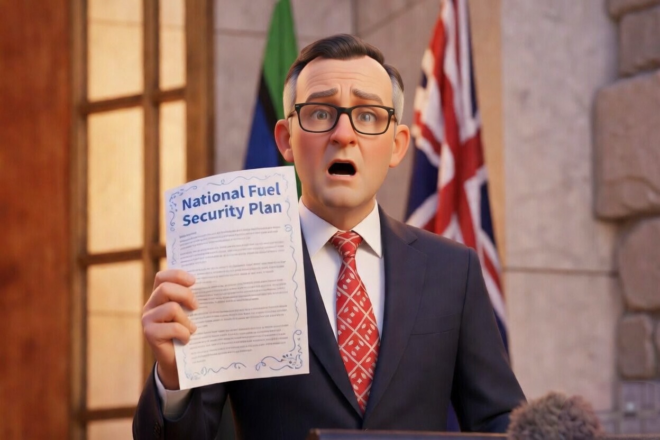
Into this situation stepped Albanese with his Address to the Nation on 1 April – a rare use of the formal televised address that governments typically reserve for crises of genuine gravity. The address was, in its substance, a collection of short-term measures dressed in the language of solidarity. The halving of fuel excise for three months, the activation of a National Fuel Security Plan, new powers to underwrite import contracts: all reasonable responses to immediate pressure, none of them constituting a strategy. The Prime Minister warned that the months ahead would be difficult, urged Australians to think of others, to conserve petrol, to avoid panic buying. The tone was not without a certain decency – the appeal to mutual responsibility is not ignoble – but it was profoundly inadequate to the moment. An address to the nation is an opportunity to reframe a crisis as the occasion for a new national project. Albanese did not reframe anything. He asked Australians to tighten their belts while he worked the phones with oil exporters, and he called this leadership. Social media and opposition commentary were merciless, and for once they were not merely partisan: the address genuinely failed to provide what the moment demanded, which was not reassurance but direction.
The deeper problem is not the address itself, but what it revealed about a government that has never quite decided what it is for. Cost-of-living relief, energy transition, Indigenous recognition, immigration management, strategic defence – these are all real priorities, but they have never been integrated into a coherent account of what Australia should become and how the government intends to take it there. The result is a politics of perpetual incrementalism that satisfies no one: insufficient for those who want transformative change, uninspiring for those who simply want to feel that someone capable is in charge. Albanese is not incompetent. He is, in many ways, a skilled political operator who has achieved things his Labor predecessors could not. But skill in the management of parliamentary numbers is not the same as the capacity to articulate a national purpose, and in 2026, the latter is what Australia needs and cannot find.
IV. A DEMOCRACY IN NEED OF RECALIBRATION
The particular danger of Australia’s current political configuration is not that it is catastrophic – it is that it is merely inadequate, and adequacy, in circumstances that demand more, is its own form of failure. The Liberal Party’s collapse leaves the opposition function in the hands of a party that does not believe in parliamentary norms when they inconvenience it and a conservative rump that is fighting over the same grievance-politics voters rather than trying to address the country’s actual problems. Labor’s comfortable mediocrity means that the discipline of competitive politics – the pressure a capable opposition places on government to justify its choices and sharpen its thinking – is largely absent. One Nation, amplified by a media empire with its own agenda, fills the space where a serious centre-right party should be, pulling the parameters of acceptable public discourse toward territory that a healthy democracy would have fenced off.
The structural conditions enabling this situation are not new, but they have converged in an unusually damaging way. Australia’s preferential voting system has historically acted as a moderating mechanism, ensuring that extremist parties either moderate to attract preferences or remain electorally marginal. One Nation’s South Australian performance suggests this mechanism is under strain: the party is no longer merely a repository for protest preferences but a destination for primary votes in sufficient numbers to win seats on its own terms. This represents a qualitative shift in the party’s relationship to the political system, and it demands a qualitative response from that system – not in the form of the reflexive ‘respecting the result’ language that politicians deploy when they mean to do nothing, but in the form of genuine interrogation of why voters are reaching past both major parties in numbers not seen since the 1990s.
The answer to that interrogation is not comfortable for either side of politics. For Labor, it suggests that economic management credentials and incremental policy delivery are necessary but not sufficient conditions for governing a democracy in a period of sustained institutional distrust. Voters who feel the political class is primarily managing its own interests while they struggle with rent and petrol and grocery bills are not going to be brought back to confidence in government by a four-year programme of modest housing initiatives and occasional excise cuts. They need to believe that the government understands the depth of the fracture between their experience and the official account of national prosperity, and that it has a plan that addresses that fracture rather than papers over it. Albanese’s address offered no such plan. It offered solidarity without strategy, which is a form of sympathy that has the unintended effect of confirming that those in charge do not actually know what to do.
For the Liberals, the answer to the interrogation is more uncomfortable still. The party cannot recover by out-Hansonising Hanson. The voters One Nation is attracting are not primarily motivated by ideology; they are motivated by a sense that they have been abandoned by a political establishment that has failed to protect them from forces – global, economic, demographic – that they did not choose and were not consulted about. A Liberal Party that responds to this by tacking further right on immigration and cultural politics will not retrieve those voters; it will simply confirm them in the belief that the establishment is beyond redemption. Recovery, if it is possible, requires the kind of internal honesty that parties in crisis typically find extraordinarily difficult: an acknowledgment that the rightward shift was not a miscalculation of tactics but a failure of political vision, and that vision can only be rebuilt through genuine engagement with the communities the party has lost rather than the performative gestures toward ‘listening’ that have characterised every post-defeat review.
Australia is not, by the standards of global democratic backsliding, in acute danger. Its institutions remain largely functional, its courts maintain independence, its elections are administered with integrity. But the preconditions for democratic erosion – declining public trust in institutions, the hollowing out of mainstream political parties, the amplification of extremist voices by commercially motivated media, and the absence of leaders capable of articulating a convincing account of the common good – are present and accumulating. The V-Dem Institute’s 2026 Democracy Report, which flags competitive authoritarianism and structural vulnerabilities in a range of established democracies, is not a prophecy but a warning. Warnings are only useful if they are heeded, and there is limited evidence that the major actors in Australian politics are heeding this one.
What recalibration would look like in practice is not mysterious. It would involve a serious reckoning with media influence in democratic politics, including the sustained structural conflict of interest represented by a single proprietor’s domination of metropolitan newspaper markets and cable news. It would involve a Liberal Party willing to do more than rebrand, finding new leadership genuinely connected to communities that have drifted away rather than retreating further into the comfort of its remaining base. It would involve a Labor government prepared to move from the management of the present to the construction of a plausible future – on energy independence, housing supply, industrial strategy, and the terms on which Australia participates in a reshaping global order. And it would involve all parties acknowledging that the fuel crisis of April 2026 is not an aberration but a preview: of the disruptions that climate change, geopolitical fracture, and supply chain vulnerability will continue to produce, and of the inadequacy of a political culture that responds to them with appeals to consumer restraint.
Australia’s unenviable position is not permanent, but it will not resolve itself. The collapse of the centre-right, the amplification of far-right populism, and the tepid incumbency of a Labor government more comfortable with management than vision have produced a political landscape that rewards grievance and punishes ambition, that mistakes the absence of catastrophe for the presence of leadership. The address of 1 April was, in this sense, a perfect symbol: a Prime Minister speaking to a nation in difficulty, offering solidarity without direction, competence without courage, and asking the people to do their bit while providing insufficient evidence that their government was prepared to do its own.


Albanese’s address to the nation was insipid. It offered no security and tax relief for a commodity that appears that it will soon be in such short supply that it will be meaningless anyway. There was nothing for those in regional and rural areas, who bear the brunt of the current dilemma; it’s not like they have the abundance of public transport options they do in the city. Freight is starting to go up, prices are already increasing.
The deflated Liberals drift without the slightest comprehension of what has resulted in their current Siberia or how to trace their way to a new heartland. Without clear direction and failing support, they fail to fill the leadership void through constructive suggestion and engagement.
One Nation screams blame. That’s it. They take no responsibility for anything and never will. They speak to those who feel abandoned by conservatives because those people are aggrieved by both the left (is there a left any more?) and the right of politics. All One Nation does is point fingers at a perceived evil, generally with brown or black skin, speaking an Asian language or that has a culture that spans more than 5 minutes.
Where are the visionaries, the brilliant orators with sound policy, able to dissemble the vacuous arguments of the unaccountable? Not in Labor, that’s for sure, and not in the other leading options. Meanwhile, we drift into another pandemic-like isolation that is likely to decimate all aspects of supply, business and social integration. Albanese is not up to the task.
Albanese’s address to the nation yesterday was a clown show, he demonstrated a clear lack of leadership and a clear lack of vision. Australia is now a rudderless ship adrift at sea, with a captain who has no clue and no plan.
The essay’s central tension — between the claim that Australia is not in acute democratic danger and the claim that the preconditions for erosion are “present and accumulating” — is never quite resolved. You are clearly trying to avoid both alarmism and complacency, which is admirable, but the calibration is slightly off. The penultimate paragraph lists the preconditions (declining trust, hollowed parties, amplified extremism, absent leadership) and then says Australia is “not, by the standards of global democratic backsliding, in acute danger.” This reassurance feels imposed rather than argued. If the preconditions are genuinely present and accumulating, the reader is entitled to ask what rate of accumulation would constitute acute danger, and what mechanism would trigger it. The V-Dem framework you invoke actually has a fairly developed account of this — you could use it more specifically rather than citing it as ambient authority.
Albanese has sold out the Palestinian people to Zionism and the Australian people to U.S. interests. He is a traitor to Labor.
Albo has proven to be an absolute failure, no, disaster as Prime Minister. To be fair, he’s slightly better than Morrison, I empathise SLIGHTLY, because there’s very little in it. We need a PM who has actual leadership qualities.
Albo is doing the best job he can in a difficult situation.
I don’t understand why the major parties don’t do anything to address people’s underlying concerns, which will cut the ground out from underneath Pauline Hanson and One Nation.
I see that the rusted-on, on X don’t like your analysis of Albanese’s performance. Rusted-ons, everywhere in politics are a problem.