
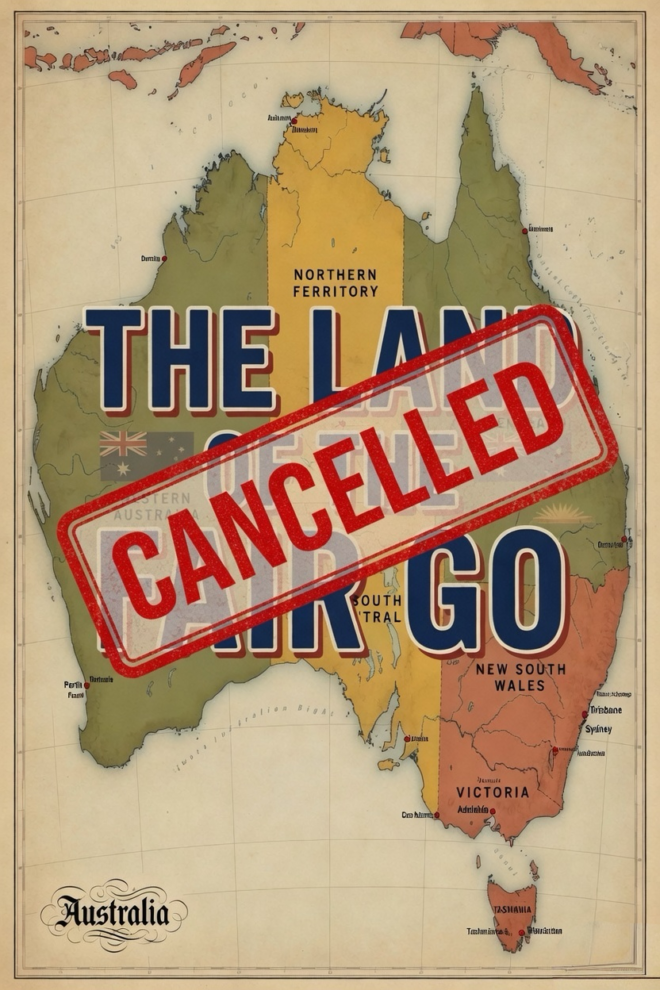
We were never innocent — let that be said —
the red earth still holds
what we tried to forget:
the missions, the dormitories, the children
taken before dawn,
the long silence of country
absorbing what we’d done.
But something worked, or tried to.
The factories hummed in the western suburbs,
the state school had a library,
the university didn’t cost a decade of your life,
the publican watered his beer
but the round still got bought,
and the man on the corner
who drank too much and loved badly
still believed, in some bruised and genuine way,
that the kid down the street
had a chance.
That was the myth, yes.
But myths, when honest,
are the maps a people make
to find the better version of themselves.
We had the map.
We were reading it, slowly,
with argument and error,
the way democracies do.
Then came the manager.
—
He was not a monster.
That would have been easier.
John Howard possessed a cold political intelligence,
which is a different thing,
and more dangerous —
a man who looked at a country
in the turbulence of economic change,
at workers whose factories were closing
not because of malice
but because of mathematics,
the long indifferent arithmetic
of globalised capital,
and made a choice.
He could have said:
the world is reshaping itself,
and we will reshape with it,
and no one will be left
to absorb the cost alone.
He chose the simpler blade instead:
be afraid of each other.
It was a masterstroke of political management.
The factories were already going —
the ships of manufacturing
had been sailing out of every harbour
in the industrial world.
Howard didn’t sink them.
But he decided which story
we would tell about the wreckage,
and whose names would be written on the hull.
He gave the private schools
what the public schools had built,
called it choice,
and watched the word ‘choice’
do twenty years of dirty work.
He gave the landlords negative gearing
and the shareholders a refund
and told the redundant man
that efficiency was history speaking,
not cruelty —
that the market had found his hands
wanting, and moved on.
He gave the bureaucracy a new vocabulary:
work for the dole,
mutual obligation —
the language of self-reliance
wrapped around small cruelties
too small to photograph,
moved the wealth upward
and called the direction ‘reform’
and waited for the commentariat
to polish the word until it shone.
They did.
—
And then came Pauline —
fish-and-chip grease and grievance,
a woman with a forest for a chip
on a shoulder barely wide enough to hold it,
speaking for people whose fear was real
even when her answers were not.
Howard did not create her.
The fears that fed her
were older than his government —
the dread of change arriving faster
than a community could name it,
of streets that sounded different,
of a country becoming something
its own people felt they hadn’t voted for.
Those fears deserved a serious answer.
Howard had one available.
He chose a different door.
He didn’t light the fire.
But he read the smoke,
left the window open,
let the warmth of it
drift into the room
where his numbers were made,
and called it
a matter for the Australian people to decide.
He passed the gun laws.
He eventually disendorsed her.
He was not her, and the distinction matters.
But he understood that the temperature she raised
kept certain other conversations
from getting cold,
and he was comfortable
in a warm room.
‘Hansonism,’ he said, ‘is a passing phenomenon.’
It was not passing.
It was learning the building,
finding which doors were left unlocked,
and moving in.
—
Now look at us.
The two great parties
in undignified pursuit,
racing toward the bottom
like economists in a mine shaft,
each one shouting
I can go lower, watch me, vote for me,
I’ll close the borders tighter,
I’ll make the language harder,
I’ll give the cruelty
a parliamentary imprimatur
and call it common sense.
And let this be said plainly:
the people who voted this way
were not all manipulated.
Some were afraid, and the fear was earned —
housing they couldn’t afford,
wages that didn’t move,
a culture shifting faster
than any of us had been prepared for.
Fear is not stupidity.
Bad answers to real questions
are still bad answers,
but the questions were real.
The fair go is a museum piece now,
behind glass in a gallery
where the entrance fee
depends on which school you went to.
The universities sell themselves
to whoever has the money
and the tuition debt
is the new indenture.
The factories are memory.
The publican is a franchise.
The round never gets bought.
And the country that argued its way
toward something better —
loud, profane, occasionally generous,
capable of shame, capable of change —
has traded all of that
for the comfort of a closed fist
and the small, mean warmth
of knowing who to blame.
—
I have not stopped loving this country.
That is the wound
that does not close —
to love a place
that is choosing, deliberately,
with its eyes open,
to be less than it was,
less than it could be,
less than the red earth
and the long sky
and the first peoples’ dreaming of it
ever deserved.
We were never innocent.
But we were, once,
at least ashamed of it.
At least trying.
—
And some still are.
That is what the grief
must not be allowed to swallow —
that inside both tents,
in the season of the race to the bottom,
there were people who stood
and said: ‘not this. Not us.’
Petro Georgiou, Liberal member for Kooyong,
broke with his own government
over children in detention,
put a human face
in front of a policy
and refused to look away.
Judi Moylan stood beside him.
Carmen Lawrence told her party
that asylum seekers were people,
not a wedge,
and paid for the honesty
in the currency of her career.
They did not win.
The tide was running the other way.
But they planted something
in the record of this country —
a refusal entered into Hansard,
quiet, inconvenient,
available to anyone who wants to know
that it was possible
to know better, and say so,
inside the machine, in real time,
at real cost.
The better impulse was not extinguished.
It was outvoted.
There is a difference.
The map is torn.
But the country it described
has not stopped existing —
in the nurse who treats whoever arrives,
in the teacher who stays late
for the kid with no English
and no one home,
in the ones who stand in the rain
outside the detention centre
with a handwritten sign
that says ‘you are not forgotten’
and mean it.
They are not a government.
They are not yet a movement.
But they are the fair go
in its only honest form —
not a slogan,
not a golden age that probably wasn’t,
but a practice,
stubbornly maintained
by people who decided
that the kid down the street
still had a chance,
and act on it,
in the rain,
with the long memory of red earth watching.
© Bakchos 2026 | Blak and Black est. 2010


Australia never had a golden age. But it had a map — an argument toward something better. This poem is about the moment we folded it up, who handed us the blade, and why the grief of loving this place doesn’t close.
The Land of the Fair Go (A Lament)
This is a strong, ambitious political poem—part lament, part jeremiad, part love letter to an idea of Australia that the poet believes is slipping away. At its best it achieves the difficult trick of being both emotionally raw and intellectually precise. At its worst it slips into the very didacticism it tries to avoid. Overall, it is one of the more honest and painful reckonings with post-Howard Australia I have read in verse.
Mark remember me? I’m fairly certain that we went to school together. It seems that time hasn’t mellowed you. You left a lasting memory on me, when you walked off the footy field a smashed Egg in the face and said “if you pick on the runt again, I’ll kicked the shit out of you.” Egg stopped bullying everyone after that. One of the last things that my father said to me was “ what ever happened to that boy who played Guido d’Wacker? He was funny.” Seems that you made a lasting impression on some. I’ll look out for more of your poetry.
G’day Mirko, yes we seem to have gone to school together. I remember you. I’m saddened to read of the passing of your father. Unfortunately most of my characters I created for Drama wouldn’t pass the politically correct police monitoring these days. Guido would definitely be out, I suspect that Bernice Beatle and Dickie Possum Poo wouldn’t pass muster these days, either. Such is life. Thanks for touching base, please keep in touch.
The poem’s greatest strength is its refusal of easy innocence. The opening line—“We were never innocent—let that be said”—is a masterstroke. It immediately disarms the usual progressive nostalgia and grounds the lament in historical reality (Stolen Generations, missions, silence). That honesty gives the later grief real weight. The repeated return to “the red earth” and “the long sky” and “the first peoples’ dreaming” never feels ornamental; it functions as a moral horizon against which all later failures are measured.
The section on John Howard is the poem’s high point. Howard is not caricatured as a cartoon villain (“He was not a monster. That would have been easier.”). The poem grants him “cold political intelligence” and then shows how that intelligence was deployed—not to create fear from nothing, but to harvest existing anxiety and direct it politically. That nuance is rare in Australian political poetry and makes the indictment sharper, not softer. The sketch of Pauline Hanson — “fish-and-chip grease and grievance, / a woman with a forest for a chip / on a shoulder barely wide enough to hold it” — is cruelly funny and oddly affectionate at the same time. It humanises without excusing. The distinction drawn between Howard and Hanson (“He didn’t light the fire. But he read the smoke…”) is politically astute and poetically economical.
“He didn’t light the fire. But he read the smoke…” that’s how John Howard unmade the fair go Aussie spirit. He read the smoke well.
The long, accumulating sentences and the deliberate use of enjambment give the poem the feel of a pub argument that has turned into something more serious. It wants to be read aloud. Lines like “the round never gets bought” land like a punch because the poem has earned the right to be that blunt.
“He chose the simpler blade instead:
be afraid of each other.”
.
This is where the shift started. Be alert, not alarmed. He really meant be suspicious and exclusionary.
Powerful!
“Petro Georgiou, Liberal member for Kooyong,
broke with his own government
over children in detention,
put a human face
in front of a policy
and refused to look away.
Judi Moylan stood beside him.
Carmen Lawrence told her party
that asylum seekers were people,
not a wedge,
and paid for the honesty
in the currency of her career.
They did not win.
The tide was running the other way.
But they planted something
in the record of this country —
a refusal entered into Hansard,
quiet, inconvenient,
available to anyone who wants to know
that it was possible
to know better, and say so,
inside the machine, in real time,
at real cost.”
Australia was never the land of the fair go for blackfullas.