
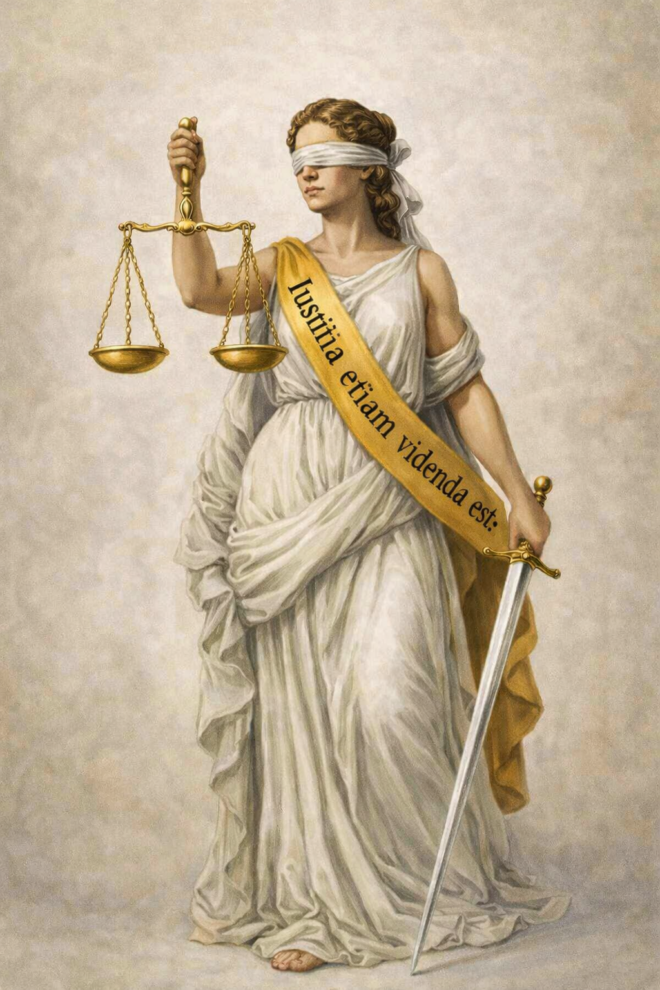
The year is 1923. Mr McCarthy is riding his motorcycle when he collides with a motorcycle with sidecar carrying a husband and wife, a Mr & Mrs Whitworth. The tandem pair incur injuries, leading to charges against McCarthy of dangerous driving. Following a court hearing the justices retire to consider the evidence and with them goes the clerk of the court to advise on any points of law that the justices may ask. Whilst there is nothing unusual in this, there is one problem – the clerk is a partner in the firm representing the Whitworths. The justices return after deliberation to convict and fine McCarthy. Although he appears not to have provided any advice and it also appears that the defence legal team were aware of the clerk’s other role, his presence during deliberations created the perception of a conflict of interest. Subsequent to an appeal, the conviction against McCarthy was quashed by the Lord Chief Justice.
“It is said, and, no doubt, truly, that when that gentleman retired in the usual way with the justices, taking with him the notes of the evidence in case the justices might desire to consult him, the justices came to a conclusion without consulting him, and that he scrupulously abstained from referring to the case in any way. But while that is so, a long line of cases shows that it is not merely of some importance but is of fundamental importance that justice should not only be done, but should manifestly and undoubtedly be seen to be done.”
~ Lord Chief Justice Hewart, R v Sussex Justices, ex parte McCarthy 1924 ~
This tenet – “that justice should not only be done, but should manifestly and undoubtedly be seen to be done” – has become a foundation of the rule of law. The fact that it stems from the actions of legal professionals themselves adds weight to the determination and sits as a warning that even they must bow to the law. It is on this premise that this article reviews the actions of a few notable lawyers.
TRUTH JUSTICE AND THE AUSTRALIAN WAY
Several high-profile lawyers have faced various courts since the turn of this century. The following detail a few notable falls from grace, some legitimately, one less so.
Padding out the Invoices – Norman O’Bryan
Norman O’Bryan led storied career. The son and grandson of judges, O’Bryan was born and educated in privilege and went on to become one of the nation’s most notable Senior Counsels. Clients included the Australian Securities and Investment Commission and counsel assisting the Royal Commission into the collapse of HIH Insurance. O’Bryan went on to a successful career pursuing class actions and with his colleague Mark Elliott, established Australian Funding Partners Limited, a business that funded litigation for clients for a cut of the final judgement.
In 2012, Banksia Securities Limited collapsed owing $663 million and $527 million in assets. The class action, initiated by one Mr Bolitho, was funded by Australian Funding Partners who would be entitled to 30% of the settlement in addition to any costs and disbursements incurred. The matter settled by $64 million, with the litigation lender claiming $19.3 million which, with costs and disbursements became $25 million. Those costs are what brought O’Bryan unstuck, the Victorian Supreme Court hearing in 2020 that he had overcharged for services that had been backdated or could not be substantiated. Unpaid invoices were marked as having been paid, the dates on some indicating that he was not working on the Banksia matter, but either on others legal cases or on holiday. Most concerningly there was no formal agreement on fees until they were required for determination of costs. Justice Dixon, quoted in Lawyers Weekly, stated:
“In a nutshell, at the expense of debenture holders, the defendants sought to achieve and then divide up ill-gotten spoils from the Bolitho litigation and then to thwart the proper administration of justice and retain their illegitimate financial gains,” Justice Dixon said.
“Once they achieved court approval of their settlement scheme through breach of their duties to the proper administration of justice, there was a concerted campaign, over the course of two years and three months, to conceal their misconduct.”
O’Bryan pleaded guilty to one count and was removed from the register of lawyers in Victoria, with South Australia following suit soon after. He has been declared bankrupt. The Victorian Director of Public Prosecutions has recommended a one-year custodial term with a community service order, arguing that the former top silk’s remorse and broad social shift to pariah should be taken into consideration in sentencing. The maximum sentence is five years. Sentencing remains under review with the court to return on 14 May 2026, however, the media coverage and social consequences to the once feted Senior Counsel is a necessary part of justice being seen to be done.
To the points of the matter – Marcus Einfeld
“I lied. I can’t say it any simpler than that. I told a lie, which was a disgraceful thing to do and for which I have been paying ever since.”
~ Marcus Einfeld, Four Corners: The Dishonouring of Marcus Einfeld, 30 March 2009. ~
Scaling the heights of any profession over a fifty-year career, only to fall must be painful. For former Justice Marcus Einfeld it was probably excoriating. Apparently placing the value of his driver’s licence far higher than a $77 fine. Einfeld was clocked for exceeding the speed limit, driving at 60 km/hr in a 50 km/hr zone. With a dwindling number of points on his licence, he was reticent to admit to the offence. And so he lied, telling local court that a friend from America, Teresa Brennan, had been driving the car.
It could all have disappeared quietly under the radar but for a short account in The Daily Telegraph, noted by the paper’s editor who knew that Ms Brennan was deceased a few years earlier. Prompted by the editor the court reporter contacted Einfeld, who initially attempted to litigate against publication of the report, before asserting the Teresa Brennan of whom he spoke was not the one identified by the editor but another.
The lies continued to grow. Einfeld insisted that he had been driving his mother’s car the day that the fine was incurred. Alas, 24 hour CCTV footage focused on his mother’s garage showed otherwise – her vehicle had never left the premises.
Marcus Einfeld was arrested and charged with 13 offences in March 2007. He was ultimately convicted for perjury and perverting the course of justice, serving two years of a maximum three-year custodial sentence.
It would have been easy for the courts to consider the cost of a fine and to deliver a minimal sentence. That was not the case for the former Justice, his name struck from the roll of lawyers in New South Wales for swearing a number of false declarations between 1999 and 2006. The very public loss of face of such a previously well regarded legal practitioner was again, the example set out by Lord Chief Justice Hewart in 1924, proving that even the most respected and senior of lawyers must bow to the rule of law.
The Insider – Nicola Gobbo
Infamous is the word that circles Nicola Gobbo. Whatever her reasons, she breached principle of client-lawyer confidentiality having spiralled from run-ins with the Victoria police as early as 1993 until her very public demise in the noughties. Assigned the pseudonym Lawyer X in 2018 by the media due to a court imposed suppression order, Gobbo represented major crime figures including Tony Mokbel and Carl Williams.
Gobbo asserted that her difficult upbringing and fear of clients influenced her actions. Certainly, drugs had been found in her home in 1993 whilst a law student, resulting in a good behaviour bond. Drugs were again found two years later, but she avoided being charged. However, not long after she became a police informant, a role she would play on and off over the coming fifteen years.
Reprimanded by Commissioner Margaret McMurdo in the Royal Commission into the Management of Police Informants, the first recommendation was to investigate Gobbo to establish if she had committed any criminal offences. Already removed from the roll of lawyers, Commissioner McMurdo further recommended that Gobbo be removed from the retired list of barristers, stating:
“Her behaviour in concert with Victoria Police undermined the administration of justice, compromised criminal convictions, and damaged the standing of Victoria Police officers uninvolved in this debacle. It has shaken public trust and confidence in Victoria’s legal profession and criminal justice system.”
The consequence of Gobbo’s breach of lawyer-client confidentiality has been the inevitable challenge to convictions and arguably, the unwarranted imprisonment of people denied a fair trial. The High Court felt similarly:
“Gobbo’s actions in purporting to act as counsel for the Convicted Persons while covertly informing against them were fundamental and appalling breaches of Gobbo’s obligations as counsel to her clients and of Gobbo ‘s duties to the court. Likewise, Victoria Police were guilty of reprehensible conduct in knowingly encouraging EF to do as she did and were involved in sanctioning atrocious breaches of the sworn duty of every police officer to discharge all duties imposed on them faithfully and according to law without favour or affection, malice or ill-will. As a result, the prosecution of each Convicted Person was corrupted in a manner which debased fundamental premises of the criminal justice system.”
There can be no denying that Gobbo breached the most fundamental of confidentialities between lawyer and client. Gobbo has faced and extremely public and personally devastating collapse of her career and perhaps most notably, her personal safety. At the time of writing, the special investigator had still not laid any charges against anyone and it appears that none will eventuate. $120 million spent with no accountability. Gobbo’s life and earning capacity has been destroyed, but neither she nor anyone in the Victoria Police has been charged and it is unlikely that any will be now. Gobbo has become the patsy for the corruption within the Victoria Police. In this case, Gobbo has suffered some consequences, but perhaps not enough. Has justice been seen to be done?
See no evil, hear no evil – Bernard Collaery
Appointed second Attorney-General of the Australian Capital Territory in December 1989, Bernard Collaery remains one of Australia’s most highly regarded barristers. Serving in the ACT parliament between 1989 and 1992 and serving as the Territory’s second Attorney-General from December 1989 to May 1991, he has been involved in significant cases including the 1997 Thredbo Landslide Coronial Inquiry, 2003 Canberra Bushfires compensation case and the Royal Canberra Hospital Implosion disaster. He is well acquainted with international law through his work as a First Secretary in the Australian Embassy in France and the as counsel for the people of the fledgling democracy of Timor-Leste. It was his involvement with the latter that upended his life.
Following the successful pursuit of independence, Timor-Leste pursued negotiations for access and rights over substantive portions of oil reserves in the Timor Sea. A pre-existing treaty between Australia and Indonesia became defunct with the founding of the new Democratic Republic of Timor-Leste on 20 May 2002 and, seeing the loss of billions of dollars in resources, Australia took on a protectionist manner. Australia’s negotiations were informed by covertly acquired discussions via bugs planted in the Timorese offices. Becoming aware of the espionage, Timor took the matter to the Hague, setting off an aggressive attack on Collaery with his chambers raided in 2013 by the Australian Security Intelligence Organisation (ASIO).
The offices of a barrister are traditionally treated as private and professional spaces; it was under the pretence of national security that the search warrant was authorised by then Commonwealth Attorney-General George Brandis. Collaery, representing the Australian Witness K for Timor in the Hague proceedings, was charged along with his client of conspiring to communicate secret information to the Government of Timor-Leste between May 2008 and May 2013. The barrister was further accused of divulging information to the ABC about the espionage. It was Brandis’ successor as Attorney-General, Christian Porter who within 6 months of assuming office, in December 2017, authorised charges be laid against Collaery.
International recognition of the matters eventually forced Australia to accept new maritime borders that resulted in a substantially better deal for Timor-Leste, who gained 90% control over the oil fields. Charges against Collaery were dropped by the Attorney-General Mark Dreyfus on 7 July 2022, negating the risk of an adverse finding by the High Court that would permit “national secrets” being aired in an open court, including testimony of the former Prime Minister of Timor-Leste Xanana Gusmao. Witness K plead guilty to conspiring to reveal classified information about alleged spying by Australia on Timor whilst negotiations about the oil fields were in progress and was sentenced to a three-month suspended sentence.
Ultimately, Collaery’s career, built over four decades, was decimated. Timor-Leste received a just outcome, but arguably justice has not been seen to be done for Collaery. Having served so many ordinary people in his career – very notably victims of disasters and conflict – he survived only by the stroke of a pen by an Attorney-General, not of an openly aired court case. No-one actually heard what Australian officials allegedly did, nor of what Collaery and Witness K were accused. It’s fair to question whether justice was done at all.
FARCE VERSUS FACTS – JUST-US IN THE AUSTRALIAN CAPITAL TERRITORY
The disparity in the administration of justice in the Australian Capital Territory and accountability for its legal practitioners compared to the rest of the country has been grossly exposed in the matters faced by Bakchos. The hubris of the actions of practitioners in the Territory emboldens each one and sets a poor example for colleagues.
So sue us – Katherine Law-Jamieson
In June 2013, ACT Government Solicitor Katherine Law-Jamieson in reply to a letter from lawyers acting for Bakchos, denied that the Government held a public interest disclosure (PID) dated 27 June 2003 or its reply from the Chief Executive dated 4 July 2003. The PID documented the racial vilification, bullying and harassment of the former Indigenous Commissioner for ACT Revenue Mr Mark Mullins by Angel Marina, as well concerns of gross corruption in his section and the broader ACT Public Service. Bakchos sought the documents under Freedom of Information.
Subsequent to Law-Jamieson’s reply, lawyers acting for Bakchos made an application to the Administrative and Civil Appeals Tribunal (ACAT) to direct the ACT to handover the materials. The ACAT found that it was unable to force the Government to handover materials that it attested not to have. Unsurprised by the outcome, Bakchos’ lawyers continued with preparations to take the case to Australian Human Rights Commission. Most notably in a stunning show of hubris, Law-Jamieson challenged Bakchos to take this action.
In 2016, Katherine Law Jamieson attested to the ACT Supreme Court that a document regarding matters involving alleged bullying and harassment by Angel Marina contained but a few hand-scribbled notes and hence there was nothing to handover. In truth, that document contained 20-pages of material which Bakchos’ legal team received too late in proceedings to be of value. As Marina’s bullying of the former Indigenous Commissioner formed the substance of the matters in the documents that the ACT Government was refusing the handover, such additional information was pertinent and could have altered the trajectory of subsequent legal proceedings.
Law-Jamieson’s blatant lie to the Court should be a disciplinary matter. It has never been addressed. It resulted in the legal matters extending until March 2017 culminating in Bakchos’ two-week trial in the ACT Supreme Court before he was fully exonerated of the charges, beating the fit-up by the ACT Government, shoddily investigated by the Australian Federal Police and unsuccessfully promulgated by the ACT Director of Public Prosecutions. The very extensive costs have been personal, professional and financial.
Most importantly, Katherine Law-Jamieson herself undermined the integrity of the Court, provable by what is on the record. She has never been held to account by her peers or for her perjury to the Court. Justice has not been served, regardless of the outcome of Bakchos’ trial.
The long and winding Solicitor-General – Peter Garrisson
There since the beginning has been the current ACT Solicitor-General, Peter Garrison. His sticky fingers have left their mark all over the matters which saw Bakchos face court in 2017.
The charges laid against Bakchos in 2015 were based upon a supposed affidavit submitted by Bakchos in preparation for his ACAT hearing in 2013. The affidavit was not actually used in proceedings and hence, never saw the light of day. A curious matter, given that Bakchos’ lawyers who had been working on his application for the Australian Human Rights Commission had absolutely no drafts of the document whatsoever. Causing further confusion, Bakchos’ lawyers were still billing for work weeks after the “affidavit” was supposedly sworn.
The first place the “affidavit” appeared was in the hands of the FOI Coordinator Ms Sue Hall, who supposedly passed it on to the Solicitor-General. The original could not be found. The ACAT file contained only a scanned copy that could not be fully forensically accessed, and both the ACAT and the former ACT Attorney-General Shane Ratternbury have refused to respond to formal requests to explain what happened to the original affidavit and who accessed Bakchos’ ACAT file. Questions that remain unanswered.
Katherine Law-Jamieson represented the Government in the ACAT hearing, alongside barrister Ken Archer. It is inconceivable that Law-Jamieson, Archer and Garrisson did not know exactly what was in the ACAT file at the time of the hearing.
Review of the matters that took down Justice Marcus Einfeld shows how seriously the courts view falsification of an affidavit. So the question is, how much more seriously should the court view the fit-up of another person by attributing an affidavit to them that they did not prepare or swear?
The costs to Bakchos and his family, personal, professional and financial have been extensive. Bakchos may have been exonerated by the ACT Supreme Court jury, but justice is a long way from done. Until those who fitted up Bakchos are held accountable, it is clear to all that representatives of the ACT behave with impunity and it’s Solicitor-General is above the law. The jurisdiction with the nation’s first human rights legislation allows its own Solicitor-General to treat it as toilet paper.
Three for the prize … or perhaps not – David Mossop
Much has been written about Justice David Mossop’s perceived bias in Bakchos’ trial. Refusing to allow the material about Angel Marina that Katherine Law-Jamieson had lied the ACT Government held, it was one of several points of law that enabled the trial to proceed. Also allowing matters to proceed was Mossop’s lack of concern that the original of the “affidavit” that formed the substance of the charges could not be produced. Mossop failed to admonish the prosecutor for racist remarks about the defendant in his opening address, which re-iterated statements to the effect that because Bakchos was Indigenous he could not be trusted. As presiding judge, Mossop was accountable for ensuring that Bakchos received a fair trial; he was in fact, vested with powers to ensure such. Instead, Mossop dismissed Bakchos’ Jewish faith when it was pointed out that he would not swear any legal document on a Bible and it was noted before preparing his closing remarks that he had best ensure that they were not biased. Mr Justice Cobb, in marking 100 years since the Lord Chief Justice Hewart’s remarks, made the statement:
“…procedural propriety in the administration of justice is sacred; it is the bedrock of the judicial oath which has been taken by judges for centuries and requires them to try cases without “fear or favour, affection or ill-will”, a phrase which reinforces the impartiality and independence of the judiciary, and the obligation on judges to conduct themselves and their business free from any interference.”
Mossop was very obviously not interested in ensuring that Bakchos received a fair trial, as noted by the defence barrister at the time. He was only interested in ensuring that he would not be appealed, a matter than would have proved futile had an appeal been required due to the extensive list kept by the defence team of the points of law that could be used should an appeal be needed.
There was no prize for the ACT Government, AFP or DPP. The jury saw through the fit-up, declaring Bakchos not guilty on all 16 charges. So angry was the presiding judge that he stormed out of the court without dismissing the defendant and had to be recalled to complete the formality. One could cynically suggest that the judge was baiting Bakchos to leave without dismissal, which would have created further procedural problems, but it is perhaps more pragmatic to consider that Mossop was simply frustrated because his obvious bias had failed to be confirmed.
Bakchos need never have stood trial, let alone should he have been belittled. Mossop had the power to dismiss the entire matter at the outset, to hold the prosecutor to account, to direct that witnesses who gave questionable testimony be charged with perjury. None of that happened and justice, for those close to the matters, know that it is a very long way from having been done, let alone being seen to be done.
Preserving the future, even if it’s just for yourself – Tu Pham
A special mention remains for the architect of these dramas that have destroyed the life of an Indigenous family for the former Acting Chief Executive Treasury Tu Pham who, to protect her own reputation, enabled the racism, bullying and harassment by Angel Marina. Whilst not a lawyer, by virtue of her very senior position in the ACT Public Service, she was vested with the power to makes decisions that had long-lasting effects on the Commissioner for ACT Revenue.
Having been advised on 18 December 2022 that decisions made by her that were biased against the Indigenous Commissioner would be referred to the Disciplinary Appeal Tribunal, she refused to respond. In a subsequent letter sent to Chief Executive Chief Minister’s Department, under which Treasury fell, the same concerns were raised.
Pham subsequently went on to enable Angel Marina’s racism even further, but accepting a PID from him that included an altered email chain supposedly between himself and a Jo Thomas at the University of London. The veracity of the email chain has been forensically examined, demonstrating the that last email was sent before the second last, proof that it had been altered. The University of London has also consistently asserted that it has no records or communication with Angel Marina.
Pham’s actions led to the decimation of a life and extensive harm to the Commissioner’s family. As a Vietnamese refugee, she was afforded all the benefits and opportunities Australia had to offer. She has done well, but only by walking over the Indigenous people she encountered. Justice awaits her.
CONCLUSION
It has been apparent from the outset that the exercise of justice in the ACT is anything by unbiased. The glaring bias with which legal practitioners within and associated with the ACT Government behave and the obvious bias of a sitting judge are an egregious assault upon the jurisdiction’s commitment to genuine human rights. There is no excuse that can be accepted for failing to hold to account the legal practitioners and those of high office who act in a deliberately discriminatory or corrupt manner. Yet abuse of anyone who challenges the ACT Government or Public Service has become so de rigeur in the Australian Capital Territory that people would rather get out before they burn out. Bakchos and his family are one example of the abuse those who stay can suffer and for whom justice has not been seen to be done. There can be only one conclusion – the ACT Government is where the unethical lawyers go, assured of the protections of a corrupt regime. Until matters like those faced by Bakchos are addressed and those who failed in their roles are held to account, the ACT will face ongoing allegations of cronyism and corruption.
For anyone wanting to practice law, it would be advisable to steer well clear of the ACT Government and Public Service. There is no doubt that it is without integrity.


Justice must not only be done — it must be seen to be done.
A century after Lord Chief Justice Hewart’s landmark ruling, Blak and Black examines what happens when lawyers become the ones who need to face the law — and what happens when they don’t.
From Marcus Einfeld’s $77 lie that cost him everything, to the ACT Government’s treatment of an Indigenous family over more than a decade, this is a story about accountability, power, and the rule of law.
The Australian Capital Territory — a jurisdiction that prides itself on Australia’s first human rights legislation, yet whose legal practitioners have, in the matters involving Bakchos, behaved with what can only be described as impunity. Fabricated affidavits. Lies to a court on the record. A sitting judge who failed in his fundamental duty to ensure a fair trial. And not one of those responsible has been held to account.
The jury acquitted on all 16 charges. Justice, in the narrow sense, was done. But it has never been seen to be done — not for those who engineered a fit-up of an Indigenous man and his family over more than a decade.
The rule of law is only as strong as the willingness to apply it to those who administer it. Where that willingness fails, what remains is not justice — it is just power.
“The rule of law is only as strong as the willingness to apply it to those who administer it.” Perfectly stated, Paulo.
Mossop should be forced to resign from the Bench because of how he conducted himself during your trial.
The rule of law doesn’t exist in the ACT. Bakchos and his family were treated like dirt by the Australian Federal Police simply because they’re Indigenous.
There is no such thing as the rule of law for Indigenous people in Australia.
Katherine Law Jamieson lied to the Supreme Court for the sole purpose of perverting justice. Worse the perversion of justice was almost exclusively about protecting a white supremacist from legal accountability for his racism.
Why isn’t Tu Pham in jail for what she did?
Judge Mossop sits high
Old biases stain the robe
Justice bends in shade
Hyppolite, Mossop is a cunt. Nothing more to say on the matter.
Brilliant, Hyppolite. And not an oink in sight!
Cuz don’t back down on Mossop. If he doesn’t like blackfullas, he shouldn’t be a judge.