
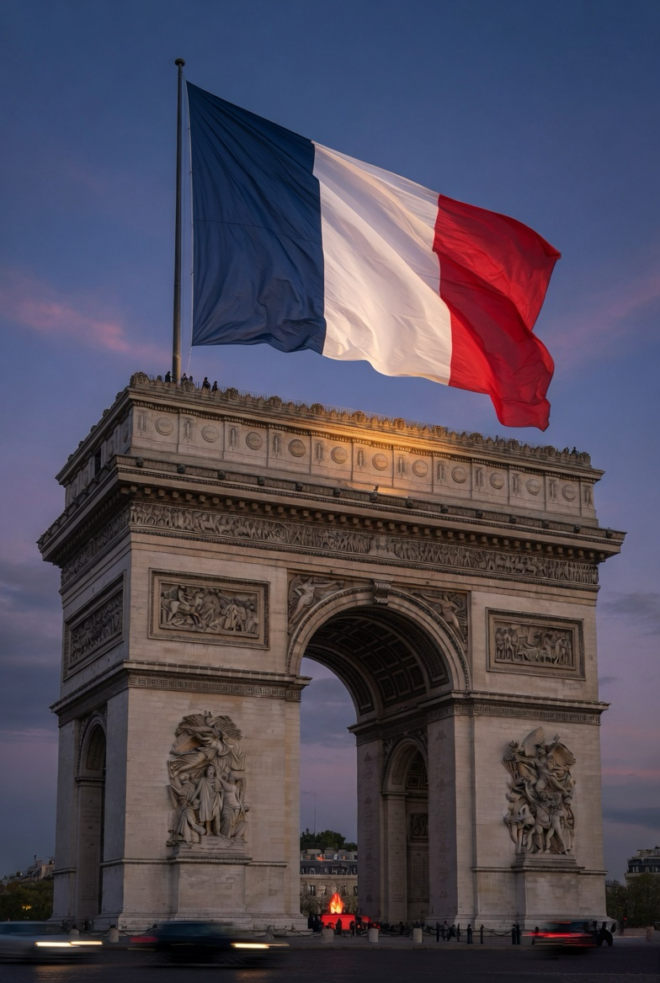
I. A Speechwriter’s High Mission
In 2008, a Frenchman named Pierre-Louis Colin, a thirty-four-year-old speechwriter at the Foreign Ministry, published a book entitled Le Guide des jolies femmes de Paris. Despite its jovial title, the book carried a serious, if faintly absurdist, purpose. Colin’s ‘high mission’, as he explained it, was to help combat what he saw as a righteous – or more precisely, self-righteous – Anglo-Saxon-dominated world. His chosen instrument in this geopolitical struggle was, characteristically, very French: a guide to the prettiest women in Paris.
‘The greatest marvels of Paris,’ he confided to his readers, ‘are not in the Louvre. They are in the streets and the gardens, in the cafes and in the boutiques. The greatest marvels of Paris are the hundreds and thousands of women, whose smiles – whose cleavages, whose legs – bring incessant happiness to those who take promenades. You just have to know where to observe them.’
The book went on to classify the arrondissements of Paris according to their feminine character, as one might classify the wine regions of Burgundy or the cheese-making districts of Normandy. Every neighbourhood, Colin insisted, had its ‘feminine speciality’. Menilmontant, in the north-east, was characterised by perfectly shameless cleavages – radiant breasts often uncluttered by a bra. The area around the Madeleine was the location to find sublime legs. Even middle-aged Parisian women between the ages of forty and sixty, he observed, displayed a unique ‘saucy maturity’, reflecting what he delicately described as an ambitious sex life that refused to lay down its weapons.
I should declare an interest at the outset. My wife is a New York Jewish woman of considerable intelligence and even more considerable opinions, and the question of which arrondissement offers the finest cleavages is not one I have been in any position to investigate personally. I read Colin’s guide with the detached scholarly interest appropriate to a man who values both intellectual curiosity and domestic survival. The former pulled me toward the subject; the latter kept my eyes on the page rather than the street. It is, on reflection, an entirely French tension.
One can read Colin’s book in two registers at once. In the first, it is precisely the kind of casually objectifying production that has, quite reasonably, become difficult to defend in the twenty-first century – a male gaze elevated to the status of national project. In the second, it is something more interesting: a refusal to accept that the world is merely functional, a deliberate aestheticisation of the everyday, an insistence that beauty encountered in the street is part of what makes a city a city. The two readings are not easily reconciled, and I have no interest in pretending otherwise. But the book is revealing – perhaps more revealing than Colin intended.
II. The Genre of the French Exception
I first encountered Colin’s book through the pages of another: La Seduction: How the French Play the Game of Life, by Elaine Sciolino, a former Paris bureau chief for the New York Times. Sciolino’s book held my attention more – not because I am indifferent to radiant breasts and shameless cleavages, but because, for reasons already explained, I am required to be – and because I recognised in it a representative specimen of a curious and expanding genre: books written about France and the French that could be written about nowhere and no one else.
Call these the books of the French exception. They are written, for the most part, with tongue firmly in cheek, yet each carries an underlying serious point: that the French are different from the rest of us – different in specific and identifiable ways, different in more general ways that nonetheless resist precise articulation. Among the titles one finds, on even a cursory survey: Sixty Million Frenchmen Can’t Be Wrong; French Women Don’t Get Fat; French Women Don’t Get Facelifts; French Children Don’t Throw Food; French Parents Don’t Give In; The Bonjour Effect: The Secret Code of French Conversation Revealed; Au Contraire: Figuring Out the French; How the French Invented Love; and the magnificently provocative 1000 Years of Annoying the French.
What animates every one of these titles – and what makes them so persistently popular across three continents – is a complicated cocktail of emotions that the non-French harbour toward France: admiration and resentful irritation; awe and envy; affection and a suspicion that the whole performance is an elaborate, well-rehearsed bluff. The French, these books collectively suggest, are simultaneously the most exasperating and the most compelling people on earth. And they know it. That, one suspects, is precisely what makes them so exasperating.
Consider, as a measure of the genre’s distinctiveness, the British broadcaster Viv Groskop’s book on how French literature can teach us to be happy. Could one imagine an equivalent volume devoted to Russian, German, or English literature? The question is not facetious. Russian literature would be the natural candidate – vast, philosophically serious, preoccupied with the meaning of life – except that it is preoccupied with suffering in a way that makes any therapeutic claim faintly ridiculous. German literature carries the burden of its own twentieth century. English literature is too embarrassed by sincerity to offer therapy. Only French literature – serious about life, but filtered through style and irony and pleasure – can be packaged as a guide to happiness without the title collapsing under its own weight. That is itself a clue to what France has managed to do that other nations have not.
III. The Intellectual Tradition and Its Shadows
Sudhir Hazareesingh, born in Mauritius – itself a former French colony – and now an Oxford academic with a flat in Paris, makes the most substantial attempt at analysis in his book How the French Think: An Affectionate Portrait of an Intellectual People. The French, he argues, evince an ‘unrelenting dogmatism’; the activities of the mind have occupied a special place in French public life; there is a devotion to culture reflected in the weight given to the written word; the philosophical spirit is more developed there than anywhere else.
These are not merely the impressions of an admiring outsider. They describe something structurally embedded in French institutions and French self-understanding. France produced Descartes, Voltaire, Rousseau, Montesquieu, Diderot, Victor Hugo, Zola, Sartre, Simone de Beauvoir, and Michel Foucault – thinkers who did not merely comment on their age but reshaped the conditions under which ages become possible. This flows from a national culture in which the life of the mind has been accorded a dignity and a social weight that most other nations, including those that claim to value it, have never quite managed to reproduce.
France has long believed itself to be a beacon to the rest of the world, animated by what Hazareesingh describes as an uncritical belief in the supremacy of the French mission civilisatrice. This is a form of arrogance – but it is arrogance with a history, rooted in the Enlightenment conviction that certain universal values – reason, liberty, equality, the rights of man – had been discovered in France and were France’s particular gift to humanity. That such values are in fact universal, and thus the property of no nation, is a complication the French have tended to manage with characteristic insouciance.
It is here, however, that any honest account must pause. The mission civilisatrice was also the ideological cover for substantial colonial violence: the conquest of Algeria, the brutalities of Indochina, the long extraction from West Africa. The same intellectual culture that produced Voltaire produced the legal categories under which colonial subjects were governed without rights. The same Academie francaise that has guarded the language has also served, at moments in its history, as a vehicle for the suppression of regional languages – Breton, Occitan, Basque, Provencal – whose speakers were taught to feel ashamed. The contemporary politics of laïcité carry forward, in attenuated form, some of the same impulse: assimilation in the name of universalism. To celebrate French seriousness about ideas without acknowledging the historical cost of that seriousness would be to write a different and less honest essay.
I raise this not to diminish the achievement but to insist on its full complexity. The tradition that produced the Declaration of the Rights of Man also produced the Code de l’indigénat. Both are true. Both are French. Any account that registers only the grandeur is a brochure; any account that registers only the violence is a polemic. The essay – like France itself, at its better moments – must hold both.
Since the Second World War – which was, for France, a purgatory of defeat, occupation, collaboration, and eventually liberation – the French have learned to live with the knowledge that they are neither the biggest nor the strongest power on earth. But they still believe themselves the best. This is not a simple delusion. It is a complex, historically informed conviction that while France may have lost the metrics of power – the armies, the empire, the economic weight – it has not lost its claim to cultural and intellectual authority. Not a week passes without some public invocation of l’exception culturelle – the insistence that France’s cultural life is not merely a commodity to be globalised, but a value to be protected. One may disagree with the protectionist instinct while acknowledging that only a nation with a serious attachment to its own cultural inheritance would feel so fiercely compelled to defend it.
IV. The Gastronomic Civilisation
No account of the French fascination would be complete without attention to food – and at this point I am on considerably safer domestic ground, my wife having no objections whatsoever to my admiring the French table in all its manifestations. The French relationship with food is not merely a preference or a pastime; it is a philosophical commitment, an organising principle of social life, and – in the view of its practitioners – an art form of the highest order.
French cuisine was recognised by UNESCO in 2010 as part of the world’s Intangible Cultural Heritage – the first national cuisine to receive such recognition. This is not merely a diplomatic compliment. It reflects the extraordinary degree to which French culinary tradition has shaped the world’s understanding of what cooking can be: not sustenance, not fuel, but a civilisational achievement. Auguste Escoffier codified a culinary language that spread across the world’s great kitchens. Brillat-Savarin theorised gastronomy as a branch of philosophy. Paul Bocuse transformed the restaurant into a site of cultural pilgrimage.
The great wine regions of France – Burgundy, Bordeaux, Champagne, Alsace, the Rhone and Loire valleys – represent an equally astonishing inheritance, one in which geography, history, agricultural practice, and aesthetic sensibility have combined over centuries to produce something irreducible and unmistakable. The concept of terroir – the idea that a wine expresses the specific character of the soil, the climate, and the place from which it comes – is a French contribution to human understanding that goes well beyond oenology. It is, at its core, an insistence that place matters, that particularity matters, and that the homogenisation of the world is a form of loss.
The French do not value food because it is expensive or because it signals status. They value it because they believe – and they are not wrong to believe – that the quality of daily life is inseparable from the quality of what one eats, and with whom, and how slowly. The long Sunday lunch, the market on a Wednesday morning, the particular bread from the particular boulangerie on the particular corner: these are not indulgences. They are the substance of a life properly lived. It is a philosophy my wife endorses without reservation. On this, at least, the New York Jewish sensibility and the Parisian one find common ground – both traditions having understood, long before the wellness industry was invented, that the table is the centre of civilised existence.
V. Seduction, Conversation, and the Democratic Cafe
It is no coincidence that Sciolino chose seduction as her governing metaphor for French social life. Seduction in the French understanding is not synonymous with sexual pursuit, though it encompasses that – and it is at this point in the essay that I must once again remind myself of my domestic circumstances and proceed with appropriate scholarly detachment. Seduction in the French sense is a much broader cultural practice: a mode of engaging with the world that valorises charm, persuasion, pleasure, and the artful management of desire, in every domain from personal relationships to political discourse to aesthetic experience.
French conversation is not merely the exchange of information; it is a performance, a mutual display, a form of play in which wit and style and the ability to mount and defend an argument are not merely useful but socially obligatory. This is what lies behind the frequent observation that the French prefer abstract argument to concrete, evidence-based discussion. They are not anti-empirical so much as pro-theatrical. The argument must sing as well as prove. It is a quality that can be simultaneously exhilarating and maddening – usually both in the same evening.
The French cafe, in Hazareesingh’s phrase, ‘symbolises equal dignity’. The cafe is the place where the worker and the intellectual, the tourist and the habitue, the solitary drinker and the animated table of friends, all occupy the same democratic space. It is, in this sense, a materialisation of the republican ideal – not equality of outcome, but equality of access to the pleasures and the conversations that make life bearable. The waiter who addresses you without deference or servility is not being rude; he is performing, in his small way, the dignity of his republic. That this democracy of pleasure sits alongside a pronounced social hierarchy in other domains is one of France’s more productive contradictions.
And here, returning to where we began, Colin’s guide to the women of Paris takes on a somewhat different character. It is, in this light, a contribution – eccentric, immodest, not entirely defensible – to the same broader tradition: the insistence that the city is an aesthetic experience as much as a functional one, that beauty is everywhere if you know how to look, and that the capacity to appreciate this is not a superficiality but a civilisational achievement. One may decline the particular form of the argument. One may be required by one’s domestic circumstances to decline it quite firmly. But one can still recognise the impulse from which it springs.
VI. The Language and the Literature
There is, in France, a residual belief in the intrinsic genius of the French language. This belief has a long history and a powerful institutional infrastructure. The Academie francaise, founded in 1635, has presided for nearly four centuries over the purity and integrity of the language – a guardianship that strikes many foreigners as comically pedantic and strikes the French as entirely natural. The periodic battles against anglicisms – le weekend, le marketing, le logiciel grudgingly preferred to software – are fought with a seriousness that tells you something essential about the French relationship to language.
French is not merely a means of communication for the French; it is a civilisational medium, the vessel in which their philosophy, their literature, their law, and their political ideas have been shaped and transmitted. To defend the language is, in this view, to defend the culture that the language makes possible. The francophone world – stretching from Quebec to Dakar, from Beirut to Ho Chi Minh City – is held together not by military or economic power but by a linguistic and cultural community. That this community is also, in part, the residue of empire is a complication the French have only recently begun to address with the candour it deserves.
The French literary tradition is, by any measure, one of the greatest in the world. From the chansons de geste of the medieval period, through Rabelais and Montaigne, Racine and Moliere, Voltaire and Rousseau, Stendhal and Balzac and Flaubert, Baudelaire and Rimbaud and Verlaine, Proust and Gide and Colette, Sartre and Camus and Beckett – a tradition of such richness and density that it can bear the weight of books arguing that it holds the secret to human happiness. Groskop’s claim is extravagant. It is also not groundless. The French literary tradition is profoundly and persistently preoccupied with the question of how to live: how to live well, how to live honestly, how to live in full awareness of mortality, failure, and the absurd. It is a literature of serious engagement with life, and that seriousness, filtered through style and irony and pleasure, is perhaps what makes it feel, to the non-French reader, like a form of therapy. Whether it is cheaper than therapy is a question I leave to the economists.
VII. The Paradox of French Unhappiness
There is one further observation that demands attention: French unhappiness. France consistently ranks poorly in international surveys of self-reported wellbeing – a fact that strikes many outside observers as deeply paradoxical, and strikes me, frankly, as one of the most interesting things about the French. Here is a country with magnificent food, extraordinary wine, world-class art and architecture, a generous welfare state, excellent public transport, long holidays, early retirement, and a philosophical tradition that has devoted centuries to the question of the good life – and yet the French report themselves as unhappy at rates that would embarrass nations far less well-appointed.
Various explanations have been offered. The French, it is said, are culturally trained not to express satisfaction – to say that things are well is to tempt fate, to expose oneself to ridicule, or simply to fail in one’s duty to be critical. The philosophical tradition that prizes rigorous analysis also cultivates a rigorous dissatisfaction with the gap between the ideal and the actual. France, which believes it has articulated universal values better than any other nation, is therefore more acutely aware of the distance between those values and the reality of French life. There is something almost heroic in this – the unhappiness of a nation too honest about its own standards.
There is also the burden of history. France in the twentieth century underwent extraordinary trauma: the carnage of the First World War, which devastated a generation; the defeat and occupation of 1940, which left a wound that has never entirely healed; the wars of decolonisation in Indochina and Algeria, which compromised the republic’s self-image in ways that have never been fully reckoned with. French unhappiness may be, in part, the unhappiness of a nation that knows what it is supposed to be and cannot quite forgive itself for the distance between aspiration and achievement.
And yet – and this is perhaps the deepest paradox – the very things that make the French unhappy are, in a sense, the things that make them admirable. A culture that takes ideas seriously enough to be distressed when ideas are betrayed; a civilisation that holds such a high standard for the good life that everyday life inevitably disappoints; a people so invested in the ideal of the republic that its repeated compromises cause real anguish – these are not symptoms of failure. They are evidence of seriousness, of genuine engagement with what it means to live in society and to hold values that one actually intends to live by. Most nations have long since given up the ambition and settled for the management. France has not. That costs something. The surveys show it.
VIII. My Uncle Raphael, or France in a Single Life
All of this – the grandeur, the intellectual tradition, the gastronomic philosophy, the love of beauty, the capacity for arrogance, the refusal to stop asking the hardest questions – was not, for me, an abstraction encountered first in books. It was embodied, with great specificity and occasional difficulty, in a single man: my uncle Raphael, my mother’s brother, the sole surviving blood relative on her side of the family, and the person who first taught me that culture is not decoration but the very medium in which a serious life is lived.
The family was originally from the south of France – that older, slower, more Mediterranean France, where the light is different and the relationship with time is different and the food is a different kind of serious. But by the time the war came they were in Paris, and what followed broke the family in the way that the war broke so many families: permanently and across continents. My grandfather did not survive. My grandmother and my mother came to Australia as refugees, carrying with them whatever could be carried, which is to say very little of the material kind and a very great deal of everything else. Raphael stayed. He remained in France – in the country that had, under occupation, participated in the destruction of its own Jewish citizens – and built a life there. The distance between Paris and Sydney was not only geographical. It was the distance between a man who chose to remain inside his history and a family who had been expelled from theirs.
What Raphael did with what remained to him was, characteristically, French and, characteristically, extraordinary. He became an academic. He specialised in German literature. A French Jewish man who had lived through the occupation of his country and the attempted annihilation of his people chose to devote his professional life to Goethe, Schiller, Kleist, Heine, Thomas Mann – to the literary tradition of the civilisation that had murdered his father and scattered his family to the other side of the world. I did not fully understand this as a child. I am not sure I fully understand it now. But I understood, even then, that it was not forgiveness in any simple sense, and not denial, and not indifference. It was something more demanding than any of those: a refusal to allow the worst of a culture to cancel the best of it, a determination to hold the contradiction open rather than resolve it cheaply in either direction.
This was, I came to understand, the purest possible expression of humanism – and it was Raphael who taught me what humanism actually means, not as a philosophical position to be adopted but as a daily practice to be enacted under pressure. The humanist does not pretend that cultures are without sin. He does not look away from what they have done. He insists, against the evidence when the evidence is at its most brutal, that the human capacity for beauty and meaning and moral seriousness is real, and worth preserving, and worth returning to even after it has been catastrophically betrayed. Raphael had better grounds than most for abandoning that insistence. He did not abandon it. He taught it to a child from Australia who had come, via a very long chain of accidents, to be his nephew. That is the fact I find myself unable to get past.
His love-hate relationship with culture – which he transmitted to me with the generosity and occasional impatience of a man who regards clarity as a moral obligation – was not the fashionable ambivalence of the cultural critic who has never had anything at stake. It was the earned complexity of someone who knew, in his bones, that the same tradition that gave you Schiller’s Ode to Joy gave you the bureaucratic machinery of the Final Solution. Both are true. Both are German. And yet Raphael read Schiller, and taught Schiller, and would have wanted his students to read Schiller – because he understood that to cede the beautiful to the murderous is to let the murderers win twice.
He was also, I should say, magnificent company at the table. Time spent with Raphael as a child meant books and argument and ideas, yes – but it meant food too, and wine, and the particular quality of attention he brought to both, which made an ordinary lunch feel like a minor event in the history of civilisation. He had opinions about everything edible, held with the dogmatic serenity that Hazareesingh identifies as a distinctively French characteristic. He had opinions about conversation that were similarly uncompromising: the argument must be pursued wherever it leads, the idea must be followed to its conclusion, sentiment is not a substitute for thought. And he had opinions about beauty – that it is not optional, that a life without serious aesthetic engagement is a diminished life, that culture is not what you do after the real business of living is attended to but is itself the real business. Being true to yourself, he insisted, was not a licence for self-indulgence. It was the hardest obligation of all – because it required you to know, first, what you actually were.
He was, in every sense that the genre of books about France attempts to capture and never quite manages, a true Frenchman. Not because he was uncomplicated – he was enormously complicated – but because he carried within himself, and enacted in his daily existence, the best and most demanding version of what French civilisation has claimed for itself: the conviction that rigour and pleasure are not opposites, that the table and the library serve the same ultimate purpose, that to be serious about culture is to be serious about life, and that to be serious about life requires you to hold your contradictions open and keep thinking. He remained in France while his family left. He loved German literature while knowing what Germany had done. He insisted on beauty while living with the knowledge of what ugliness is capable of. He was my uncle, and he was the most French person I have ever known, and I am grateful for him in ways I do not have adequate language for – which is, perhaps, why I keep writing.
IX. Why the Fascination Persists
The question that the genre of the French exception collectively poses – and cannot quite answer – is why France exerts so persistent a fascination on the rest of the world. Other nations are rich; other nations are historically significant; other nations have produced great literatures, great cuisines, and great philosophies. Yet the shelves of bookshops in London and New York and Sydney groan with titles about the French that have no equivalent devoted to the Germans, the Italians, or the Spanish – let alone the Australians, who have the additional disadvantage of being both cheerful and, in the eyes of most Europeans, not yet fully sure what they think about anything.
Part of the answer lies in visibility. France has, over several centuries, invested heavily in the projection of its culture – through the Academie francaise, through the Alliance francaise, through a film industry protected by the state, through a cultural diplomacy that has always understood that soft power matters. The French cultural presence in the world is not accidental; it is the product of a coherent, if sometimes high-handed, national strategy.
But this cannot be the whole answer, because no amount of strategic cultural projection explains the emotional texture of the non-French response to France – that peculiar mixture of admiration, envy, affection, and irritation that the genre documents so faithfully. That response suggests something more fundamental: that France represents, for the rest of the world, a living argument that an alternative modernity is possible – a modernity that has not entirely surrendered to the market, that still believes in the value of beauty and the importance of ideas, that insists on the pleasure of daily life as a serious political and cultural commitment.
The French are exasperating because they are right about things that the rest of us have quietly abandoned. They are right that food matters. They are right that language matters. They are right that culture is not merely entertainment. They are right that the public realm should be beautiful. They are right that the life of the mind is a dignified vocation. They are right that pleasure is not trivial. They have also, in defending these convictions, often been wrong in serious and damaging ways – wrong about empire, wrong about assimilation, wrong about the universality of what was sometimes only a national style dressed in the language of humanity. But they have not been wrong about everything. And they have been right about much that the rest of us have stopped even trying to defend.
At the end of this survey I find myself where I began: a man of mixed heritage – Indigenous, French and Jewish, Australian by formation, cosmopolitan by temperament – reading books about a country I sometimes call home and a people I know well but have never entirely understood. In them I found something that confirms what I have long believed: that culture is serious, that beauty is serious, that how to live is the most serious question of all. France has not answered that question. No country has. But France has refused, with a stubbornness that is at once its greatest virtue and its most persistent fault, to stop asking it. My uncle Raphaël taught me that. He learned it the hard way.
X. A Last Word from the Arrondissements
Pierre-Louis Colin’s guide to the women of Paris is, in the end, a love letter – eccentric, immodest, dated, and very French – to the city itself. Its premise is that beauty, encountered in the quotidian, in the street and the cafe and the garden, is not merely decorative but essential: essential to a city’s claim to be a city, essential to a culture’s claim to take life seriously, essential to a civilisation’s claim to have thought hard about what human life is for.
Whether Colin was right about which arrondissement offers the finest legs, I am not in a position to say. My wife – who has read this essay in draft, and whose marginal annotations I will spare you – has made her views on the matter perfectly clear. But I note that she has not objected to any of the other nine sections, which suggests that the argument survives the removal of the empirical fieldwork. A French critic would no doubt insist that the fieldwork was the best part. He would probably be right. He would certainly be right that he was right.
France, for all its arrogance, its dogmatism, its historical sins, and its extraordinary capacity to irritate the world while simultaneously enchanting it, remains what it has always been: the country that insists, with the full weight of its history and its culture, that the good life is possible, and that it has some idea of what the good life looks like. It is this insistence, more than the food, more than the wine, more than even the women of any particular arrondissement, that explains the fascination – and that ensures the shelves will continue to groan with books about a people who refuse, with magnificent stubbornness, to be anything other than entirely, exasperatingly, irreducibly themselves.
Even my wife admits the food is extraordinary. We agree to disagree about everything else. It is, in its own small way, a very French arrangement. Raphael, I think, would have approved of her. He had very high standards for both the table and the argument. She meets both.
© Bakchos 2026 | Blak and Black est. 2010


You speak of your Uncle Raphael with a reverence and love you express for few. Emblematic of France, I can see the same determination and intent to rise above the circumstances in you. Reg said your father would be proud of the man you’ve become. I suspect Raphael would be too.
Thanks Watershedd. My Uncle survived the Holocaust, all I’ve done is weathered the ire of a few racist and corrupt white Australian Federal Police officers, and a wanker who pretends that he achieved something significant as a Canberra Raider. I’m surprised that Angel Marina hasn’t claimed to be the first Raider to take a dump. His other “firsts” are on the same par of significance.
Your uncle was passionate about German literature and was a passionate teacher.
I love this paragraph, Bakchos. This is France in a nutshell.
“Pierre-Louis Colin’s guide to the women of Paris is, in the end, a love letter – eccentric, immodest, dated, and very French – to the city itself. Its premise is that beauty, encountered in the quotidian, in the street and the cafe and the garden, is not merely decorative but essential: essential to a city’s claim to be a city, essential to a culture’s claim to take life seriously, essential to a civilisation’s claim to have thought hard about what human life is for.”
The portrait of Uncle Raphael is the essay’s emotional and intellectual climax. It transforms what could have been a string of cultural observations into something lived and earned. By showing rather than telling—Raphael choosing German literature after the Occupation, insisting on holding contradictions open—you make humanism feel like a daily, costly practice rather than a slogan. This section alone justifies the entire piece. It is moving without ever becoming mawkish, and it retroactively deepens every earlier discussion of French “seriousness.”
Bakchos you repeatedly refuse the easy move. You acknowledge the objectifying gaze in Colin’s book, the violence of the mission civilisatrice, the suppression of regional languages, and the hypocrisy of laïcité—yet you never let those facts cancel the genuine achievements. The line “Any account that registers only the grandeur is a brochure; any account that registers only the violence is a polemic” is pitch-perfect. This refusal to resolve the contradictions cheaply is the essay’s greatest strength.
Kumpel When I met your Uncle he was charming and witty. Polished and polite. Erudite and funny. A more refined version of you. He’s an amazing man who overcame a lot and ultimately made a lot out of himself. You both should be proud. XOXO
I love French culture.
Vive la France!