
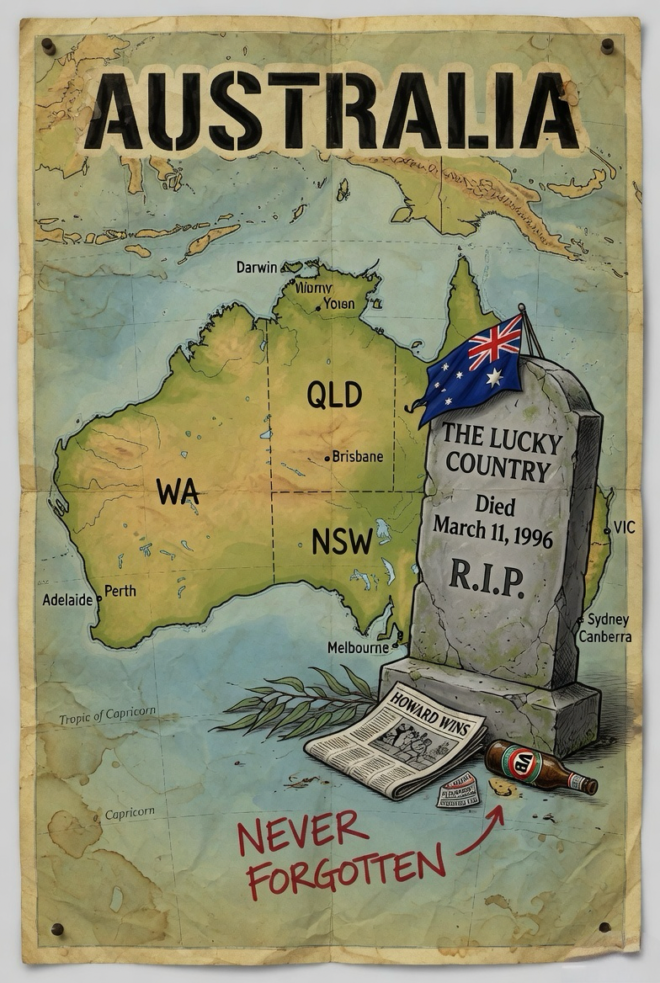
Preface: A Nation and its Myth
Donald Horne meant it as an indictment. When he titled his 1964 portrait of Australia The Lucky Country, he was not celebrating a sunburned paradise of rugged egalitarianism. He was delivering a verdict: that Australia had prospered not through the genius of its institutions or the wisdom of its leaders but through dumb geological fortune and the benign accident of geography. The country had been lucky, Horne warned, and it was governed by second-rate people who mistook that luck for achievement. Sixty years on, Horne’s irony has curdled into prophecy. The luck is still being extracted from the earth – but it no longer belongs to the people who live above it. And the second-rate people have multiplied.
This is an essay about what has happened to Australia: to its politics, its public institutions, its economy, its sense of shared obligation, and its conscience. It is not a nostalgic essay. The Australia of the past was often brutal, often exclusionary, and always imperfect. But there was, within the postwar settlement and its long aftermath, a genuine belief – however imperfectly realised – that the country’s wealth ought to be distributed broadly, that a rising tide might actually lift boats other than yachts, that the test of a civilised society was not the fortune of its richest citizens but the dignity afforded to its most vulnerable. That belief has not merely eroded. It has been systematically dismantled, and the dismantling has been managed by people who cannot find the courage to admit what they are doing.
I. The Mediocrity Ascendant
There is a particular species of Australian public figure that has come to dominate the national life: competent at manoeuvre, skilled at the managed appearance of competence, and entirely bereft of either intellectual substance or moral courage. They populate the front benches of both major parties, the corner offices of the ASX’s largest companies, and the upper echelons of the public service. They have learned to survive without ideas, to advance without risk, and to speak at great length without saying anything that might later be held against them.
The rot runs deep and it runs wide. In politics, the talent pool from which both major parties draw their candidates has contracted to a shallow pond of staffers, union apparatchiks, lobbyists, and party factional operatives – people who have never managed anything more complex than a ministerial diary and who have been insulated since their early twenties from the ordinary economic pressures that shape the lives of those they are elected to represent. The pathway to parliament now runs almost exclusively through the machine. Independent thought is not discouraged; it is architecturally impossible within a system that rewards obedience to faction above all other virtues.
The corporate sector has undergone a parallel devolution. The titans of Australian capitalism – the mining magnates, the bank chiefs, the retail oligarchs – have largely substituted rent extraction for genuine value creation. The major banks have spent decades designing products engineered to transfer wealth from customers to shareholders, with the Royal Commission into Misconduct in the Banking, Superannuation and Financial Services Industry confirming what any attentive Australian had long suspected: that the institutions entrusted with the financial lives of ordinary citizens regarded those citizens primarily as revenue-generating units to be exploited until the cost of exploitation exceeded the cost of settlement. No one went to prison. Several went to retirement on packages that would fund a small regional hospital
The public service, once a genuine repository of institutional knowledge, independent analysis, and frank and fearless advice, has been hollowed out by decades of outsourcing, ideological capture, and the systematic preference for political reliability over professional excellence. The senior ranks of the Australian Public Service now function primarily as an implementation arm of ministerial offices staffed by people whose principal qualification is that they attended the same university events as the minister. The frank and fearless advisor – that endangered species of permanent secretary who would tell the minister not what the minister wished to hear but what the evidence required – has been replaced by the sophisticated facilitator, expert in the management of optics, fluent in the language of outcomes and deliverables, and reliably incapable of producing either.
II. The Participation Certificate as National Religion
Somewhere in the evolution of Australian institutional life, a category error occurred, and it has since been elevated to official doctrine. The error is this: the confusing of process with achievement, of effort with result, of the meeting held with the problem solved, and of the qualification obtained with the competence demonstrated. Australia has built, across its education system, its public institutions, and increasingly its corporate culture, an elaborate infrastructure for the celebration of participation – and it has done so at the direct expense of the cultivation of excellence.
Children who cannot read are promoted through primary school so that no one’s feelings are hurt. University degrees are conferred on students who lack the foundational skills that previous generations acquired in high school, because the funding model requires enrolments and the reputational model requires pass rates. Graduate programs in law, medicine, and engineering are increasingly populated by people whose credentialling is impeccable and whose capacity for independent judgment is, charitably, undeveloped. The credential has been decoupled from the capacity it was designed to certify, and no one in a position of institutional authority has the courage to say so, because the saying of it would require them to defend a standard, and the defence of standards is now understood as a form of elitism.
The public sector reflects this faithfully. Performance management systems designed in theory to reward excellence and address underperformance operate in practice as elaborate rituals for the documentation of adequacy. The exceptional public servant is rarely promoted faster than the mediocre one; the mediocre one is never managed out. The system has optimised for the avoidance of conflict rather than the delivery of results, and in doing so it has created a culture in which the dominant professional skill is not competence but the management of appearances.
This is not a small problem. The capacity of the state to function – to build the infrastructure, design the programs, and implement the policies that a complex modern society requires – depends on the quality of the people doing those things. When that quality declines, everything declines with it: the hospitals that cannot manage their waiting lists, the housing programs that cannot deliver houses, the infrastructure projects that run years late and billions over budget without producing anyone who is accountable for the failure. The participation certificate has become the foundational credential of Australian public life, and it is eating the institutions from within.
III. The Plunder of the Commons
Australia is, in geological terms, an extraordinarily wealthy country. Beneath its ancient soils lie iron ore, coal, natural gas, lithium, gold, uranium, and rare earth minerals upon which the global economy increasingly depends. These resources belong, in any meaningful moral and political sense, to the Australian people – to the generations who have lived on this continent and the generations who will inherit it. They are the shared inheritance of a commonwealth. The manner of their extraction, the terms under which they are taken, and the distribution of the wealth they generate are among the most consequential decisions a democratic society can make.
Australia has made those decisions very badly.
The effective tax rates paid by the major mining companies on Australian resources are, by any international comparison, scandalously low. The Petroleum Resource Rent Tax – the mechanism by which Australians are meant to receive their share of the wealth generated from the extraction of their natural gas – has for years collected almost nothing from the largest projects in the country, as multinational companies use transfer pricing, debt loading, and the extraordinary generosity of cost deduction rules to ensure that projects generating tens of billions of dollars in revenue return almost nothing to the public treasury. Australia is, by some measures, the world’s largest exporter of liquefied natural gas, and the Australian people have received, in government revenue from that export, a sum so negligible relative to the wealth generated that it constitutes a standing rebuke to every government that has administered the system.
The iron ore royalties flowing to the West Australian government are more substantial, but they have largely served to subsidise a state government reluctant to reform its own fiscal base rather than to build the national endowment that this generation owes to the next. The billionaires who have made their fortunes from Australian resources – and whose names are invoked with almost reflexive reverence in the financial press as exemplars of enterprise and vision – have done so primarily because they were fortunate enough to hold tenements above mineral deposits that the geological history of the continent placed there, and because successive Australian governments, across both major parties, lacked either the courage or the inclination to insist on a fair return.
This is not anti-enterprise sentiment. It is basic arithmetic. When a finite and irreplaceable resource is extracted and sold, the wealth thereby created should flow primarily to the community that owns that resource, with a fair return to the capital and labour that extracted it. That is the theory on which resource royalties rest. The practice in Australia has inverted the theory: the flow is primarily to the capital, and the community receives what the political system – heavily lobbied by the capital – permits it to receive. The resource nationalism that other countries regard as a legitimate expression of democratic sovereignty is, in Australia, denounced as economic vandalism by the very interests that benefit most from the current arrangement.
IV. The Howard Settlement and the Triumph Of Greed
To understand how Australia arrived at this point, it is necessary to understand the Howard years – not merely as a political period but as a cultural formation that reshaped the country’s moral vocabulary in ways from which it has not recovered.
John Howard governed Australia from 1996 to 2007. His governments were not uniformly bad – the gun control legislation of 1996 stands as a genuine achievement of political courage, and the GST represented a serious, if contested, attempt at tax reform. But the legacy of the Howard era that has proved most durable and most damaging is not legislative but cultural: the systematic legitimation of personal greed as the organising principle of Australian social life, and the delegitimation of collective obligation as the organising principle of the commonwealth.
The Howard government understood, with considerable political sophistication, that a country of property owners would be a conservative country – that the extension of asset ownership to the aspirational middle class, principally through the capital gains tax discount and the superannuation system’s distortion in favour of the already wealthy, would produce a citizenry whose political instincts aligned with the preservation of those assets rather than the redistribution of wealth. The result was a generation of Australians who came to understand their net worth primarily through the lens of their property values, and who consequently came to regard as a threat to their prosperity any policy that might increase housing supply, limit negative gearing, or otherwise restrain the inflation of residential asset prices.
Howard also oversaw – and actively cultivated – a deepening contempt for public institutions and collective provision. The rhetoric of the Howard years consistently positioned private provision as the expression of individual virtue and public provision as the domain of those who had failed to make sufficient effort. The private school system was expanded at public expense; the public hospital system was systematically starved; the language of the welfare state was gradually replaced by the language of mutual obligation, with obligations flowing almost exclusively from the poor to the state and almost never from the wealthy to the community.
Pauline Hanson emerged during this period not as an aberration but as a logical extension of the cultural permission structures the Howard government had created. Where Howard spoke in the careful code of mainstream conservatism – work ethic, personal responsibility, traditional values – Hanson translated those codes into the vernacular of explicit resentment. Howard occasionally disowned the translation while benefiting from the sentiment; the political realignment it represented has now become permanent. The Howard era did not merely win elections. It moved the Overton window of Australian political life decisively rightward and kept it there.
V. The Criminalisation OF Poverty
There is a line of argument – respectable in liberal democratic societies, foundational in the Australian political tradition – that holds that the quality of a civilisation is measured not by the magnificence of its peaks but by the condition of its valleys: that a society which produces billionaires while its most vulnerable citizens sleep under bridges has failed in its most fundamental obligation. Australia has failed that test with remarkable thoroughness, and it has compounded the failure with a set of policy choices that have transformed poverty from a social emergency requiring a collective response into a legal condition to be managed, contained, and where possible, criminalised.
The homelessness figures are not abstract. On any given night, more than 122,000 Australians are without a home – sleeping rough, in emergency accommodation, in overcrowded temporary shelters, in cars, in arrangements of such precarity that the distinction between housed and unhoused is largely semantic. This in a country of 26 million people, possessed of extraordinary natural wealth, running a budget that finds billions for submarines and stadiums and tax concessions for investment properties. The proportion of that 122,000 who are First Nations Australians is grotesquely disproportionate: a marker not merely of ongoing disadvantage but of the specific and continuing consequences of dispossession – the removal from country, the destruction of kinship networks, the intergenerational trauma that no Closing the Gap framework, however sincerely designed, has thus far been able to address.
The response of Australian governments to homelessness has not been primarily to build housing. It has been to manage the visible presence of homeless people through a combination of public space exclusions, move-on orders, fines for camping in public places, and the quasi-criminalisation of survival behaviours – sleeping in doorways, begging, urinating in public when no other option exists – that are the inevitable consequences of having nowhere to go. The person who loses their housing is first impoverished, then criminalised for the behavioural consequences of that impoverishment, then fined for behaviours they cannot afford to pay, then – in the ultimate circularity of the system – potentially imprisoned for the non-payment of fines incurred for the crime of being poor in a public place.
The Robodebt catastrophe – in which the Australian government deployed an automated debt recovery system to pursue welfare recipients on the basis of averaged income data it knew, at the levels of the public service and ministerial offices that designed the scheme, to be legally invalid – represents perhaps the purest expression of this dynamic. The system was designed to intimidate. The intimidation was consciously directed at the most vulnerable: people with mental illness, people with limited literacy, people who lacked the resources to challenge the debt or the sophistication to understand that the debt itself might be fraudulent. People died. The Royal Commission into the Robodebt Scheme found that the program was not merely administratively deficient but consciously dishonest – that public servants and ministers knew the legal basis for the debts was untenable and pressed on regardless. No one has been held meaningfully accountable.
VI. The Albanese Paradox
Anthony Albanese has spoken often about growing up in housing commission in Camperdown – the single mother, the council flat, the embodied understanding of economic precarity that he carries, or claims to carry, into the Lodge. It is, as a political narrative, genuinely affecting. It is also, as a guide to policy ambition, almost completely inert.
Under the Albanese government, the homelessness crisis has not abated. The housing affordability crisis – driven by the intersection of inadequate supply, sustained demand-side subsidies for investor landlords, and the structural incentives embedded in the negative gearing and capital gains tax concession regimes that Labor went to two elections promising to reform and has since abandoned – has continued to deteriorate. Rents have risen faster than inflation. The national social housing stock, which has been declining as a proportion of total housing for three decades, has not been meaningfully expanded. The government’s signature housing intervention – the Housing Australia Future Fund – was delayed, contested, and ultimately scaled to a quantum so far beneath the scale of the problem that describing it as an adequate response requires a generosity of assessment that the circumstances do not warrant.
Albanese speaks of growing up in housing commission. Australians are growing up without housing at all, or with housing that consumes so large a proportion of their income that the residual is insufficient for the other necessities of a dignified life. The gap between the autobiography and the policy is not, in itself, evidence of bad faith. Politics is the art of the possible, and the institutional constraints on any government are real. But the constraints that bind Labor on housing are largely self-imposed: the consequence of a party that has decided the electoral risks of genuine reform outweigh the moral costs of inaction and has preferred the management of the crisis to its resolution.
The hypocrisy is not merely personal. It is structural. A Prime Minister who grew up in public housing, presiding over a system in which public housing is so scarce that the waiting lists in most states run to a decade or more, should feel – and if he feels it, should express – a particular urgency. The urgency is not visible in the policy settings. The rhetoric of the Lodge outpaces the legislation of the parliament by a distance that grows more uncomfortable with each quarterly homelessness data release, each news cycle about families sleeping in their cars, each winter in which the emergency shelters are full and the overflow is a footpath.
VII. From the Inside: A Witness Account
The argument that Australian public institutions have been captured by mediocrity is not, for this writer, an abstraction derived from policy analysis or journalistic observation. It is the lived experience of someone who held senior executive positions within the Australian public service – positions from which the machinery of government is visible not as it presents itself to the public but as it actually operates, in the meeting rooms and corridors and budget cycles where the real decisions are made and the real characters revealed.
What those positions revealed was this: that the selection, promotion, and retention of senior public servants in Australia has become systematically decoupled from professional competence, and that the mechanisms which ought to correct for this – performance management, accountability frameworks, ministerial oversight – have been so thoroughly captured by the culture of managed mediocrity that they function primarily to protect it.
Consider the species of senior official whose ascent is built not on demonstrated analytical capacity or sound judgment but on a combination of inflated self-regard and the social capital accumulated from a prominent sporting career. Australia’s culture of athletic celebrity translates, with disturbing ease, into institutional authority – the assumption that a man who was once admired on a football field must possess qualities of leadership and decisiveness worth deploying in complex policy environments. The assumption is frequently wrong. The sporting celebrity who cannot demonstrate basic competency in the technical domain his position requires – who has, in fact, failed repeatedly to acquire that competency at the most elementary level – does not thereby fail to advance. He advances anyway, carried by ego, by network, and by the institutional reluctance to hold senior figures to standards that their performance plainly does not meet.
Then there is the more complex and uncomfortable phenomenon of identity weaponised as a shield against accountability. It is necessary to say this carefully, because the argument is easily misread. The structural barriers facing women and people from minority backgrounds in Australian institutions are real, documented, and ongoing. Genuine equity in senior appointments is both a moral requirement and an institutional good. None of that is in question here. What is in question is the specific and observable dynamic in which a senior official whose performance is manifestly inadequate deploys their identity – gender, ethnicity, or both – as a pre-emptive defence against any scrutiny of that performance, and in which an institutional culture so fearful of the appearance of discrimination declines to apply the standards it would apply to anyone else. The result is not equity. It is the corruption of the equity framework itself – a corruption that ultimately damages the cause it claims to serve, by providing ammunition to those who wish to dismiss legitimate equity considerations as cover for the protection of incompetence.
And then there is the meeting-room moment that captures the culture more precisely than any policy document could. A serious question is put – the kind of question that a senior official is paid, at considerable public expense, to have thought about and answered. The response is not analysis. It is not even an acknowledgment that analysis is owed. It is a deflection so brazen in its contempt for professional obligation that it silences the room: a statement, offered without apparent irony, that a forthcoming personal circumstance will relieve the speaker of any requirement to engage with the question at all. No answer is given. No answer is later provided. The question, and the accountability it represented, simply disappears into the institutional culture that produced it.
These are not isolated incidents. They are the system working as it has been designed – or rather, as it has been allowed to degrade – to work. The Australian public service once attracted and retained people of genuine distinction: economists, lawyers, scientists, and policy thinkers who understood that public service was a vocation with obligations attached, not merely a career with benefits attached. What it attracts and retains now, at too many of its senior levels, is the person who has learned to navigate the system without ever being required to demonstrate what the system exists to deliver.
The cost is borne, as always, by those the system is supposed to serve.
Conclusion: What the Lucky Country Owes
Horne’s original charge – that Australia was a lucky country run by second-rate people – was a provocation designed to disturb a complacent national self-image. The complacency is gone now, replaced by something more corrosive: a knowing cynicism that understands the gap between the national rhetoric and the national reality but has largely ceased to find it intolerable. The political class has learned to speak the language of fairness and community while administering a system that concentrates wealth and externalises precarity. The corporate sector has learned to speak the language of stakeholder capitalism while optimising for shareholder returns. The public service has learned to speak the language of evidence-based policy while implementing the preferences of ministers regardless of the evidence.
What remains is the luck – the extraordinary mineral wealth, the geography, the climate, the agricultural abundance – and the question of whom it serves. The answer, currently, is that it serves the few: the resource billionaires, the investment property portfolios, the multinational majors whose LNG revenues flow to shareholders in Houston and Tokyo while Australian pensioners choose between heating and eating. It serves the political machines that perpetuate the arrangements by which the wealth flows as it does. It serves the participation-certificated administrators who manage the system’s legitimate functions while ensuring that its fundamental injustices are handled with sufficient bureaucratic smoothness to avoid excessive public disturbance.
It does not serve the 120,000 people without homes tonight. It does not serve the First Nations families for whom the Closing the Gap framework is a government document that describes their disadvantage with impressive specificity and addresses it with insufficient urgency. It does not serve the generation of young Australians for whom homeownership – that foundation of the postwar social compact – is a statistical improbability rather than an aspiration. It does not serve the workers whose real wages have stagnated across a decade of resource booms that generated private fortunes without producing the broadly shared prosperity that ought to have been their social dividend.
Australia can be, again, something more than a quarry with a flag. But not with these people, these institutions, and this political culture. The Lucky Country has not died of bad luck. It has died of choices – made consciously, repeatedly, and for the most part by people who knew exactly what they were choosing and chose it anyway.
That is the indictment. The verdict will be delivered, as it always is, by history.




This is a powerful, elegantly written polemic that captures a deep frustration with Australia’s institutional and cultural trajectory. The essay is structured like a prosecutor’s closing argument—rhetorically assured, morally charged, and unflinching in its diagnosis of mediocrity, rent-seeking, and eroded collective purpose. Bakchos draws on Donald Horne’s The Lucky Country with precision, flipping its irony into a verdict on decline. The prose is sharp, the anecdotes vivid (especially the “from the inside” section), and the moral core—measuring a society by its valleys, not its peaks—resonant with a long Australian (and broader social-democratic) tradition. It is not nostalgia; it explicitly concedes the postwar settlement’s flaws. That honesty strengthens the indictment.
The identity and competence tension: The “identity weaponised as shield” passage is the most delicate. The author acknowledges structural barriers and insists genuine equity is an institutional good. That caveat is important. Yet in a piece otherwise hostile to “managed appearances,” it invites the charge of scapegoating. Without named examples or data on performance metrics, it risks reading as anecdotal grievance. It is a legitimate governance question—standards must apply universally—but it is handled with less rigour than the resource or Robodebt sections.
The “identity weaponised as shield” passage is the most delicate. Bakchos acknowledges structural barriers and insists genuine equity is an institutional good. That caveat is important. Yet in a piece otherwise hostile to “managed appearances,” it invites the charge of scapegoating. Without named examples or data on performance metrics, it risks reading as anecdotal grievance. It is a legitimate governance question—standards must apply universally—but it is handled with less rigour than the resource or Robodebt sections.
I’m an Australian economist who has lived overseas for 25+ years. I return to Australia frequently. I have watched with dismay the trajectory of the country over the last quarter century. This essay is spot on.