
I. A Grammar of Erasure
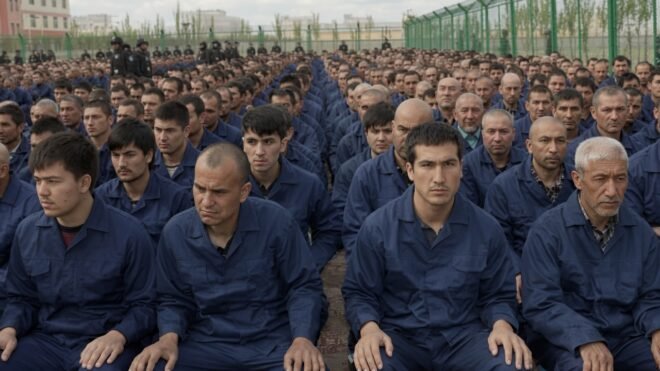
There is a particular cruelty in the kind of persecution that does not announce itself as a massacre. No mass graves are televised; no burning villages lead the evening news. Instead there are boarding schools, language quotas, surveillance cameras mounted on minarets, and forms to be filled out in Mandarin. This is the twenty-first century’s preferred idiom of destruction: administrative, bureaucratic, almost bored in its thoroughness. The Chinese Communist Party’s campaign against the Uyghur people in East Turkestan (the name preferred by many Uyghur activists and diaspora organisations for the region Beijing calls Xinjiang, “new frontier,” and which I use here for that reason, while noting that “Xinjiang” remains the official designation and the term most commonly used in international reporting) is not simply a human rights violation catalogued in a UN report and then forgotten. It is a case study in how a modern state converts a people into a population, a culture into a statistic, a homeland into a security zone.
The scale of the detention system built after 2017 is documented from several independent directions rather than any single source, and the sourcing is worth stating with its limitations attached. Demographic research by Adrian Zenz, drawing on leaked Chinese government procurement and budget documents, first identified the buildout of camp facilities and the mechanics of the internment quota system; satellite imagery analysis by the Australian Strategic Policy Institute’s Xinjiang Data Project subsequently mapped several hundred suspected detention and forced-labour sites. Both researchers and institutions are candid advocates for a critical view of Beijing’s policy, a stance that does not make their underlying documentary evidence false but that a fair-minded reader should weigh when assessing scale claims drawn primarily from their work. Beijing, for its part, does not dispute that the facilities existed, describing them instead as voluntary vocational and deradicalisation centres addressing poverty and extremism, a characterisation contradicted by the accounts of former detainees but relevant to note as the official position. The firmer ground, less contested and less dependent on any single advocacy-adjacent source, is the reporting of Reuters and the Associated Press on coerced birth control and sterilisation, and the independent August 2022 assessment released by the UN Office of the High Commissioner for Human Rights, which found that the extent of arbitrary detention and associated patterns of ill-treatment may amount to crimes against humanity. Estimates of the number detained between 2016 and 2019 vary considerably – from several hundred thousand to figures approaching one million – reflecting the genuine difficulty of verifying conditions inside a closed security state, and that range of uncertainty is worth stating plainly rather than collapsing into a single round number. What is not seriously disputed, including by researchers who differ on scale, is that detainees have described forced renunciation of Islamic practice, compulsory Mandarin instruction, and indoctrination sessions structured around loyalty to the Party and to Xi Jinping personally. Beijing has since declared the camps closed, a claim the UN assessment and subsequent reporting treat with scepticism, since much of the same population appears to have been redirected into prison sentences or coerced factory labour rather than released home.
But the camps and the surveillance grid, horrifying as they are, may not be the most consequential instrument of destruction. The more patient, more totalising project is aimed at the transmission mechanism of culture itself – the passage of language, memory and belonging from one generation to the next. A people can survive a decade of camps. It is far less certain that a people can survive the systematic re-engineering of how its children are raised, taught and made to speak.
I do not come to this subject as a recent arrival. The plight of the Uyghur people was among the first international issues Blak and Black took up, back when the platform was still finding its voice as something more than a record of grievance against the ACT Government and the AFP. It seemed to me then, as it seems to me now, that a publication built to document the erasure of one colonised people has an obligation to recognise the same architecture at work elsewhere, however far from home, and however inconvenient that recognition might be for those who would prefer their solidarities kept local and their condemnations kept selective. What has changed in the years since is not the substance of the injustice, which has if anything deepened, but the world’s evident willingness to look past it.
II. Before the Camps: A History That Did Not Begin in 2017
It would be a disservice to the subject, and to the reader, to write as though the events of 2017 arrived without a history. The current campaign has a genealogy, and honesty requires tracing at least its outline, including the parts of the record Beijing invokes in its own defence.
Xinjiang’s incorporation into the Chinese state dates to the Qing conquest of the region in the eighteenth century, with a further, more contested consolidation under the People’s Republic after 1949 and the establishment of the Xinjiang Uyghur Autonomous Region in 1955 – an autonomy that has, in practice, always been circumscribed by central Party authority rather than genuine self-government. Han migration into the region, encouraged by state policy and accelerated by the Xinjiang Production and Construction Corps, steadily altered the territory’s demographic balance across the second half of the twentieth century, generating longstanding Uyghur grievances over land, employment and political marginalisation well before the current decade.
Those grievances were punctuated, periodically, by violence, and this record cannot be elided without distorting the picture. Ethnic riots in Urumqi in July 2009 left some 200 people dead by official count, with victims on both Uyghur and Han sides; a knife and bomb attack at Kunming railway station in March 2014 killed 31; a car attack in Tiananmen Square in October 2013 and a series of smaller bombings in the years preceding the camps were cited by Beijing as evidence of an organised separatist and, in its framing, jihadist threat linked to the East Turkestan Islamic Movement. These events were real and genuinely lethal, and any honest account of what followed has to hold them in view rather than presenting the Chinese state’s subsequent conduct as an unprovoked bolt from a clear sky. It is worth noting, too, that the United States listed ETIM as a terrorist organisation for nearly two decades before delisting it in 2020 under the first Trump administration, amid a broader deterioration in US-China relations – a decision China’s foreign ministry criticised at the time as politically motivated. The episode cuts in both directions at once: it does not erase the fact of the earlier violence, but it is a useful reminder that terrorism designations themselves move with the diplomatic weather, which is precisely the point made later in this essay about genocide determinations.
What the historical record does not support is the proportionality of what followed. The 2014 “Strike Hard Campaign Against Violent Terrorism,” and the vastly larger internment system that grew out of it after 2016 under the regional Party leadership of Chen Quanguo – previously responsible for a comparable security buildout in Tibet – extended a security response to isolated, if serious, incidents of violence into an indiscriminate programme targeting religious practice, language transmission and cultural expression among a population of some twelve million people, the overwhelming majority of whom had no connection whatsoever to any act of violence. A state is entitled to prosecute terrorism. It is not thereby licensed to criminalise beards, fasting during Ramadan, teaching children their grandparents’ language, or naming a son Muhammad – all of which have been documented, in varying periods and localities, as flagged behaviours within the region’s algorithmic policing systems. The gap between the stated justification and the actual scope of the policy is, in itself, among the more damning pieces of evidence against the official account.
III. What a Culture Is Made Of
It is worth pausing on what, precisely, is being erased, because the abstraction of “cultural genocide” can obscure the granular, sensory texture of what is actually at stake. Uyghur civilisation is not an ethnographic curiosity preserved for UNESCO’s convenience. It is a lived Central Asian synthesis – Turkic in language, Islamic in faith, shaped over centuries by trade along the Silk Road corridors that ran through oasis cities like Kashgar, Turpan and Hotan. Uyghur classical music, the muqam suites, blend Persian, Arab and Central Asian modal traditions into a form recognised by UNESCO as part of humanity’s intangible cultural heritage. Uyghur literature carries a written tradition stretching back over a millennium, through Karakhanid-era scholarship into a modern canon of poetry and prose. Domestic architecture, oasis irrigation systems, and culinary traditions built around wheat, mutton and melon cultivated from land wrested from desert by generations of engineering and patience all constitute a civilisation considerably older than the political category “Xinjiang” imposed upon it.
None of this is static folklore. Culture, properly understood, is not an artefact behind glass; it is a set of practices continuously re-enacted by living people – a grandmother singing while she kneads dough, a father teaching a son the proper cadence of a folk tale, a community gathering for a meshrep, the traditional Uyghur communal assembly combining food, music, dance, oral history and moral instruction, itself recognised by UNESCO and, tellingly, restricted in several localities by authorities who appear to understand its function as a vehicle of cultural transmission outside Party control.
This is the crux of what makes the current campaign qualitatively different from ordinary state neglect or even ordinary discrimination. Beijing has correctly identified that the durability of Uyghur identity does not reside primarily in monuments or museums – those can be preserved, curated, sanitised and displayed to visiting delegations as evidence of “ethnic unity” even as the living culture they once housed is dismantled. Identity resides instead in the intimate, everyday mechanisms by which one generation hands the next its language, its stories, its moral vocabulary. Sever that transmission and the museum pieces become exactly what the state wants them to become: relics of a culture rather than expressions of one.
IV. The Boarding School as Instrument – and the Limits of the Comparison
It is here that the comparative historical record becomes illuminating, though it needs to be handled with more care than a rhetorical flourish allows. The removal of children from their families and their placement into institutions designed to sever linguistic and cultural transmission is among the most thoroughly studied techniques of state assimilation policy in the modern world. Australia’s Bringing Them Home report, published in 1997, documented the systematic removal of Aboriginal and Torres Strait Islander children – the Stolen Generations – under policies explicitly designed to assimilate Indigenous Australians by breaking the intergenerational chain of language, kinship and law. Canada’s residential school system and the United States’ Indian boarding school era pursued a structurally similar logic. Reporting on current boarding facilities in Xinjiang, including work by Human Rights Watch and independent researchers examining the region’s expanded residential schooling system, has documented Uyghur children being placed in institutions where instruction proceeds primarily in Mandarin and where the density of contact with parents and grandparents – the people who carry the oral culture – is measurably reduced.
Honesty requires naming where the comparison strains as well as where it holds. The Stolen Generations, the Canadian and American boarding school systems, arose within classic settler-colonial configurations: a metropolitan or immigrant population establishing new sovereignty over land already inhabited by peoples with no prior political relationship to the coloniser, and no claim to shared national citizenship. Xinjiang’s case is differently structured – a region formally incorporated into a unitary state for over two and a half centuries, whose residents hold full citizenship of that state, and whose current treatment is driven less by land acquisition for settlement than by a security and assimilation logic tied to fears of separatism and to a Party ideology that treats cultural and religious distinctiveness as inherently destabilising. The mechanisms rhyme; the political architectures that produced them do not map onto each other cleanly, and readers with a serious interest in either history are better served by that qualification than by a comparison flattened for effect. What the cases share, and what justifies placing them side by side despite their differences, is a common underlying calculation: that direct violence against adults produces martyrs and international condemnation, while the quieter re-engineering of childhood produces something more durable – a generation raised inside the state’s preferred language and cosmology, unable to fully inherit what its grandparents knew.
The Wiradjuri understand this particular calculation not as an analogy borrowed from elsewhere but as lived inheritance, even while the surrounding political history differs. When I hear a Uyghur father describe raising a daughter who does not know if she will ever again hear her own language spoken in her own home, I do not hear an identical story to my own family’s, and I want to be careful not to claim that it is. But I hear a recognisable variation on it – the removal of children, the discouragement of language, the decades-long project of convincing a people that their own culture is an obstacle to their own advancement, however different the constitutional and historical scaffolding surrounding each case.
V. The Counterterrorism Defence, and Its Limits
Fairness to the subject requires stating Beijing’s defence in its strongest form before assessing it, rather than the version most convenient to dismiss. The Chinese government’s position is that its policies in Xinjiang constitute a legitimate, if severe, counterterrorism and deradicalisation response to a genuine record of religiously inflected separatist violence; that living standards, infrastructure and poverty indicators in the region have measurably improved under Party governance; that Western governments making genocide determinations, most prominently the United States under the first Trump administration in January 2021, are engaged in strategic point-scoring against a rival power rather than disinterested legal analysis; and that other states, including several Western ones in the post-9/11 period, have themselves adopted expansive security measures against Muslim minority populations without facing comparable international censure.
Elements of this defence are not without foundation and deserve to be treated as such. The Kunming and Tiananmen attacks were real atrocities with real victims, and a state does bear a legitimate responsibility to respond to organised violence. Genocide determinations made by legislatures rather than courts do carry an unavoidable element of political signalling, and it would be naïve to pretend great-power competition plays no part in which human rights violations attract sustained Western attention and which do not – a selectivity, incidentally, that has been raised pointedly and not unreasonably by critics observing the comparative silence of some of the same governments on other populations’ suffering.
Where the defence fails is at the point where the existence of a security threat is allowed to stand in for the proportionality of the response to it – two questions that are logically separate and that the official framing consistently collapses into one. That a threat existed is not seriously in dispute. What does not follow from it is the scope of what was built in its name. A counterterrorism policy responding to a finite number of violent incidents, however serious, does not require the algorithmic surveillance of an entire ethnic population’s mosque attendance, the mass collection of biometric data including DNA and voice prints from people with no connection to any offence, the internment of individuals for behaviours as unrelated to violence as possessing a Quran published before 2012 or having relatives abroad, or the systematic restriction of language transmission to children. Economic development, even where genuine, does not require the dismantling of the specific institutions – the meshrep, minority-language publishing, religious education for minors – that carry a culture rather than a GDP figure. The defence, taken on its own strongest terms, establishes only that a proportionate security response to documented threats would have been justified. It does not establish that what was actually built was that response, and the gap between the two is where the defence collapses.
VI. The Failure of the International Architecture
If Beijing’s defence fails on its own terms, the question becomes what the rest of the world has done with that failure – and the honest answer is very little of consequence. It would be comforting to believe that the post-1945 international order, built explicitly in response to genocide, retains the capacity to prevent its recurrence. The record of the past decade suggests otherwise, at least where the perpetrator is a permanent member of the UN Security Council with sufficient economic leverage to make consequences expensive for those who would impose them.
The August 2022 assessment from the UN human rights office – delayed for years amid what several diplomats and observers described as sustained Chinese pressure, and released in the final minutes of the outgoing High Commissioner Michelle Bachelet’s term – found that the extent of arbitrary detention, together with patterns of torture and other ill-treatment, may constitute crimes against humanity. Several national parliaments and governments, including the United States, Canada, the United Kingdom and the Netherlands, have formally characterised Beijing’s conduct as genocide, though these determinations, as noted above, are legislative and executive findings rather than judicial ones. Import restrictions on goods produced with forced Uyghur labour have been enacted in the United States through the Uyghur Forced Labor Prevention Act of 2021 and in comparable, generally narrower measures elsewhere. Sanctions have been imposed on named officials and entities, including regional Party secretary Chen Quanguo.
And yet the region’s demographic and cultural transformation has proceeded largely without interruption, because the instruments available to the international system were never calibrated to the scale of the challenge. Sanctions on individual officials do not alter policy set collectively by a Politburo insulated from personal financial exposure. Import bans, meaningful as symbolic acts, represent a modest constraint against an economy of China’s size. Genocide determinations by individual parliaments carry moral and evidentiary weight but no binding legal consequence absent Security Council action – action rendered structurally impossible by Beijing’s veto over any resolution concerning itself.
Lon Fuller’s classic account of the internal morality of law identified congruence between declared rules and official action as a precondition for anything worthy of the name “legal system.” International human rights law, applied selectively and enforced asymmetrically according to the power of the accused state, fails this congruence test at the global level. States that lack strategic leverage face tribunals, sanctions regimes and coordinated diplomatic isolation. States that possess it absorb formal condemnation as a cost of doing business and continue largely unimpeded. A sitting American president who, in an earlier term, presided over an administration that formally declared Beijing’s Xinjiang policies a genocide can travel to China for high-level engagement focused on trade and strategic competition, with no substantive public indication that this catastrophe featured prominently in the discussions. This is not necessarily hypocrisy so much as candour about the actual hierarchy of state priorities: human rights commitments function, too often, as rhetorical furniture, deployed when costless and quietly set aside when a more transactional relationship is on offer.
VII. What Remains Possible
None of this is offered as counsel of despair, because despair is, in its own way, exactly what the erasure project requires of its targets. A people convinced that resistance is futile does the state’s remaining work for it. The more honest and more demanding conclusion is that the diaspora – scattered across the United States, Europe, Turkey and Central Asia – has become, whether by choice or by necessity, a primary custodian of Uyghur cultural continuity, precisely because the homeland has been rendered unsafe for that function.
This is a heavier burden than it may first appear, because diaspora preservation is structurally harder than homeland transmission. A culture reproduced at home is reproduced ambiently – in the rhythm of a market, the cadence of a call to prayer, the unremarkable fact of hearing one’s own language spoken by strangers on the street. A culture reproduced in exile must be reproduced deliberately, against the gravitational pull of the host society’s language and institutions, by people who are simultaneously building new lives. Many do so under continued surveillance and transnational repression extending well beyond China’s borders, a pattern documented by researchers at the Oxus Society and Freedom House among others. Volunteer-run language schools, cultural associations sustaining the meshrep tradition, and digital archiving projects racing to capture oral history, literature and photography before the generation that carries them passes away are not folkloric hobbies. They are acts of infrastructure-building for a nation that currently exists nowhere on a map but persists, however precariously, in the minds and practices of the people who refuse to let it disappear.
There is a precedent worth naming honestly, and again with the qualification that historical analogy is a tool for illumination rather than equivalence. Aboriginal and Torres Strait Islander peoples in Australia did not recover what the Stolen Generations policies took by waiting for the Australian state to volunteer restitution. Language revitalisation, the reconstruction of severed kinship records, and the slow work following the Bringing Them Home report emerged from decades of community-led effort, sustained across generations, achieving only partial and contested success, and achieved despite rather than because of the state that had done the damage. The Wiradjuri language itself was, for a period of the twentieth century, assumed by linguists to be moving toward extinction; its ongoing revival exists because people who had every reason to conclude the project was hopeless refused that conclusion. This is offered not as a promise that the Uyghur case will resolve the same way – the political conditions are too different, and the outcome remains genuinely uncertain – but as evidence that severed transmission is not, categorically, irreversible.
VIII. The Discipline of Memory
There is a Stoic argument to be made here, one that Marcus Aurelius, writing his private notebook on a military campaign at the edge of an empire he did not fully control, would have recognised: the things within one’s power and the things outside it must be distinguished with some rigour, not as a counsel of resignation but as a precondition for effective action. Uyghurs in exile cannot compel the Chinese Communist Party to dismantle its surveillance state. They cannot compel the UN Security Council to act against one of its own permanent members. They cannot compel great-power diplomacy to prioritise moral commitments over strategic and commercial ones.
What remains within their power is the deliberate, unglamorous, generational labour of transmission: teaching a language to a child born in Fairfax or Munich or Almaty who may never see Kashgar; recording an elder’s account of a wedding custom before that elder dies; keeping the meshrep alive as a living practice rather than a museum re-enactment; ensuring that Uyghur literature exists in forms that outlast the Party’s capacity to suppress its publication inside the country of its origin. This work will not restore what has been destroyed inside East Turkestan itself, and it would be dishonest to claim otherwise. But it establishes something the state cannot fully reach: a reservoir of cultural continuity located beyond its jurisdiction, from which a future reconstitution – however distant, however uncertain – remains at least possible.
There is no guarantee that Uyghur culture will outlast the Chinese Communist Party’s campaign against it, just as there was no guarantee, at various bleak points in the twentieth century, that a great many persecuted peoples’ cultures would outlast the states attempting to erase them. But the historical record contains enough cases of survival against comparable odds – including, not incidentally, in this continent’s own Indigenous nations, whose circumstances differed but whose outcome offers a genuine if imperfect precedent – to make continued transmission a rational wager rather than a sentimental one. The sand of the Taklamakan, on the edges of which Uyghur ancestors built oasis civilisation out of irrigation, patience and collective labour over centuries, has outlasted every empire that has crossed it. The international system will not save this culture; that much can now be stated as a settled fact rather than a fear. What remains is the discipline of doing the work anyway – teaching the language, keeping the record, refusing the forgetting – on the same terms the Taklamakan itself has always demanded of the people who built there: not hope, but persistence, sustained without any guarantee of reward.
– – –
Bakchos is the founder of Blak and Black, an Australian media and advocacy platform established in 2010. Bakchos writes from the intersecting perspectives of Wiradjuri heritage, Jewish identity, and humanism.
© Bakchos, July 2026




Some of you will remember that the Uyghur people’s situation was one of the very first international issues this platform ever wrote about. Years on, the camps are officially “closed,” the world has largely moved its attention elsewhere, and the deeper project — severing a people’s language and memory from one generation to the next — continues.
This piece traces the campaign against Uyghur cultural identity in East Turkestan/Xinjiang — from the pre-2017 history Beijing invokes in its own defence, through the proportionality problem in its counterterrorism justification, to the structural failure of the international human rights architecture when the accused state holds a UN Security Council veto.
The Australian government has spent 250 years trying, unsuccessfully, to erase Indigenous cultures, hopefully the Chinese government will be equally unsuccessful in erasing Uyghur cultural.
Uyghurs are now coming to a crushing realization: The world has failed them. If they are to survive as a people, Uyghurs in the diaspora must preserve in exile what China is erasing.
Beijing is working to undermine efforts like ours. Human rights groups have documented a broad campaign of intimidation by China aimed at silencing Uyghurs abroad, and digital security watchdogs say China-linked actors are likely behind cyberattacks against Uyghur websites. Uyghur Post has faced relentless attacks, forcing prolonged shutdowns. Fake sites have sprung up, apparently to confuse readers and erode our credibility. Similar challenges are reported by Uyghurs engaged in cultural preservation around the world.
.
Pressure on China to end its atrocities against Uyghurs must never relent. But what the Uyghurs need from the global community is changing. If the world can’t stop what’s happening in China, governments and private organizations must recognize that a unique slice of human culture faces extinction — and provide funding and institutional support for the Uyghur communities within their borders who are fighting to prevent that.
China’s human rights record is appalling