
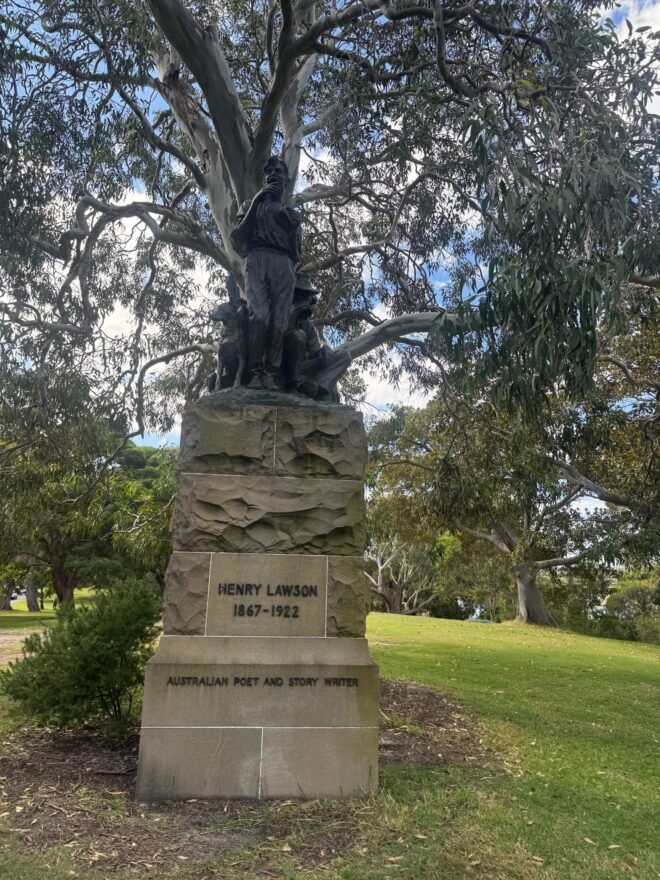
There is a particular kind of Australian who will tell you, with the confidence of someone who has never examined the claim, that the country belongs to those who have been here longest. Leave aside, for now, the devastating irony that on any honest reckoning this would return the continent to the Aboriginal and Torres Strait Islander peoples, on whose sovereign land every subsequent arrival – convict, free settler, gold-rush prospector, post-war refugee, and yesterday’s skilled migrant alike – has made their life. Leave that aside and consider the claim on its own terms, because it reveals something important: what passes for Australian patriotism is often not patriotism at all but a form of territorial anxiety dressed in flag merchandise.
Henry Lawson understood the distinction. In 1896, writing in the register of the democratic bush, he published “The New Chum Jackeroo,” a poem that has outlasted most of the sneering it set out to rebuke. The “new chum” of the title was colonial slang for the newly arrived – the green immigrant or city-bred jackeroo who didn’t yet know which way the horse faced or how to read the sky for weather. The sneer directed at him was almost reflexive among the experienced hands: he was soft, ignorant, out of place, an embarrassment. Lawson found this contempt not merely unkind but intellectually stupid.
‘I hate to hear the stupid sneer
At New Chum Jackaroos.’
The word “stupid” is precisely chosen: not cruel, not wrong, not un-Christian. Stupid. The sneer was a failure of intelligence, a blindness to what the newcomer carried and what he would become.
This essay argues that Lawson was right, and that he was right in a way that cuts far deeper than the surface reading of multicultural advocacy. The true Australian patriot is the one who welcomes the new chum – not because welcoming feels virtuous, not because immigration statistics are flattering, but because genuine patriotism requires a clear-eyed understanding of what Australia actually is, how it came to be, and what sustains it. The nativist who sneers at the newcomer is not protecting something; he is misreading something. He has confused the symptom for the cause, the surface for the substance, the accident of arrival date for the essence of national character.
I. What Lawson Actually Knew
It would be a mistake to conscript Lawson too cleanly into the cause of twenty-first-century multiculturalism. He was a complicated man writing in a complicated time. The 1890s were the decade of the Bulletin’s “Australia for the White Man” masthead, of organised labour’s fierce hostility to Chinese workers on the goldfields, of a nationalism that drew its emotional force partly from racial exclusion. Lawson published in that Bulletin. He shared some of its assumptions. He was not a progressive in any contemporary sense of the word.
And yet “The New Chum Jackeroo” stands apart from the nativist consensus, and stands apart for reasons that transcend its immediate occasion. The poem’s argument is not sentimental. It does not ask the bushman to be kind to the newcomer because kindness is a virtue. It makes a harder claim:
‘He may not ride as you can ride,
Or do what you can do;
But sometimes you’d seem small beside
The New Chum Jackaroo.’
The experienced hand who sneers may actually be the lesser man. The newcomer may carry qualities – courage, adaptability, the willingness to begin again in unfamiliar terrain – that the settled and the comfortable have long since traded away. Lawson is not asking for charity toward the weak. He is insisting on accurate perception of the strong.
This distinction matters enormously for how we think about patriotism. The nativist’s patriotism is essentially retrospective: it venerates what has already been built, who has already arrived, what has already been settled. Lawson’s patriotism is prospective and dynamic: it attends to what is being made, who is making it, and what qualities the nation requires in those who would sustain it.
‘’Twas he who sailed of old beyond
The margin of the chart.’
The new chum’s spirit is the founding spirit – not the spirit of those who defended the familiar, but of those who abandoned it for the unknown. Australia was not built by people who stayed where they were comfortable. It was built, layer by layer, by people who crossed water they had never crossed and arrived somewhere they did not know.
Lawson’s patriotism, in other words, is a patriotism of character rather than of heredity. What makes a true Australian is not the length of one’s tenure but the quality of one’s engagement – the willingness to work without shirking, to battle on when others despond, to contribute to something larger than personal advantage. These are qualities distributed without regard to birthplace. They are as likely to be found, or more likely, in someone who has risked everything to be here than in someone who simply happened to be born here.
‘His share of work he never shirks,
And through the blazing drought,
He lives the old things down, and works
His own salvation out.’
That is not a description of a charity case. It is a description of a nation-builder.
II. The Nativist’s Mistake
To understand why the patriotism of welcome is genuine patriotism, it helps to understand precisely where the nativist goes wrong. The error is not primarily moral – though it is that too – but conceptual. The nativist has misidentified what Australia is.
If Australia were a fixed and finished thing – a completed culture, a settled inheritance, a landscape whose meaning had already been fully decoded – then the case for caution about newcomers might have some internal logic. You might argue, as you would about a completed painting, that additional brushstrokes risk ruining what is already there. But Australia is nothing of the kind. It is a process, not a product. It is a conversation that began – in its oldest register – sixty-five thousand years ago, has been interrupted, resumed, argued over, and added to continuously, and is nowhere near its conclusion. There is no completed version of Australia to protect. There is only the ongoing project of making it, which requires the continuous arrival of people willing to participate in that making.
This is not a metaphor. It is demographic and economic reality. With approximately 31.5 per cent of the current population born overseas, and nearly half having at least one overseas-born parent, Australia is not a monoculture with a multicultural fringe. It is a nation constituted by successive waves of arrival, each of which has altered the texture of what came before and been altered by it in turn. The post-war Italian and Greek migrants who built the Snowy Mountains Scheme and opened the espresso bars that changed how Australians thought about coffee were once new chums sneered at by the Anglo-Celtic establishment. Their children and grandchildren are now among the most emphatic defenders of Australian culture – often, with some irony, against the next wave of arrivals. Each generation of former new chums has tended, in time, to forget that it was once new.
The nativist forgets this history because he needs to. His position depends on a founding moment – a time before which Australia was pure and after which it has been diluted – and no such moment exists. The First Fleet arrived as new chums on Aboriginal land. The free settlers who followed them were new chums resented by the emancipists. The Chinese diggers on the goldfields were new chums driven out by men whose own parents had been new chums. Burke and Wills, as Lawson pointedly observed, were New Chums, every one. The entire history of non-Indigenous Australia is a history of new chums becoming old hands becoming resentful of the next new chums – a cycle that serves no one and illuminates nothing.
What the nativist is actually defending, beneath the language of culture and values and way of life, is position. He is defending the advantage that comes with prior arrival: the established networks, the culturally legible credentials, the unearned familiarity with local norms. This is understandable – position is valuable and its loss feels real – but it should not be confused with patriotism. To protect your own position at the expense of the national project is not love of country. It is love of self, dressed in a flag.
III. What Welcome Actually Requires
The patriotism of welcome is not the same as sentimentality about immigration. It does not require us to pretend that all migration is without difficulty, that cultural difference never produces friction, or that the obligations of welcome run only one way. Lawson was not sentimental. His new chum was not a passive beneficiary of Australian generosity; he was an active participant in Australian life, working his own salvation out, proving himself through labour and persistence. The welcome that genuine patriotism demands is a welcome into participation, not a welcome into comfort.
This distinction clarifies what the duties of welcome actually involve. They are not primarily attitudinal – a matter of feeling warmly disposed toward newcomers – but structural and practical. The failure to recognise overseas qualifications, for instance, is not merely an administrative inefficiency. It is a form of structured contempt for the new chum’s demonstrated competence, a repetition in bureaucratic form of the bushman’s sneer. A doctor trained in Sudan or the Philippines who is working as a hospital orderly because credential recognition takes years is not being treated as someone who might make us look small beside him. He is being treated as someone to be managed. The patriot who welcomes the new chum fights these structures, not because fighting them is virtuous, but because allowing them to persist wastes the national investment and dishonours the national character.
Similarly, the welcome owed to those who have crossed Lawson’s metaphorical deserts – the refugees and asylum seekers who have endured what the poem calls barren, hungry shores – is not discharged by processing them efficiently and releasing them into the community. It involves the sustained work of settlement: language programs, housing support, connection to community, protection from exploitation. The Vietnamese boat people of the 1970s, once among the most contested arrivals in Australian history, are now among the clearest demonstrations of what welcome correctly extended can achieve. Their descendants staff our hospitals, run our businesses, and sit in our parliaments. The return on that investment – moral and economic – has been extraordinary. But it required decades of unglamorous work by communities, churches, governments, and individuals willing to do what genuine welcome demands.
There is also the question of what the new chum owes. Lawson’s poem is not a charter of unconditional reception. The new chum earns his place – not by conforming to a cultural template, not by surrendering what he brought with him, but by contributing, by engaging, by participating in the shared project of making the country. Australia’s multicultural success – and it is, by international comparison, a genuine success – rests on a compact: the nation extends the fair go; the newcomer engages in good faith with the nation’s norms and institutions. This compact has mostly held. The research on social cohesion consistently shows that Australia’s immigrant communities are more likely, not less, to report pride in Australian identity, precisely because they have chosen it rather than inherited it.
IV. The Patriotism of the Long View
The deepest argument for the patriotism of welcome is temporal. It requires looking not at what Australia is today but at what it is becoming, and understanding that the direction of that becoming is shaped, more than any other single factor, by how we receive those who arrive at its margins.
A nation that welcomes the new chum draws from the deepest reservoir of human motivation: the energy of those who have risked everything to be somewhere, who carry the hunger of the displaced and the gratitude of the arrived, who have no option of coasting on inherited comfort because no such comfort was inherited. This energy is not available to the settled. It belongs structurally to the new, and a nation that taps it wisely is a nation that renews itself from the inside. Australia’s extraordinary economic resilience over three decades – the longest continuous run of growth in OECD history before the pandemic – was not achieved despite immigration but through it. Migration drove population growth, filled skill shortages, generated the consumer demand and the entrepreneurial creativity that sustained expansion. To close that valve in the name of protecting what already exists would be to misunderstand how what already exists came to be.
But the argument is not only economic, because patriotism is not only economic. The deeper case is about what kind of country Australia wants to be in the imagination of its own citizens and in the estimation of the world. A country that turns inward, that treats its boundaries as walls rather than thresholds, that conflates arrival date with human worth, diminishes itself in ways that GDP does not capture. It loses the capacity for self-renewal that made it remarkable. It becomes, in the end, what the sneering bushman always was: a man defending a position rather than building something.
Lawson understood, in 1896, that the great Australian story was not a story of settled inheritance but of restless making. The new chum – green, uncertain, without the local password – was not a threat to that story. He was its continuation.
‘’Twas he who proved the world was round —
In crazy square canoe’
The willingness to attempt the crossing in inadequate vessels, to navigate by instruments not yet calibrated for the destination, to arrive ignorant and become, through labour, fluent: this is the founding gesture of the Australian character, repeated in every generation, in every language, by every person who has looked at this continent from a distance and decided to make it home.
V. The Test of Character
There is a version of Australian national identity – proud, self-reliant, irreverent, egalitarian, allergic to pretension – that is entirely compatible with the welcome of the new chum and, in fact, demands it. The fair go is not a selective principle. It does not apply to those who arrived first and withhold itself from those who arrived yesterday. Applied selectively, it is not the fair go at all but its opposite: a mechanism for entrenching the advantage of the already-advantaged.
The true Aussie patriot, on this account, is not the one who insists on the priority of his own tenure. He is the one who has absorbed the lesson that Lawson was already trying to teach in the 1890s: that what matters is character, not calendar; contribution, not credential of birth; the quality of engagement with the shared project, not the accident of which generation you happened to arrive in. He is the one who extends to the new chum the same rough-handed welcome that his own ancestors needed and received, or needed and were denied, and who understands that the health of the national character is measured, in part, by how it behaves toward those who have not yet proven themselves in its terms.
This is a demanding patriotism. It requires more than flying the flag or singing the anthem or professing attachment to a landscape. It requires the active work of welcome: fighting the bureaucratic structures that waste imported talent, building the settlement services that turn arrival into belonging, teaching the history honestly so that no generation grows up imagining that the multicultural nation is a deviation from an earlier purity rather than the realisation of a founding logic. It requires, above all, the intellectual honesty to recognise the new chum for what he is: not a threat to Australia but its continuation, not the nation’s problem but, as Lawson saw clearly, one of its oldest and most reliable solutions.
‘I hate to hear the stupid sneer
At New Chum Jackaroos.’
The hatred was not sentimental. It was the response of a clear-eyed man to a failure of intelligence. More than a century later, the sneer persists – in policy, in rhetoric, in the casual contempt that dresses itself as cultural pride. The patriot’s response remains the same: not outrage, but correction. Not a lecture on values, but a lesson in history. The new chums built this country. They are building it still. The patriotism of welcome is not the softer option. It is the harder truth.



Australia was built by “new chums”, they are the backbone of Australia’s prosperity, without them, Australia wouldn’t be the prosperous country it is today. Despite what fools like Pauline Hanson and her ilk say, multiculturalism has benefited us all, and it continues to benefit us all. Embrace reality and work together to build Australia’s tomorrow.
Bill you are absolutely correct, for Australia to keep experiencing strong economic growth, which benefits us all, we all have to embrace the new chums.
Pauline Hanson is too dumb to get the message of this post, which I assume is aimed at her and her supporters. Unfortunately Hanson appeals to our base instincts, it’s hard to counter that appeal.
It’s about time that Pauline Hanson was held accountable for her racism, and Australia must start to embrace the new chums.
Very clever use of Henry Lawson‘s poetry. Well done.
Is Australia really that racist? In the States we generally consider Australia to be a tolerant democracy. Are we wrong?