
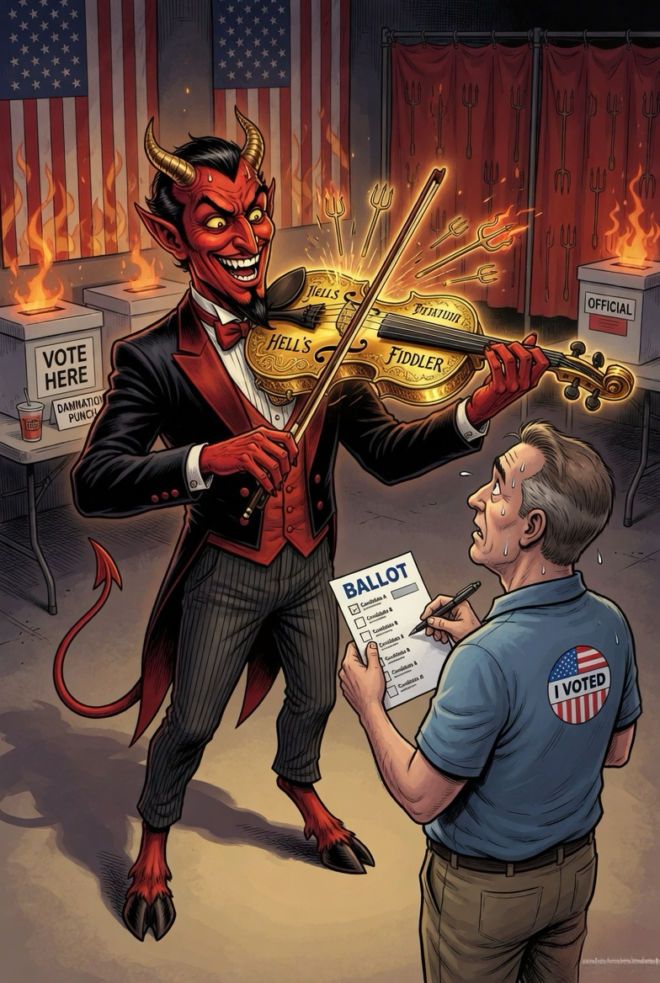
I. The Oldest Wager
There is a transaction that precedes the polling booth by several centuries, one that has been conducted in courthouse squares, at revival meetings, and in the long corridors of power wherever human beings have agreed to delegate authority to other human beings. It is not the social contract in the Rousseauvian sense – that elegant abstraction of philosophers who largely avoided the people they theorised about. It is something rawer and more recognisable: the wager. Someone arrives with something to offer. Someone else holds something they want. The terms are stated, or implied, or deliberately obscured. And the exchange takes place under conditions that one party almost always controls more thoroughly than the other.
The wager is the constitutive act of democratic politics. Before a single ballot is cast or a single law debated, there is an encounter between those who seek power and those who possess it in the only form that ultimately matters: the franchise. Everything else – the televised debates, the opinion polling, the campaign finance architecture, the party machinery, the think tanks and their white papers – is scaffolding around this original and irreducible exchange. Someone wants your assent. You possess it. The question is what they offer, and whether you are equipped to evaluate the offer honestly.
This essay takes that transaction seriously as a transaction. Not as a civic ritual to be celebrated, not as a dysfunction to be lamented, but as an exchange with identifiable parties, asymmetric information, real stakes, and a history of outcomes that reward close reading. The voter who understands the wager as a wager – who recognises its structure, its recurring patterns, and its reliable pathologies – occupies a fundamentally different position from the voter who approaches each election as a fresh emotional encounter with possibility. One is reading a familiar text with growing comprehension. The other is meeting a confidence artist for what they believe is the first time.
II. What Is Actually Being Exchanged
The politician arrives, in every era and every jurisdiction, with what appears to be an offer. The language shifts with the decade – hope, change, strength, renewal, reclamation – but the structure beneath the language is constant. What is being offered is a version of the future. A specific arrangement of social conditions that does not yet exist and may never exist, rendered in sufficiently vivid rhetorical colour that it produces, in the listener, something approximating desire. The offer is always made in the conditional tense, and the distance between that conditional tense and the indicative past tense of what actually occurred is the primary site of political disappointment in every democracy that has ever functioned long enough to disappoint anyone.
What the voter is being asked to provide is not merely a mark on a ballot. The vote is the surface transaction. Underneath it runs a deeper current: attention, trust, the allocation of civic energy, and something harder to name but easier to lose – the suspension of well-founded scepticism. A politician cannot govern effectively on votes alone; they require the ongoing legitimacy that comes from a constituency that has not yet concluded it was deceived. This is why the most sophisticated political operations do not merely seek votes. They seek converts. They want the voter not just to mark the box but to invest emotionally in the outcome, to identify their own dignity with the candidate’s success, so that the cost of reassessing that investment becomes prohibitive.
The golden fiddle in the old story is precisely this kind of offer. It is spectacular. It is designed to produce wonder rather than scrutiny. Nobody who is gasping at the instrument is simultaneously calculating whether the person offering it has legal title to it, or whether its strings will produce actual music once the showmanship is stripped away. The aesthetic experience is the political strategy. You are meant to feel before you think, and to feel so intensely that the window for thinking narrows to almost nothing.
This is not a conspiracy. It does not require malice, or even self-awareness, on the part of those offering the instrument. Most politicians believe, with some sincerity, in at least the general shape of what they are promising. The gap between promise and delivery is not usually a product of deliberate deception so much as a collision between the conditions under which promises are made – the rally, the primary season, the focus group – and the conditions under which governance actually occurs, which are intractable, expensive, slow, and resistant to the narrative arc that campaigning requires.
III. The Architecture of the Offer
Political promises have a structure that is worth understanding in some detail, because that structure is remarkably stable across cultures, ideologies, and historical periods. The components are: a diagnosis of a problem that affects the audience; a named antagonist or abstraction responsible for that problem; an implied or explicit claim of unique qualification to address it; a vision of the resolved condition; and, critically, a timeline that extends just far enough beyond the election to be unfalsifiable at the moment of voting.
The diagnosis must be accurate enough to resonate but imprecise enough to apply broadly. The antagonist must be sufficiently real to be believable and sufficiently abstract to absorb any objection. The claim of qualification must be unverifiable in the time available. The vision must be desirable enough to generate identification but vague enough to survive contact with governing reality. And the timeline must be long enough that by the time the promise is tested, the conditions will have changed, the original framing will have shifted, and the conversation will have moved on to the next election cycle and its own fresh architecture of offers.
What this structure does not accommodate is the voter who refuses to enter it on its own terms. The politician’s offer is designed to be evaluated from inside the architecture – where the diagnosis feels urgent, the antagonist feels real, the vision feels achievable, and the timeline feels reasonable. The voter who steps outside that architecture and asks structural questions – not “do I want this?” but “how would this actually work?”, not “does this problem feel real?” but “what has actually caused it?”, not “is this person qualified?” but “qualified by what standard, verified how?” – that voter is not the intended audience. They are the complication.
Democratic systems are built on the theoretical premise that the electorate will function as that complication. That voters, in aggregate and over time, will hold the architecture accountable against outcomes. That they will remember what was promised and compare it against what was delivered and adjust their willingness to re-engage accordingly. The practice of democracy is the chronic gap between that theory and what actually happens when human beings make decisions under conditions of information overload, emotional manipulation, time pressure, social identity, and reasonable exhaustion.
IV. The Asymmetry of Knowledge
The wager at the heart of democratic politics is not conducted between equals. This is the fact that polite discourse about democratic participation tends to elide, because acknowledging it too directly feels either like an indictment of voters or like an indictment of the system. It is neither. It is simply a description of the conditions under which the exchange occurs, and those conditions need to be named before they can be addressed.
The politician, or more precisely the political operation behind the politician, knows a great deal about the voter. They know, with granular demographic precision, which anxieties are most active in which communities. They know which policy framings produce sympathetic responses in which cohorts. They know the median attention span for a policy argument. They know which emotional registers activate or suppress voter turnout. They possess, through polling, data analytics, and years of operational experience, a detailed map of the electorate’s psychological terrain. They navigate that terrain professionally.
The voter, by contrast, typically knows a great deal about their own life and relatively little about the specific mechanics of governance, the actual constraints on policy implementation, the history of similar promises made and broken in earlier political cycles, or the gap between the rhetorical version of a policy and its operational reality. This is not a character defect. It is a rational response to the costs of political information-gathering. Learning enough about policy to evaluate political promises accurately is a significant investment of time and cognitive energy that competes with every other demand on a life. Most people cannot make that investment routinely, and the political system does not particularly incentivise them to try.
The implication of this asymmetry is not that democracy is broken or that voters are incapable. It is that the voter who does invest in political knowledge – who reads past the headline, who follows the legislative record, who compares the rhetoric of 2024 against the record of 2019 – is exercising a rare and consequential form of power. They are disrupting the information asymmetry that political operations depend on. They are, in effect, learning to play the instrument on its own terms rather than simply being dazzled by it.
V. Memory as the Democratic Instrument
The most politically undervalued cognitive capacity in democratic life is not intelligence, not ideological sophistication, not familiarity with constitutional law. It is memory. Specifically, the willingness to hold a political actor to the record of their actual conduct over time, rather than evaluating them freshly against the latest presentation of their carefully curated self.
Political operations understand this perfectly. The management of political memory is one of the central functions of the modern campaign apparatus. The news cycle is calibrated – by both media economics and political strategy – to produce a perpetual present tense, in which yesterday’s broken promise competes for attention with today’s fresh outrage, and the week before last has effectively ceased to exist as a usable reference point. The abundance of political information does not, in practice, enhance democratic memory. It tends to overwhelm it. When everything is significant, nothing accumulates into a stable account of what a person or a party has actually done over time.
The voter with a long memory is, in this environment, a structural anomaly. They are the person who remembers that the infrastructure package was promised in three consecutive election cycles. They are the person who has noted that the emergency legislation that was going to be reviewed in twelve months has never been reviewed. They are the person who recalls the specific language of the 2016 commitment and can compare it, word by word, against the 2022 explanation of why it was not met. This kind of memory is not nostalgia, and it is not bitterness. It is the application of evidence to ongoing assessment, which is exactly what the design of democratic accountability requires and what the design of political communications systematically discourages.
Memory is the democratic instrument in the most literal sense. The ballot derives its power not from the moment it is cast but from the accumulated weight of everything that preceded the casting – every unkept promise, every legislative manoeuvre, every gap between stated principle and actual vote, every occasion on which the golden instrument was flourished and then quietly set aside. Without memory, the ballot is a fresh wager each time. With it, the ballot becomes something closer to a reckoning.
VI. The Role of Shared Narrative
No individual exercises democratic power in isolation. The vote is a singular act but the conditions that give it meaning are collective. This is why the quality of public discourse – the stories a political community tells about itself, its history, and the nature of its choices – matters so much more than the aggregated preferences of disengaged individuals.
The political promise works partly because it is rarely evaluated in isolation. It enters a pre-existing narrative landscape: a community’s understanding of who it is, who threatens it, what it has earned, and what it is owed. A skilled political operator does not introduce a new narrative; they graft onto an existing one. They speak in the idiom of grievances that are already present and give them a new object and a new resolution. The offer acquires plausibility not from its own internal logic but from its fit with the story the audience is already telling about itself.
This is why the most durable forms of democratic resilience are cultural as much as procedural. A political community that has developed, over time, a shared scepticism about the distance between political language and political reality – that has stories, traditions, and institutions that carry the memory of what promises have looked like and what they have delivered – is substantially more resistant to the operations of the political offer than one that encounters each election cycle as a fresh beginning. The procedural mechanisms of democracy (elections, courts, free press, legislative oversight) are necessary but not sufficient. They require a civic culture that knows how to use them and why.
This is not a counsel of cynicism. A community that treats all political actors as equally unreliable produces its own dysfunction – the diffuse nihilism that gives cover to the genuinely dangerous by making any distinction between actors seem naive. The goal is not universal suspicion but calibrated discernment: the capacity to distinguish between the golden instrument that gleams without playing and the plain instrument that produces real music in real conditions. That distinction requires information, memory, and a willingness to let evidence update assessment.
VII. When the Wager Goes Wrong
Democratic history is substantially a record of wagers that went badly for the voter. This is not a partisan observation. It holds across ideological traditions, across national contexts, and across historical periods, with a consistency that suggests something structural rather than accidental. The conditions that produce broken political promises are not aberrations; they are inherent to the architecture of the exchange itself.
The gap between promise and delivery is widest in three recurring conditions. The first is when the promise was made to win an election from a position of opposition, against the constraints of actual governance that can only be experienced from office. Oppositions campaign in poetry; governments administer in the prose of competing interests, inherited programmes, unanticipated crises, and the fundamental inertia of large bureaucratic systems. The poetic promise and the prosaic reality are not reconcilable, and the politician who discovers this upon assuming office faces a choice between honesty about the gap and an increasingly elaborate account of why the gap is someone else’s fault.
The second condition is when the promise targets a problem whose causes are structurally resistant to the tools available to the office being contested. Housing affordability, wage growth, inflation, community cohesion – these are genuinely complex phenomena with multiple contributing causes operating at different temporal scales. A political promise to solve them is either the product of sincere overestimation of what office can do, or the cynical exploitation of genuine suffering for electoral gain, or some opaque mixture of both. In any of these cases, the voter who holds the promise against the outcome is doing something the system formally requires but operationally discourages.
The third condition is when the information environment is so saturated with competing claims, counter-claims, and strategic noise that the connection between promise and outcome becomes genuinely difficult for even an attentive voter to trace. This is not a new problem, but it has intensified substantially with the architectural changes to information distribution that have occurred over the past two decades. When the conditions under which a promise was made, the specific language of that promise, the record of relevant votes, and the explanation offered for non-delivery are all simultaneously available and simultaneously contested, the cognitive cost of arriving at a stable assessment rises dramatically.
VIII. The Plain Instrument
Against all of this, the voter still holds what the politician needs most and cannot supply for themselves. The transaction cannot be completed without the voter’s assent, and that assent, however imperfectly the system channels it, retains a genuine power that no amount of political sophistication can ultimately circumvent.
The instrument the voter holds is plain. It does not glitter. It is a mark on a piece of paper, or a press of a screen, or a letter in an envelope. Its plainness is often mistaken for weakness, for insignificance, for a ritual gesture that changes less than it promises. This misreading is itself a political operation – the effort to convince the voter that their instrument is decorative rather than functional, that the real decisions occur elsewhere, among people for whom the franchise is merely a scheduling constraint.
The instrument is most powerful not in its individual use but in its collective pattern over time. A single vote rarely determines an election and never determines a government’s direction by itself. But a consistent pattern of voters who punish broken promises, who reward honesty about constraints, who refuse to re-engage with the same offer from the same actor on the same terms – that pattern reshapes the calculations that political operations make before the promise is formulated. The intelligent anticipation of an informed electorate is the most powerful force in democratic politics, more powerful than any individual electoral result, because it operates before the wager is proposed.
What the informed voter actually does, in the daily practice of democratic citizenship that is not only the act of voting, is something more like sustained pressure than periodic choice. They attend to the record. They notice when language shifts. They compare the account being offered for policy failure against other available accounts. They ask what incentives structure the choices being made on their behalf. They maintain a provisional rather than a final assessment, open to evidence in either direction. This is not a heroic posture. It does not require exceptional courage or intelligence. It requires only the discipline of keeping the wager in view rather than pocketing the original offer and walking away from the table.
The fiddle the voter holds is made of that discipline. It plays when memory is active, when information is sought rather than accepted, when the gap between promise and delivery is named rather than explained away. It plays when the voter declines the role of audience and insists on the role of party to a contract – a party with standing, with records, and with the practical means of enforcement that democratic systems, when they are functioning, actually provide.
IX. The Unfinished Contest
The wager at the centre of democratic politics is never finally settled. This is not a failure of the system but its defining characteristic. Every election re-opens the transaction, re-exposes the asymmetries, re-creates the conditions in which the golden instrument will be offered and the plain one must be wielded. There is no version of democracy in which the political offer is finally exposed as fraudulent and abandoned. The offer will be revised, rebranded, redelivered under new conditions and with new emotional architecture, because the underlying structure of the exchange – power sought, assent required – does not change.
What changes, and what can change, is the sophistication with which the voter approaches the transaction. Not sophistication in the sense of technical expertise, though expertise helps. Sophistication in the sense of a clear-eyed understanding of what is being offered, what is actually being asked for in return, what the historical record of similar offers suggests about likely outcomes, and what the practical tools of democratic accountability look like when used rather than merely celebrated.
The Devil in the old story does not stop after losing one contest. He will be back on the next road, with the same instrument and probably a better tune. The insight of that story has always been misread as a story about the hero’s exceptional talent. It is not. It is a story about preparation: the knowledge, built up over years of actual practice, that allows a person to recognise a challenge for what it is and meet it on terms of their own choosing rather than the challenger’s.
Democratic citizens who have paid attention over time – who have watched promises made, broken, repackaged, and made again; who have tracked the distance between the language of campaigns and the reality of governance; who have developed, through sustained and sometimes painful attention, a working model of how political power actually operates – those citizens are prepared. Not invulnerable, not infallible, not immune to the appeal of a well-constructed offer. But prepared. Capable of recognising the architecture of the wager before they are inside it.
That preparation is not sufficient to fix every democratic dysfunction. It will not resolve structural inequalities, or repair captured regulatory agencies, or correct the political economy of campaign finance, or rebuild institutions that have been systematically degraded over decades. The plain instrument has real limits. But within those limits, wielded by enough citizens who understand the transaction they are entering, it produces something that no quantity of political sophistication can permanently prevent: accountability. Real, consequential accountability, of the kind that alters calculations before they become decisions and costs before they become comfortable.
Let the politicians arrive with their golden offers. Let them tune their instruments to whatever frequency the current moment’s anxieties require. The people have been practising, in the years between elections, in the ordinary attention they have chosen to pay or not pay to the record. When they step up to the ballot, they do not need to outperform the politician on the politician’s terms. They need only to play what they know, honestly and without sentiment, on an instrument that was never glittering but was always real.
The contest is never won. It continues. That is the condition of democratic life, and it is not a tragedy. It is the form that self-governance takes when it is taken seriously – not as a ceremony, not as a franchise to be exercised once every few years in a spirit of civic obligation, but as the permanent, demanding, irreplaceable practice of free people who have decided, against all the evidence that power corrupts and promises dissolve, to keep showing up and playing.


The piece presents itself as politically neutral — “this is not a partisan observation” (Section VII) — and largely sustains that neutrality at the level of explicit claim. But the sensibility is unmistakably that of a reader suspicious of populist promises, of emotional appeals over deliberative ones, of spectacle over record. This is a legitimate political sensibility, but it is a sensibility.
People are fools if they don’t take their right to vote seriously, people fight revolutions and die for the right to vote. Think about how your vote will affect you and your country’s future before deciding on who you vote for.
You’re absolutely right Faceless Freedom Fighter, people are fools if they don’t take their right to vote seriously, and use their vote strategically.
I’ve seen people kill, and be killed for the right to vote. Your right to vote in free and fair elections is a rare privilege in today’s world. Cherish the privilege, and exercise your right thoughtfully and strategically, and most of all, peacefully.
If you don’t vote you forfeit the right to complain about the outcome of an election.
The writing is consistently strong and occasionally excellent. The essay operates in a register of controlled formality — neither academic nor popular, but occupying the productive middle ground of the serious essayist. Sentences are long but not unwieldy; the periodic structure is used for emphasis rather than decoration.
Whoever you vote for, don’t vote for that ginger bitch with the whiney voice.
Everyone make your vote count, we can’t risk One Nation gaining any significant foothold in government.