
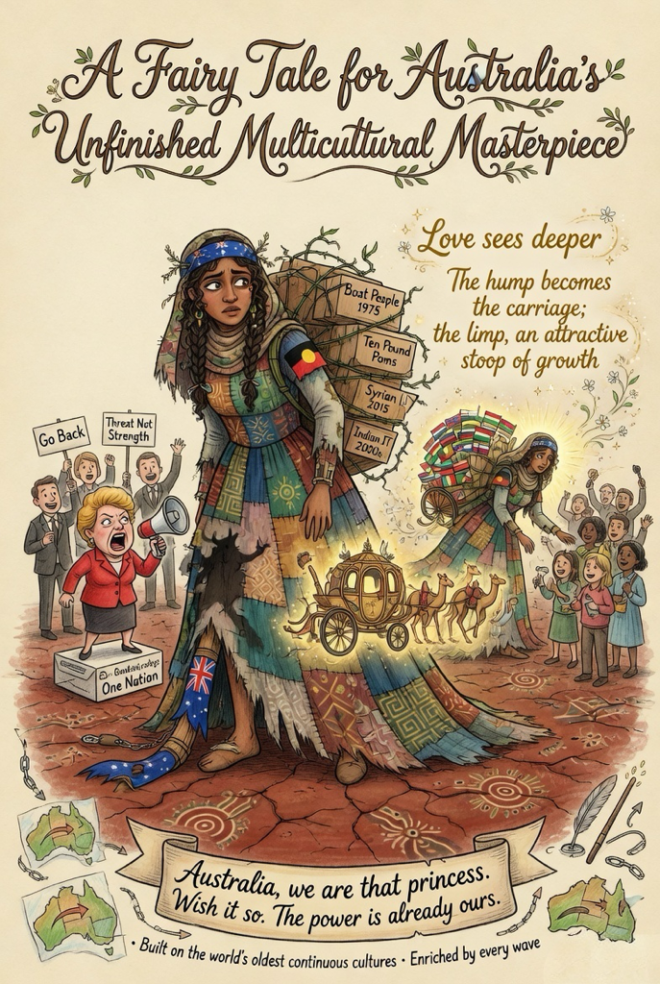
“You can do it,” Riquet answered, “if you love me enoughto wish it may be so. If you doubt this, my lady, you must know that the same fairy who gave me, when I was born, the power of making the person I loved clever, also gave you the gift of making the man you love handsome. If you want to, you can do this.”
“If that is true,” said the princess, “then I wish withall my heart for you to be the handsomest and nicest prince in the world. Anypower I have, I give to you.”
No sooner had the princess said these words than Riquet with the Quiff seemed to her the handsomest man in the world… There are those who say that this was nothing to do with the fairy’s spells, but that love alone had worked the transformation. They say that when the princess thought about her lover’s wisdom and perseverance and all the virtues of his mind and character, she no longer saw his crooked body and ugly face, that the hump on his back seemed merely the natural stance of a man of the world, and the dreadful limp she hadnoticed before now struck her as no more than a slight, attractive stoop
— Charles Perrault, Riquet à la Houppe (1697)
I. The Fairy Tale and the Nation
Charles Perrault wrote his fairy tales in a France intoxicated by its own reflected grandeur — a court of mirrors, literal and figurative, in which beauty and power were synonymous and the ugly were, by definition, unworthy. Against that backdrop, Riquet with the Quiff stands as something quietly revolutionary: a story in which the transformation is not physical but perceptual, not magical but moral. The ugly prince is not made beautiful by a spell. The princess simply learns to see differently. Love, the tale suggests, is not the abandonment of critical judgment but its deepest expression — the faculty by which we perceive the real value concealed beneath an imperfect surface.
It would be easy, reading Perrault’s elegant little story, to dismiss it as whimsy. But fairy tales have always carried the freight of the culture that produces them. They encode anxieties and aspirations too large or too dangerousto be spoken plainly. They smuggle philosophy past the censors of the comfortable. And this particular tale — about learning to see the beloved not as the world first presents them, but as they truly are — has something urgent to say to us here, now, in the great unfinished project of Australian multicultural democracy.
Australia, we are that princess. We stand at a moment of choice as consequential as any in our history, though it wears the unremarkable clothes of the everyday: an election cycle, a parliamentary debate, a radio talkback programme, a social media thread. In each of these ordinary arenas, a fundamental question is being answered about what kind of country we intend tobecome. Do we choose to see Australia as it truly is — complex, unfinished, magnificent in its plurality — or do we allow the demagogues of division tohand us a mirror warped by fear, in which difference appears as threat and the unfamiliar as enemy?
II. The Oldest Continuous Cultures on Earth
To understand what is at stake, we must first understand what Australia actually is, not what any one political faction wishes it were. This continent has been home to human civilization longer than any other place on Earth. The Aboriginal and Torres Strait Islander peoples who have lived here for at least sixty-five thousand years developed systems of knowledge, governance, astronomy, ecology, philosophy, and law of extraordinary sophistication. They did not simply inhabit this land; they shaped it, read it, sang it into being through traditions as intricate and as durable as any cathedral or legal code the Western tradition has produced.
This is the foundation on which everything else in Australian life rests, whether or not we acknowledge it. The Yolngu of Arnhem Land, the Wiradjuri of the central tablelands, the Noongar of the southwest, the Arrernte of the red centre — these are not merely historical presences to be commemorated at the beginning of a council meeting. They are living intellectual and cultural traditions that continue to generate knowledge, art, governance, and meaning. The Welcome to Country is not a bureaucratic formality; it is a reminder that we are all, in one way or another, guests in someone else’s story.
Onto this ancient foundation, wave after wave of migration has laid its own strata. The British colonists who arrived in 1788 brought a legal and administrative tradition, a language, and a set of institutions that — for all their brutal origins — became the skeletal structure of the modern state. The Chinese miners of the goldfields, the Afghan cameleers of the inland, the Pacific Islander workers of the cane fields — all made contributions that were systematically erased from the official record, a forgetting that White Australia Policy institutionalised and that we have been slowly, imperfectly, unlearning ever since.
The post-war migration programmes brought Italians, Greeks, Poles, Latvians, Lithuanians, Germans, Dutch, and dozens of other European communities whose children and grandchildren now populate every profession, every institution, every suburb. Then came the Vietnamese boat people, the Lebanese communities of western Sydney, the Sudanese families of Melbourne’s outer suburbs, the Indian engineers of the technology sector, the Filipino nurses, the Chinese students who stayed and built lives, the Afghan Hazaras who survived persecution to become Australians. Each cohort arrived carrying what people always carry when they cross oceans: memory, hope, skill, wound, and an almost incomprehensible courage.
This is not a collection of separate stories. It is a single story, and it is ours.
III. Riquet’s Hump: The Imperfections Are Real
There is a temptation, in celebrating multicultural Australia, to paper over the genuine difficulties. Perrault does not make that mistake. Riquet’s hump is real. His limp is real. His crooked body and ungainly face are real. The princess who must learn to love him is not deluded; she has genuinely perceived things that are difficult. The fairy tale’s power lies precisely in the fact that it does not pretend the imperfections away — it asks us to look through them, past them, toward what underlies them.
The imperfections of multicultural Australia are equally real and ought to be named honestly. Integration is genuinely hard. The social capital that makes a community function — the shared assumptions, the common references, the instinctive trust between strangers — takes time to build across linguistic and cultural difference. There are neighbourhoods in our major cities where poverty, discrimination, and social isolation have combined to create conditions of genuine despair. There are communities where the trauma of persecution and displacement has not been adequately addressed, where the generations born here carry wounds inflicted before they arrived. There are workplaces where credentials earned overseas are not recognised, where names that sound foreign are passed over in hiring, where the glass ceiling is also, for many, a glass wall.
There are also, let us be honest, genuine cultural tensions that are not simply the confection of racists. Different communities hold different values — about the role of women, about religious authority, about the obligations of family versus the rights of the individual, about the appropriate relationship between state and conscience. A multicultural society that pretends these tensions do not exist is not practising genuine pluralism; it is practising a kind of polite avoidance that ultimately serves no one. The conversation about who we are and who we are becoming has to be frank enough to accommodate real disagreement, robust enough to survive genuine conflict.
All of this is Riquet’s hump. It is real. It does not go away by being wished away. To acknowledge it is not to concede the argument to the xenophobes; it is to insist that the argument be conducted in good faith, on accurate ground.
IV. The Demagogues and the Distorted Mirror
What the demagogues do — what Pauline Hanson has done for three decades,what her imitators and enablers do in the comment sections and the talkback studios and the political party rooms — is something quite different from an honest accounting of the difficulties. They do not name the problems in order to solve them. They name the problems in order to weaponise them. They amplify the hump and ignore the wisdom. They fixate on the limp and deny the perseverance. They present the complexity of multicultural Australia not as a challenge to be worked through together, but as evidence that the whole project was a mistake, that the strangers among us are the problem, and that the solution is subtraction rather than integration.
Hanson’s 1996 maiden speech to Parliament is worth revisiting, not because it has aged well — it has not — but because its structure reveals a playbook that has barely changed in thirty years. The speech begins with a genuine grievance: the economic dislocation of rural and regional communities, the sense of being left behind by a political class more interested in global markets than local lives. That grievance is real. It deserves a serious response. But the speech does not provide one. Instead, it pivots rapidly from economic anxiety to racial resentment, suggesting that the cause of rural suffering is not structural economic change, not the failure of policy to support communities in transition, but the presence of Asian migrants and Aboriginal Australians receiving, in her telling, preferential treatment.
This is the demagogue’s essential manoeuvre: to take a real wound and point it at the wrong target. The farmer whose town has been hollowed out by the closure of its manufacturing base does not benefit from hostility toward Vietnamese families in Cabramatta. The worker whose wages have been suppressed by decades of anti-union policy is not helped by blaming Sudanese refugees in Melbourne. The elderly resident of a coastal town who feels culturally displaced by rapid demographic change is not served by a political programme whose only concrete policy proposal is making things harder for people who are already here and already Australian.
Hanson has had many political lives because she has served useful purposes for forces larger and wealthier than herself. The media organisations that have amplified her voice have done so not out of commitment to free speech— a principle they apply selectively — but because outrage is good for ratings and the politics of division are good for certain commercial interests. Themainstream conservative parties that have alternately embraced and distanced themselves from One Nation have done so according to tactical calculations about preference flows, not principled assessments of what her politics do to the fabric of Australian society.
What her politics do to that fabric is damage it. Not by raising hard questions — hard questions are necessary — but by foreclosing the possibility of good-faith answers. When difference is consistently framed as danger, when diversity is consistently presented as decay, the cumulative effect is a poisoning of the social trust on which any genuinely pluralist society depends. We become less able to see each other. We become less able to work together. We become less capable of the imaginative act that Perrault’s princess performs: the act of looking past the surface to the person beneath.
V. What Love Actually Sees
Perrault is careful to leave open the question of whether the fairy’s spell worked or whether love alone transformed the princess’s perception. “There are those who say,” he writes, that it was love rather than magic. He does not resolve the ambiguity, and his restraint is wise. Because what the story is ultimately about is not transformation at all — it is about vision. The princess does not change Riquet. She learns to see him. And what she sees, when she truly looks, is not the hump and the limp and the squint but the wisdom, the perseverance, the virtues of mind and character that were always there.
What do we see when we truly look at multicultural Australia? We see a country that is, by virtually every measure that matters, enriched by its diversity. The economic case is overwhelming and has been made many times: migrant entrepreneurs start businesses at higher rates than the native-born; migrant workers fill critical shortages in healthcare, aged care, construction, agriculture, and technology; the international students who study at our
universities and often stay bring skills and networks and perspectives that make our institutions more vital and our economy more competitive. A country
that closed its doors to migration would be a poorer country within a generation, and a much poorer one within two.
But the economic case, compelling as it is, is not the most important one. The more important case is cultural and moral. A society that has genuinely incorporated people from every part of the world develops a collective intelligence, a breadth of reference, a capacity for problem-solving that monocultural societies simply cannot match. When an Australian hospital brings together doctors and nurses from India, the Philippines, South Africa, China, Lebanon, and the Indigenous communities of the Top End, it brings together not merely technical skills, but entire traditions of understanding about the human body, about illness, about care, about what medicine is for. The result is not confusion — it is richness.
When an Australian school contains children from thirty different language backgrounds, the classroom does not become a Tower of Babel — or rather, it does, and the Tower of Babel was not the catastrophe that the Genesis account implies. It was a moment of extraordinary human ambition. A multilingual child is not a child with a deficient grasp of English; she is a child with cognitive architectures of unusual flexibility and power, trained by the daily experience of switching between conceptual systems to navigate the world with a suppleness that the monolingual cannot easily acquire.
When Australian literature, art, music, and food are shaped by the confluence of Indigenous tradition, European inheritance, and the extraordinary variety of cultures that migration has brought — the result is not a diluted culture but an amplified one. The Australian literary tradition that runs from David Unaipon and Katherine Susannah Prichard through to Nam Le, Christos Tsiolkas, Alexis Wright, and Hannah Kent is not diminished by its diversity; it is made more interesting, more ambitious, more capable of telling the full range of human truths than it could be if it drew from a single well.
VI. The Unfinished Masterpiece
And yet we must insist on the word “unfinished.” The masterpiece is real, but it is not complete. To celebrate what has been achieved without acknowledging what remains to be done would be its own form of distortion — a different kind of warped mirror, one that flatters rather than frightens, but is no more accurate for that.
The gap in life expectancy between Indigenous and non-Indigenous Australians remains a national scandal after more than two decades of official concern. The over-representation of Aboriginal and Torres Strait Islander people in the criminal justice system, in child protection systems, in homelessness statistics — these are not the consequences of cultural deficiency, as the racists would have it, but of systemic failure: the longshadow of dispossession, the ongoing effects of policies that separated families and destroyed communities, the inadequacy of services and opportunities in remote areas, and the persistent racism that operates at every level of the institutions that are supposed to serve everyone equally.
The refugees who arrived by boat and were m subjected to a bipartisan policy of offshore detention — a policy that has been condemned by the United Nations, by medical and mental health professionals, and by every organisation with direct knowledge of its effects — have been failed by the country that should have offered them protection. The Temporary Protection Visa holders who have lived in Australia for years, in many cases for decades, raising children who know no other home, continue to exist in a state of bureaucratic limbo that serves no purpose beyond the political signalling of toughness.
The everyday racism that Muslim Australians, African Australians, Chinese Australians, and many others encounter in their workplaces, on public transport, in interactions with state institutions — this is not, as the dismissers would have it, merely a matter of sensitivity or perception. It is documented, it is persistent, and it does material harm to the people who experience it, to the communities they belong to, and to the social fabric of a country that cannot afford to waste the contributions of any of its people.
The masterpiece is unfinished because the work of justice is unfinished. And the work of justice is unfinished because the politics that would drive it forward keeps getting ambushed by the politics of fear. Every time a serious conversation about closing the gap, or reforming refugee policy, or addressing systemic racism in employment is about to gain traction, the demagogues arrive with their distorted mirrors and their weaponised grievances, and the moment passes.
VII. The Wedding and What It Requires
Perrault’s fairy tale ends with a wedding. Having transformed her perception, having made the gift of her love, the princess marries Riquet and they live — in the conventional formula — happily ever after. We do not need to take the “ever after” literally to appreciate what the wedding represents: a commitment. Not a tentative, conditional, one-foot-in-and-one-foot-out arrangement, but a full and irreversible pledge to the life that is actually available, as distinct from the life that a simpler world might have offered.
Australia’s wedding — its full commitment to the multicultural project — requires several things that we have not yet fully provided. It requires, first, an honest reckoning with the past. The history of colonial dispossession, of the Stolen Generations, of the systematic exclusion of non-European migrants, of the violence and the contempt and the erasure — this history cannot be buried and called reconciliation. It has to be faced, named, and acknowledged before the healing that genuine reconciliation requires can begin. The Voice referendum of 2023, which failed, was one attempt at thi reckoning — imperfect, contested, but animated by a genuine desire to move forward on terms that acknowledged Indigenous Australians as something more than beneficiaries of other people’s generosity. Its failure, engineered in part by a deliberate campaign of misinformation and racial anxiety, was a setback whose effects will be felt for years.
The wedding requires, second, institutional reform. The formal equality before the law that Australia provides is necessary but not sufficient. Structural racism — the patterns of disadvantage and exclusion that persist not because anyone intended them, but because institutions designed in a different era for a different population have not been adequately redesigned — must be actively dismantled. This means reviewing hiring practices, redesigning service delivery, rethinking curriculum, reforming policing, and a dozen other unglamorous projects that require sustained political will across multiple electoral cycles.
The wedding requires, third, a politics adequate to the complexity of the country we actually are. The two-party system that has dominated Australian federal politics for most of a century was designed for a more homogeneous society. It struggles to represent the interests and perspectives of a country as plural as ours has become. The growing diversification of the parliament — the emergence of more diverse candidates across all parties, the increasing willingness of voters to support independents and minor parties — reflects a democratic instinct that the existing structures be made more genuinely representative. This is a healthy development and should be encouraged, not managed or suppressed. And the wedding requires, crucially, the rejection of those who profit from its postponement. To vote for Pauline Hanson, or for any candidate whose political identity is built on the demonisation of any community, is not to express legitimate frustration with the political establishment — there are many better vehicles for that expression. It is to actively invest in a politics whose only reliable output is the prolongation of division and the prevention of the work that needs to be done. It is to choose the distorted mirror over the real face of the country.
VIII. Love Australia Enough
The fairy’s gift, in Perrault’s tale, is symmetrical and mutual. Riquet can make the woman he loves wise; she can make the man she loves beautiful. The power runs in both directions. Neither can complete the transformation alone. What the story describes is not the subordination of one to the other, but the creation of something new by the act of mutual recognition and mutual commitment.
This is precisely the shape of the multicultural promise. It is not a promise made by the host society to the newcomers — a gracious condescension that can be withdrawn if the newcomers fail to perform gratitude adequately. It is a mutual promise, made between all the people who live here, that they will see each other, hear each other, and work together toward a shared life. The First Nations peoples who did not choose to share their country but have nevertheless continued to offer the gift of their knowledge and their culture to those who came after them. The migrants who did not choose to abandon their homelands, but have offered the gift of their courage and their labour and their difference to the country that received them. The descendants of colonists who did not choose the circumstances of their arrival, but can choose, now, to besomething other than the inheritors of dispossession.
All of these people, together, are the princess. All of them hold the fairy’s gift. And the gift is simply this: the capacity to see the country as it truly is — imperfect, yes; unfinished, certainly; carrying the hump of its history and the limp of its ongoing injustices — and to love it enough to wish it transformed. Not into something it is not, but into the fullest expressionof what it already, potentially, is.
To love Australia enough is not a passive or sentimental act. It is an act of will, of imagination, and of political courage. It means choosing, everytime the opportunity presents itself, the politics of inclusion over the politics of exclusion. It means holding leaders accountable not merely for their management of the economy or the budget, but for whether they make Australia more or less capable of seeing itself clearly. It means insisting, in our families and our workplaces and our communities, that the distorted mirrors be put down and the real conversation begin.
Perrault’s princess does not transform Riquet in a moment of romantic rapture. She thinks about his wisdom. She thinks about his perseverance. She considers the virtues of his mind and his character. She brings her full intelligence and her full attention to bear on who he actually is, and in that sustained act of seeing, the transformation occurs. This is what loving Australia enough looks like. Not the flag-waving sentimentality that the demagogues prefer — which asks nothing of us and changes nothing — but the sustained, attentive, sometimes difficult act of seeing the country whole.
IX. The Handsomest Nation in the World
No sooner had the princess said these words than Riquet with the Quiff seemed to her the handsomest man in the world. There is a version of Australia — not a fantasy, not a utopia, but a realisable, achievable, actually-available version of the country we already are — that appears, when we are willing to truly look at it, as the most remarkable political and cultural experiment on Earth. A country that has spent sixty-five thousand years developing the deepest human knowledge of this continent. A country that has, m imperfectly but genuinely, built from the wreckage of colonial violence a society that works, that is fundamentally decent, that has demonstrated, again and again, a capacity for renewal and self-correction that many older nations would envy. A country whose diversity is not a problem to be solved but a power to be released and embraced.
That country is already here. It exists in the Yolgnu woman who carries sixty-five thousand years of ecological knowledge and a university degree in
environmental science. In the Lebanese Australian judge who administers a law that did not exist when her grandparents arrived. In the Vietnamese Australian farmer who grows produce for a market her parents could not have imagined. In the young Afghan Australian activist who is demanding, loudly and in excellent English, the rights that this country promised and has not yet fully delivered. In the Aboriginal artist who is showing the world, through forms that are both ancient and radically contemporary, that there are ways of seeing and knowing that European modernity has barely begun to understand.
These are not exceptions to Australia. They are Australia. They are the hump transformed into the natural carriage of a worldly nation. They are the
limp become an attractive stoop. They are the squint twinkling with all the bright agonies and joys of a country that has chosen — is still choosing, must keep choosing — to be greater than its fears.
Our first step to completion is simple and no negotiable: rid ourselves of the populist politics and politicians who thrive on division. Reject those who sell fear instead of future. Demand leaders who see the full picture, not merely the votes in the fracture. Insist on a public conversation adequate to the complexity and the dignity of the country we are.
Only then can we, like the princess, promise ourselves to this better vision. Only then will the wedding take place — the celebration of a nation
that finally appears to itself, and to the world, as the handsomest, most elegant, most attractive version of what it was always meant to be. Not the most powerful. Not the wealthiest. Not the loudest. But the most genuinely, most courageously, most completely itself: a country built on the world’s oldest continuous culture and enriched by every culture since, still becoming, still growing, still — after all these years and all this difficulty — full of the fairy’s gift.
Love Australia enough. Wish it so. The power is already ours.




Agreed Australia’s multiculturalism is an unfinished masterpiece. People need to appreciate and embrace the work in progress.
I’m with you on this Mirko!
As long as Pauline Hanson remains on the political scene Australia will remain a country divided by her hate, bigotry and political ambitions.
Pauline Hanson won’t be best pleased with this post. Like you
Please explain?
No country can survive when politicians are deliberately trying to pry open small fissures in the community.
Pauline Hanson is a dumb, racist bitch. She should do Australia a favour and go back to her fish and chip shop.
Pauline Hanson is the main enemy of Australian unity and progress.
Witty and poignant at the same time.