
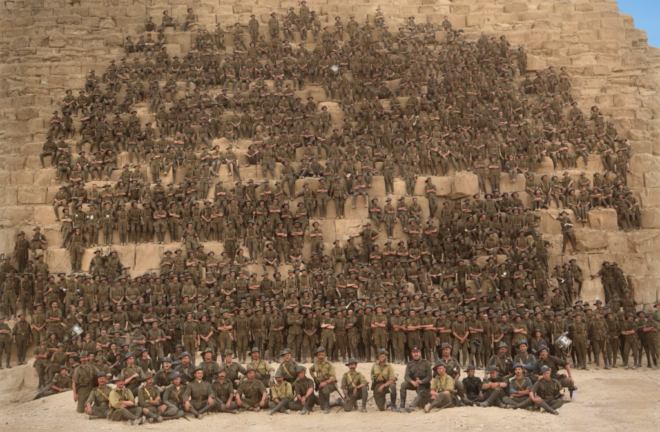
An Anti-War Statement in Twenty Stanzas
— after a report in the Tamworth Daily Observer, July 1915 —
1
July burns its fever-flag above the Peel,
the winter sun a lie, the air a hive
of drumming want; the nation learns to feel
that hunger is the proof a man’s alive.
2
The Dardanelles had bled its syllables
into the telegrams, each word a stone
laid cold on cold; grief hammered into calls
for bodies, bodies, bodies – bone on bone.
3
Men volunteered to pay a brother’s debt,
as if the ledger of the dead could close
by adding to its columns; as if yet
more sacrifice could cauterise the blows.
4
They came to Tamworth in their working boots,
the ordinary leather of the meek,
stood patient in the queue – those stubborn roots
of duty flowering dark across the week.
5
One man: unnamed, unremarkable to war,
a father of nineteen – the ink set down
his arithmetic where no metaphor
could soften it: a census, not a crown.
6
Two sons already swallowed by the shore,
already breathing the peninsula’s dust,
already learning what the Anzac lore
would polish bright and burnish bright: the rust.
7
Three sons in training, sharpening themselves
on Liverpool’s parade ground, blades of grain
prepared for threshing; two more boys – the shelves
of childhood barely cleared – now cleared for pain.
8
And now the father, standing in the line,
as if his body were a final vote,
as if the blood could make the ledger fine,
as if he were the last unspoken note.
9
Seven, from one house, threading toward the same
mean corridor of stone and salt and wire,
seven souls unspooling toward a flame
that would not know their faces from the fire.
10
The reporter wrote his numbers, not his name:
the state prefers the tally to the man,
prefers the counted to the one who came,
prefers the instrument to one who ran.
11
He did not speak of empire or of crown,
he did not lift a rhetoric of light;
he simply waited as the sun went down,
carrying the plainness of his right.
12
That plainness was itself a kind of speech:
the grammar of a man who trusts the word
he’s given – that the sacrifice will reach
some justice. Reader, was that trust well-heard?
13
Suffering does not balance suffering out,
the scales of grief are broken at the beam;
you cannot heal a wound by wound, a doubt
by deeper doubt, a nightmare by a dream.
14
By September the fever-flag went slack,
the enlistment queues dissolving like the mist
that rises off a grave; the country’s back
still aching from the weight of what was kissed.
15
The peninsula devoured the leaves it made,
each autumn casualty list a stripped bough,
and slowly, slowly, from the masquerade
of glory, something real began to show.
16
Twice they came with conscription’s iron chain,
twice the country pulled its wrists away:
not cowardice – a people learning pain
has limits, that the word enough means stay.
17
But in July the fever burned full white,
and one man, father, stood and said: I’m next –
as if the war were his to set aright,
as if his body were the final text.
18
We do not hold his name. It fell between
the columns, lost the way a small stone falls
through harbour water, swallowed by the green
and darkening deep that takes them, takes them all.
19
We hold his count alone – the seven threads
he wove into the loom of a machine
that did not weave but tore; the war that shreds
the cloth and calls the ravelling glory’s sheen.
20
Remember him – the one the paper lost –
remember what the arithmetic concealed:
that every column has a human cost,
that none of it was worth it, none of it healed.
by Bakchos

Bakchos, this is beautiful. The decimation of a family, a line, names forgotten. And in the background, so hushed they are almost missed, those left behind who are left with the realisations of sons who never came home, of a father who understood and still went to be with his boys.
These words are the cold truth:
“the state prefers the tally to the man,
prefers the counted to the one who came,”
You’ve captured an aspect of “Lest we forget”, so much more than the appeals to freedom would have us believe. You captured the dehumanisation whilst highlighting one father in a vast blackness. Brilliant.
Power and moving. Straight to the point, people aren’t numbers, we will always remain people.
The Arithmetic of Grief is a twenty-stanza anti-war poem built around that silence — around what the columns conceal, what the ledgers of sacrifice never balance, and why the word enough is not cowardice but the hardest wisdom a nation can earn.
Powerful poem, the man with 19 children becomes the representative “everyman” a man turned into a number sent to kill other men turned into numbers. A vivid description of the mindless nature of war.
Bravo my friend, bravo. Brilliant anti war poem. Love it.
Brilliance in 20 stanzas. Best anti war poem I’ve read for a long while.
I love this poem, powerful, emotive, beautiful, evocative, heartfelt, memorable all in one. Well done.
Powerful poem cuz, well done, you’ve done Erambie proud.
Kumpel this really is a good poem. Powerful and emotive. Congratulations, very well done.
The central metaphor to your poem is brilliant and sustained: The “arithmetic of grief,” the ledger, the tally, the columns, the “census, not a crown”—this runs through all twenty stanzas without ever feeling hammered. It turns bureaucratic language against itself and makes the dehumanising machinery of war visceral.