
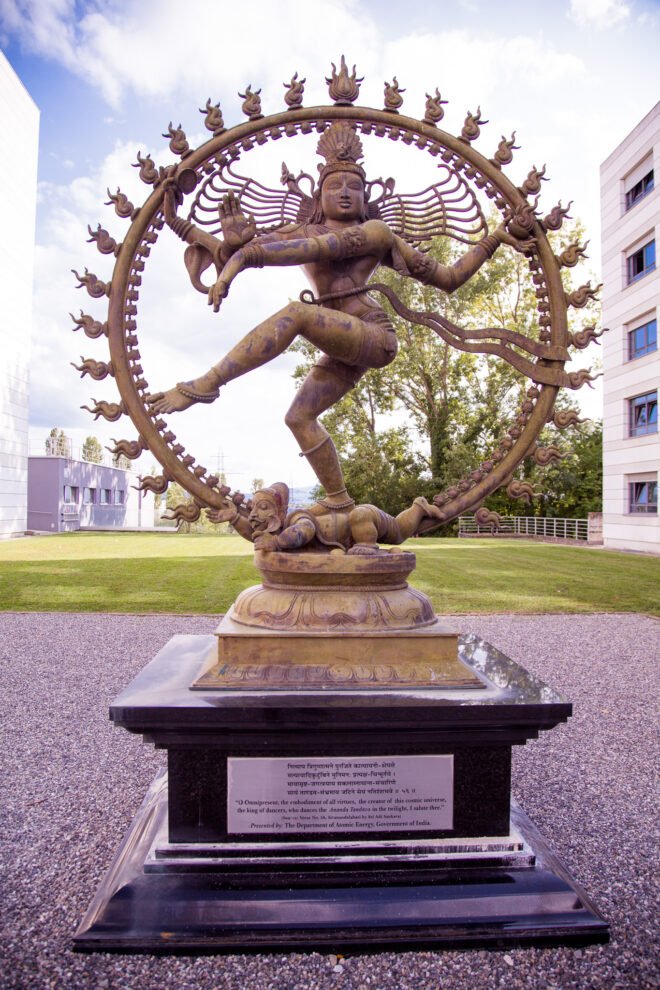
Nataraja dances, his right foot supported by a crouching figure, his left foot elegantly raised. Of his four arms, one swings downwards, pointing to the raised foot; another with palm held up signals, ‘Do not fear!’ In his other hands he holds aloft a drum and a flame. The river Ganga sits in his hair. A cobra uncoils from his lower right forearm, and the crescent moon and a skull are on his chest. He dances within an arch of flames. The dance is called the Dance of Bliss.
I. THE LORD OF THE DANCE
This dance is said to have first been performed at Chidambaram, about two hundred and forty-four kilometres south of Madras on India’s eastern coast. For worshippers of Shiva the Dance of Bliss is eternal, having neither beginning nor end. Nataraja is the Lord of the Universe. His dance expresses the state of bliss which he enjoys and embodies; he dwells in the heart of every person, and though he is to be found throughout the universe, his complete form is uniquely present at Chidambaram – the heart of the world – where he is accompanied by his consort, Sivakamasundari. She is his knowledge, his desire, his action. She embodies the compassion he feels for the world. Nataraja’s left foot is raised in dance so that worshippers may bow before it. He grants all wishes. The sight of Nataraja at Chidambaram is a great blessing, and worship of him frees one from rebirth.
How supremely great in power and grace this dancing image must appear to all those who have striven in plastic forms to give expression to their intuition of Life. Ananda Coomaraswamy, writing in 1918, understood that the image resists easy reduction to theology or superstition. It speaks, rather, to those who have not divided life and thought into airtight compartments – those who perceive the whole before the parts.
No artist of today, however great, could more exactly or more wisely create an image of that Energy which science must postulate behind all phenomena. If we would reconcile Time with Eternity, we can scarcely do so otherwise than by the conception of alternations of phase extending over vast regions of space and great tracts of time.
— Ananda K. Coomaraswamy, The Dance of Shiva (1918)
Nature, Coomaraswamy continued, is inert and cannot dance until Shiva wills it. He rises from his rapture, and dancing sends through inert matter pulsing waves of awakening sound, and matter itself dances, appearing as a glory round about him. Dancing, he sustains its manifold phenomena. In the fullness of time, still dancing, he destroys all forms and names by fire and gives new rest. This, Coomaraswamy insisted, is poetry – but none the less science.
The parallel between Shiva’s cosmic dance and the dance of subatomic particles was first explored by Fritjof Capra in his 1972 essay ‘The Dance of Shiva: The Hindu View of Matter in the Light of Modern Physics,’ and expanded into his celebrated 1975 work The Tao of Physics, still in print in over forty editions worldwide. In recognition of this profound resonance, the Government of India presented the European Organisation for Nuclear Research – CERN – with a two-metre bronze Shiva Nataraja in 2004. The plaque installed beside it quotes Capra: modern physics has shown that the rhythm of creation and destruction is not only manifest in the turn of the seasons and the birth and death of all living creatures, but is the very essence of inorganic matter. For the modern physicist, Shiva’s dance is the dance of subatomic matter.
Hundreds of years ago, Indian artists created visual images of dancing Shivas in a beautiful series of bronzes. In our time, physicists have used the most advanced technology to portray the patterns of the cosmic dance. The metaphor thus unifies ancient mythology, religious art, and modern physics – and, I would argue, the most pressing ethical questions of our age.
II. THE MOST BEAUTIFUL HARMONY
In Coomaraswamy’s book – essentially a series of seemingly disconnected essays – all thought springs from the same central impulse and converges into one design: the vast and tranquil metaphysics of India, which works to render happy and ennoble the human race. As with Shiva Nataraja himself, there is no negation. All is harmonised. All the forces of nature are grouped like a forest whose thousand waving arms are led by Nataraja, the master of the dance.
Everything has its place, every being has its function, and all take part in the divine concert – their different voices, and their very dissonances, creating, in the phrase of Heraclitus, a most beautiful harmony. Whereas in the West, cold, hard logic isolates the unusual, shutting it from the rest of life and labelling it as ‘other,’ India, ever mindful of the natural differences in souls and in philosophies, endeavours to blend them into each other, so as to re-create in its fullest perfection the complete unity. The matching of opposites produces the true rhythm of life.
I shall find hidden Thy infinite joy
In every splendour of smell and vision and sound;
Even while a thousand fetters still bind me to the wheel
I shall taste thy infinite liberty.
~Rabindranath Tagore~
John Donne understood the same truth from a different tradition. No man is an island, entire of itself; each is a piece of the continent, a part of the main. If a clod be washed away by the sea, Europe is the less. Each man’s death diminishes me, for I am involved in mankind. Therefore, send not to know for whom the bell tolls – it tolls for thee.
We live in a world that proclaims the harmony of the dance while systematically destroying the dancers. Nowhere is this contradiction more nakedly visible than in West Papua, where the drumbeat of Shiva’s creation is answered not by bliss, but by aerial bombardment, military occupation, and the slow annihilation of one of the world’s oldest living cultures.
III. THE ACT OF NO CHOICE
When West Papua was absorbed into Indonesia in the early 1960s, the timing was no accident. The multimillion-dollar Freeport-McMoRan mining contract was signed in 1967 – two years before West Papuans were given any vote on their future. As the West Papuan independence leader Benny Wenda, writing in The Guardian in October 2011, observed with bitter precision:
The deal to exploit our resources had already been signed before the vote took place: Indonesia left nothing to chance in securing its future revenue stream. The Act of Free Choice (we call it the Act of No Choice) saw just 1,025 people allowed to vote, out of a population close to 1 million, under threat of violence.
— Benny Wenda, The Guardian, 12 October 2011
That vote – convened under United Nations auspices and required by international law’s commitment to decolonisation – was a fraud of historic proportions. A population of nearly one million people, among them custodians of some of the world’s most biologically and culturally rich terrain, were assigned a destiny by a process that would shame a parish council. The Grasberg contract, signed under the guidance of Henry Kissinger – who later joined Freeport’s board – was already law before the ink was dry on the UN’s conscience.
Grasberg is not merely a mine. It holds the world’s largest gold reserve and the sixth largest copper reserve. Its tailings – the crushed, chemically treated remnants of ore extraction – have been discharged for decades into the Ajkwa River system at a rate that staggers comprehension. The Norwegian Government Pension Fund, in a landmark 2008 divestment report, described the daily disposal of two hundred and thirty thousand tonnes of tailings into river systems as generating severe and long-term environmental damage – irreversible in any timescale meaningful to human life. The World Bank no longer finances projects using riverine tailings disposal. The International Finance Corporation does not accept it. Yet it continues in West Papua, because Indonesian environmental standards fall significantly short of those required in the home countries of Freeport or Rio Tinto, where the same practice is prohibited by law.
Rio Tinto, whose very name commemorates the environmental devastation wrought by Phoenician and Roman miners on the Tinto River in southern Spain – a waterway now so acidic and heavy-metal-laden that NASA uses it as an analogue environment for Mars research – was for decades a partner in this enterprise. When the Norwegian Government divested in 2008, it cited the unacceptable risk of lasting and irreversible environmental harm. Rio Tinto eventually sold its Grasberg interest to Indonesia’s state mining company in 2018 for 3.5 billion dollars, booking its profits and departing. The tailings remain.
The headline above a 2011 Guardian report put it without adornment: Everyone profits from West Papua, except for Papuans. More than a decade later, the arithmetic has changed only in scale.
IV. SECURING DEVELOPMENT THROUGH FORCE
In September 2025, a catastrophic mud rush at the Grasberg Block Cave underground mine – in which approximately eight hundred thousand metric tonnes of wet material surged through multiple levels of the mine – killed seven workers. Operations were suspended. Freeport announced that full production would not resume until 2027. The mine’s earnings, its landslides, its operational crises – all are logged in SEC filings and shareholder updates with clinical precision. The people who live in the shadow of the tailings dam feature only as variables in a risk register.
Meanwhile, the human toll among those for whom West Papua is not an investment but a homeland has been reaching its own catastrophic inflection point. According to the 2025 Annual Report on Human Rights and Conflict in West Papua published by the Human Rights Monitor, the situation across the central highlands has transitioned from a localised insurgency into an extensive, modern-tactics military campaign. Indonesian forces are pushing into remote areas, establishing permanent outposts inside indigenous villages to secure territory for resource extraction and economic development. Security force raids have involved battle drones, aerial bombardments, and anti-personnel landmines or booby traps. Conflict-related civilian casualties, which stood at sixty-three in 2023 and forty-four in 2024, rose again to seventy-three in 2025.
Seventy-three people. Each one a clod washed away by the sea. Europe is the less. The world is the less. The harmony is broken.
As of December 2025, over one hundred and five thousand people in West Papua were internally displaced – most unable to return to their villages due to ongoing military operations or the permanent presence of security forces in their communities. In Intan Jaya Regency alone, approximately twenty-three non-organic military posts were constructed in a single month, resulting in the effective closure of fifty-two out of fifty-nine educational facilities and six health centres. Human rights lawyers and the Indonesian Legal Aid Foundation documented the connection explicitly: the military presence in Intan Jaya exists primarily to secure the gold-rich Wabu Block mining concession, covering approximately one point one eight million hectares of indigenous land.
The primary drivers of conflict-related human rights violations are no longer immediate responses to armed resistance, but a coordinated effort to secure territory for resource extraction and economic development in West Papua.
— Human Rights Monitor, Annual Report 2025: Human Rights and Conflict in West Papua
Under President Prabowo Subianto, who assumed office in October 2024, this logic has been systematised. Finance Minister Sri Mulyani Indrawati announced in August 2025 the creation of five hundred new military battalions – the most significant peacetime military expansion in Indonesia’s modern history. Christian Solidarity International, in a statement to the UN Human Rights Council in March 2025, warned explicitly of plans to restart the transmigration program, which moves non-indigenous settlers to West Papua, and of the authorisation of two million hectares of new rice and sugar plantations in the Merauke Regency, devastating what remains of the region’s tropical rainforests. Amnesty International’s Indonesia director Usman Hamid described this trajectory as an existential threat to the people of West Papua.
New satellite data published in 2025 confirmed that the Indonesian government’s National Strategic Projects drove twenty-four percent of West Papua’s forest loss in 2024. The scale of deforestation maps precisely onto the geography of military deployment. Where the trees fall, the soldiers follow – or precede. The sequence is becoming difficult to distinguish.
V. THE ARCHITECTURE OF IMPUNITY
In March 2024, footage emerged of Indonesian soldiers torturing three indigenous Papuans in Puncak Regency. Following public outrage, eight soldiers were detained. The subsequent investigation by Indonesia’s National Human Rights Commission (Komnas HAM) has, as of early 2026, produced no public findings. This is not aberrant – it is structural. Extrajudicial killings surged from seventeen cases in 2023 to eighteen in 2024. In October 2025, a court in Wamena convicted four police officers for the murder of Tobias Silak in Yahukimo – a rare exception that itself illustrates the rule: justice required months of civil society pressure, a lengthy trial, and a transfer of proceedings from a sympathetic jurisdiction.
Political organisations such as the West Papua National Committee (KNPB) faced continued repression and prosecution throughout 2024 and 2025. In November 2025, four Papuan activists from Sorong City were convicted of treason under Article 106 of the Indonesian Criminal Code – the charge being participation in a plan to ‘separate a part of the territory of the Republic of Indonesia.’ They received seven months’ imprisonment. They had attended a meeting. In October 2025, Komnas HAM itself came under threat, as a proposed revision to Indonesia’s human rights law sought to constrain its independence and investigative powers.
The Sarei v. Rio Tinto litigation, which wound through United States federal courts for years before the Supreme Court’s 2021 ruling effectively closed that avenue for alien tort claims, demonstrated both the possibilities and the limits of international legal accountability. The 2006 Ninth Circuit ruling had been genuinely groundbreaking: it affirmed that corporations could be held vicariously liable for violations of jus cogens norms, that such violations could not be shielded as ‘official acts,’ and that claimants need not exhaust local remedies. But the arc of that litigation – dragged across decades, ultimately extinguished – also illustrated that legal creativity and moral urgency are no match for the structural patience of capital and state power acting in concert.
The European Parliament, in a 2025 written question on the EU-Indonesia Comprehensive Economic Partnership Agreement, noted that the EU-Indonesia Human Rights Dialogue had lapsed between 2021 and 2024, even as civilian casualties increased and displacement exceeded one hundred thousand people. The question was asked. The answer was silence. Trade negotiations continued.
VI. THE DANCE CONTINUES
The crouching figure beneath Nataraja’s right foot is Apasmara – the demon of ignorance, the spirit of forgetfulness and heedlessness. Shiva dances upon him not to destroy him entirely but to subdue him: ignorance can never be wholly extinguished, only held down, held at bay, while the dance of conscious life goes on above. The flame in Nataraja’s upper left hand is not only the fire of destruction – it is the fire that clears the ground for creation. Destruction and creation are not opposites in Shaiva metaphysics. They are phases of a single rhythm.
We in the West have largely lost the capacity to hold this thought. We have divided creation from destruction, profit from consequence, the beneficiary from the victim, and labelled the boundary between them ‘the market.’ The one hundred billion dollar Anglo-Australian mining enterprise that gave itself the name of a river it had turned into an alien landscape, the American corporation whose chairman told the New York Times in 2005 that paying twelve million dollars annually to the Indonesian military for security constituted ‘ordinary business activities’ – these are not anomalies. They are Apasmara enthroned. They are the demon given the seat of the god.
Coomaraswamy’s essays resist this fragmentation. They insist on the whole. All forces are grouped like a forest whose thousand waving arms are led by Nataraja. Every being has its function. Every voice, even in its dissonance, contributes to the complete unity. But unity of this kind is not the unity of erasure – not the unity achieved when one culture absorbs another by force of arms and mineral contract. The harmony Heraclitus spoke of is produced by the tension between opposites that remain genuinely themselves. A string produces music because it is taut between two fixed points. Cut it from its moorings and you have neither tension nor song.
The indigenous peoples of West Papua – custodians of extraordinary biological and cultural diversity, speakers of languages that encode relationships with forest and river that no satellite mapping can replicate, practitioners of ceremonial and cosmological traditions with their own accounts of creation and destruction, of rhythm and rest – are being cut from their moorings. At the current rate of displacement, militarisation, deforestation, and cultural suppression, what is being lost is irreplaceable. Not just for Papuans. For all of us. For the harmony.
Each man’s death diminishes me,
For I am involved in mankind.
Therefore, send not to know
For whom the bell tolls,
It tolls for thee.
~John Donne~
In 2025, seventy-three civilians were killed in West Papua by Indonesian security forces. Over one hundred and five thousand people were displaced from their homes and their ancestral lands. Fifty-two schools were shuttered by military occupation in a single regency. The forests fell at a rate correlated precisely with the expansion of mining concessions and plantation projects approved in Jakarta.
Nataraja dances within an arch of flames. He sustains manifold phenomena. In the fullness of time, still dancing, he destroys all forms and names by fire and gives new rest. The question Coomaraswamy did not need to ask – because his world had not yet produced the particular form of destruction we are living through – is this: what happens when the fire is not the purifying fire of cosmic renewal, but the fire of extraction, of military ordnance, of burning rainforest and acidified river? What happens when Apasmara is not suppressed by the dancing god, but instead controls the state, the corporation, and the international trade agreement?
What happens is West Papua. What happens is one hundred and five thousand displaced persons, seventy-three dead, and fifty-two dark schools.
VII. THE INTERCONNECTEDNESS OF ALL HUMANITY
Coomaraswamy’s central thought – the thought from which all his essays spring and into which they all converge – is that humanity is not a collection of separate units but a single organism, and that the destruction of any part of it diminishes the whole. This is not sentimentality. It is metaphysics. It is also, increasingly, ecology and cognitive science and systems theory: complex, interdependent systems do not survive the arbitrary removal of their constituents.
Planet Earth is, as Heraclitus understood and Shiva embodies, a most beautiful harmony – one in which everyone, indeed everything, has a place and a purpose. If we destroy one culture, let alone a whole civilisation, what we destroy is not merely an interesting anthropological specimen. We destroy a node in the web of human meaning, a unique angle of perception on existence, a set of relationships with the living world that took thousands of years to develop and cannot be reconstructed from satellite data or academic monographs.
The Norwegian Government understood something of this when it divested from Rio Tinto in 2008. The Ninth Circuit judges understood something of it in 2006 when they ruled that corporations could not hide behind sovereign immunity when they participated in crimes against humanity. Amnesty International understands it when it names the destruction of West Papua’s environment an existential threat. Christian Solidarity International understands it when it carries the testimony of Papuan communities to the Human Rights Council in Geneva.
But understanding and action remain separated by a vast and profitable distance. The EU-Indonesia trade agreement proceeds. The five hundred military battalions are recruited. The Kucing Liar underground mine – Freepo rt’s next major concession, expected to produce over seven billion pounds of copper and six million ounces of gold between 2029 and 2041 – moves through its development phases on schedule, with or without the living communities above it.
Shiva’s palm is raised: Do not fear. But the gesture requires a god who can sustain what he creates, destroy what must be destroyed, and dance through the difference with wisdom. What we have instead is Apasmara’s administration: ignorant, extractive, heedless – dancing on the bodies of the displaced rather than on the demon of forgetting.
Everyone profits from West Papua, except for Papuans.
~Benny Wenda, West Papuan independence leader, The Guardian, 12 October 2011~
We are implicated. Those of us who benefit from the global copper supply chain, from the gold markets, from the trade agreements signed in our names by governments we elect – we are implicated. The clod washed away by the sea diminishes the continent on which we stand. The bell is tolling. The dance is not a spectacle. It is an invitation – to consciousness, to solidarity, to the recognition that the harmony of the whole depends on the dignity of each of its parts.
Nataraja dances, and the dance is eternal. But eternity is not an excuse for indifference. The Dance of Bliss is also a dance of responsibility – to the drum that sets the rhythm of creation, to the flame that clears the ground for what comes next, and to the left foot raised in grace, beneath which every worshipper, every sufferer, every displaced person in the highlands of West Papua, is invited to bow and to be seen.
Bakchos
Blak and Black
© 2026



Shiva Nataraja dances within an arch of flames — a symbol of cosmic creation and destruction held in perfect harmony. In West Papua, 73 civilians were killed in 2025. 105,000 displaced. 52 schools shuttered by military occupation. The dance continues. The dancers are dying.
Western people need to wake the fuck up and see the cost their life styles have on other people.
That’s the truth Anaya.
What is being done to the West Papuan people to steal their resources is criminal, capitalism can be criminal in outcome if not in intention.
Western nations are exploiting and destroying developing nations then they cry foul when western exploitation causes a refugee crisis in the developing nations they’re exploiting.
Indonesia is committing ecocide and genocide in West Papua, everyone but West Papuans benefit, no one but West Papuans die for those benefits.
The essay draws on the Human Rights Monitor’s 2025 Annual Report, the Norwegian Government’s landmark divestment from Rio Tinto, the Sarei v. Rio Tinto litigation, and the European Parliament’s questions about the EU-Indonesia trade agreement — to ask what it means to speak of human harmony and interconnectedness while the structures of capital and state power systematically destroy both.
John Donne’s bell is tolling. The question is whether we are listening.
Shiva Nataraja spins in an arch of flames — creation and destruction braided into one jaw-dropping dance. It’s majestic and savage at once, a reminder that beauty and ruin can live in the same heartbeat. But down in West Papua this ain’t metaphor: in 2025, 73 civilians killed, 105,000 uprooted, 52 schools shuttered by military occupation. The cosmic dance keeps going. The dancers are dying. Don’t scroll past. Hold them in mind. Speak up.
Western corporate imperialism is destroying the developing world and driving the refugee crisis that western populist politicians capitalise on to drive wedges into their own societies to benefit oligarchs. The real losers are everyone who aren’t oligarchs.
Great post, loved it.
Greed is destroying West Papua and our planet.