
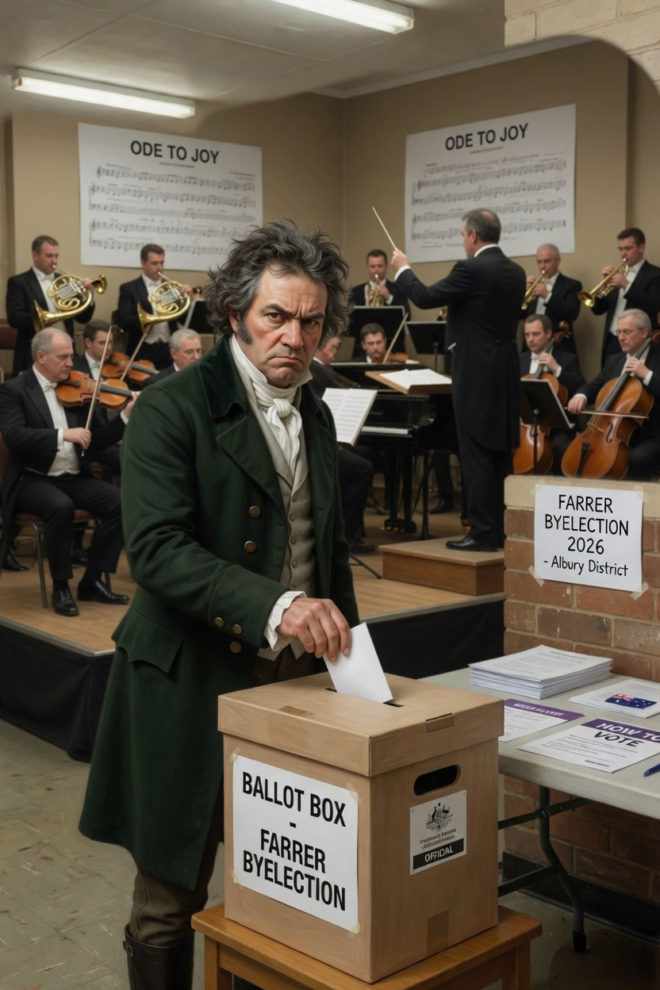
Freude, schöner Götterfunken, Tochter aus Elysium – Joy, bright spark of divinity, daughter of Elysium.
~Friedrich Schiller, An die Freude (Ode to Joy), 1785~
I. The Spark That Did Not Come from Elysium
Friedrich Schiller wrote his great ode in 1785, at the age of twenty-five, burning with the conviction that joy – Freude – was not a private mood but a metaphysical force capable of binding humanity together. It is the kind of poem only a young person can write: ferocious in its faith that the world might yet be saved by the sheer power of human fellowship. A century later, Beethoven set those words to music in the choral finale of his Ninth Symphony – a work composed when he was almost entirely deaf, hearing in silence what the rest of us cannot. The result is so architecturally perfect in its movement from darkness to transcendence that it still makes the soul soar.
I say this as a Jew, and without embarrassment. The Ninth belongs to no church, no nation, no race. It belongs to the human animal at its most aspirational. When the bass voices finally enter in the fourth movement and the chorus rises, something happens in the body that is prior to ideology, prior to theology, prior to politics. It is the sound of what Schiller called “Alle Menschen werden Brüde” – all men become brothers. In that moment, I believe it.
And then the music ends, and I read the news from Farrer.
On Saturday night, 9 May 2026, the New South Wales electorate of Farrer delivered a very different kind of spark. One Nation – Pauline Hanson’s party, built on the explicit logic of exclusion, of assigning blame for national decline to migrants, to Muslims, to Aboriginal people, to the rotating cast of scapegoats – achieved a remarkable swing in the by-election triggered by Sussan Ley’s retirement. In a safe conservative seat, One Nation did not merely show up. It competed. It announced itself as a force that will not be quietly managed back into irrelevance.
It is not the spark of Elysium. But it is a spark, and we had better understand what is feeding it.
II. Wer ein holdes Weib errungen – On the Breaking of Bonds
Schiller’s ode radiates outward from the intimate to the universal: lover to lover, friend to friend, person to cosmos. What Farrer tells us is something about the severing of that radiation – the growing number of Australians for whom the connections that were supposed to bind citizen to state, worker to economy, community to government, have frayed past the point where ordinary political loyalty makes psychological sense.
I understand the protest vote. Not as an abstract political science concept but as a lived human experience. When the price of milk, the price of petrol, and the quarterly rent are all moving in the same terrible direction at once; when you sit six hours in an emergency department because there are not enough nurses; when you hear politicians describe an economy that bears no resemblance to the one in which you actually live – something breaks. The vote stops being a calculation about policy platforms and becomes a cry. A primal, legitimate, furious cry. And when that cry is given a ballot paper and a pencil, it reaches for whatever is closest to hand that looks different from the thing that failed it.
In Farrer, what was closest to hand was One Nation. I do not celebrate that. But I do not pretend not to understand it. Condescension has never once in the history of democratic politics persuaded a protest voter to come home.
Most of the people in Farrer who voted One Nation are not ideological white nationalists. Some are – and we should be honest about that – but most are people in regional New South Wales who have watched infrastructure decay, whose children have left for the cities, whose hospitals are understaffed, whose services are remote in every sense of that word. The Liberals, who held Farrer for generations, made them feel taken for granted. Labor never made them feel at home. So they reached for the one voice that, whatever its many and serious faults, was at least loud about their existence.
III. Deine Zauber binden wieder – The Old Trick
Schiller wrote of joy’s magic reuniting what custom and convention have torn asunder. The irony is excruciating. Because what One Nation offers, in place of reunion, is the deepest kind of division – the kind that tells one group of people that their suffering is the fault of another group of people, rather than the product of structural failures, policy choices, and concentrated capital.
This is the old trick. It is as old as politics itself. When the granary is empty, point at the Jews. When the factories close, point at the migrants. When the housing market becomes a mechanism for the intergenerational transfer of wealth that permanently excludes anyone who did not inherit it, point at the refugees. The targets shift. The mechanism is constant. Genuine grievances are systematically redirected away from the institutions and power structures that produced them, toward the most vulnerable people in the country, who had nothing to do with producing them.
Elevating a party built on this logic will do nothing for national unity. I want to be direct about this, because there is sometimes a liberal temptation to treat any acknowledgment of the protest vote as implicit endorsement of the vehicle through which it is expressed. That is not what I am arguing. One Nation is bad for Australia. It is bad for the Aboriginal Australians Pauline Hanson has spent decades demeaning. It is bad for the Muslim Australians she has targeted with barely concealed Islamophobia. It is bad for the multicultural fabric that is, whatever the anxieties of the moment, one of this country’s genuine achievements. A One Nation Australia would be a meaner, smaller, more frightened version of what we are.
But the answer to One Nation is not to dismiss the people voting for it. The answer is to address the conditions that make that vote feel, to those casting it, like the only rational response available.
IV. Alle Menschen werden Brüder – The Conditional
There is a line in Schiller’s ode that has always struck me as more demanding than celebratory. Alle Menschen werden Brüder, wo dein sanfter Flügel weilt – all men become brothers wherever thy gentle wing abides. The conditional is everything. Brotherhood is not a given. It is a condition that has to be created and maintained. It depends on the active presence of something – joy, solidarity, justice, call it what you will – that nurtures it. In its absence, the default human tendency is not brotherhood but tribalism. Not inclusion but the drawing of lines.
One Nation will keep growing as a party of protest for as long as the genuine grievances of the Australian population remain unaddressed. This is not a prediction offered with any pleasure. It is a structural observation. Protest votes do not disappear when the establishment shakes its head disapprovingly. They grow. They calcify into habitual voting patterns. They become cultural identities. What begins as a cry of pain becomes, over time, a community of shared resentment, with its own media ecosystem, its own social networks, its own mythology of persecution by elites. We have watched this process unfold in country after country. There is no reason to think Australia is immune.
The swing is the real story, not the outcome. And the story is of a major conservative party that, for a generation, has taken regional Australia for granted while serving the interests of the corporate and property-owning class that funds it – and is now discovering that the people it took for granted have found somewhere else to go.
The lesson is available for reading. Whether it will be read is another matter.
V. Freude trinken alle Wesen – The Pattern Beyond the Continent
What is happening in Farrer is not peculiar to Farrer. It is not peculiar to Australia. Across the entire arc of Western liberal democracy – the United States, the United Kingdom, France, Germany, Italy, the Netherlands, Sweden, Hungary, Poland – the same phenomenon is unfolding at approximately the same time. Mainstream parties of both the centre-left and the centre-right are haemorrhaging support to populist movements of the far right. The names differ. The cultural anxieties differ. The local grievances differ in their colouring. But the structure is identical: a base of working and lower-middle-class voters who feel the system has failed them, redirected by charismatic populists toward nativist explanations for their suffering.
One could argue this is coincidence – that each country has its particular triggers (Brexit, the long aftermath of 2008, deindustrialisation in the American heartland, the housing crisis stretching from Sydney to London to Amsterdam to San Francisco), and that similar conditions naturally produce similar responses. That argument is largely correct. Globalised capitalism produces similar fractures across nations integrated into the same economic system.
But the simultaneity also raises a harder question. The infrastructure of far-right information ecosystems does not spring from nowhere. The cross-border funding of populist movements is documented. The role of social media platforms – whose algorithmic architectures were designed to maximise engagement, and which discovered that outrage and fear are the most engagement-maximising emotions available – is not a conspiracy theory. It is a business model. Whether the result is principally an organic response to material conditions, principally a manufactured amplification of those conditions, or – as I suspect – both at once, the practical conclusion is the same: this is not a storm that will pass on its own. It requires a response commensurate with its scale.
VI. Wem der große Wurf gelungen – What Would Be Worth Winning
What would it mean for the major parties – Labor, primarily, since it currently holds government, but the Liberals too in their inevitable eventual return – to respond to One Nation not with tactical management but with genuine reckoning?
It would mean, first, taking regional Australia seriously as more than an electoral calculation: sustained investment in regional health, not announcements before elections and silence between them. It would mean a serious housing policy that addresses the structural drivers of unaffordability – negative gearing, capital gains tax concessions, the ways the tax system has made property speculation more attractive than productive investment – rather than the endless tinkering at the margins that changes nothing for anyone trying to buy a first home. It would mean an industrial relations framework that actually restored bargaining power to workers who have spent forty years watching their share of national income shrink. In short, it would mean the structural changes that the broad centre-left has spent forty years describing as the price of electability rather than the price of not doing them.
But it would also mean something harder. It would mean telling the truth about what One Nation is, and doing so without the condescension that has historically accompanied that conversation. One Nation has consistently othered the most marginalised people in this country. Aboriginal Australians, who have spent more than two centuries surviving the consequences of colonisation. Muslim Australians, many of whom arrived here fleeing theocracy and war, and were then accused of importing the thing they fled. Refugees, who crossed oceans in desperate circumstances and were told that their desperation was a trick. These are not abstractions. They are people, and the politics of othering causes them genuine harm. But naming that harm is not incompatible with taking seriously the grievances of the people who vote for the party doing it.
Both things are true simultaneously. The inability to hold both things in mind simultaneously is itself part of the problem.
VII. Seid umschlungen, Millionen – The Demanding Vision
The most overwhelming moment in Beethoven’s Ninth comes when the chorus reaches Seid umschlungen, Millionen. Be embraced, you millions. Beyond the starry canopy must dwell a loving father.
It is, at this distance from Schiller’s poem, an almost impossible vision. A loving father beyond the stars. Millions embraced. All men brothers. The world as it might be if joy – genuine, structural, political, material joy, not the consumer-satisfaction version the market has been trying to sell us as a substitute – were distributed with something approaching justice.
I will not pretend this vision survived the twentieth century intact. Schiller’s Germany became, within a hundred and sixty years of the poem’s composition, the country that built Auschwitz. The German-Jewish cultural symbiosis that allowed a Jewish boy to grow up loving Beethoven the way I love him was annihilated by the same nation that produced both. Adorno’s question – whether poetry is possible after Auschwitz – is not a rhetorical flourish. It is the central problem of any modern person who still wants to claim universalist art as a moral resource.
I claim it anyway. Not naïvely. Not as if the catastrophe did not happen. But because the alternative – the surrender of the vision of universal brotherhood to those who already deny it – is worse. The Ninth does not pretend that darkness does not exist. It passes through the darkness and comes out the other side. That passage is the only honest model I know for what democratic renewal would actually require.
VIII. Diesen Kuss der ganzen Welt – The Radical Generosity
Schiller imagines joy expansive enough to reach the whole world – not just the good, not just the deserving, not just those who have earned it by the standards of the powerful, but the whole world. Diesen Kuss der ganzen Welt. This is the radical generosity at the heart of the poem, and it is precisely what made it right for Beethoven, a man of radical democratic sympathies who had once dedicated his Third Symphony to Napoleon and then scratched out the dedication in fury when Napoleon declared himself Emperor.
The radical generosity of Schiller’s vision is exactly what the politics of One Nation refuses. Its joy, such as it is, is conditional – available to some, defined against others. Its community is built by exclusion. Its identity is constituted by the existence of those it excludes. This is not, in the end, a vision of joy at all. It is a vision of resentment with a flag. And resentment, however politically useful in the short term, cannot govern. It can only tear down.
Australia has built something worth preserving. A democracy, imperfect but real. A multicultural society that has, against considerable odds and in the face of persistent racism, managed to be more than the sum of its divisions. Institutions that, however battered, retain a capacity for self-correction. These things are not given. They are achievements. They are fragile. They require active maintenance by people who understand their value.
The Farrer result should be read as a warning – not a panic, not an excuse for hysteria, not an occasion for hand-wringing that substitutes for analysis. A warning. The people of Farrer, and the larger constituency of Australians who share their circumstances, are telling us something that needs to be heard. Hearing it does not mean endorsing the vehicle through which it is expressed. It means taking seriously the underlying message, which is: we are not all right, and we need you to actually fix it, not manage it.
IX. Ahnet, Millionen? – The Open Question
The closing movement of Schiller’s ode asks its most searching question directly: do you sense him, world? Do you feel the presence of something greater? It is a question about whether, beneath the noise and suffering and division of ordinary experience, there is something worth striving toward.
I do not know, with any confidence, whether the political class of Australia is capable of providing what this moment requires. I do not know whether the structural forces driving the growth of One Nation and its analogues across the Western world can be addressed through the ordinary mechanisms of democratic politics, or whether those mechanisms are themselves too compromised, too captured, too short-horizoned to do what needs to be done. These are genuinely open questions, and anyone who answers them with certainty in either direction is probably not engaging seriously with their difficulty.
What I do know is that the music endures. That Beethoven, deaf and isolated, reached through the silence to something that makes the soul soar. That Schiller, young and burning with conviction, wrote words that still, two and a half centuries later, carry a charge. That the vision of all men as brothers has not lost its power to move us, even when the gap between the vision and the political reality of the moment feels as wide as the distance between the Farrer by-election count and the choral finale of the Ninth.
Perhaps that gap is not a reason for despair but a measure of the work remaining. The orchestra at the opening of the Ninth’s final movement plays fragments of the previous three movements and rejects them, one by one, before finding its way to the human voice. It knows what does not work. It is searching for what does. That search – conducted honestly, without pretending the darkness is not dark – is the only description I can offer of what Australian democracy needs to do now.
One Nation won a significant protest vote in Farrer. Across the Western world, its analogues are winning protest votes in places that once seemed safely moderate. The conditions feeding those votes are real and serious. The vehicle carrying them is dangerous and built on exclusion. Both things are true. The Ninth Symphony contains both things too – the darkness and the light, the searching and the finding – and it does not resolve the tension between them by pretending either one does not exist.
Joy, Schiller wrote, is the daughter of Elysium. She comes from the realm of the blessed. But she comes here, into the ordinary world: into the concert hall where a deaf composer cannot hear his own masterpiece, into the electorate of Farrer, into the long slow argument of democracy about what we owe each other.
She comes here, or she does not come at all. The question is whether we have the wit and the will to make ourselves worthy of her arrival.
© Bakchos 2026 | Blak and Black est. 2010



This is excellent opinion writing—literate, morally serious, emotionally intelligent. It models the very generosity it preaches by refusing to treat One Nation voters as either saints or idiots. Its central tension (universal joy versus particular resentment) is the right one for the moment. If the goal was to make thoughtful readers uncomfortable in a productive way—feeling both the pull of the Ninth and the sting of Farrer—it succeeds.
.
The only real shortfall is that the political diagnosis, while nuanced, still tilts toward a centre-left economic explanation and underplays the cultural/immigration drivers that One Nation explicitly campaigns on and that large chunks of the electorate now prioritise. That tilt does not make the essay dishonest; it makes it an argument rather than pure analysis. And a good argument it is.
.
The music endures, as you say. So does the gap between the music and the ballot box. Your piece does not close that gap, but it refuses to look away from either. That is about as much as a single essay can ask of itself.
Pauline Hanson and One Nation are the sole island in a political void. They are not the best option for those disenchanted by the mainstream parties, they are the only option, the only ones speaking about the the matters that everyone else is too afraid to speak about. Hanson doesn’t give a hoot about political correctness, in fact she goes after those very grievances that voters grumble about and takes them to the extreme. The major parties are idiots. If they won’t face the difficult conversations and take decisive action, Hanson will continue to be the only voice screeching into the void created by voters’ frustration and the Ode will become a dirge.
Pauline Hanson is an uneducated, vacuous populist. She’s a hardcore racist, who has been waiting for a moment in history when her racism might be disguised as something else. Her 15 minutes in the sun has finally arrived.
This is a beautifully crafted, piece of long-form political writing. The Schiller/Beethoven scaffolding is not gimmickry; it is organic and genuinely illuminating. You have taken a dry political event — a by-election swing that became a historic win — and turned it into a meditation on joy, resentment, universalism, and democratic failure that feels earned rather than forced. The prose has real music in it. The personal voice (the Jewish boy who still claims Beethoven) gives the universalist plea moral weight instead of sounding like a lecture. This is stronger, tighter, and more confident than the draft you first showed me. Well done.
Pauline Hanson is a fake redhead, racist bitch!
Fuck that ginger haired bitch Pauline Hanson.
Pauline Hanson is a cunt.