
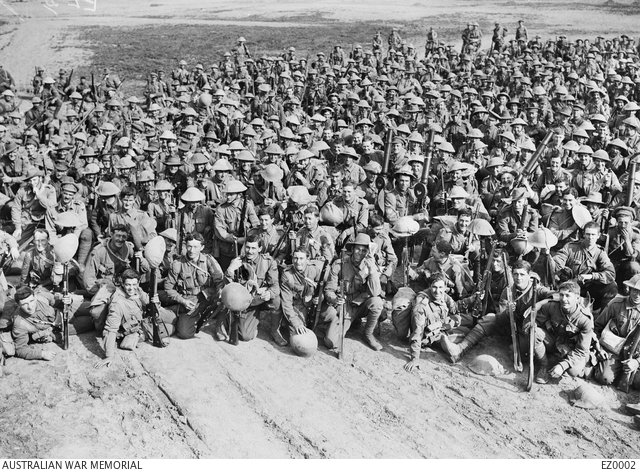
Image courtesy Australian War Memorial.
σεῖο δ᾿, Ἀχιλλεῦ,
οὔ τις ἀνὴρ προπάροιθε μακάρτερος οὔτ᾿ ἄρ᾿ ὀπίσσω·
πρὶν μὲν γάρ σε ζωὸν ἐτίομεν ἶσα θεοῖσιν
Ἀργεῖοι, νῦν αὖτε μέγα κρατέεις νεκύεσσιν
ἐνθάδ᾿ ἐών· τῷ μή τι θανὼν ἀκαχίζευ, Ἀχιλλεῦ.
ὡς ἐφάμην, ὁ δέ μ᾿ αὐτίκ᾿ ἀμειβόμενος προσέειπεν·
μὴ δή μοι θάνατόν γε παραύδα, φαίδιμ᾿ Ὀδυσσεῦ.
βουλοίμην κ᾿ ἐπάρουρος ἐὼν θητευέμεν ἄλλῳ,
ἀνδρὶ παρ᾿ ἀκλήρῳ, ᾧ μὴ βίοτος πολὺς εἴη,
ἢ πᾶσιν νεκύεσσι καταφθιμένοισιν ἀνάσσειν.
~ Odyssey, Book 11, lines 482–491 ~
“While you were still alive, we Argives honoured you as we did the gods.” These words he answered, swiftly: “Glorious Odysseus, don’t try to reconcile me to my dying. I’d rather serve as another man’s labourer, as a poor peasant without land, and be alive on Earth, than be lord of all the lifeless dead.”
Two days ago I wrote about Du Fu and the army carts that rattled out of Chang’an in the eighth century. The dust rose so thick that the bridge at Xianyang disappeared from view, and mothers and wives ran alongside the carts, tugging at the sleeves of the conscripts and crying out. The poem ends on the shore of Qinghai Lake, where the bones of the old dead still lie unburied, and the old ghosts and the new ghosts weep together under a wet sky. What makes the poem endure is its refusal to ennoble. Du Fu does not tell the mothers their sons died gloriously. He lets a soldier explain, in the flat voice of a man marched off to the frontier as a boy, that it is better now to bear a daughter than a son, because a daughter can at least marry the neighbour, while a son ends up beneath the wild grass.
I want to carry that thought out of eighth-century China and into the wheat and beetroot country of northern France, because the same sentence was spoken there in a different accent, and because it was spoken there for a very long time without anyone being allowed to hear it. It is also a sentence that Homer put into the mouth of the greatest soldier in the Greek imagination, and the Greeks were in no doubt about what it meant.
What Achilles Said
In the eleventh book of The Odyssey, Odysseus descends to the edge of the underworld and meets the shade of Achilles. He does the decent, diplomatic thing, which is to console him. You were honoured like a god when you lived, he says, and now you rule the dead with great power, so do not grieve at being dead. It is exactly what a nation says to its bereaved: your son has been made immortal by his sacrifice, and he rules among the heroes.
Achilles will have none of it. “Don’t try to reconcile me to my dying,” he says. He would rather be a hired labourer on another man’s land, the poorest of the poor, a peasant with no allotment of his own, and be alive under the sun, than be king over all the exhausted dead. The Greek word for the poor man, aklēros, means a man without a lot, without a share of the land. Homer is not choosing his words idly. Achilles is naming the lowest rung of the social ladder in his world and saying that the lowest rung of life beats the highest throne of death.
This is the most important correction to the glorification of war ever written, and it was written nearly three thousand years ago by a poet whom soldiers have been reading for most of that time. Du Fu, who knew the Shijing and the old ballads of the frontier as well as any man in China, reaches the same conclusion by a different road. The consolations the living offer the dead are for the living. The dead, if we could ask them, would trade every honour we have in our gift for one more ordinary morning.
I keep that exchange in mind when I read about Fromelles, because the men who died there were, for the most part, exactly the poor peasants and labourers Achilles had in mind, and because the nation spent the following century doing to them what Odysseus did to Achilles.
A Clear Evening in July
Around 6 pm on Wednesday, 19 July 1916, in full daylight on a clear sunny day, the 5th Australian Division answered the call to attack. It was thrown against the German front line at Fromelles as a diversion, to help support the massive British offensive then in the balance at the Somme, some eighty kilometres to the south.
Consider what that sentence means. The attack was not the main event. It was a feint, meant to persuade the German command to keep its reserves where they were rather than send them to the Somme. Historians have long argued that it was hastily planned and thinly supported, that the artillery preparation was inadequate to the task, and that the Germans were never really fooled. The division had arrived on the Western Front only weeks earlier. For many of its men, Fromelles was their first major action in France, and a good number of them had already come through Gallipoli.
The Australians charged into the teeth of German machine guns that had survived the Allied bombardment in their purpose-built concrete bunkers. The casualties were devastating: 5533 out of around 7000 attackers, with almost 2000 killed. It was the greatest loss of life in a single night in Australian history. Amazingly, and against all the odds, hundreds of attackers broke through the German front-line trenches and forced the defenders to retire. But without support they were trapped by German counter-attacks, and eventually they were either killed or captured.
The detail that stays with me is not the number. It is the daylight. The great set-piece slaughters of the Western Front are often imagined as events of mud, fog and darkness, but this one began in the long, clear light of a northern summer evening. The men who went over the parapet could see exactly what they were walking into, and so, it seems, could the men who sent them.
Afterwards the wounded lay in No Man’s Land through the night and into the following day. Some were carried in by comrades who went out again and again under fire, and the stretcher-bearers and rescuers of that night rank among the bravest of the war. But there were hundreds who could not be reached, and then hundreds more whom no one could account for at all.
The Missing
Some of the dead were recovered after the Armistice in November 1918 and buried in the cemeteries nearby. But the fate of many who died behind the German lines was unknown for more than ninety years. Many of those who charged that day simply disappeared. Twelve hundred and ninety-nine of them are listed as missing on the wall at the VC Corner Cemetery, near the Australian front line on the Fromelles battlefield.
In a war fought by 65 million soldiers over four years, where 37.5 million were killed, wounded, captured or went missing, you might think that thirteen hundred or so missing Diggers are a drop in the ocean. That is exactly the calculation Du Fu refuses to make, and that Achilles would not let Odysseus make. They were not numbers. They were sons, brothers, husbands, fathers and mates. They were labourers and teachers, bank clerks and lawyers, farmers and posties. The dead included twelve sets of brothers and two sets of fathers and sons. All of them had hopes of long lives, contented families and quiet retirements. As far as their families or the rest of the world knew, they had simply vanished on 19 July 1916 near a small village in north-eastern France called Fromelles.
Think about what it meant to be the mother of one of the missing. There was no body to bury, no grave to visit, no date and place to hold on to. In the old language of Du Fu’s poem, there was only the bone on the shore with no one to gather it. A missing man’s family lives for years in a suspended grief, because the one thing they are owed, the certainty of where he lies, is withheld. The nation put a name on a wall and a poppy on the name, and called it remembrance.
The Art Teacher
They remained in the mists of history until a Greek-born Australian art teacher from Melbourne began his quest to find them. Lambis Englezos had no military training, no institutional backing and, at the outset, very little reason to expect that anyone in authority would listen. He began, in the early 2000s, with the question that official history had stopped asking: where did the missing actually go? Working through German records, aerial photographs and the accounts of survivors, he and his team of supporters came to believe they knew the fate and the final resting place of around 170 of the Diggers who had gone missing at Fromelles.
I find it hard to ignore that the man who did this was himself Greek. Englezos acted as Homer’s Greeks understood the duty to the dead: that a body unburied is a wrong done to the living and the dead alike. The great scenes of the Iliad turn on it. Priam crosses the lines at night to beg for his son’s body, and Achilles, who has been desecrating that body for days, relents and weeps. Sophocles’ Antigone defies a king rather than leave her brother’s corpse to the dogs. The obligation to bury is older than the nation-state, older than the war memorial, older than the idea that dying for your country confers any particular honour at all. It is simply what one human being owes another.
Englezos was right. In 2008 the burial pits behind the German lines near Pheasant Wood, which his work had identified, were located, and in 2009 archaeologists excavated them. The remains of around 250 soldiers were recovered, the great majority of them Australian, and DNA testing and painstaking research have since restored names to many of them. In 2010 a new Commonwealth war cemetery was dedicated at Fromelles, the first built in about fifty years. Men who had been missing for ninety-four years were laid to rest with their names on their headstones. The effort that found them was never led by a government. It was led by a schoolteacher with a stubborn conscience and the people he persuaded to believe him.
It is a matter of some shame that it took so long. We spend a great deal of money on the ceremony of remembering, on the dawn services and the centenary programs and the commemorative coins, and it fell to an amateur to do the one thing that remembering most plainly requires, which is to go and look for the dead.
Six Bob a Day
The Australian soldier of the First World War was famously the best-paid fighting man in the empire. He received six shillings a day, “six bob”, against the single shilling of his British counterpart, and the sum entered the language. Diggers were sometimes teased as “six-bob-a-day tourists”, a phrase that carried the flavour of an adventure and a wage. The title of this essay borrows that phrase on purpose, because it points at something the legend has tended to hide. A man who sailed for six bob a day was, in the great majority of cases, a man for whom six bob a day was good money. These were working men. They were drovers and shearers, wharf labourers and railway hands, men who could be spared from the economy at the price of a wage and a uniform.
That is Achilles’ poor peasant again, the man for whom the best prospect in life was to hire himself out to another man’s farm. The wage was the bait, and the trade was a poor one. The same principle runs through Du Fu’s poem, where the frontier is held by boys taken from the fields. Wars are fought at the expense of the people who can least afford to lose a season’s labour, and the dead are mostly drawn from the same class that would have been working another man’s land.
Nowhere is that clearer than among the Aboriginal men who enlisted. Under the Defence Act, soldiers were supposed to be of “substantially European origin or descent,” and many Aboriginal volunteers were turned away. Even so, at least a thousand served, Wiradjuri men among them, and often they went on the understanding that they would be treated as equals in the ranks, which many of them found to be true in the trenches in a way they had never found it at home. They came back to a country that denied them citizenship rights, refused many of them the soldier-settler land granted to white returned men, and kept moving their families on and off the missions. Achilles’ aklēros, the man without land, has seldom been so literally described. They had fought for a nation that, on their return, would not give them a lot.
When the stories of the Anzacs are told in schoolrooms every April, the poor and the dispossessed are in them, but they are folded into a general portrait of the manly, laconic bushman. What is left out is that the burden of the war fell, as it always falls, along the lines of class and race.
Repent
Mabel Gardner was an active member of the peace movement in Melbourne during the war. On 8 November 1918, when rumours of peace were running through the city and wild rejoicings were breaking out in the streets, she made an entry in her diary:
Today there are rumours everywhere that Peace has been declared, and in some places wild rejoicings. Rejoice! The word seems ridiculous. It is too late! After four years of wicked folly; after we have been dragged down to the depths of misery, we are asked to rejoice. There seems no sense of shame anywhere, that such things have been. Peace should have been and could have been declared years ago. With all the maimed and wounded with us; all the wrecked homes and ruined lives; let us instead of rejoicing, Repent!
It is hard to read this without hearing Du Fu. Here is the same refusal of the victory narrative, the same insistence that the proper response to the end of a war is not jubilation but shame at its having been fought. Mabel was not a general or a philosopher, and she knew she was swimming against a flood of public feeling. She wrote it anyway, and in the privacy of a diary, which is where honest people were often reduced to putting such thoughts in 1918.
Her younger brother, Private Thomas Gardner of C Company, 59th Battalion, was discharged from the Australian Imperial Force on 14 October 1918. Six weeks later, and thirteen days after the Armistice was declared, he was dead. The death certificate reads:
24 November 1918, Thomas Oliver Gardner: Drowning, the result of an accident while bathing, Kangaroo Lake, Mystic Park, Kerang, Victoria.
Two days later, on 26 November, Mabel noted in her diary
“Tom’s funeral; 11 am. Several returned soldiers marched and everyone was very kind.”
I have read that entry many times and I am not sure what to say about it that it does not say itself. Tom Gardner survived the war. He was discharged, he went home, and a few weeks later he went swimming in a lake in the Victorian summer and did not come back. It was an accident in the strictest sense, and no one is to blame. But Mabel’s account sits in the same collection as the shell-torn fields of the Somme, and it belongs there. The war had been officially over for thirteen days. The returned soldiers who marched at his funeral were the last honour guard of a man whom the army had already let go. And “everyone was very kind”, the sentence that ends the entry, is the sound of a family absorbing a loss that the national story has no place for, since he was neither killed in action nor wounded, only dead in the aftermath.
What Mabel’s diary shows is how much of the cost of a war falls outside the casualty lists. Some men die in the open ground in front of a machine-gun bunker, and some drown in lakes a month later. Some are listed on a wall, and some are never counted at all. Everyone in the family, the mother who waits for a body that never comes and the sister who writes in a diary that peace is no cause for rejoicing, belongs to the war’s casualties too.
What We Owe
The Great War was over, and yet it was not. Odysseus could not talk Achilles out of the truth of death, and no amount of ceremony has talked the dead out of it since. What the dead want, if the old poets are right, is not honour. It is life, and where that is impossible, what remains to be done for them is humble and practical: to know where they lie, to say their names, and to refuse to repeat the arithmetic that spent them.
Fromelles teaches that it is possible to be faithful to the dead in the plainest way, by going out and finding them. It also teaches a harder lesson, which is that the war which made them dead was an act of folly, to use Mabel Gardner’s word, undertaken for ends that did not require their sacrifice. She said that peace should have been declared years before. She was right, and the thirteen hundred names on the wall at VC Corner are the interest on the delay.
If we mean to honour the missing of Fromelles, and the Wiradjuri and other Aboriginal soldiers who returned to a country without a lot for them, and the boys under the wild grass in Du Fu’s poem, the honour begins with Achilles’ answer: do not tell me I am a king among the dead. Give me back the field, the wage, the quiet morning. We cannot give them back. But we can decline to send the next generation of poor men out on the same errand, for the same wage, in the same clear evening light.
– – –
Bakchos is the founder of Blak and Black, an Australian media and advocacy platform established in 2010. Bakchos writes from the intersecting perspectives of Wiradjuri heritage, Jewish identity, and humanism.
© Bakchos, November 2026




Another powerful anti-war post, well done friend. I hope those with the power to influence read this.