
After the Army Cart
Yesterday’s post, The Bones on the Shore, read Du Fu’s “Ballad of the Army Carts” for what it is: an anti-war poem as powerful as any written in any language, in any culture. I thought it belonged to Remembrance Day because the drums are being beaten again in the West, this time in the direction of China, and a Tang poet who watched conscripts march off to die on distant frontiers has more to say to us than most of the commentators now urging a reckoning with Beijing.
Today I want to move on from war while staying with the idea that lies underneath it, which is our shared humanity. I have been reading poems from many cultures, spanning roughly four thousand years, and the longer I read the more one pattern insists on being noticed. In each of these traditions people describe themselves as made of two things at once: a body that ages and fails, and something else that is not simply the body, and that watches the failing and puts it into words. If that is true of the Egyptian and the Roman, the Chinese and the Persian, the Cheyenne and the Englishman, then we are, in the most important respect, the same creature, and a creature that recognises itself in every other should find war unnecessary. Everything ought to be settleable by diplomacy. I know that is blind optimism, and history offers too many counterexamples for me to pretend otherwise. So let us look honestly at what the evidence shows and what it does not, and then ask what a shared recognition is worth in a world that goes on making war regardless.
A Recognition Older Than Any Creed
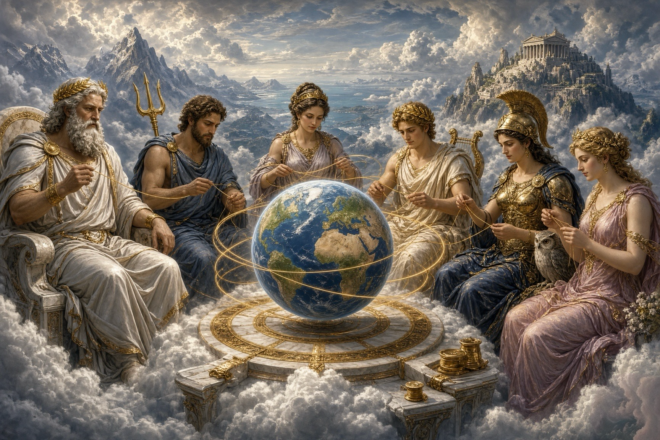
Across every inhabited continent, and across millennia of written and oral tradition, human beings have returned with remarkable consistency to a single recognition: life is brief, the body is subject to decay, and the visible world is in constant flux. The recognition appears in banquet songs, ruin poems, death songs, quatrains, sonnets and Buddhist verses. It is not merely a literary motif. It arises from the same human capacity that has produced, with near-universality, the conviction that persons are more than the physical organisms they temporarily inhabit. The poems that measure the shortness of life and the anthropological record of soul-beliefs, taken together, form a continuous thread, physical and spiritual at once, that runs through the cultures of humanity. I call it the golden thread, and what follows traces it from the Nile to the Thames.
The Harper and the Tomb
In ancient Egypt the tension was already explicit. The Harper’s Songs that accompanied banquets urged the living to enjoy the day, while the tomb and its offerings stood as a constant reminder that the physical span is limited. A funerary monument and a drinking song might seem opposites, one solemn and one festive, yet they are the same sentence spoken in two registers. Egyptian religion also treated the person as composite. The ka, the vital double, could remain near the body and be sustained by offerings, while the ba, the mobile spiritual aspect, could travel out of the tomb and return to it. The body would dissolve, but other elements of the person were understood to continue, and the elaborate funerary cults were in effect a vast and costly project to keep those elements supplied and connected.
What strikes me is the logic that joins the banquet to the tomb. The physical is real and precious precisely because it is temporary, and the human response to that fact includes preparation for what is not purely physical. Enjoy the wine and build the tomb: both are answers to a single recognition, and the Egyptians held them together without any apparent sense of contradiction some four thousand years ago. Every later poem in this essay is, in one way or another, a variation on that pairing.
Horace and the Envy of Time
In classical Rome the same awareness was distilled into lyric form. In Odes I.11 Horace addresses a young woman named Leuconoe and tells her not to ask, because it is forbidden to know, what end the gods have granted to her or to him, and not to consult the Babylonian calculations of the astrologers. It is far better, he says, to endure whatever comes, whether Jupiter has allotted more winters or this one is the last. Time, he adds, is envious and has already fled while we speak, so seize the day, trusting as little as possible in the next. Carpe diem has been worn so smooth by posters and coffee mugs that it is easy to forget what the poem actually says. It is not a counsel of mere appetite. It is advice from a man who has accepted that human knowledge has limits and human time has a term.
The practical instruction to strain the wine and cut back long hope to a short span is framed by reference to the gods who allot the years. Time is personified as envious, and the day must be seized precisely because it does not sustain itself. The physical life is finite, and the orientation of the poem is toward a larger order that includes divine will and the boundaries of what mortals may know. Horace was no mystic, and he is openly impatient with astrologers and false certainties, but even his scepticism takes place inside a cosmos larger than the body. The poem asks Leuconoe to live well within limits she did not set and cannot see past, which is a spiritual posture as much as a prudential one.
Ruins, Grasses and the Mind That Notices
In Tang China, Du Fu, the same poet who watched the army carts roll out, stood among the ruins of the Jade Flower Palace and recorded the pathos of vanished glory. The stream still swirls and the wind still moans in the pines, but grey rats run over broken tiles where a prince once held his court. The dancing girls have become yellow dust, their painted cheeks crumbled away, and of all that magnificence only a stone horse remains. Then comes the turn that lifts the poem above description: the poet sits on the grass and begins to write, and the pathos of it overcomes him. The physical decay is meticulously observed, but the act of composition is itself a spiritual response. Du Fu measures the ruins against human aspiration and finds the measurement worth recording, and in doing so he does something that no rat and no roof tile can do.
Centuries later in Japan, Matsuo Bashō compressed a comparable insight into a single haiku, written, in the tradition’s account, on the site where warriors had once fought and fallen. Summer grasses now cover the ground, and they are all that remains of the warriors’ dreams. The grasses are purely physical and purely seasonal. The dreams they have outlasted belong to a dimension of memory, ambition and meaning that grass cannot contain. The brevity of the form mirrors the brevity of the lives it commemorates, while the act of noticing and naming that brevity is a distinctly human and reflective gesture.
It is worth pausing on the fact that both of these poems are about the aftermath of war as much as about time. Neither poet doubts that the dreams of the soldiers and princes were real. Both register their disappearance as a loss, and neither finds any consolation in the glory that was supposed to justify the dying. That, I think, is why they sit so naturally beside the army carts: the same mind that sees a ruin as a ruin sees a conscript as a person.
The Caravan and the Potter’s Bowl
In Persia, Omar Khayyam returned again and again to the image of life as a caravan that passes strangely fast. The quatrains urge us to take the moment that passes in joy, to leave tomorrow’s grief unconsumed, and to bring the cup, because the night is already going. A caution is due here: scholars have long debated which of the many quatrains attributed to Khayyam he actually wrote, and the tradition that bears his name is in part a collective creation. That is no obstacle to the argument, since what matters is the shape of the recognition that the tradition preserved and that readers across centuries found true. Those who take the verses as simple tavern cheer miss how much they cannot stop asking. The call to present enjoyment is inseparable from questions of fate, the limits of the intellect and the mystery of what lies beyond the visible world. Wine and the moment are physical, but the questions that crowd around them treat the human being as oriented toward more than biological duration.
In the Buddhist literature of India the theme is stated with didactic force. A well-known verse in the early collections compares human life to a potter’s vessel: just as an earthen bowl made by a potter ends in breaking, so does the life of every mortal. Another declares that conditioned things are by nature impermanent, subject to arising and decay, and that happiness lies in bringing them to rest. These are not merely observations about biology. They are instruments for a spiritual practice aimed at liberation from the cycle of arising and ceasing. The physical body is taken seriously so that it may be seen through, or transcended. The same literature warns repeatedly that even the young die, that days and nights consume a life the way shallow streams run dry, and that trust in the continuity of the body is misplaced. The recognition of physical impermanence is the starting point of a path, and the path is understood as spiritual.
Sand Creek and the Great Cold
Indigenous oral traditions offer equally direct expressions. At Sand Creek in 1864, as soldiers advanced on a Cheyenne and Arapaho camp that believed itself under the protection of the United States, the chief White Antelope is reported to have stood and sung as they came: nothing lives long, only the earth and the mountains. As with any reported oral material, the exact wording should be held loosely, but the song is consistent with a much wider tradition. It acknowledges the extreme brevity of human life while affirming the relative permanence of the earth itself, an affirmation that places the individual within a larger and enduring order that is both physical and sacred. That the words were sung in the middle of a massacre makes it impossible to read them as a mere consoling sentiment. They are a declaration of relationship, made at the last moment available. Many Native American death songs treat dying as an occasion for the spirit to state its place in what endures. The body falls; the song continues as an offering.
Across large parts of Africa, traditional proverbs and dirges likewise speak of life as mist, as a brief sojourn, or as subject to the great cold, while funeral practices and ancestral cults treat the dead as continuing members of the community. The body is returned to the earth, but the person is not thereby reduced to silence. The living continue to address, feed or consult the ancestors, which indicates a conviction that relationship does not end with the cessation of breath. It would be a mistake to flatten a continent of many thousands of languages and cultures into a single belief, and I do not claim that the practices are identical. The claim is narrower and, I think, safer: that in very different places people have treated the dead as present in ways that only make sense if the person was never identical with the body.
Sonnet 73 and the Deepening of Love
In the English tradition the theme remains vivid and personal. Shakespeare’s Sonnet 73 presents the ageing speaker through three successive images: late autumn with its bare and shivering boughs, the twilight that fades in the west, and a dying fire glowing on the ashes of its own youth. Then the closing couplet turns the whole poem toward the listener:
This thou perceiv’st, which makes thy love more strong,
To love that well which thou must leave ere long.
The physical decline is real and closely observed, yet the response it draws out is an intensification of a bond that is not itself physical. The perception of impending loss deepens rather than diminishes the value of what is still present. Later poets continue the same work. Robert Frost’s “Nothing Gold Can Stay” measures the earliest green against the inevitable fall, and countless modern meditations on mortality set the perishable beside whatever the speaker believes will last. Sonnet 73 gives the old Egyptian logic its most tender form: because the body is leaving, love is not to be postponed.
What the Anthropologists Found
These literary expressions belong to a broader pattern documented by anthropology. Surveys of hunter-gatherer societies reconstruct animism, the attribution of spiritual essence or agency to persons, animals and often places, as among the oldest recoverable religious traits. Belief in some form of afterlife follows closely in the reconstructed sequence. Many cultures elaborate dual or multiple souls: one aspect bound to the body’s vitality and breath, which dissipates or lingers near the corpse, and another, freer aspect, capable of travelling in dreams or of continued existence after death. The Egyptian ka and ba are one example and the Chinese distinction between hun and po another, with comparable distinctions in Siberian, Native American, African and Austronesian traditions. The very vocabulary of spirit in many languages is tied to breath or wind, from the Latin spiritus and the Greek psyche to the Sanskrit atman and the Hebrew ruah, and to numerous indigenous terms besides. In each case the animating principle is named as something real yet not identical with flesh.
Cognitive research adds a further layer. Studies have suggested that an intuitive sense that minds can be separated from bodies appears early in human development and across cultural settings, even though the elaborations differ and some modern secular contexts favour more materialist intuitions. The near-universality of funerary rites that treat the dead as somehow still present, the global occurrence of ancestor veneration, and the human habit of addressing the unseen all point in the same direction. Religion itself, understood as belief in supernatural agents and the practices that follow from it, appears to be unique to humans and is present in virtually all known societies.
What This Does Not Prove
None of this constitutes proof of any particular metaphysical doctrine, and intellectual honesty requires me to say so plainly. Cultural details vary widely. Some traditions emphasise multiple souls with different destinies, some a single enduring self, some temporary shades, some absorption into a greater whole. Philosophical and scientific accounts that treat consciousness as wholly emergent from physical processes exist, and they must be taken seriously. Some modern studies of afterlife intuitions find more materialist responses than earlier theories of universal intuitive dualism would have predicted, which means the claim of a universal intuition has to be stated with care.
The strongest objection deserves its full weight. A sceptic can say that the poems show only that humans fear death and tell themselves stories to soften it, that the shared vocabulary of breath reflects nothing more than the observation that the dying stop breathing, and that the dimension I keep gesturing toward is a projection of the brain onto a world that does not contain it. The anthropological record cannot refute that account, and I do not think it is foolish. It may well explain how the intuition arises.
Yet the recurring human pattern remains striking, and it does not depend on the sceptic losing the argument. People experience themselves as subject to the laws of the physical world, in ageing, illness and death, and at the same moment as beings capable of reflecting on that condition, of addressing gods or ancestors, of seeking a liberation or a meaning that the body alone cannot supply, and of making poems that treat physical life as both real and incomplete. Whatever the ultimate explanation, that double self-understanding is a fact about human beings, as well documented as any other. It is the fact that the poets and the anthropologists are, from different directions, describing.
The Thread and the Drums
The poems and the anthropological evidence therefore illuminate one another. The capacity to notice that nothing lives long, and to answer that notice with song, ritual, disciplined reflection or the composition of a poem, is itself evidence of a dimension of human existence not exhausted by the perishable body. That dual recognition, physical and spiritual together, is the golden thread. It does not erase the differences of language, landscape or creed. It runs through them, binding the Egyptian harper preparing for the tomb, the Roman poet urging the seizure of the day, the Chinese poet among ruins, the Japanese traveller looking at summer grasses, the Persian sage watching the caravan pass, the Buddhist teacher comparing life to a potter’s vessel, the Cheyenne chief singing that only the earth and mountains last, the African mourner addressing the ancestors, and the English sonneteer finding love deepened by the approach of loss.
I began with war, so I should end by saying what the thread does and does not do about it. It does not prevent war. Du Fu knew that. Horace wrote under an empire that made war its business, and the singer at Sand Creek was killed by people who, in their own churches, believed in souls. A shared recognition of mortality has never by itself been sufficient to stop one human being from killing another, and I would be insulting the dead of every war if I pretended otherwise.
What the thread does offer is a standard against which war can be measured, and a reason for diplomacy that is more than sentiment. War depends on a particular act of reduction: the enemy must be seen as only a body, a target, a number, something that can be removed without remainder. Every poem in this essay refuses that reduction. The conscript on the road to the frontier, the warrior whose dreams are now summer grass, and the soldier on the other side of the line all carry both the failing body and the something more that the poets saw. They have ancestors who would have sung for them and a mother who will address their absence for the rest of her life. Diplomacy, understood properly, is not the naive belief that all disputes will dissolve into agreement. It is the discipline of remembering, in the room where the decisions are made, that the people on the other side are also both.
That is why I wanted to set this beside yesterday’s remembrance of the army carts. We mourn the dead of war because we recognise in them more than the bodies that were lost, and the poets of every continent have said the same of all of us. Life is brief, real and precious, and the human response to that fact has always been to reach beyond it, in song, in ritual, in love. The thread is the shared recognition that we are both, and if we kept hold of it, a good deal fewer drums would be beaten.
– – –
Bakchos is the founder of Blak and Black, an Australian media and advocacy platform established in 2010. Bakchos writes from the intersecting perspectives of Wiradjuri heritage, Jewish identity, and humanism.
© Bakchos, November 2026
BLAK AND BLACK | MEDIA AND ADVOCACY | EST. 2010