
I. The Boys Who Were Sent
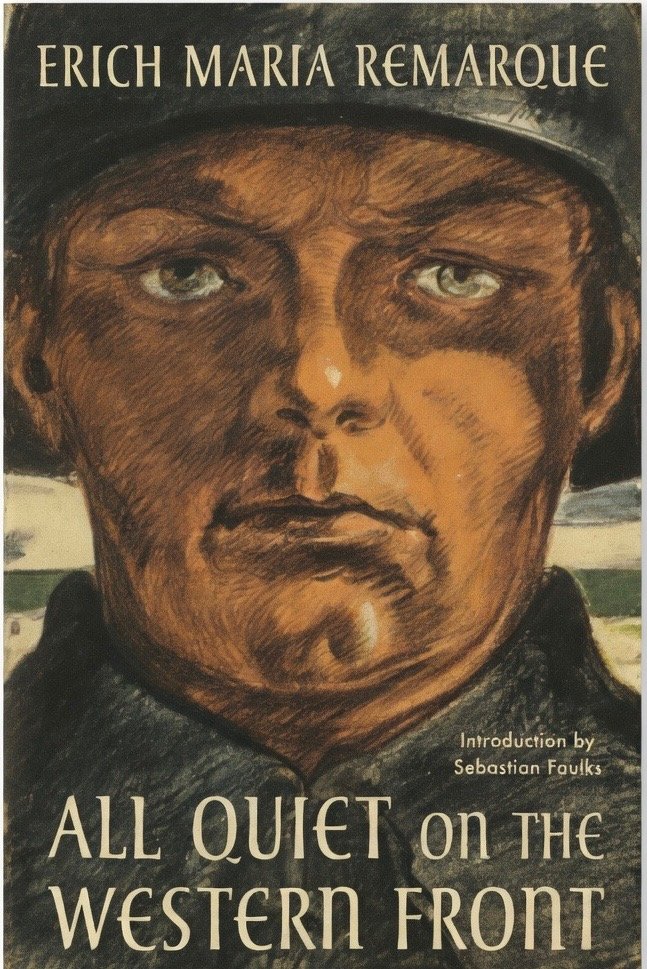
In 1929, Erich Maria Remarque published All Quiet on the Western Front, a novel so devastating in its honesty that the Nazi regime burned it publicly four years later. The burning was, in its own way, a tribute. Remarque had written something that could not be tolerated by those who needed young men to believe that dying for a nation was glorious. His novel was not a polemic or a manifesto. It was something far more dangerous: a precise, merciless account of what war actually does to the bodies and minds of the young.
The protagonist, Paul Baumer, enlists with his classmates at the age of eighteen or nineteen, urged on by their schoolmaster Kantorek, who speaks with the full confidence of a man who will not be going. This dynamic — the older generation sending the younger to die while remaining safely at a distance — is the novel’s central indictment, and it remains as relevant today as it was in 1914. Kantorek calls them the Iron Youth. Paul and his comrades learn quickly that iron is what kills you, not what you are made of.
What Remarque captures with such precision is not the heroism of war but the systematic destruction of a generation’s capacity for ordinary life. Paul comes home on leave and finds he cannot speak to his family. He sits in his boyhood room surrounded by his old books and feels nothing but absence. The war has not made him a man in any meaningful sense. It has made him a creature adapted to survival in conditions that have no civilian equivalent. He knows how to sleep in mud, how to identify the sound of different shells, how to watch a friend die. He does not know how to have a conversation about the future, because the concept of a future has been surgically removed.
This is the waste Remarque is documenting: not just the bodies, though there are many of those, but the inner lives, the possibilities, the entire architecture of who these young men might have become. His friend Kemmerich dies early in the novel, and Paul watches his boots get passed from soldier to soldier as each owner is killed. The boots outlast everyone. Objects persist. Youth does not.
II. The Mythology of Heroism
The novel is, among other things, a systematic dismantling of the heroic ideal. Remarque does not write heroes. He writes young men who are hungry, frightened, lousy with lice, and desperately trying to stay alive long enough to eat something warm. The acts of courage that appear in the novel are almost always acts of desperate self-preservation or loyalty to friends, entirely devoid of the nationalist grandeur that the Kantoreks of the world require for their recruitment speeches.
Heroism, as Remarque presents it, is a lie told by those in safety to those in danger. It is the vocabulary of distance. The closer you get to the actual fighting, the less the word means. Kat, the older soldier who becomes something of a father figure to Paul, possesses the only wisdom the novel endorses: practical, animal, concerned entirely with food and survival and the small comforts that keep a man sane. He does not speak of glory. Nobody who has seen the field hospital does.
Remarque reserves particular contempt for the performance of heroism — the parades, the speeches, the men behind desks deciding where the lines should be drawn. There is a scene in which Paul encounters his old headmaster back home, surrounded by men of the same generation, debating grand strategy over beer. They have opinions about which territories should be seized, which tactical approaches are most effective. Paul listens and feels an alienation so complete it borders on nausea. These men are playing a game with other people’s deaths and calling it patriotism.
This is the stupidity of heroism that the novel identifies and refuses to excuse: not the courage of the individual soldier, which Remarque treats with compassion, but the institutional and cultural machinery that converts that courage into a resource for old men’s ambitions. The heroic ideal does not merely send boys to die. It ensures they go willingly, even gratefully, having been taught that this is what it means to be a man, to be a citizen, to matter.
Paul’s generation were, as he puts it, cut off from life at eighteen and given death as a vocation. Those who survive the war are not spared. They are simply destroyed more slowly. They have learned a set of skills that have no peacetime use and unlearned the capacity for hope that peacetime requires. Heroism promised them meaning. What they received instead was a landscape of craters and the faces of men they watched die.
III. The Shadow Over Iran
The relevance of Remarque’s vision does not require much stretching to reach the present. In 2026, the prospect of a ground conflict involving Iran has moved from theoretical to increasingly discussed in strategic and political circles. The language surrounding it is already familiar: deterrence, surgical strikes, the axis of instability, existential threats. These are the modern equivalents of the Iron Youth — abstractions designed to make the incomprehensible seem manageable, and to make the sending of young people into danger seem like a rational policy option rather than a catastrophe in preparation.
Iran is not a small or fragile state. It has a population of nearly ninety million, a mountainous and complex terrain, a deeply embedded military and paramilitary infrastructure in the form of the Islamic Revolutionary Guard Corps, and decades of experience in asymmetric and proxy warfare. Military analysts who have studied the prospect of a ground engagement consistently arrive at the same conclusion: the entry point is far easier to identify than the exit. What would boots on the ground actually mean in that context? It would mean young men, most of them from working-class backgrounds, most of them in their late teens and early twenties, placed inside a conflict with no clear terminus and objectives that would shift with every week of resistance.
The political class that would make such a decision is largely composed of people who will not be in those boots. This is not an accusation unique to any particular country or administration — it is a structural feature of how modern democracies wage war. The decision-makers are insulated from the consequences by age, class, and geography. The Kantoreks are still at their desks, still talking about iron youth, still convinced that the right framing will make the enterprise seem worthwhile.
What Remarque’s novel insists upon, with a force that has not diminished in nearly a century, is that the distance between the rhetoric of war and its reality is not a gap that can be closed by better speechwriting. It is an ontological chasm. The young soldier in the trench — or the FOB, or the urban patrol — inhabits a reality that the decision-maker cannot access from a situation room. And when that soldier returns, if they return, they bring that reality back with them into a world that has no framework for it. The rates of suicide, addiction, and psychological disorder among veterans of the Iraq and Afghanistan campaigns are not anomalies. They are the predictable consequence of sending people into conditions that deform the psyche and then returning them to a society that wants to call them heroes rather than casualties.
A ground war with Iran would not be Iraq or Afghanistan. It would likely be worse in scale, more complex in its regional implications, and harder to extract from politically. The young people who would fight it deserve, at minimum, the honesty that Remarque tried to provide in 1929: that glory is a word used by people who are not going, and that the gap between the recruiting poster and the field hospital is the distance between a lie and the truth.
IV. Ukraine and the Mathematics of Slaughter
The war in Ukraine, now grinding into its fifth year, has provided the twenty-first century with its own Remarque landscape. The numbers themselves carry a kind of horror that resists easy comprehension. Estimates of combined casualties run into the hundreds of thousands. The front lines have, at various points, moved by miles over the course of months, each mile purchased at a cost that defies any rational strategic calculus. Young Ukrainian men have been mobilised into a war they did not choose against an invasion they did not invite, and young Russian men have been sent — many of them from the most economically marginalised regions of a vast country — to die on foreign soil for objectives that have shifted and contradicted themselves with each passing season.
What makes the Ukraine war particularly Remarquian is the combination of industrial-scale attrition and the intimate, grinding misery of trench warfare. Drone technology has added a new dimension of impersonal killing, but the fundamental experience of the infantryman on that front — cold, exhausted, watching friends die, uncertain of the strategic purpose of the next hundred metres — is not so different from what Paul Baumer described on the Western Front. The machinery has changed. The human cost has not.
The mindlessness of the slaughter lies not in any lack of intelligence or intention on the part of those who direct it, but in the structural logic of attrition warfare, which tends toward a kind of arithmetic brutality: you kill enough of them, and they stop. The problem is that ‘enough’ keeps moving, and the people doing the dying are not the people doing the arithmetic. Commanders and political leaders can absorb casualties as data points. The soldiers absorb them as the deaths of people they knew.
Remarque understood this distinction with terrible clarity. His novel contains no villains in the conventional sense — no sadistic commanders, no cackling enemies. What it contains instead is a system, a vast and impersonal machine that processes human beings and returns corpses and psychological wreckage. The individuals within the system are not evil. They are compliant, or frightened, or convinced, or simply caught. The evil, if that is the right word, is structural. It lives in the gap between the people who decide and the people who die.
In Ukraine, that gap is visible daily. Western capitals debate the merits of various weapons packages, the legal frameworks for their deployment, the diplomatic implications of various forms of support. On the front line, a twenty-two-year-old from Kharkiv tries to stay alive through another night of artillery. The debate in the capitals is not cynical or malicious — most of it is conducted in genuine good faith by people who believe Ukraine’s cause is just. But it is conducted at a distance that the young soldier cannot afford. He does not have the luxury of abstraction.
V. What the Novel Still Knows
All Quiet on the Western Front endures not because it is a great anti-war novel in the polemical sense, but because it is a great novel about experience — specifically about the experience of young people placed in conditions designed by older people, and the irreversible damage that results. Remarque is not naive about the causes of wars or the occasional necessity of resistance. He is clear-eyed about what war costs at the human level, and about the tendency of societies to obscure that cost behind language designed to make it bearable.
The novel’s final image — Paul dying on a quiet day, almost by accident, when the official reports will later record that all is quiet on the Western Front — is a masterpiece of irony. The machinery of war is so vast and so indifferent that one more death barely registers. The quiet is the quiet of a system that has consumed him and moved on. The irony of the title is that quiet is the condition of his death, not the condition of anything that led to it.
As the twenty-first century generates its own versions of Remarque’s landscape — in the ruins of Mariupol, in the prospect of a Middle Eastern ground war, in the continuing return of veterans from a dozen smaller conflicts that barely register in the news cycle — the novel’s insistence on the individual human cost of political and military decisions remains its primary moral contribution. It refuses the comfort of abstraction. It insists that the casualty figures are not numbers but people, each of them a Paul Baumer, each of them someone who should still be here.
The stupidity of heroism, in Remarque’s accounting, is not the stupidity of courage. Courage is real and sometimes necessary and often genuinely moving. The stupidity is the institutional capture of courage by ideology — the conversion of a young person’s willingness to sacrifice into a resource for old men’s projects, sold back to them as glory, and redeemable only in the currency of their own destruction.
Nothing in the century since the novel’s publication has made this observation obsolete. If anything, the sophistication of the machinery — the precision of the weapons, the granularity of the intelligence, the slickness of the information operations — has made the underlying dynamic harder to see. But it is still there. The Kantoreks are still at their desks. The iron youth are still being told what they are made of. And somewhere, always, a pair of boots is being passed from one dead soldier to the next.


Trump is a draft dodger and a coward. Everything about him is stolen in one way or another. No doubt, the war with Iran will result in him stealing someone else’s valour.
We’re all marching off to war again, marching to the drum beat of billionaires and weapons manufacturers. How nice, the billionaires and CEOs sit comfortably behind their mahogany desks while others march and die to fatten the balance sheets of the billionaires and CEOs.
How many times is Trump’s MAGA base going to allow him to betray them, before they respond? How many times is America going to allow Israel to drag them into another war before they respond?
While our youth are fighting and dying in foreign lands, the real war is being ignored. The real war is the 1% versus humanity!
So much for Trump campaigning on no more wars. How many countries has Trump bombed since he became president the second time? Trump is a dangerous man.
Trump is a conman Ana a warmonger. Say no more.
Trump is dragging the world into a nuclear holocaust known as WWIII. This is what MAGA voted for.
The drums of war are so loud they’re now almost deafening. Australia needs to keep Trump’s latest Middle East venture. It’s none of our business.
War is coming and everyone on the planet is going to pay the price for Trump’s staring role in the Epstein files.
The body bags came home two by two
The body bags came home two by two
Hoorah! Hoorah!
The longer I live, the more convinced I become. There is never an excuse for offensive war. Who is really driving and profiting from the war on Iran? A handful of billionaires, that’s it.