
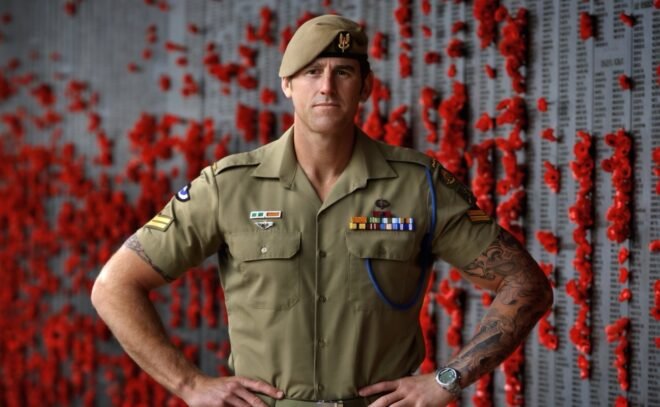
I. THE ICONOGRAPHY OF THE UNTOUCHABLE
On the morning of 7 April 2026, Australian Federal Police officers arrested Ben Roberts-Smith at Sydney Airport. He was formally charged with five counts of war crime – murder under section 268.70(1) of the Criminal Code Act 1995 (Cth), each carrying a maximum penalty of life imprisonment. The charges relate to the alleged killing of five unarmed Afghans across two separate incidents: at Kakarak in Uruzgan Province on 12 April 2009, and at Darwan in Uruzgan Province on 11 September 2012. AFP Commissioner Krissy Barrett confirmed at a press conference that it would be alleged the victims were not taking part in hostilities at the time of their murder, and that they were shot either by the accused directly or by subordinates acting on his orders and in his presence. It was, by any measure, a historic moment. Roberts-Smith had been, not long before, the most decorated living Australian soldier: a Victoria Cross recipient, a boardroom presence backed by one of the country’s wealthiest media proprietors, a man whose portrait hung in the Australian War Memorial alongside an account of his supposed gallantry in Afghanistan. The distance between that iconography and an arrest at an airport departure gate is the distance this essay proposes to measure – not simply as biography, but as a diagnostic of how Australian democratic institutions manage, or mismanage, the accountability of those who act in the nation’s name.
The Roberts-Smith case is not only a story about one soldier’s alleged crimes. It is a story about the structure of impunity: the networks of power, patronage, and institutional inertia that can insulate an individual from accountability long after the facts of his conduct have been established to legal satisfaction. It is, simultaneously, a story about the rule of law’s resilience – about journalists, judges, and specialist investigators who, eventually, refused to let the matter rest. To understand what his arrest means, it is necessary to understand the long road that preceded it.
II. AFGHANISTAN AND THE BRERETON REPORT: A CULTURE OF UNLAWFUL KILLING
Australia’s engagement in Afghanistan from 2001 to 2021 was, by official account, a contribution to international security and the protection of civilian populations from Taliban rule. In practice, the conduct of elements of the Australian Special Air Service Regiment (SASR) during that engagement told a different story – one that the Inspector-General of the Australian Defence Force, Major General Paul Brereton, spent four years documenting.
The Brereton Report, released in heavily redacted form in November 2020, found credible evidence of 39 unlawful killings of Afghan nationals, perpetrated or participated in by 25 current or former Australian soldiers. The report described a subculture of “blooding” – the practice of requiring newly deployed soldiers to kill prisoners to prove themselves – and documented systematic trophy-taking, casual brutality, and the silencing of those within the special forces community who objected. The findings were shocking to the Australian public, not least because they required the dismantling of a carefully constructed national mythology: that Australian soldiers fight with honour, that the digger tradition demands adherence to the laws of armed conflict, and that mateship and integrity are the ADF’s foundational institutional values.
Within that broader reckoning, the allegations against Roberts-Smith were among the most serious. Investigative journalists Chris Masters and Nick McKenzie, working for Nine newspapers – the Sydney Morning Herald, The Age, and the Canberra Times – had been investigating his conduct since at least 2017. Their reporting alleged that Roberts-Smith had, during his deployments in 2009 and 2012, committed multiple murders of unarmed Afghan civilians and prisoners; that he had kicked an unarmed man from a cliff before ordering his execution; that he had pressured a junior soldier to kill an elderly, unarmed man in order to “blood” him; that he had directed the execution by machine gun of a man with a prosthetic leg; and that the prosthetic limb was subsequently appropriated as a novelty drinking vessel at the special forces’ base bar, known as the Fat Ladies’ Arms. These were not peripheral allegations. They described a pattern of conduct that, if proven, amounted to deliberate war crimes of a premeditated and sadistic character.
III. THE DEFAMATION TRIAL: TRUTH AS A DEFENCE
Roberts-Smith’s response to this journalism was to sue. In August 2018, he commenced defamation proceedings against the three newspapers, seeking vindication of his reputation and, implicitly, the suppression of the reporting. It was a bold gambit, and for a time it appeared well-resourced. Kerry Stokes, the billionaire owner of Channel Seven – for whom Roberts-Smith worked as a senior executive – reportedly financed the legal action. The plaintiff brought the full weight of private wealth and reputational capital to bear against allegations he characterised as fabrications by disgruntled former comrades.
The defendants chose to plead substantial truth. Under Australian defamation law, establishing that the imputations in the published articles were substantially true constitutes a complete defence. The newspapers would therefore need to prove, on the balance of probabilities, that Roberts-Smith had done what they alleged. This produced a paradox of legal procedure: the most consequential examination of alleged Australian war crimes to that point occurred not in a criminal court, but in a civil one – and was initiated not by the state but by the accused himself.
The trial, running for 110 sitting days before Justice Anthony Besanko of the Federal Court of Australia, became a forensic examination of the Afghan deployments. Witnesses included multiple SASR soldiers – men who had served alongside Roberts-Smith and who, at considerable personal and professional cost, gave evidence against him. Afghan witnesses also testified. Roberts-Smith gave evidence under oath. The proceedings were, by any standard, an extensive and adversarial testing of the factual record.
On 1 June 2023, Justice Besanko delivered his judgment. He dismissed the defamation case in its entirety. More significantly, he found on the balance of probabilities that Roberts-Smith had been responsible for or complicit in four unlawful killings. Besanko J concluded that he had “difficulty accepting the applicant’s evidence on any disputed issue” and stated plainly that Roberts-Smith had “disgraced his country.” The judgment further found that he had lied to the court and colluded with witnesses – a finding that compounded the gravity of the primary conclusions.
The appeal to the Full Court of the Federal Court, heard over ten days beginning in February 2024, was unanimously dismissed in May 2025. On 4 September 2025, the High Court of Australia refused an application for special leave to appeal and ordered Roberts-Smith to pay the defendants’ costs. All avenues of civil appellate relief were exhausted. The civil finding that he had murdered four unarmed Afghans was, at that point, as settled as Australian law could make it.
IV. THE KEELTY DISCLOSURE: WHEN THE SYSTEM PROTECTS ITS OWN
Between the journalism of 2017 and the arrest of 2026, a critical episode illuminates the structural vulnerabilities of accountability systems when they encounter powerful and well-connected subjects. In November 2018, the Australian Federal Police announced it had received referrals to investigate allegations of war crimes committed by Australian soldiers. A covert operation targeting Roberts-Smith was commenced shortly thereafter.
What followed was an episode that should disturb anyone committed to the rule of law. Mick Keelty, a former AFP Commissioner, informed Roberts-Smith – days after the covert operation commenced – that the AFP had received referrals regarding his alleged conduct. The disclosure was not an act of neutral information-sharing. Roberts-Smith subsequently began using burner phones, a response consistent with a person seeking to obstruct or circumvent a covert investigation. The operational integrity of the AFP’s inquiry was directly compromised by the intervention.
The Keelty disclosure raises questions that go beyond individual misconduct. Keelty’s career had made him one of the most senior figures in Australian law enforcement history. His access to Roberts-Smith – and his apparent willingness to share intelligence about a covert investigation with its subject – speaks to the informal networks that can operate alongside, and sometimes against, the formal mechanisms of state accountability. In a democratic system governed by the rule of law, investigations into alleged serious crimes are not meant to be subject to the intercession of former officials acting in ways that advantage the investigated party. That this happened, and that it apparently went unaddressed for years, is itself an indictment – of the networks of power and loyalty that can operate within and adjacent to official institutions, and of the insufficient scrutiny applied to such interventions when the subject is a celebrated figure.
The practical consequences of the Keelty disclosure were significant and lasting. Evidence may have been destroyed. Witnesses may have been approached. The chill cast over any witness willing to speak to investigators was intensified by the knowledge that the investigation’s existence had been communicated to its subject. The AFP’s eventual referral of briefs of evidence to the Commonwealth Director of Public Prosecutions in 2020 – and the DPP’s apparent inaction for years thereafter – became increasingly difficult to explain without reference to the political and institutional pressures operating around a case of this sensitivity and public profile.
V. THE INVERSION OF JUSTICE: MCBRIDE AND ROBERTS-SMITH
No analysis of the Roberts-Smith case can be complete without confronting the parallel case of David McBride. McBride, a former Australian Army lawyer, leaked classified documents about the conduct of Australian troops in Afghanistan to the ABC in 2016. Those disclosures contributed directly to the investigative journalism that eventually produced the Brereton Report and the prosecutions now before the courts. McBride acted, at significant personal and professional risk, in what he understood to be the public interest and in service of the principle that the laws of armed conflict apply to Australian soldiers regardless of the operational context in which they find themselves.
The Commonwealth’s response was to prosecute him. While the AFP received war crimes referrals and sat on them, while the DPP allowed years to pass without charging Roberts-Smith, the prosecutorial machinery of the state moved with notable alacrity against the man who exposed the crimes. McBride was convicted and sentenced to five years and eight months imprisonment. He was incarcerated. The whistleblower went to prison; the alleged war criminal remained at liberty, wearing his Victoria Cross at ANZAC Day dawn services, his uniform displayed in the Australian War Memorial alongside an account of his “gallantry” in Afghanistan.
This inversion is not merely a moral affront. It is a structural statement about how the Australian state, at a particular moment in its institutional history, prioritised the protection of official secrecy over the accountability of those who exercise lethal force in its name. The rule of law is not simply a procedural arrangement – it is a substantive commitment to the principle that no one stands above its requirements, and that its processes will be applied consistently regardless of the power or prestige of those affected. The McBride-Roberts-Smith contrast reveals the degree to which that commitment can be honoured in rhetoric while being violated in practice: the state protecting the secrecy that conceals crimes rather than the accountability that exposes them.
Hannah Arendt observed that the most terrifying aspects of political violence are not its dramatic moments, but its bureaucratic normalisation – the way in which systems of accountability come to protect their own perpetrators while punishing those who reveal them. The prosecution of McBride and the decade-long deferral of charges against Roberts-Smith is a modest but telling illustration of this dynamic within a liberal democracy that considers itself committed to the laws of armed conflict and the principles of democratic accountability. The two cases together constitute a mirror in which Australian governance can examine itself – if it has the institutional courage to do so.
VI. THE OFFICE OF SPECIAL INVESTIGATOR AND THE ARCHITECTURE OF ACCOUNTABILITY
The arrest of Roberts-Smith on 7 April 2026 is, in significant part, the product of deliberate institutional design. The Office of Special Investigator (OSI) was established in 2020 – in the immediate wake of the Brereton Report – as a specialist body with the mandate to investigate and, where the evidence warranted, prosecute potential Australian war crimes committed in Afghanistan. Its creation represented a belated but genuine recognition that the existing prosecutorial architecture – designed neither for the evidentiary complexity nor the political sensitivity of war crimes cases – was inadequate to the task that the Brereton findings demanded.
The OSI had already demonstrated its operational seriousness before the Roberts-Smith arrest. In March 2023, it charged former SAS soldier Oliver Schulz with war crime murder over the shooting of an unarmed Afghan man in a wheat field in Uruzgan Province in 2012 – the first time in Australian history that a serving or former member of the armed forces had faced such a charge. Schulz, who has pleaded not guilty, is due to face trial in February 2027. Roberts-Smith is therefore the second Australian Afghanistan veteran to be criminally charged with war crime murder. AFP Commissioner Barrett stated at the press conference announcing the arrest that the joint OSI-AFP investigation had commenced 53 investigations involving allegations of war crimes by ADF members in Afghanistan, with ten still ongoing, adding that if the evidence led to other people needing to be charged, ‘you can be assured that will happen.’ That statement carries considerable weight. The Roberts-Smith charges are a significant landmark, but they are not the end of the accountability reckoning the Brereton Report set in motion.
The Roberts-Smith prosecution represents a qualitatively different challenge. The evidentiary record from the defamation trial is extensive and now a matter of public record. Multiple SASR soldiers gave testimony against Roberts-Smith under oath, and their evidence – subject to the qualification that some of it was given under statutory certificates limiting its direct use in subsequent criminal proceedings against those witnesses – established a detailed factual basis for the alleged killings. The criminal standard, however, is proof beyond reasonable doubt: substantially more demanding than the civil balance of probabilities. That two courts, and ultimately the High Court, found the civil standard satisfied does not mean criminal conviction is assured. The OSI and the AFP will need to construct a criminal case that meets a higher threshold, and to do so in circumstances where the prior proceedings have shaped the available evidence in complex ways.
This is as it should be. The principle that criminal law demands the highest standard of proof before it deprives a person of liberty is not a technicality or a loophole – it is a foundational protection of individual rights within a democratic polity governed by the rule of law. Roberts-Smith is entitled to the presumption of innocence, to a fair trial, and to the full protections that criminal procedure affords any accused. The significance of his arrest does not depend on the certainty of his conviction. It depends on the fact that the rule of law is, at last, being applied to him as it is applied to others – without deference to his decorations, his connections, or his prior capacity to mobilise private wealth in his defence.
VII. DEMOCRATIC ACCOUNTABILITY AND THE LIMITS OF THE HERO MYTH
The Roberts-Smith case invites reflection on a broader pathology in the governance of military institutions within liberal democracies: the hero myth and its corrosive effects on accountability. The hero myth operates by constructing certain individuals – decorated soldiers, celebrated commanders, figures of public veneration – as standing outside the ordinary calculus of moral and legal scrutiny. Their valour is taken to redeem their conduct; their decorations are treated as a kind of immunity. The Victoria Cross, in this reading, becomes not merely a recognition of gallantry, but a form of sovereign exemption from the laws that govern lesser men.
The Brereton Report was, in part, a document about what happens when this mythology is institutionalised within a military subculture. The report’s findings about a culture of unlawful killing within SASR units were not incidental departures from an otherwise honourable record – isolated aberrations produced by the fog of war. They were, the inquiry suggested, the product of a subculture in which impunity had become normalised: in which the licence to kill that combat operations necessarily confer had expanded, in the absence of adequate accountability, to encompass killings that no interpretation of the laws of armed conflict could authorise.
Democratic accountability over military force is one of the oldest and most fundamental requirements of constitutional government. The power to deploy lethal force in the name of the state is the most consequential power that democratic governance can exercise. It demands, precisely for that reason, the most rigorous systems of oversight, investigation, and where necessary prosecution. When those systems fail – when the hero myth insulates individuals from scrutiny, when former commissioners disclose covert investigations to their subjects, when whistleblowers are prosecuted while the people whose crimes they expose remain at liberty – the democratic contract is not merely inconvenienced. It is fundamentally compromised.
The Australian public is not well served by institutions that protect their own at the expense of those communities – both domestic and international – whose safety and dignity those institutions are meant to uphold. The Afghan civilians allegedly murdered by Roberts-Smith and by others identified in the Brereton Report were not abstractions. They were men going about their lives under the conditions of a war whose consequences they bore, but did not choose. The application of the rule of law to their deaths is not only a matter of Australian domestic governance. It is a matter of international legal obligation, of Australia’s standing as a signatory to the laws of armed conflict, and of the basic requirements of human dignity that no military culture, however storied, can legitimately override.
VIII. FROM KABUL TO GAZA: THE PRINCIPLE CANNOT BE SELECTIVE
The Roberts-Smith prosecution does not exist in a vacuum. Its significance as a statement about the reach of the rule of law is only as durable as the consistency with which that rule is applied. And in this respect, a parallel question – one that Australian public discourse has been reluctant to examine with equivalent rigour – now presses with increasing legal urgency: what are the implications of the Roberts-Smith precedent for Australian citizens who have served with the Israel Defence Forces in Gaza?
The question is not hypothetical. Since the commencement of the Gaza conflict following the Hamas attacks of 7 October 2023, substantial numbers of Australian citizens – many of them dual nationals – returned to Israel to serve as IDF reservists. The Australian Centre for International Justice (ACIJ) has estimated that up to 1,000 Australians have been involved in the conflict as active IDF members or reservists. Figures obtained by Declassified UK from IDF sources put the number of Australians who have served or are serving with the IDF at over 600. The Australian Border Force has confirmed that it has, in some cases, questioned Australians suspected of attempting to join the IDF. But systematic investigation has not followed.
The legal framework that potentially governs their conduct is the same framework that governs Roberts-Smith’s. In 2002, the Howard government passed the International Criminal Court Act and consequential amendments to the Criminal Code Act 1995 (Cth), inserting Division 268 – a comprehensive suite of offences covering genocide, crimes against humanity, and war crimes. The then Attorney General, Daryl Williams, stated explicitly that the legislation was designed to ‘create, as offences against the criminal law of Australia, each of the offences over which the International Criminal Court has jurisdiction’ and to ensure that Australia ‘can never become a safe haven for the perpetrators of the most serious international crimes.’ Critically, Division 268 carries universal jurisdiction: it applies regardless of whether the conduct occurred in Australia, regardless of whether the person is an Australian citizen, and regardless of the nationality of the victims.
The international legal proceedings relating to Gaza have generated findings of escalating gravity. In November 2024, the ICC issued arrest warrants for Israeli Prime Minister Benjamin Netanyahu and former Defence Minister Yoav Gallant for alleged war crimes and crimes against humanity. The ICC Prosecutor’s office confirmed an ongoing investigation into the Palestine situation covering conduct since 13 June 2014, extending to and beyond the post-7 October 2023 escalation. In 2025, the UN’s Independent International Commission of Inquiry on the Occupied Palestinian Territory concluded that Israeli forces had committed acts amounting to genocide against Palestinians in Gaza, though it must be noted that this determination is not a binding legal ruling. The ICC Prosecutor notably declined to charge genocide at this stage, signalling the high evidentiary bar that specific finding requires. The International Court of Justice, in South Africa’s case against Israel, has issued multiple sets of provisional measures.
Whether the conflict ultimately meets the legal threshold for genocide under the Rome Statute – which requires specific intent to destroy a national, ethnic, racial or religious group in whole or in part – remains the subject of active and contested international legal proceedings. What is not contested is that the ICC Prosecutor has found sufficient basis to allege war crimes and crimes against humanity at the command level. Under the doctrine of command responsibility and the principles of individual criminal liability embedded in Division 268 of the Criminal Code, individual soldiers – including foreign nationals serving within the IDF’s operational structure – can bear criminal responsibility not only for acts they directly commit, but for those they order, facilitate, or fail to prevent when they have the capacity to do so.
The ACIJ has been assembling a legal dossier on Australians who may have been involved in conduct amounting to international crimes, for transmission to the AFP. In response to ACIJ representations, Attorney-General Michelle Rowland acknowledged that ‘all parties to the conflict must comply with international and relevant domestic legal obligations’ and that the government ‘continues to caution all Australians who seek to serve with the armed forces of a foreign country to carefully consider their legal obligations.’ The AFP confirmed that ‘any Australian suspected of committing a criminal offence while in a conflict zone may be investigated’ and could face prosecution. These statements, however, have been widely characterised – including by the ACIJ – as manifestly inadequate to the seriousness of the situation and to Australia’s obligations under international law.
The double standard is difficult to ignore, and the Roberts-Smith prosecution makes it harder still to sustain. Australians who fought for ISIS were prosecuted and their families vilified, while Australians who served with the IDF in Gaza have faced minimal scrutiny on their return. The asymmetry is not merely political inconvenience. It is a structural challenge to the coherence of Australia’s commitment to the universal application of the laws of armed conflict. If the principle established by the Brereton Report and now enforced by the OSI is that Australian citizens who commit war crimes in the course of military service cannot shelter behind the uniform they wear, that principle cannot rationally apply to one conflict and not another.
There is, of course, a critical distinction that must be maintained. Roberts-Smith has been charged following a decade of investigation and a civil trial that established, to the highest appellate level, findings of unlawful killing. No equivalent process has yet run its course in respect of Australians who served with the IDF. The presumption of innocence applies to each of them as fully as it applies to Roberts-Smith. The point is not that they are guilty – it is that the rule of law requires the same institutional seriousness in examining their conduct as was eventually, if belatedly, applied to his. Selective justice is not justice. It is the appearance of justice deployed in the service of political convenience.
Australia’s obligations under international law are not discharged by cautioning citizens heading to conflict zones. As the principle of complementarity in the Rome Statute makes clear, if national courts are willing and able to investigate and prosecute international crimes, the ICC defers to them. Australia cannot credibly claim that role while simultaneously declining to exercise it. The Roberts-Smith arrest is an opportunity – and an obligation – to demonstrate that Australian accountability mechanisms apply to Australian conduct in Gaza as rigorously as they are now being applied to Australian conduct in Afghanistan. The legal architecture is identical. The moral imperative is the same. The only variable is political will.
IX. CONCLUSION: THE LONG ARC
Ben Roberts-Smith’s arrest does not, by itself, resolve the questions his case raises. It does not compensate the families of those allegedly killed in Afghanistan. It does not rehabilitate David McBride’s standing or undo his imprisonment. It does not restore the reputations of the SASR soldiers who told the truth at personal cost, or return to the Afghan witnesses the security and dignity that their testimony before Australian courts demanded of them. These are the costs that accountability, delayed, has already imposed – and they cannot be undone by a single arrest, however historically significant.
What the arrest does mark is a point in the long arc that democratic accountability requires. It demonstrates that specialist investigative institutions, given clear mandates and adequate resources, can pursue serious cases even against powerful and well-resourced subjects. It demonstrates that the Australian civil courts, performing their function with rigour and integrity over years of complex proceedings, can establish factual records that survive the most demanding appellate scrutiny. And it demonstrates – with the caution that the presumption of innocence always demands – that the rule of law retains sufficient vitality to insist that no one, however decorated, however connected, however long insulated by institutional deference and private wealth, stands permanently beyond its reach.
The rule of law is not a guarantee. It is a practice. And like all practices, its value depends entirely on the consistency and integrity with which it is applied – on whether it reaches downward to the powerless and upward to the powerful with equal force. The Roberts-Smith case has been, for most of the past decade, a case study in the conditions under which that equality of application fails. His arrest is a case study, at last, in the conditions under which it holds.
Whether it culminates in justice – for the alleged victims, for Australian democratic governance, and for the principle that the laws of armed conflict are not aspirational declarations but binding obligations – remains to be determined by the proceedings now commenced. The institutions of the rule of law have, after a long delay, arrived at the place that democratic accountability required. What they do when they get there is everything.

These words are the essence of the whole thing: “The Australian public is not well served by institutions that protect their own at the expense of those communities – both domestic and international – whose safety and dignity those institutions are meant to uphold”
The CDPP needs to follow up with those Australians who served with the IDF in Gaza. The rule of law cannot be selective.
No doubt daddy’s influence has kept justice at bay for quite a while, but not for ever.
The mining baroness has been pretty vocal about her disdain of the arrest. BRS has more than a few friends of substantial means who are yet to scatter. Let’s see if that continues.
The man is an alleged murderer and if proven, a war criminal.
Australia needs to investigate all instances of potential war crimes, regardless of the role or rank played by those called into question. To not do so would undermine the very principle for which we engage in military conflict – to protect the vulnerable, whether within our own borders or across the seas. If the allegations prove unfounded, we all stand taller. If the allegations are proved, we show ourselves to be a nation willing to look inward, hold ourselves and our people accountable to the standards we profess and able to self-regulate our affairs. Without that, there’s the risk of a war crimes tribunal with the International Criminal Court and that would reflect most poorly on our country.
All war criminals should stand trial, including war criminals who served with the IDF.
Whether it culminates in justice – for the alleged victims, for Australian democratic governance, and for the principle that the laws of armed conflict are not aspirational declarations but binding obligations – remains to be determined by the proceedings now commenced.
The institutions of the rule of law have, after a long delay, arrived at the place that democratic accountability required.
What they do when they get there is everything