
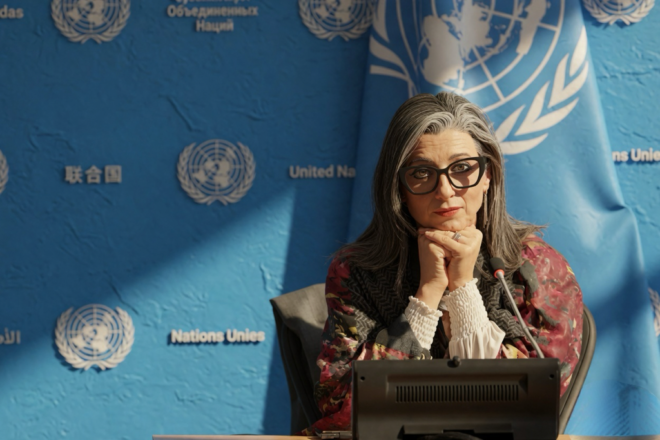
I. A Room Without Empathy
On 30 October 2024, Francesca Albanese – UN Special Rapporteur on the Occupied Palestinian Territories – stood before the General Assembly and said what those in power have spent the better part of a year conspiring to make unsayable. She said it plainly, without diplomatic cushioning, without the careful circumlocutions that allow the powerful to hear what they wish to hear. She asked the assembled representatives of the world’s nations a question that was also an indictment:
Is it possible that after forty-two thousand people have been killed, you cannot empathise with the Palestinians?
The silence that question was designed to expose is more eloquent than any answer the General Assembly might have offered. Forty-two thousand dead at the time she spoke. Not statistics. Not abstraction. Forty-two thousand human lives extinguished – many of them children, many of them sheltering in places the world told them were safe. By April 2026, the Gaza Health Ministry’s toll – corroborated by UNRWA and now accepted by the IDF itself as broadly accurate – had reached 72,315. A landmark household study published in The Lancet Global Health estimated 75,200 violent deaths by January 2025 alone, a figure 34.7 percent higher than the Ministry’s administrative records for the same period, suggesting those records represent a floor rather than a ceiling. Independent analyses of excess mortality place the true toll higher still.
But intellectual honesty – and Albanese herself would demand it – requires that we hold another number alongside this one before proceeding. On 7 October 2023, Hamas murdered 1,200 Israelis: civilians, elderly, children, young people at a music festival who had gathered to dance, not to die. Over 250 were taken hostage. The atrocities of that morning – at Kibbutz Be’eri, at the Nova festival, in the communities of the western Negev – were war crimes under any reading of international humanitarian law. Hamas bears primary responsibility for initiating this catastrophe, and no account of what followed is honest if it does not begin here.
International humanitarian law was built precisely to hold multiple parties simultaneously. It does not offer a hierarchy of victims. The obligation to protect civilian life, to apply proportionality, to permit humanitarian access – these bind all parties regardless of the conduct of their adversaries. What Albanese addressed in the General Assembly was the conduct that followed October 7: the forty-two thousand deaths in a territory of 2.3 million people, the conditions international legal bodies have determined meet the threshold for genocide findings, the silence of those with the power and the obligation to act. That argument stands on its own terms – and it stands more honestly when it does not require us to look away from where the catastrophe began.
This essay is not a neutral account of those events. It is a defence of Francesca Albanese and an argument that her voice represents something this moment desperately needs: the refusal of conscience to be silent when silence is complicity. But conscience, to mean anything, must be universal. It begins with the murdered Israelis and the hostages still in Gaza. And it does not end there.
II. The Logic of Sanction
Shortly before her address to the General Assembly, the United States imposed sanctions on Francesca Albanese. The ostensible charge was that she had worked with the International Criminal Court – a body the United States itself does not recognise, but whose authority it invokes with convenient selectivity when prosecuting adversaries. The real charge, she made clear, was something else entirely: she had reported faithfully on Israel’s violations of Palestinian human rights.
In a statement that deserves to be read as a kind of dark comedy of imperial self-revelation, the United States labelled this reporting ‘anti-Semitism.’
Let us be precise about what that means. A woman who has spent her career applying the frameworks of international humanitarian law – impartially, methodically, with the rigour of someone who understands that law either applies to everyone or protects no one – was designated by the most powerful government on earth as a figure equivalent in moral standing to Vladimir Putin, Bashar al-Assad, Ayatollah Ali Khamenei, and Nicolás Maduro. This is the company in which Washington placed the first UN Special Rapporteur in history to be sanctioned by the United States.
It is fair to note that Albanese has attracted scrutiny from within the human rights community itself – not only from Israel’s defenders. Some critics, including scholars who share her broader concerns about Gaza, have questioned the consistency of her framing and the degree to which a Rapporteur can maintain impartiality when the mandate is as politically charged as hers. These are legitimate professional questions, and a robust international human rights architecture benefits from asking them.
But a sanction is not scrutiny, and the US action is not accountability for perceived overreach. The United States does not recognise the ICC’s jurisdiction. It has not submitted itself to the Court. To sanction a UN official for working with an institution the US simultaneously invokes against adversaries and rejects when turned toward allies is not institutional accountability. It is the naked exercise of power to insulate a strategic partner from international legal scrutiny. The chilling effect is the point: every future Rapporteur now knows that faithful application of their mandate to a US ally carries the risk of personal sanction. That is an assault on the international human rights architecture, not a defence of it.
The absurdity would be comic if the stakes were not so grave. But the stakes are grave, and the absurdity is purposeful. Those who have studied how settler colonial states manage their own critics – and this writer, Wiradjuri, knows something of that management – will recognise the structure immediately. Delegitimise the reporter. Impugn the motive. Make the act of documentation itself the crime. The mechanisms change. The basic structure does not.
III. Obligation, Not Charity
There is a phrase in Albanese’s address that cuts to the moral heart of the matter, and it is a phrase that ought to be understood not merely as rhetoric but as law: ‘This is not about charity towards the Palestinians. This is about your obligations.’
Obligation. It is a word the international community has learned to flee. Charity is comfortable – it positions the powerful as benevolent, the suffering as grateful recipients, the relationship as voluntary. Obligation is not comfortable. It demands. It holds. It does not permit the comfortable exit of deciding that the suffering is, on balance, too politically complex to address.
The obligations flow in all directions. They bind Hamas: the deliberate targeting of civilians, the taking of hostages, the use of civilian infrastructure as military cover – these are war crimes, condemned without qualification by the same international law that governs Israel’s conduct. No cause, however legitimate its underlying grievance, transforms that fact. The Geneva Conventions are not a menu from which parties select the provisions they prefer.
They bind Israel equally: military necessity does not dissolve the obligation to protect civilian life, to maintain proportionality, to permit humanitarian access. The urban warfare context is genuinely complex – no serious analyst denies that Hamas’s tactical choices have forced Israel into devastating dilemmas. But complexity is not absolution. The International Court of Justice, in its January 2024 provisional measures ruling, found it plausible that Israel’s conduct in Gaza could constitute genocide – a threshold finding that does not prejudge the ultimate outcome but carries its own legal weight, and which cannot be dismissed by anyone who takes international law seriously.
And the obligations bind third-party states – including the United States. The Genocide Convention imposes active duties of prevention. It does not permit the comfortable exit of deciding that the situation is too politically complex to address. The conventions Albanese invokes exist precisely because the world looked at the industrialised murder of the Jewish people and said: never again. Not never again when convenient. Not never again unless the perpetrator is a strategic ally. Never again.
IV. The Tradition She Stands In
It is worth pausing to consider who Francesca Albanese is and what she represents – not as an individual, but as an embodiment of a tradition. The tradition of independent international human rights monitoring exists because the world’s powers cannot be trusted to monitor themselves. It exists because the history of the twentieth century demonstrated, repeatedly, that states will deny, minimise, and actively obstruct accounting for their own conduct. The Special Rapporteur system – imperfect, under-resourced, often ignored – is one of the few mechanisms by which that tradition is institutionally preserved.
Albanese has not deviated from her mandate. She has done exactly what the Human Rights Council appointed her to do: document, analyse, and report. She has done so under conditions of extraordinary pressure, facing an organised campaign of harassment, death threats, and now the extraordinary step of US sanctions. She has not moderated her findings to placate powerful states. She has not softened her language to preserve her access to diplomatic circles. She has, in the most literal sense, spoken truth to power.
The tradition she stands in includes figures across history who have faced exactly this kind of response – the declaration that their truth-telling constitutes a form of aggression, their documentation a form of incitement. It is a tradition this publication knows from the inside. The experience of Indigenous advocacy in this country – the experience of being told that naming dispossession is divisive, that documenting police violence is anti-Australian, that insisting on treaty is a provocation – maps directly onto what Albanese faces. The tactics are not new. They are the standard repertoire of those who need impunity to remain comfortable.
V. What Empathy Demands
‘Empathy is the glue that makes us stand united as humanity.’ It is easy, reading that line, to hear it as sentiment. But Albanese is not a sentimentalist. She is a lawyer and a scholar. When she invokes empathy in the General Assembly, she is not making an appeal to feeling as a substitute for law. She is making an argument about the preconditions of law – about what must be present in a political community before legal obligations can be meaningfully discharged.
And if empathy is universal – as the argument requires it to be – then it cannot flow in only one direction. It must encompass the families of those murdered on 7 October alongside the families burying their dead in Gaza. It must be capable of grieving both without subordinating one to the other. Empathy deployed selectively is not the glue Albanese describes. It is partisanship wearing philosophy’s clothes – and it ultimately weakens the very argument it claims to advance.
Law without empathy is not law. It is procedure – a system of forms and motions that can be observed while the substance it is meant to protect is destroyed. What Albanese saw in the General Assembly on 30 October 2024 was procedure without empathy: nations going through the motions of international engagement while a civilian population was subjected to conditions that international legal bodies have determined meet the threshold of genocide.
To call for empathy in this context is to call for something more demanding than sentiment. It is to call for the recognition that Palestinian lives are lives – absolutely and without qualification. It is equally to call for the recognition that Israeli lives are lives, that the terror of October 7 was real, that the hostages still in Gaza are human beings whose return matters. The architecture of international human rights law was built on the understanding that both propositions are true simultaneously. That is not a compromise position. It is the only position from which genuine progress – ceasefire, hostage release, accountability for all parties, and ultimately a political horizon that makes recurrence less likely – becomes possible.
VI. The Disservice to Jewish People
There is one dimension of this that demands explicit attention, because it is so cynical and so damaging: the weaponisation of antisemitism accusations against Albanese.
Antisemitism accusations must be evidence-based. Albanese has made statements that have drawn legitimate criticism – language that some, including Jewish scholars who share her broader concerns about Gaza, have found poorly calibrated. The line between criticism of Israeli state conduct and rhetoric that slides toward antisemitic tropes is real, and it requires vigilance. Dismissing all such concerns as bad faith would be as intellectually dishonest as deploying the accusation reflexively.
But the US framing – that Albanese’s reporting on Palestinian human rights constitutes antisemitism – is not evidence-based application of that standard. It is the standard’s negation. It takes a concept built to protect Jewish people from genuine hatred and redeploys it as a diplomatic instrument to shield state conduct from scrutiny. As Albanese herself observed, this ‘does a grave disservice to Jewish people worldwide.’
It does so because it suggests that Jewish identity can have only one permissible political expression. This erases the substantial body of Jewish thought – in Israel, in the diaspora, in the academy – that has engaged critically with occupation policy and with the conduct of this war. Jewish voices for Palestinian rights are not marginal. They are part of a long and serious tradition. To label their concerns antisemitic is not protection of Jewish people. It is the instrumentalisation of Jewish suffering for political purposes.
Antisemitism is a real and lethal danger. It has claimed lives. It is embedded in institutions and movements across the political spectrum. It deserves a standard that means something. The United States, in applying that label to a UN Rapporteur’s human rights documentation, has worked actively to degrade that standard – and a degraded standard of antisemitism is, ultimately, a gift to actual antisemites.
VII. What Remains
Francesca Albanese will survive the sanctions. She has said she will not be silenced, and she has demonstrated in every year of her tenure that this is not merely a declaration of intent but a description of her character. The documentation she has produced – meticulous, legally grounded, internationally recognised – will not be erased by a US Treasury designation.
But what the sanctions reveal cannot be un-revealed. They reveal that the most powerful state in the international system is prepared to deploy the mechanisms of economic coercion against individuals whose only offence is faithful adherence to their mandate. They reveal that ‘anti-Semitism’ has been weaponised so aggressively that it is now applied to UN officials for documenting human rights violations. And they reveal the profound bankruptcy of a foreign policy that asks the world to respect a rules-based international order while exempting its allies from the rules.
The path forward from this catastrophe – if there is one – runs through accountability applied without exception: for Hamas’s crimes on 7 October and after, for Israeli military conduct that has produced civilian casualties on a scale international legal bodies have found potentially genocidal, for great powers that manage accountability for others while granting themselves exemption. It runs through the return of every hostage still in Gaza. It runs through ceasefires, through humanitarian corridors, through the long and painful political work of building a framework in which Israelis and Palestinians can both live without the permanent threat of annihilation.
This publication stands, without reservation, with Francesca Albanese. Not because we agree with every word she has written, but because what she represents – the principle that accountability is universal, that law applies to everyone, that more than 72,000 dead Palestinians deserve the same moral recognition as any other 72,000 human beings – is the principle on which any liveable future must be built. The Lancet’s independent estimate, and UNRWA’s ongoing documentation, suggest the true number is higher still. That principle began with 1,200 murdered Israelis. It does not end there. It cannot, and still call itself principle.
Empathy is the glue. Conscience that negotiates with impunity is not conscience. And conscience that applies only to the victims it finds convenient is, in the end, just another name for power.
– – –
Bakchos is the founder of Blak and Black, an Australian media and advocacy platform established in 2010. Bakchos writes from the intersecting perspectives of Wiradjuri heritage, Jewish identity, and humanism.
© Bakchos, May 2026




This is a genuinely good essay. It is doing something difficult — making a passionate argument while maintaining analytical discipline — and it mostly succeeds. The opening question from Albanese’s address is an excellent anchor, and the closing formulation earns its aphoristic quality because the preceding argument has done the work to justify it.
The statistical material in Section I is used responsibly, and flagging the Ministry figures as a floor rather than ceiling is intellectually honest. One small note: the essay moves fairly rapidly from October 7 casualty figures to Gaza casualty figures without fully dwelling on the 250 hostages still in Gaza (at that moment). Their return is mentioned in the closing sections but feels slightly underweighted given how heavily the piece leans on the universality of empathy.
This is such a contrast to yesterday’s reflection on bureaucracy. Francesca Albanese is the complete opposite, an office holder who carries the weight of her position with such integrity it puts every bureaucrat to shame. She is fierce and brave. I’ve had few heroes through my years, but she comes pretty close.
Watershedd, Francesca Albanese is definitely one of the shining heroes of humanity. A humanist star in the 21st century.
Powerful post Bakchos, just a few quibbles. The genocide framing is another point of tension. Albanese and the essay use the term; the ICJ found only plausibility at the provisional stage. The full case remains unresolved. Reasonable analysts disagree sharply on whether Israel’s actions meet the legal threshold (specific intent to destroy the group in whole or part) versus constituting war crimes or disproportionate force in urban warfare against an enemy embedding itself among civilians. The essay treats the “threshold” language as near-settled; it is contested.
Bill, Bakchos is right. The strongest sections are IV–VII, where the author links Albanese’s predicament to broader patterns of power insulating itself from scrutiny (a theme resonant with Indigenous Australian experience) and warns that weaponizing antisemitism accusations ultimately harms Jewish safety by diluting the term. The closing insistence that principle “began with 1,200 murdered Israelis. It does not end there” is principled and necessary. The critique of charity-versus-obligation and the call for empathy as precondition for law are philosophically serious.
In a moment when both Israeli and Palestinian civilians have paid horrific prices, essays that insist accountability must be universal—as this one does—are valuable, even when imperfect. The author’s closing line is worth repeating: “Conscience that applies only to the victims it finds convenient is, in the end, just another name for power.” That principle cuts in every direction.
FFF for all civilised people, conscience has to travel equally in all directions. That’s ultimately the point of civilisation.
This is a genuinely good essay. It is doing something difficult — making a passionate argument while maintaining analytical discipline — and it mostly succeeds. The opening question from Albanese’s address is an excellent anchor, and the closing formulation earns its aphoristic quality because the preceding argument has done the work to justify it.